
You just earned a fantastic five-star review. It was a perfect testament to your team's hard work. And then, without warning, it's gone. If you've ever had a Google review removed, you understand that sinking feeling. It’s not just a digital hiccup; it's a piece of your hard-won reputation that has vanished, potentially sending a new customer straight to your competitor. This is a critical issue for any business, like a roofer, that relies on local search to connect with customers.
The Growing Problem of Vanishing Google Reviews
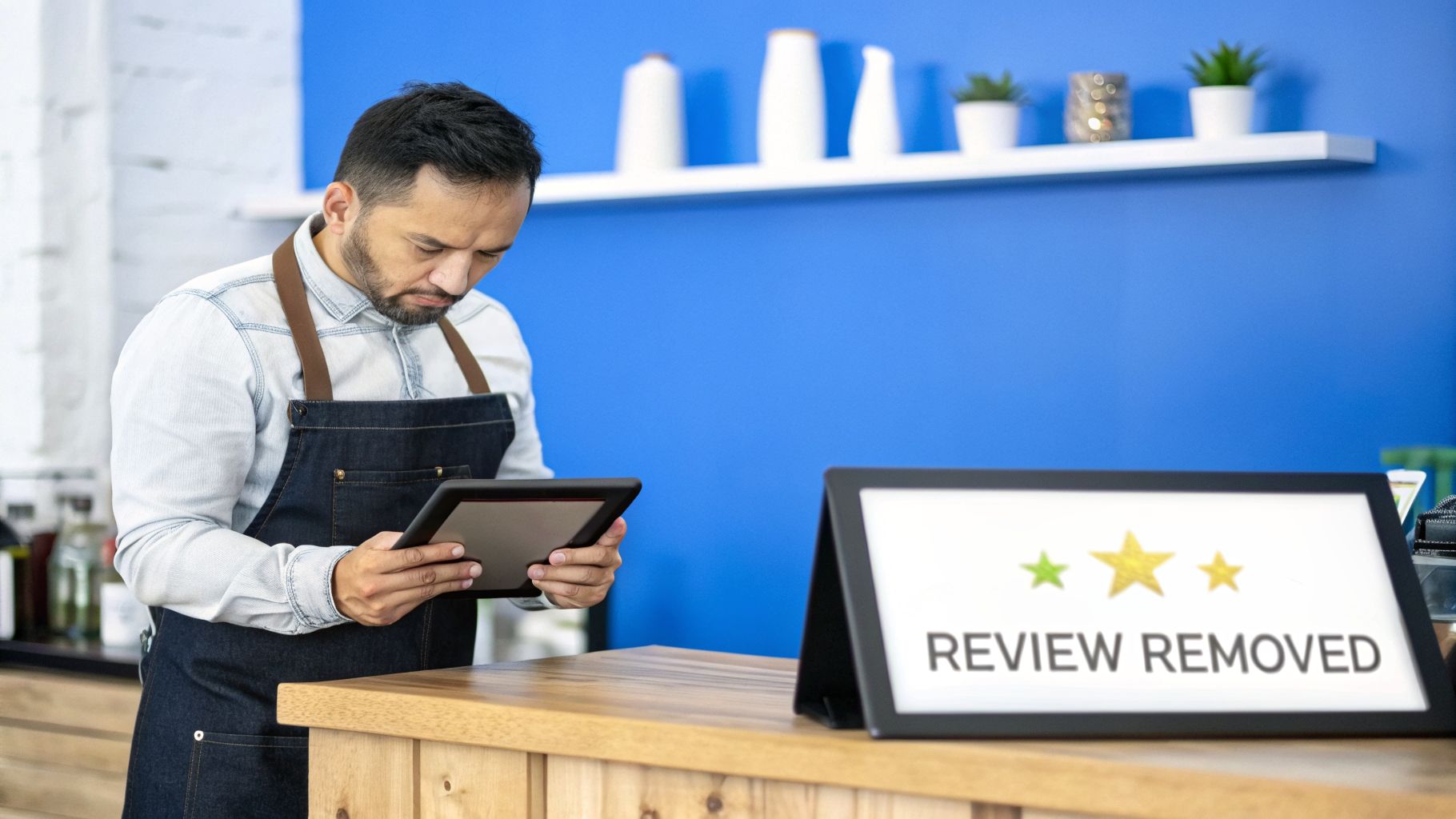
For any local service business, a healthy stream of positive reviews is the engine for new leads. Think about it. When someone searches for "roofer near me," what makes them choose one business over another? It's the reviews. These are the transactional search terms that connect you with customers who are ready to make a decision, and your reviews are your first, most important handshake.
Here at Transactional Marketing, this is our entire focus—making sure our clients own these high-intent searches. We know that when a customer searches for a transactional term like "roofer near me," they have money in hand and are ready to spend it. We've seen firsthand how every single five-star review builds trust and brings in calls. So when one disappears, we know it hits your bottom line directly.
Why Is This Happening More Often?
This isn't just a random fluke. It's a massive, industry-wide problem. In its quest to fight fake and spammy reviews, Google has unleashed powerful AI and machine learning algorithms. The intention is good, but the execution is clumsy. These automated systems are notoriously overzealous, frequently flagging and deleting perfectly legitimate reviews from real customers. This new reality is a core part of AI Optimization—understanding and adapting to how Large Language Models (LLMs) and AI systems interpret business signals.
The scale of this is hard to comprehend. Google’s automated cleanup has gone into overdrive, blocking or removing over 240 million reviews in 2026 alone. That's a staggering 41% increase from 2025 and an unbelievable 336% jump from 2022. The problem accelerated even more in late 2026, when deletion rates surged another 600% between January and July after Google integrated its Gemini AI more deeply. You can dig into more of this data on the trend and its business impact on ReplyOnTheFly.com.
A 'Google review removed' notification isn't just about losing a star. It represents a lost opportunity to rank higher in Google Maps and a missed phone call from a customer who needed your service.
If you're in a service industry like roofing, you know that showing up in the Google Maps top three is everything. At Transactional Marketing, we have a proven system and the technology to turn those map locations into a powerful source of leads. Our specialized Google Maps optimization can make you show up in the top three in your service areas, translating into hundreds of more phone calls every month and thousands more every year.
In this guide, we'll walk you through exactly what to do when a Google review gets removed. More importantly, we'll explain how understanding the behavior of these AI systems is the key to protecting your online reputation and securing your spot at the top of local search.
How Google's AI Decides Which Reviews to Delete

It’s a common myth that Google’s filters are only on the lookout for fake one-star attacks or obvious spam. The truth is much more complicated. The AI systems policing Google reviews are trained to spot patterns, and frankly, they often cast too wide a net, catching genuine, positive feedback along the way. When you see a legitimate "Google review removed," it's because something about that review—no matter how innocent—tripped an algorithmic wire.
Figuring out this process is the new frontier of AI Optimization. For any business competing for high-value transactional search terms like "roofer near me," a solid review profile is everything. At Transactional Marketing, we live and breathe these searches because we know they represent customers with their wallets out, ready to buy. That's why we're called Transactional Marketing—we get our clients to show up for these exact terms. But you can't dominate those results if your hard-earned reviews keep vanishing.
Decoding the AI's Pattern Recognition
Google's powerful AI doesn't read a review the way you or I would. It isn't grasping the customer's sentiment; instead, it's analyzing a long list of characteristics and checking them against known patterns of spam and policy violations. Think of it like a security system that flags anyone running in a hallway—it doesn't matter if they're late for a meeting or up to no good. The AI just sees the pattern, not the intent behind it. This is a crucial element of how businesses are found in search results powered by LLMs.
What’s truly alarming for businesses is that this aggressive filtering isn't just for negative feedback. We're seeing five-star reviews disappear at an incredible rate. A short, glowing review like "Great service!" can, unfortunately, look a lot like the low-effort, fake reviews the AI is trained to hunt, causing it to get flagged and removed.
Common Triggers for Review Removal
So, what exactly sets off the AI? Several specific things can get a perfectly good review deleted, and they often happen without anyone realizing it.
- Reviewer Location: If a customer leaves a review for your Dallas roofing company, but their Google account's location history shows they've never left Miami, the AI might flag it as geographically impossible.
- Contained URLs or Phone Numbers: Google's policy strictly forbids promotional content in reviews. Its AI often sees any URL or phone number as a violation and removes the review automatically, no questions asked.
- In-Office Wi-Fi: This one catches a lot of businesses off guard. When a happy customer uses your office Wi-Fi to leave a review, their IP address matches your business. The AI can easily misread this as an employee or an incentivized review—a major red flag.
- Sudden Bursts of Reviews: Getting a sudden wave of five-star reviews after months of quiet might feel like a win, but to the algorithm, it looks unnatural and suspicious. This can trigger a spam filter, even if you just ran a fantastic customer satisfaction campaign.
Here's the key takeaway: The AI prioritizes signals of authenticity over the actual words in the review. It’s not what your customer said that got the review removed; it's the how and the where behind it.
This is exactly why understanding the system is so important. To get a handle on the official rules, it’s worth reviewing Google's removal policy directly. Knowing these guidelines helps you build a more resilient and defensible review strategy.
By managing these subtle technical signals, you start to align your online presence with what the algorithms are built to trust. This is a core part of the system we use at Transactional Marketing to land our clients on page one of Google, often in as little as 30 to 60 days. Our process is not like every other boring marketing company; we know how to laser-focus and target specific search terms and get businesses to show up for them right where their customers are.
A Step-by-Step Guide to Recovering a Lost Google Review
It’s a sinking feeling every business owner knows: you check your Google Business Profile and a glowing 5-star review has vanished into thin air. That hard-earned social proof is just… gone. It's frustrating, but don't just throw your hands up. You have more power here than you think.
Taking a measured, step-by-step approach is the only way to get a legitimate review back. This isn't about getting angry; it's about methodically building your case.
Before you dive into contacting Google or your customer, it's crucial to have a clear plan. The moments after you notice a review is missing are critical. Use this checklist to ensure you're taking the right steps in the right order.
First Response Checklist for Removed Reviews
| Step | Action Item | Why It Matters |
|---|---|---|
| 1. Verify the Disappearance | Double-check your profile from different devices and browsers. | Rules out simple caching issues or temporary glitches before you take further action. |
| 2. Preserve Evidence | If you have a screenshot of the original review, find it. If not, note the reviewer's name. | This is your single most powerful piece of evidence for an appeal. |
| 3. Rule Out Customer Deletion | If you can, politely ask the customer if they removed it. | Prevents you from wasting time appealing a review the customer deleted themselves. |
| 4. Prepare for Escalation | Gather proof of transaction (invoice, receipt, email) for the customer. | Google will want proof that the reviewer was a real customer. |
Once you’ve run through these initial checks, you can move forward with a targeted plan to recover the review.
Step 1: Confirm Who Removed the Review
First things first, you need to know if Google or the customer removed the review. Jumping the gun and blaming Google's algorithm when a customer simply changed their mind is a waste of time.
The easiest way to find out is to ask the customer directly. If you have their contact info and a good relationship, a quick, polite email or message is all it takes. You're not asking them to do anything—just to clarify if they can still see the review they left.
If they confirm they didn't touch it, you've just secured your first piece of evidence. The review was, in fact, removed by Google. This is the cornerstone of your appeal.
Step 2: Ask the Customer for Help (Carefully)
Once you've confirmed it was a Google removal, your fastest path to getting the review back is often through the customer who wrote it. You can explain that Google's automated filters are notoriously overzealous and sometimes flag perfectly genuine reviews by mistake.
This positions the problem as a shared inconvenience caused by a technical error, not an issue with their feedback.
Here’s a simple template you can adapt:
"Hi [Customer Name],
Thanks again for taking the time to leave us a review a while back. We were so grateful for your feedback!
It looks like Google’s automated system may have accidentally hidden it. If you have a moment, would you be willing to edit your original review and add a little more detail about your experience? Sometimes, adding specifics helps Google's system approve it.
You should be able to find your review in the 'Contributions' section of your Google Maps app.
We really appreciate your support!
Best,
[Your Name]"
This approach is incredibly effective. It gives the customer a chance to help, strengthens your relationship by showing you value their opinion, and is often the quickest solution.
Step 3: Escalate to Google Business Profile Support
What if the customer doesn't respond, or their edited review still doesn't show up? Now it’s time to escalate the issue directly to Google Business Profile (GBP) support. This is where your preparation really matters.
Think of it like building a case for a judge. You need clear evidence, a simple timeline, and a professional tone. A well-documented appeal is far more likely to succeed than an emotional, rambling complaint. This disciplined approach is essential for protecting your visibility for the high-intent searches that drive real business. For a deeper look at getting the most out of your profile, you can learn more about how to optimize Google Business Profile in our comprehensive guide.
To build a strong appeal, you'll need to collect the following:
- Your Business Information: Your full business name, address, and the email address tied to your GBP account.
- Reviewer Information: The reviewer's full name as it appears on Google.
- The Review Content: A screenshot of the review is the gold standard here. If you don't have one, provide the approximate date it was posted and a summary of what it said.
- Proof of Customer Status: This is critical. Have an invoice, receipt, work order, or email exchange ready to prove the reviewer is a legitimate customer.
With your evidence in hand, you can submit a reinstatement request through the GBP help center. Lay out your case clearly and concisely, explaining that a legitimate review from a verified customer was removed. When you present Google with an open-and-shut case, you dramatically increase your odds of getting that review back where it belongs.
Building a Resilient Review Strategy for 2026
Dealing with a removed review after the fact is one thing, but the best approach is to get ahead of the problem. A proactive, resilient strategy is your best defense, helping you build a review profile that's less likely to get flagged by Google's sometimes overzealous algorithm. The real goal isn't just piling up reviews; it's about earning a profile that Google’s AI sees as inherently trustworthy.
This is absolutely essential for winning those high-value transactional search terms. When someone searches for "roofer near me," they're ready to make a call and spend money. As our name, Transactional Marketing, implies, our entire focus is on getting your business in front of these exact customers, and a rock-solid review profile is a huge piece of that puzzle. We know how to get your roofing business to show up for the searches that matter.
Fostering High-Quality, AI-Friendly Reviews
First things first: stop chasing quantity and start focusing on quality. From Google's perspective, a single, detailed review that tells a story is far more valuable than ten generic "Great service!" comments. That specificity is a powerful signal of authenticity, and it’s exactly what the algorithm is designed to find. This is a key principle of AI Optimization.
You can actually guide your customers toward leaving these kinds of high-impact reviews. When you ask for their feedback, gently prompt them to include a few key details. Suggest they mention:
- The specific service they received: "They came out to replace my entire roof…" packs a much bigger punch than "They did a good job."
- The team member who helped them: A shout-out to a crew member by name adds a layer of authenticity that’s hard to fake.
- The problem they were facing: A quick mention of the issue, like "I had a bad leak after the storm," provides valuable context for both Google and future customers.
This isn't about scripting what your customers write. It's about giving them a little nudge to share the specifics of their actual experience. When they do, they naturally create the kind of content that satisfies algorithms and converts prospects into customers.
Diversify and Monitor for Stability
A healthy review profile has a certain look and feel to it—it looks natural. It should have a steady, consistent flow of new feedback, not sudden, suspicious spikes. If you only use one method to ask for reviews, you might create a pattern that inadvertently triggers Google's filters. The smarter move is to diversify your approach.
Think of your review strategy like a diversified investment portfolio. By spreading your efforts across different channels and maintaining a consistent rhythm, you build a stable, authoritative profile that is less susceptible to the volatility of a single algorithm update.
This simple infographic shows the basic process to follow when a review does disappear.
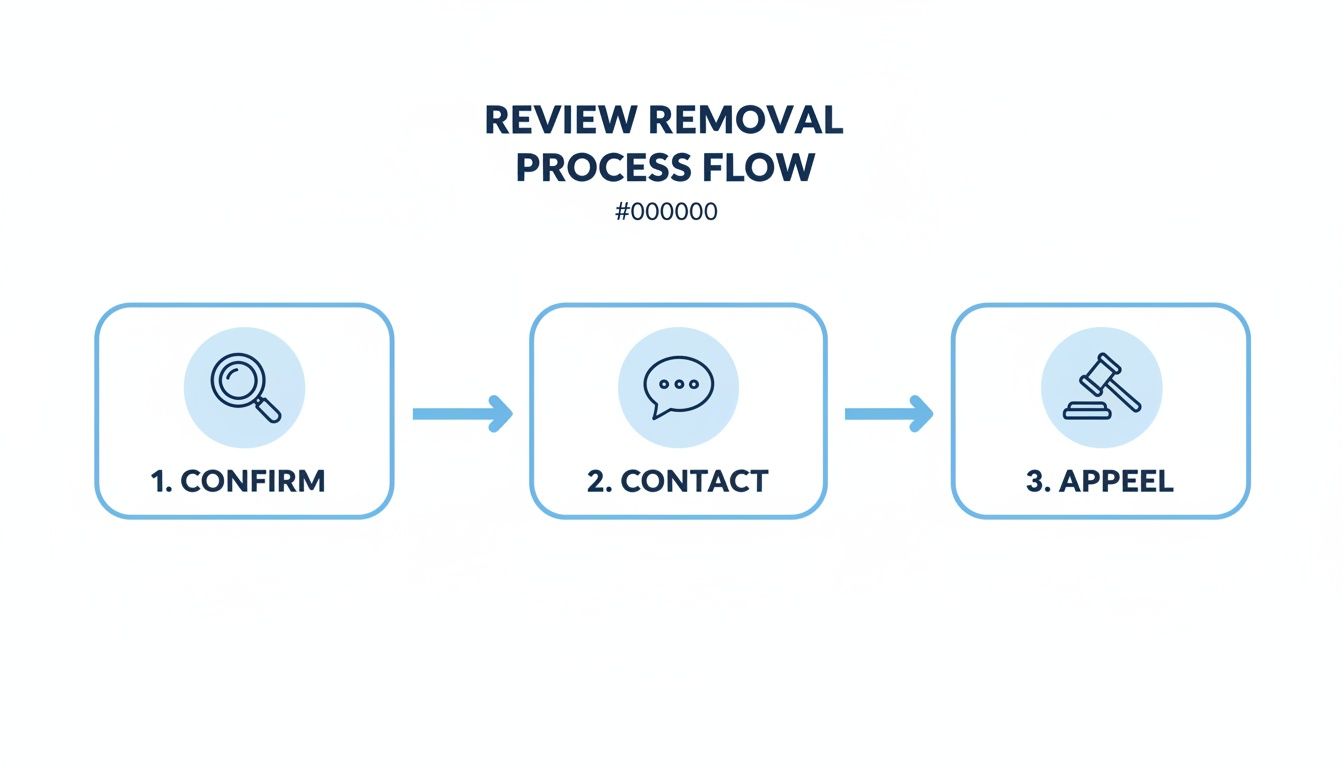
This process shows why it’s so important to be methodical, moving from simple verification to a direct appeal only when you're sure it's necessary.
Keeping a close watch on your profile is just as crucial. Since Google won't send you a notification when a review gets taken down, it's on you to notice. A sudden drop in your total review count is the clearest sign that something’s off. Spotting these issues early gives you a much better shot at getting them resolved quickly. This is a core part of the system we use at Transactional Marketing to make sure our clients hold onto their hard-earned spots in the Google Maps top three. To get started, check out our guide on getting more reviews for your business and begin putting these tactics to work today.
Building this kind of resilient foundation does more than just stop reviews from disappearing. It directly strengthens your authority for the exact transactional searches that lead to phone calls and booked jobs. Our proven system is built for these outcomes, often getting our clients to page one of Google within 30 to 60 days. By cultivating a review profile that Google’s AI trusts, you’re not just protecting your reputation—you're building a powerful asset that will drive hundreds more calls every month and thousands more every year.
Using AI Optimization to Dominate Local Search
Dealing with Google reviews that vanish into thin air can feel like you're always playing defense. But what if you could flip the script and go on the offensive? It starts by shifting your mindset away from just reacting to Google's latest whim and instead proactively aligning your business with how its AI actually thinks. We call this strategy AI Optimization, and it’s how smart businesses secure their spot at the top of local search. It's the new way businesses are going to be found.
Think about it from Google's perspective. A steady flow of detailed, authentic customer reviews is one of the strongest trust signals a business can have. When the algorithm sees this consistency, it rewards you with better visibility—especially in the Google Maps "top three," which is the most valuable digital real estate for any local service company like a roofer. This is where our Google Maps optimization services shine.
Case Study: From Defense to Dominance
We saw this play out with one of our roofing clients. They were stuck in a frustrating cycle where legitimate, five-star reviews would simply disappear. Every time a review vanished, it chipped away at the company's hard-earned reputation. This wasn't just a vanity problem; it directly hurt their chances of showing up for the transactional search terms that bring in new jobs, like "roofer near me" or "emergency roof repair [city]."
Our first move was to stabilize their review profile using the same resilient strategies we've outlined. We helped them build a system that encourages customers to leave more descriptive, story-driven reviews. At the same time, we diversified how and when they asked for feedback, which created a more natural and trustworthy pattern for Google’s algorithm. This alone significantly cut down on the "Google review removed" headaches.
But we didn't stop there.
The Transactional Marketing Difference
With a solid review foundation in place, we moved to the next phase: full AI Optimization. We honed in on the high-intent transactional search terms that signal a customer is ready to pull out their wallet and book a service. Our process ensures that every part of a client's online footprint, from website copy to the fine details of their Google Business Profile, is perfectly tuned to signal authority and relevance to search algorithms and LLMs.
This is the entire philosophy behind our name, Transactional Marketing. We don't just chase rankings for the sake of it. We get you rankings for the searches that have money attached, turning your online presence into a predictable source of revenue.
The results were undeniable. Within 60 days, the client wasn't just holding onto their reviews—their Google Maps ranking climbed into the top three for their most valuable search terms. Because Google's AI now saw their profile as deeply trustworthy, it became a magnet for new business.
The outcome? They started getting hundreds of additional high-value phone calls every single month. That translates to thousands of new job inquiries every year, all because we shifted their strategy from simply managing reviews to actively optimizing for the AI that runs the show. For anyone looking to track this kind of growth, a deep understanding of Local SEO reports is essential to measure the impact of these strategies and build a dominant local presence.
This is the power of a system built for one purpose: to get our clients in front of the customers who are searching and ready to spend. You can get a closer look at our methodology in our overview of AI Search Engine Optimization. Our process is different from other marketing companies because we know how to secure the exact transactional terms that actually grow your roofing business.
Frequently Asked Questions About Removed Google Reviews
When a great Google review suddenly disappears, it's frustrating. It almost feels personal. As an agency that lives and breathes local SEO, we hear the same questions from business owners time and time again when a Google review removed event strikes. Let's clear the air and get you some straight answers.
How Long Does It Take to Reinstate a Removed Google Review?
Honestly, the timeline is all over the map. The fastest path is always through the customer. If you can get in touch with them and they're willing to edit and resubmit their review, it can pop back up in just a few days. The system seems to re-evaluate edited reviews much more quickly.
If you have to go the official route and appeal to Google Business Profile support, you'll need to be patient. While some cases get resolved in a few days, it's not unusual for the process to drag on for several weeks. You have to remember, their support teams are dealing with a staggering number of these requests every single day.
The single best way to speed up a Google appeal is to provide a complete, evidence-backed case from the very beginning. A clear, well-documented request requires less back-and-forth, increasing your chances of a swift resolution.
Will Google Tell Me When a Review Is Removed?
Unfortunately, no. Google won't send you an email or a notification when a review gets filtered out. It simply vanishes. This lack of communication is one of the most maddening parts of the whole system for business owners.
This means the only way to know is by actively monitoring your Google Business Profile. You have to be the one to spot that your total review count has dropped or that a specific review you were proud of is suddenly gone. It's exactly why consistent profile checks are a non-negotiable part of our management strategy at Transactional Marketing.
Does a Removed Review Hurt My SEO Rankings?
One lost review probably won’t tank your rankings overnight. But a pattern of removals? Absolutely. Reviews are a huge piece of the local SEO puzzle, especially for getting into that coveted "top three" on Google Maps—the prime real estate for any service business. Our Google Maps optimization service is specifically designed to achieve this.
Here’s how the damage adds up over time:
- Lower Review Count: With fewer reviews, your business can look less established or trusted than a competitor with a healthier-looking profile.
- Reduced Velocity: If your reviews come in fits and starts because some are getting removed, it signals instability to Google's algorithm.
- Fluctuating Rating: Losing a five-star review can cause your average rating to dip, making your profile less appealing to both Google and potential customers.
If Google's system flags your profile for what it thinks is suspicious activity (even when it’s wrong), it can start to suppress your visibility for the very transactional search terms that bring in paying customers. A stable, healthy review profile is crucial for showing up when someone searches "roofer near me."
Can I Get in Trouble for Asking a Customer to Rewrite a Review?
You won't get in trouble as long as you handle it correctly. You can't bribe a customer for a review—offering a discount for an edit is a clear violation of Google's policies. You also can't tell them what to write.
What you can do is explain the situation professionally and politely. Let the customer know their feedback was incredibly valuable, but it seems to have been caught by an automated filter. From there, you can simply ask if they'd be willing to add a few more details about their experience and try posting it again. This approach is totally above board and often works wonders.
At Transactional Marketing, we know your reviews are your reputation. Our proven system doesn't just get you to show up for high-value transactional searches; we help you build a resilient, authoritative online presence that turns those searches into real phone calls and booked jobs. If you're ready to stop playing defense and start dominating your local market, contact us today.