


Think of a content marketing strategy as your game plan for turning online searches into actual, paying customers. For a local service business, this isn't about writing random blog posts. It's about creating laser-focused content that answers the exact questions your ideal customers are asking right when they're ready to hire someone. Specifically, it's about dominating the transactional search terms that connect your business with customers who have money in hand, ready to spend.
This approach, which we specialize in at Transactional Marketing, builds trust from the very first click, making your business the go-to choice the moment a customer is ready to spend.
What Is a Transactional Content Marketing Strategy?

When we talk about a content strategy for a local service company, we’re moving past the fluffy, generic articles you see everywhere. We’re building a system designed to dominate the transactional search terms that people use when they have a problem and money in hand. This is the core philosophy at Transactional Marketing—getting our clients to show up for searches like "roofer near me" or "dentist near me." These are the searches that drive immediate business.
Let’s use a real-world example. A homeowner might start by Googling "signs of a burst pipe." A powerful content strategy makes sure your plumbing company provides that first answer. By helping them diagnose the problem, you immediately build authority. So when that search escalates to "emergency plumber near me," you’re already the trusted expert they know. That's the core idea behind Transactional Marketing.
Moving Beyond Brand Awareness to Driving Calls
The old-school approach to content marketing focused on casting a wide net, hoping to catch a few leads. The modern, transactional approach is far more direct and effective. It's a complete system built to generate phone calls and form fills, not just website visitors.
The table below breaks down the key differences between these two philosophies.
Transactional vs Traditional Content Marketing
| Core Element | Traditional Content Marketing | Transactional Content Marketing |
|---|---|---|
| Primary Goal | Build brand awareness over time | Generate immediate, qualified leads and phone calls |
| Audience Focus | Broad audience, often "top of funnel" researchers | Hyper-local customers with urgent, high-intent needs |
| Key Metrics | Website traffic, social shares, time on page | Phone calls, booked jobs, form submissions, revenue |
| Content Topics | General industry topics, "how-to" guides for DIYers | Answers to "buyer-intent" questions ("cost of…", "near me") |
| SEO Strategy | Ranks for broad, informational keywords | Dominates local, high-value transactional keywords |
| Business Impact | A slow burn that may or may not lead to sales | A direct pipeline from search engine to paying customer |
As you can see, the transactional model is built for one thing: getting your phone to ring. It connects content directly to the services that make you money.
It’s a System, Not Just a Blog
A truly effective strategy integrates several moving parts. It's not enough to just write good articles; you need to make sure the right people see them. This often requires a combination of expert SEO and Content Marketing Services.
A winning transactional strategy always includes:
- Local SEO: Dialing in your website to rank for city and neighborhood-specific transactional searches, ensuring you show up first for local customers ready to buy.
- Google Maps Optimization: Actively managing and improving your Google Business Profile to land in the Map Pack, which translates into hundreds of more phone calls every month.
- AI Optimization: Structuring your content to be easily understood and surfaced by AI assistants and LLMs when people ask for recommendations for services like yours.
At Transactional Marketing, our proven system is engineered to get your website on the first page of Google, often within 30 to 60 days. We don't chase vanity metrics; we laser-focus on the specific transactional search terms that bring you paying customers right in your local city.
This targeted approach turns your website from a simple online brochure into a customer-generating machine. Instead of attracting casual browsers, you create a direct pipeline to people who need your services right now, like those searching "air conditioning repair near me." It's exactly how we grow local businesses and hit revenue goals.
To see how this all comes together, check out our complete guide on internet marketing for local businesses. The goal is simple: make your business the most visible and credible option the instant a potential customer decides it's time to buy.
The Pillars of a High-Impact Local Content Strategy

For a local service business, a truly effective content strategy is built on a few core principles. Think of them as pillars supporting your entire digital marketing structure. If one is weak, the whole thing gets shaky. When they work in harmony, they transform your website from a static online brochure into a machine that consistently brings in new customers.
The end game is simple: connect with a potential customer right when they’re searching for your services and convince them to pick up the phone. We’re talking about transactional terms—searches like "air conditioning repair near me" or "emergency dentist in Dallas." To win that click and that call, your strategy needs to be deliberate, measurable, and laser-focused on your specific service area.
Knowing Your Audience's Urgent Problems
The first and most critical pillar is understanding your audience on a deeper level. This isn’t about general demographics. For a strategy focused on immediate transactions, you have to get inside the head of someone with an urgent, often stressful, problem to solve.
A homeowner in the middle of a July heatwave isn’t casually browsing "HVAC system components." They’re frantically typing "why is my AC blowing hot air" into their phone. Likewise, a parent whose child just chipped a tooth at the park isn't researching "dental crown materials." They're looking for "same-day tooth repair for child."
By focusing on the problem and the urgency driving the search, your content instantly connects with a customer who needs a solution now. You're not just providing information; you're offering a lifeline at their precise moment of need. This is the essence of capturing transactional searches.
Setting Goals That Drive Revenue
Next, you need to shift your thinking from broad marketing fluff to tangible business outcomes. Chasing "more website traffic" is a classic vanity metric—it looks good on a report but doesn't necessarily pay the bills. A transactional content strategy is judged by one thing: its direct impact on your bottom line.
This means setting specific, measurable goals. Instead of just aiming for more site visitors, we set targets that actually move the needle:
- Increase inbound calls for "roof repair" by 25 per month.
- Generate 15 qualified leads for "pest control services" through the website contact form.
- Book 10 new patient appointments for "emergency dental care" each week.
These kinds of goals give every piece of content a clear job to do, whether it's to generate a call, a form submission, or a booked appointment. With our well-executed plan, getting your site ranked on page one for your most valuable service terms within 30 to 60 days is a realistic and achievable target.
Choosing Content Formats That Convert
Once you know who you’re talking to and what you want them to do, the third pillar is choosing the right tools for the job—the content formats themselves. Not all content is created equal, and the trick is to match the format to your customer’s needs and your business goals.
For a deeper dive on this, our Authoritative Guide to Content Marketing for Local Businesses is a great resource.
High-Impact Formats for Local Service Businesses:
- Service Pages: These are your money pages. You need a detailed, optimized page for each service you offer (e.g., "Water Heater Installation") in each city you serve (e.g., "…in Phoenix"). They are the bedrock of ranking in both traditional search and Google Maps.
- Blog Posts: Think of these as your problem-solving content. Articles that answer direct, transactional questions like "How Much Does Emergency Plumbing Cost?" or "5 Signs You Need a New Roof" attract users in the decision-making phase.
- Video Case Studies: Nothing builds trust like seeing results. Short videos that show a finished job—a pristine new HVAC unit, a perfectly removed tree—give potential customers the confidence to hire you.
- Checklists & Guides: A downloadable "Pre-Winter HVAC Maintenance Checklist" not only provides genuine value but also captures a potential customer's contact information for future follow-up.
Distribution and Measurement
Finally, creating fantastic content is pointless if no one sees it. The last pillar is all about getting your content in front of the right local customers and meticulously measuring what works.
This means optimizing every piece for traditional search engines and the new wave of AI-powered conversational search (LLMs). More importantly, it means having a transparent dashboard where you can see the results in black and white. You should be tracking keyword rankings, your visibility on Google Maps, and—above all—the number of phone calls and leads your content is generating. This is how you close the loop and prove the tangible ROI of your marketing efforts.
Why Transactional Keywords Are Your Key to Growth
Not all website traffic is created equal. That simple fact is the secret to unlocking real, measurable growth for your service business. Our name, Transactional Marketing, isn't just a brand—it's a philosophy. We build our entire strategy around the searches that lead directly to a sale.
Let's break down the critical difference between a casual search and one that’s ready to make you money.
Think about it this way: someone searching for "how does a water heater work" is just doing research. They're curious. They might have a problem brewing, but they're not in a hurry. Now, contrast that with someone searching for "water heater installation near me." That person has a problem right now, and they're actively looking to hire someone to fix it. This is a transactional search term, and it's the exact type of search we get our customers to show up for.
Your growth hinges on being the top result for that second searcher.
The Power of High-Intent Search
When a potential customer types a transactional keyword into Google, they're basically raising their hand and saying, "I'm ready to buy." They have an urgent need and are hunting for a local pro to solve it. This is where a sharp, focused content strategy becomes your most valuable player.
Instead of casting a wide, generic net, we target the exact phrases your paying customers are using at their moment of need. It’s all about meeting them right when they’ve decided to open their wallet. This approach transforms your website and Google Business Profile from a passive online brochure into a lead-generating machine that works for you 24/7.
Here are a few real-world examples of this in action across different trades:
- Pest Control: We don't chase "what do ants eat." We target "pest control for ants in Scottsdale."
- Dentistry: Forget "types of dental crowns." We go after "same-day dental crown near me."
- Roofing: We skip "how to fix a roof shingle" and zero in on "local roof replacement quote."
Each of these searches represents a customer with money in hand, looking for an immediate solution. Our entire system is designed to put your business directly in their path. To see how we find these money-making phrases, check out our guide on keyword research best practices.
Why a Transactional Focus Is Not Optional
Simply having a website isn't enough anymore. Content marketing has become the standard, with recent studies showing that 91% of global brands use it. What's more, a full 81% of marketers now consider content a core part of their business strategy. For local service businesses, these numbers tell a clear story: your customers have come to expect useful, high-quality information from the companies they hire. You can read more about these content marketing statistics and what they mean for your business.
This shift means that ignoring transactional keywords is no longer a viable option. Your competitors are almost certainly doing it. If your business doesn't show up when a homeowner searches for "emergency AC repair," you are literally handing that job—and that revenue—to another company.
A transactional keyword strategy isn't just about getting more traffic—it's about getting the right traffic. It’s the difference between attracting casual browsers and attracting customers who are ready to book a job today. That's why we are called Transactional Marketing.
Our process is built to cut through the online noise. We don't waste your time or budget chasing keywords that only generate clicks. We focus exclusively on the terms that generate calls. By optimizing for these "money" keywords, we ensure your business appears in your city, right where your customers are looking. This is how we consistently land our clients on the first page of Google, often in just 30 to 60 days, and drive hundreds of new phone calls every single month.
How Your Content Dominates Google Maps and Local Search
For any local service business, winning a spot in the Google "Map Pack" isn't a luxury—it's absolutely essential. This is the first place potential customers look when they need help now, searching for things like "roofer near me" or "plumber near me." These are the transactional search terms we live for. A smart content strategy is the engine that drives your business into that all-important top-three listing.
A lot of business owners think their website's content and their Google Maps listing are two separate things. The reality is, they're deeply intertwined. Your website's content is the proof you offer Google that you are a legitimate, knowledgeable expert in your field and, crucially, in your service area.
Without that strong content, your Google Business Profile (GBP) is just another pin on a crowded map. With it, your profile transforms into a powerful magnet for customers who are ready to hire you.
Proving Your Local and Service Authority
A huge piece of the puzzle is building undeniable proof of your expertise. At Transactional Marketing, our entire system revolves around creating specific, detailed pages for every single service you offer in every city you cover. If you run an HVAC company, that means having individual pages for "AC Repair in Phoenix," "Furnace Installation in Mesa," and "Duct Cleaning in Tempe." We never combine SEO services for different industries; each gets its own laser-focused article.
This isn't just about adding more pages to your site. This hyper-local content sends incredibly strong relevance signals to Google. It proves you don’t just happen to work in a general region; it shows you're an active, established authority in those specific neighborhoods.
Think of it this way: You can tell Google you’re a plumber serving a major metro area, and that’s a start. But when your website has detailed, helpful pages about leak detection in a specific suburb and water heater repair in another, you're giving Google concrete evidence of your local footprint. The algorithm loves this kind of proof and rewards it with higher map rankings.
Getting this level of detail right is fundamental to how we get our clients ranking on page one, often in as little as 30 to 60 days.
Turning Your Google Business Profile into a Lead Machine
Your Google Business Profile is your digital storefront right on the map, but it can't perform on its own—it needs to be fed with quality content. Our approach goes far beyond a simple setup. We fully optimize your profile and create a powerful connection to all the authoritative content on your website.
Here’s how our proven technology turns your GBP into a powerhouse for generating leads:
- Service & City Page Synergy: We link your website’s hyper-local service pages directly to your GBP, creating a web of authority that makes your business the obvious choice for Google.
- Rock-Solid Citation Consistency: We build and manage your business listings across the web, making sure your name, address, and phone number are identical everywhere. This consistency is a massive trust signal for Google.
- Strategic GBP Posts: We use your GBP to broadcast updates, special offers, and new content, linking back to your high-value service pages. This keeps your profile active, engaging, and relevant in Google's eyes.
This methodical, deliberate process is engineered to push your business into the coveted top three map listings. What does that mean for you? Transactional Marketing has the technology to make this happen, which translates into hundreds of additional phone calls every single month and literally thousands of more phone calls every year.
From Visibility to Phone Calls
The real-world impact of a well-executed content strategy is massive. The global content marketing industry is on track to hit $107.5 billion by 2026, and that's because generating qualified leads remains its most powerful use. You can see more on these industry growth projections from Research Dive.
For a local service business, this isn't just an abstract number; it translates into phone calls and booked jobs. When a homeowner searches for "air conditioning repair near me" and sees your business in the top three of the Map Pack—with great reviews and a professional website just a click away—it builds instant trust.
They are far more likely to click to call you than to keep scrolling for other options. That's the essence of what we do at Transactional Marketing. We put you right where customers with a problem to solve are looking, making you the most obvious and credible choice. If you want to learn even more, check out our guide on how to rank higher on Google Maps.
Preparing for the Future with AI Optimization and LLMs
The way people find local services is changing right under our noses. It's no longer just about what someone types into Google. The real action is shifting to what they ask their AI assistants, and getting your business ready for this is non-negotiable. This new frontier is AI Optimization.
For a local service business, AI Optimization isn't some far-off, complex idea. Think of it as teaching AI who you are. It’s the process of organizing your website’s content so that AI assistants and Large Language Models (LLMs) can instantly grasp what you do, where you work, and why you’re the best choice. You're essentially feeding these new digital gatekeepers the clear, authoritative info they need to recommend you with confidence. This is how businesses are going to be found in the future, and AI optimization has everything to do with LLMs and how you show up in their results.
How AI Is Changing Local Search
Picture the search queries of tomorrow. A homeowner won't just type "roofer near me." Instead, they’ll ask their smart speaker, "Find me the best-rated roofer for storm damage repair in Scottsdale."
The AI on the other end needs to do more than just match keywords. It has to truly understand the request by identifying a few key things:
- Entity: Your business name and what you are (a roofing company).
- Service: The specific job needed ("storm damage repair").
- Location: The exact city or neighborhood ("Scottsdale").
- Quality: Signs of trust, like great reviews and demonstrated expertise.
If your website is a jumble of generic text, the AI will simply skip right over you. It will always favor the business whose content is clear, well-structured, and gives a straight answer to the user's question.
At Transactional Marketing, our AI-driven content engine is built for this exact future. We produce industry-specific, topic-focused content designed to be understood by both people and machines, establishing your business as the definitive expert in your local market.
Building Your Content for Conversational AI
To get ready, you need to start treating your content as a complete knowledge base for your business. The goal is to create pages that answer questions in a natural, conversational way. This isn't about stuffing in keywords; it's about providing genuinely helpful answers that prove your authority.
For instance, a blog post titled "What to Do After a Hail Storm Hits Your Roof in Phoenix" does more than just target a keyword. It delivers specific, expert advice that an LLM can easily recognize and serve up to someone who asks that exact question. This ensures you show up not just in traditional search results, but in the AI-powered answers that are quickly becoming the standard.
And this approach works. We see it in the data. For example, when it comes to popular formats, 45% of marketers cited video as their top-performing content type, and nearly half of all marketing leaders point to audience research as essential. As you can see from these 2026 content marketing statistics, well-researched content that targets high-intent phrases—like "emergency plumber near me"—is the clearest path from a search to a booked job.
By building a library of content that solves your customers' specific problems, you gain a massive advantage. You aren't just optimizing for today's search algorithms; you're future-proofing your business for the age of AI. You can learn more about how we put these ideas into practice with our own approach to AI Search Engine Optimization.
Your 60-Day Action Plan for Transactional Content
A great strategy is worthless without execution. So, let's get practical. Here’s a clear, step-by-step checklist to launch a transactional content strategy that actually delivers results. This isn't just theory; it’s an actionable game plan that reflects the same process we’ve used to get clients onto the first page of Google, often within just 30 to 60 days.
This roadmap cuts through the fluff, showing you exactly how a focused, aggressive approach brings in what matters most: more calls, more qualified leads, and more booked jobs. It’s about building a system that consistently puts you in front of customers who have their wallets out, ready to hire you right now.
Weeks 1-2: Deep Dive and Keyword Targeting
The first two weeks are all about laying a solid foundation. We'll start by pinpointing your top five to ten most profitable transactional keywords. These aren't vague search terms. We’re talking about the exact phrases people use when they need a pro immediately, like "emergency plumber in Houston" or "air conditioning repair near me."
This critical first phase includes:
- Business Goal Alignment: We'll start by digging into which services bring you the most revenue and are the most profitable.
- Competitive Analysis: Next, we'll size up your top local competitors. We’ll see what they're ranking for and, more importantly, find the gaps in their strategy that we can exploit.
- Keyword Selection: We’ll choose the high-intent, money-making terms that attract actual customers, not just casual website visitors.
Weeks 3-4: Foundational Content Creation
With our target keywords locked in, it's time to build the core assets. This means creating dedicated, authoritative pages for each primary service you offer and every city you serve. For instance, a roofer working in several towns would get a unique page for "roof replacement in City A" and a completely separate one for "roof repair in City B."
Each piece of content is engineered to do two things: establish your expertise and convert visitors into paying customers. This is how we prove to Google that you are the definitive local authority for your specific trade. We don't believe in one-size-fits-all; every industry gets a tailored article and strategy. For example, SEO services for a roofing company is one blog post, while SEO for a dental business is a completely different article.
Weeks 5-6: GMB and Local Signal Optimization
This is where we connect your powerful new website content directly to your Google Maps presence. A well-optimized Google Business Profile (GBP) is absolutely essential for showing up in the local 'Map Pack'—and that's where the vast majority of transactional searches turn into phone calls.
Think of your website content and your GBP as two sides of the same coin. When they are perfectly aligned, they send powerful trust signals to Google. Our approach involves syncing your service and city pages with your profile to prove your relevance, pushing your business into those top three map listings. Getting into the Map Pack can easily mean hundreds of extra calls every single month.
The way people search is always changing, and this alignment is more critical than ever. Search has evolved from simple keyword searches to hyper-local, AI-driven conversations.
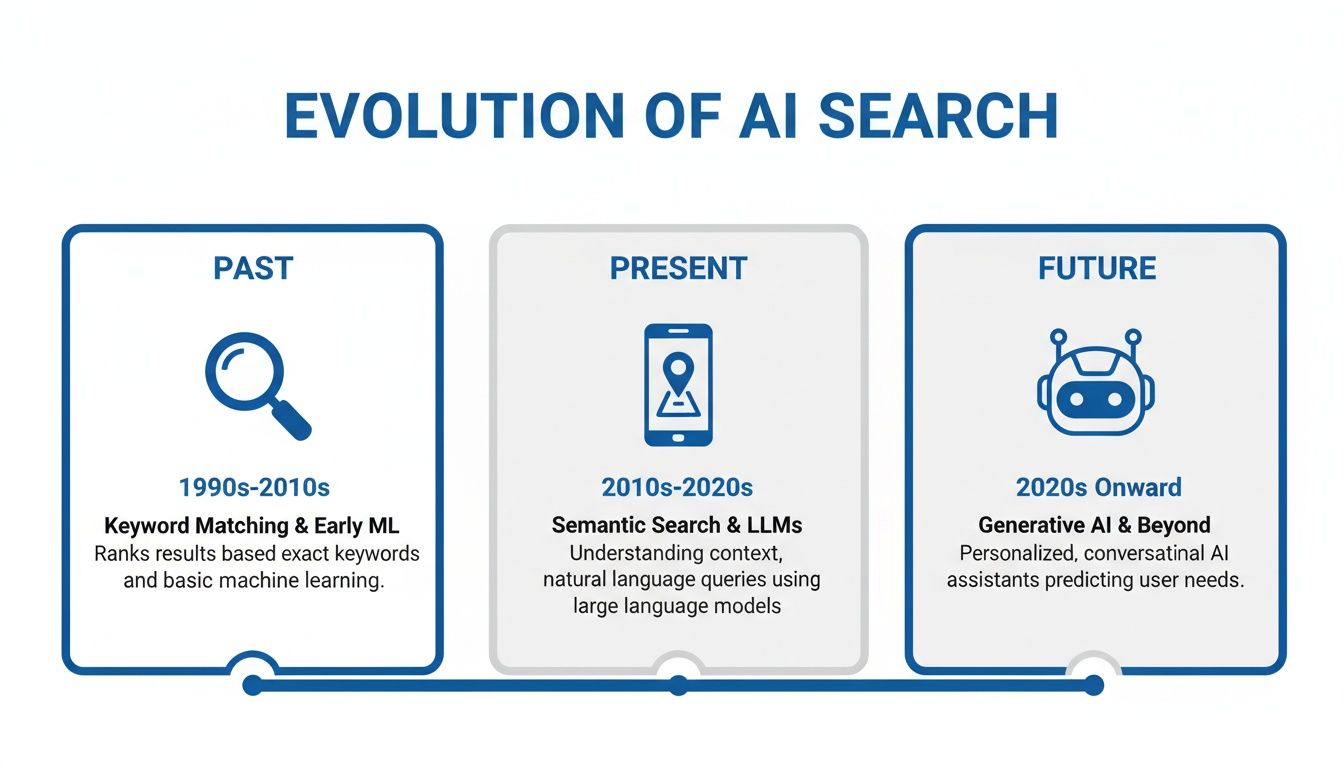
The takeaway here is simple: visibility on Google Maps and in AI-powered search is no longer optional. It's the future of how local businesses will be discovered.
Weeks 7-8: Performance Tracking and Iteration
The final two weeks are all about the data. You need to see what's working. You’ll get access to a transparent dashboard to monitor progress in real time. We track keyword rankings, your placement on Google Maps heat maps, and the single most important metric: the number of inbound calls you receive.
This data-driven approach allows us to constantly refine and improve your strategy, ensuring you see continuous growth and a clear, undeniable return on your investment.
Frequently Asked Questions
It's natural to have questions when you hear about a new approach to marketing, especially one designed to make the phone ring right away. Let's walk through some of the most common ones we get from local service business owners just like you.
How Is This Different From Standard SEO?
That's a great question, and it gets to the heart of what makes this method so effective. Many standard SEO campaigns get bogged down chasing broad traffic, trying to rank for informational keywords that attract browsers, not buyers.
Think of it this way: a traditional approach might get you to rank for "how does an air conditioner work." Our transactional content strategy, on the other hand, ignores that entirely. We focus exclusively on capturing searches from people who are ready to pull out their wallets. We target the money phrases, like "air conditioning repair near me." This is a transactional search term, and it's why our company is named Transactional Marketing—it's all we go after.
It's a shift in philosophy. We're not just building traffic; we're building a direct pipeline for paying customers, turning your website into your best lead-generation tool.
Can I Implement This Strategy for Any Service Industry?
Absolutely. The core principles work for any local business that provides a service—whether you're a roofer, plumber, dentist, or lawyer. The system is built to be tailored to your specific trade.
The real key is the deep-dive research we do first. We have to identify the exact high-intent, transactional keywords your potential customers are typing into Google when they have an urgent need. From there, we build out content that establishes you as the authority for those services in your specific area. A strategy for a pest control company in Dallas will look completely different from one for an electrician in Denver. We never combine industries or services; each gets its own separate, laser-focused marketing plan.
How Does Content Affect My Google Maps Ranking?
They are deeply intertwined. Your website's content acts as the foundation that supports your Google Maps listing. When you create high-quality, location-specific pages on your site—like dedicated pages for each city or neighborhood you serve—you're sending powerful signals to Google.
You're essentially proving to its algorithm that you are the most relevant, authoritative expert for that service in that location.
This digital proof is what gives your business the momentum it needs to climb into the Google Maps "3-Pack." Getting into that box isn’t about luck; it's about showing Google you deserve to be there. For our clients, our technology turns these map locations into top-three rankings, which translates directly into hundreds of more phone calls every month and literally thousands more every year.
Why Is AI Optimization Important Now?
AI and voice search are fundamentally changing how people find local services. More and more, your potential customers are asking Siri, Alexa, or Google Assistant for recommendations. This is the new way businesses will be found.
Optimizing for AI means we structure your website's content so these Large Language Models (LLMs) can instantly understand who you are, what you do, and where you do it. When someone asks their phone for "the best plumber near me," an AI-optimized site is far more likely to be the one recommended. It’s about ensuring you stay visible as the technology continues to evolve.
Ready to stop chasing clicks and start getting calls? At Transactional Marketing, our entire system is built to get your business showing up for the search terms that actually drive revenue. We have a proven system that gets our customers' websites showing up on page one of Google, typically within 30 to 60 days.
Discover how we can make your phone ring today at transactional.net