

You’re probably here because you’ve already paid for marketing that sounded good on paper and failed where it counts. The reports looked busy. The agency talked about impressions, reach, engagement, and awareness. Meanwhile, your dispatch board didn’t fill up, your front desk didn’t get more calls, and your sales team didn’t see more booked jobs.
That disconnect is the primary problem.
A local service business doesn’t need more random traffic. It needs to show up when someone searches with intent to hire. Terms like “emergency plumber near me,” “AC repair [city],” or “dentist near me” aren’t casual searches. They’re transactional search terms. The person searching is close to making a decision, and if you’re not visible in that moment, your competitor gets the call.
That’s why white hat seo services matter when they’re done correctly. Not as a generic SEO package. Not as a pile of blog posts with no strategy. Not as vanity rankings for broad keywords that never convert. The only approach that makes sense for a service business is one built around capturing buying intent, turning local visibility into phone calls, and doing it in a way that holds up as Google and AI search keep changing.
Stop Wasting Money on Marketing That Does Not Work
A lot of owners end up in the same cycle.
They sign with an agency. The agency launches a redesigned website, posts a few blogs, sends a report full of charts, and explains why “brand lift” takes time. Three months later, rankings for the terms that matter still aren’t there. Google Maps visibility is weak. Leads are flat. Nobody can explain how the work connects to revenue.
That happens because most marketing for local service businesses is aimed at activity, not outcomes.
If you run an HVAC company, plumbing shop, pest control business, dental office, chiropractic clinic, roofing company, or med spa, your growth usually doesn’t come from being vaguely known online. It comes from being found when someone needs help now, or is ready to schedule now. A service business wins by owning the searches with immediate commercial intent.
What bad marketing usually looks like
- Broad targeting: The agency chases high-volume phrases that bring visitors who aren’t ready to buy.
- Weak local focus: Your Google Business Profile is under-optimized, your city pages are thin, and your service area visibility stays patchy.
- Reporting without context: You get dashboards, but no clear answer to “Did this produce more calls?”
- Content for content’s sake: Articles get published, but they don’t support actual service keywords or local buying intent.
Most frustrated owners don’t have a traffic problem. They have an intent problem.
A transactional approach fixes that by asking a harder question before any SEO work starts. Which searches lead to booked jobs? Not “what gets clicks.” Not “what might trend.” Which terms bring people with money in hand.
What a smarter target looks like
A white hat strategy built for transactions usually centers on:
- Near-me intent: Searches where the customer wants a local provider immediately.
- Service plus city searches: Terms tied to a specific job and service area.
- High-urgency terms: Break-fix, emergency, estimate, repair, install, and appointment language.
- Map pack visibility: Because local buyers often choose from the first businesses they see on the map.
That’s the shift. Stop funding marketing that entertains a report. Start building visibility around searches that create revenue.
White Hat SEO The Foundation for Sustainable Growth
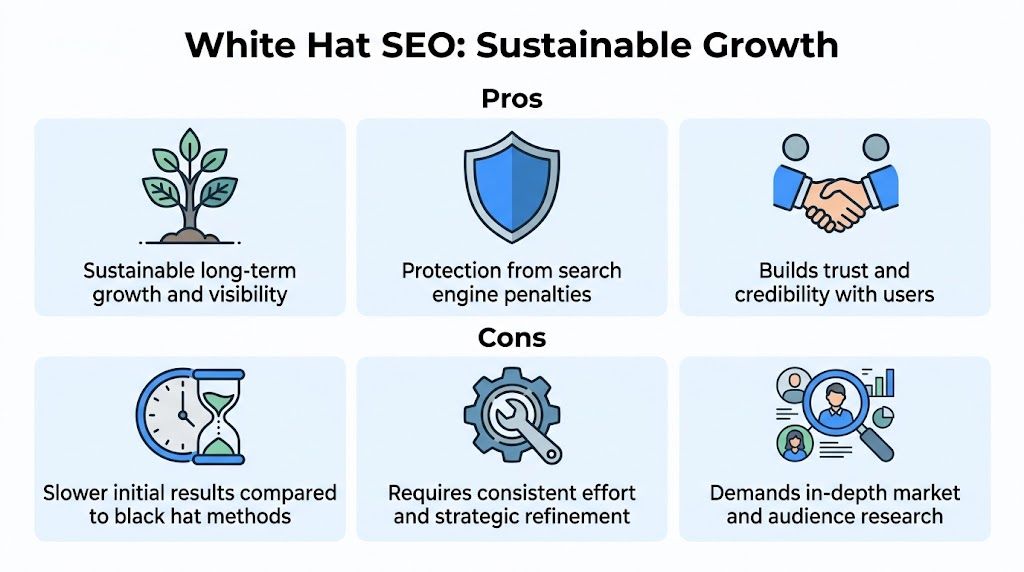
White hat seo services are the long-game version of local growth. They build search visibility by giving Google and customers what they want. Clear service pages. Useful content. strong local relevance. Clean technical setup. Real authority. Real trust.
Black hat SEO does the opposite. It tries to force rankings with manipulation. That used to tempt a lot of businesses because the spike could happen quickly. Then the drop came.
By 2025, Google’s systems were detecting manipulation aggressively enough that the August 2025 spam update caused significant traffic declines within hours to days for non-compliant sites, according to this analysis of white hat and black hat SEO. That’s the difference in one sentence. White hat builds an asset. Black hat builds a liability.
White hat versus black hat in the real world
It is similar to construction.
A white hat campaign is reinforced concrete under the building. The foundation work takes discipline. It isn’t flashy. But once it’s in place, everything above it performs better and lasts longer.
A black hat campaign is a structure set on wet sand. It can look fast. It can look impressive for a moment. Then one algorithm update exposes what it was built on.
Here’s what that comparison looks like in practice:
| Approach | What it relies on | What usually happens |
|---|---|---|
| White hat SEO | user intent, technical health, credible content, ethical links, local relevance | steadier rankings, stronger trust, better resilience |
| Black hat SEO | keyword stuffing, fake links, manipulative tactics, shortcut publishing | unstable gains, penalty risk, cleanup costs, lost leads |
What white hat actually means for a service business
It means your SEO strategy has to help a real customer complete a real decision.
That usually includes:
- Search intent alignment: Pages match what the person wants, not just the keyword phrase.
- Technical quality: Mobile usability, crawlability, site speed, HTTPS, sitemap structure, and clean internal linking all support discoverability.
- Local proof: Service areas, reviews, photos, business profile accuracy, and location relevance support local trust.
- Authority building: Links and mentions come from legitimate relationships and useful content, not manufactured schemes.
If you want a simple refresher on the basics behind all this, What Is Search Engine Optimization Explained is a useful overview before getting more advanced.
The trade-off most owners need to hear
White hat is slower at the start than spammy shortcuts. That’s true.
It also avoids the trap where you pay twice. First for the shortcut, then again to clean up the damage. That’s why serious local businesses invest in durable local visibility instead of hacks. If your business depends on leads from search, stability matters more than theatrics.
For companies focused on service-area visibility, a strong local SEO strategy for service businesses is where white hat execution turns into booked jobs.
Practical rule: If an SEO tactic would embarrass you to explain to Google, it probably doesn’t belong in your business.
The Core Components of a Transactional SEO Strategy
A transactional SEO strategy isn’t a random checklist. It’s a coordinated system built around one goal. Show up when local buyers are ready to act.
That means every part of the campaign has to earn its place. If it doesn’t help your business win more high-intent searches, strengthen map visibility, improve conversion paths, or support authority, it’s noise.

Google Maps and Google Business Profile optimization
For most service businesses, Google Maps is where revenue starts.
When someone searches “plumber near me” or “dentist near me,” the map pack often gets attention before the organic listings. If your profile is weak, incomplete, inconsistent, or poorly tied to your service areas, you lose visibility in the exact moment the search has the most value.
Strong Google Business Profile work usually includes:
- Category accuracy: The primary category and supporting categories need to match the business closely.
- Service area clarity: Coverage has to align with where you intend to rank and work.
- Photo proof: Real jobsite, office, team, and service images reinforce trust.
- Review velocity and quality: Not manufactured reviews. Genuine customer feedback tied to real work.
- Posting and profile upkeep: Fresh activity supports a living business presence.
Many agencies underperform in this area. They treat the profile like a setup task instead of an ongoing local asset.
AI-driven content silos built around buyer intent
A transactional site doesn’t need generic “marketing content.” It needs content architecture.
That means creating a clear content silo around each core service so Google can understand the business thoroughly and buyers can find the exact page that matches their problem. If you’re targeting air conditioning repair, one weak page titled “HVAC Services” won’t cut it. You need coverage that reflects actual search behavior.
A smart silo might include:
- Primary service pages: Core revenue pages for repair, replacement, installation, or specialty services.
- Problem pages: Pages for urgent or specific needs like burst pipe repair, cracked tooth treatment, or wasp nest removal.
- Location pages: Service-plus-city pages that connect your offer to the market you serve.
- Supporting articles: Educational content that strengthens relevance and answers pre-conversion questions.
Google’s first organic result earns a 27.6% click-through rate, according to this white hat SEO analysis. That’s exactly why precise page targeting matters. If you can move a high-intent service page into top positions, the business impact can be substantial.
A disciplined keyword plan sits under that structure. That’s where keyword research best practices for high-intent local terms make the difference between ranking for curiosity and ranking for buyers.
Ethical link building that strengthens authority
A local service business still needs authority, but authority can’t come from junk links.
The right links come from relevant business relationships, local organizations, industry sites, collaborative networks, associations, sponsorships, and useful assets worth citing. That work takes longer, but it supports long-term trust instead of creating cleanup problems later.
What doesn’t work well anymore:
- Bulk link packages
- Private blog network schemes
- Spam directory dumps
- Irrelevant guest posts on low-trust sites
What works better:
- Industry-relevant placements
- Local partnership links
- Citations that are accurate and consistent
- Content that earns mentions because it’s actually useful
Later in the campaign, this kind of authority supports both organic rankings and local pack strength.
Here’s a useful walkthrough on how local search campaigns come together in practice:
Technical SEO that removes friction
This is the part many owners never see, but they feel the effect when it’s ignored.
Technical SEO handles the infrastructure behind rankings and conversions. If your site is slow, hard to crawl, messy on mobile, or inconsistent in structure, good content can still underperform. For local service companies, that often means missed rankings and lower conversion efficiency.
Key technical priorities include:
Mobile responsiveness
Google uses mobile-first indexing, so the mobile version needs to work cleanly.Site speed
Compressing images, using modern formats like WebP, enabling caching, and reducing load friction all help performance.HTTPS and trust signals
Security matters for both users and search visibility.Crawlability
XML sitemaps, clean URL structure, internal links, and indexation control help Google understand the site.Conversion usability
The page should make it easy to call, book, or submit a form without hunting.
A page that ranks but doesn’t convert is unfinished work.
The strongest white hat seo services connect these four pieces. Maps, content silos, authority, and technical health. Not as isolated deliverables, but as one system aimed at transactional search.
How AI Optimization Future-Proofs Your Local Business
Search is changing from a list of links into an answer engine.
Customers still search for local services, but they’re increasingly getting summarized recommendations, AI-generated overviews, and suggested providers shaped by trust signals across multiple platforms. That means local SEO can’t stop at old-school ranking tactics. Your business has to be understandable, credible, and consistently validated wherever search systems look for proof.
Why E-E-A-T matters more in AI search
For local businesses, AI optimization is mostly an extension of good white hat practice. The difference is that weak, generic pages get exposed faster.
If your site says you’re experienced, but shows no real proof, that claim is thin. If your competitors publish staff bios, real service photos, detailed location coverage, customer testimonials, and job-specific pages, they give AI systems more evidence to work with.
For small local businesses, demonstrating E-E-A-T is considered critical for Google SGE in 2026, and data cited in this analysis of white hat SEO and local authority says that integrating authentic proof like GMB-verified photos and service-area case studies into content silos can lead to 20-30% faster map pack gains.
What AI optimization looks like in practice
The businesses that hold up well in AI-influenced search usually do a few things consistently:
- They document real experience: Staff bios, certifications, service photos, before-and-after examples, and local job evidence all help.
- They structure content clearly: Each page has one job, one intent, and useful depth.
- They reinforce trust across platforms: Google Business Profile, video platforms, review sites, and local mentions support credibility.
- They answer real buying questions: Not vague articles. Specific, practical content tied to real services.
AI optimization also works better when your paid and organic strategy aren’t fighting each other. If you want a good overview of that relationship, PPC and SEO working together is worth reading.
The local advantage most businesses underuse
Big brands can publish more content. Local service businesses can show more proof.
That’s the edge. A local company can show the neighborhoods it serves, the people who do the work, the vehicles on the road, the office customers visit, the treatment rooms, the technicians, the completed projects, and the exact problems solved. AI systems don’t just reward scale. They reward credible detail.
That’s why an AI search optimization strategy for local businesses should be tied directly to your service pages, your maps presence, and your trust assets. The future-proof move isn’t chasing a separate AI trick. It’s making your business easier to verify.
Measuring Real Results and Realistic Timelines
Most SEO reporting is too soft for a service business owner.
You don’t need a report that says visibility is “improving” while the phones stay quiet. You need a reporting model that ties search performance to booked jobs. That starts with realistic expectations and the right scorecard.
Some local campaigns can start gaining traction for targeted service terms in 30 to 60 days, especially when the site, Google Business Profile, and local targeting are tightly aligned around transactional searches. That kind of movement is not magic. It comes from narrowing focus, fixing technical issues quickly, and pushing pages that are built to convert.
The metrics that actually matter
If the goal is revenue, these are the numbers worth watching first:
- Rankings for transactional keywords by city: Not broad vanity terms. The actual service-plus-location searches that lead to leads.
- Map visibility across service areas: Heat maps help show where you’re visible and where competitors still own the pack.
- Phone calls and form submissions: The signals that connect search to demand.
- Search Console performance: Impressions, click-through rate, top queries, and average position help diagnose where gains are happening.
- Landing page engagement: Which service pages hold attention and move visitors to action.

What the numbers say about local gains
White hat local SEO is measurable when the campaign is built correctly.
Data cited in this review of white hat SEO and local business growth says local SEO map pack wins average a 25% increase in calls, and tracking keyword timelines with heat maps can show 10-15% map rank lifts in just 3 months for service businesses like pest control.
Those are the kinds of metrics owners care about because they connect visibility to operational reality. More calls. Better local coverage. More opportunities to book work.
Track the keywords people use when they’re ready to hire, then track what happened to calls after those rankings improved.
A timeline that makes business sense
A serious local SEO campaign usually has phases.
| Phase | What you should expect |
|---|---|
| Early phase | technical fixes, profile cleanup, page improvements, indexing and baseline measurement |
| Building phase | movement on target terms, stronger local relevance, early map gains, improved click quality |
| Compounding phase | broader service-area coverage, stronger authority, more stable lead flow from search |
The biggest mistake is expecting mature results from immature foundations. SEO isn’t instant, but it should be explainable. You should be able to see what changed, why it changed, and whether it’s moving toward more revenue.
A strong marketing effectiveness measurement framework makes that visible instead of leaving you to guess.
How to Choose The Right SEO Partner For Your Business
Choosing an SEO company is mostly about filtering out bad fits fast.
A lot of providers know how to sell confidence. Fewer know how to build local search visibility around jobs, patients, appointments, and calls. If you hire based on polished language alone, you’ll likely end up back in the same position that pushed you to search for help in the first place.
Red flags that should stop the conversation
The first warning sign is usually overpromising.
If a provider guarantees a #1 ranking, treats SEO like a secret formula, or refuses to explain how they build links, walk away. Search is competitive, local markets vary, and no honest operator can guarantee exact ranking outcomes on demand.
Other red flags show up in the sales process:
- Long lock-in contracts: They want commitment before they’ve earned trust.
- Vanity metric obsession: They lead with traffic, impressions, or “exposure” instead of calls and conversions.
- No map strategy: They talk about SEO but ignore Google Business Profile and local pack visibility.
- Generic deliverables: The same package for a roofer, dentist, pest control company, and chiropractor usually means weak strategy.
- Thin reporting: You get activity logs, not business insight.
Green flags that point to a real growth partner
The right partner should make the process easier to understand, not harder.
Look for a provider that speaks plainly about trade-offs. White hat work takes consistency. Map visibility requires active management. City pages and service pages need purpose. Authority isn’t built from junk links. A good strategist won’t hide those realities.
The strongest green flags include:
- Transactional keyword focus: They care about searches tied to intent to buy.
- Local market specificity: They talk about service areas, maps, city targeting, and local competition.
- Transparent reporting: You can see rankings, queries, heat maps, and lead signals clearly.
- Contract flexibility: They rely on performance and communication, not handcuffs.
- Industry familiarity: They understand how service businesses sell.
SEO Vendor Evaluation Checklist
| Evaluation Point | Green Flag (Look for This) | Red Flag (Avoid This) |
|---|---|---|
| Keyword strategy | Focus on transactional terms and city-level intent | Focus on broad traffic keywords with weak buying intent |
| Google Maps | Clear plan for Google Business Profile and map pack visibility | Maps treated as an afterthought |
| Reporting | Dashboard with rankings, calls, forms, and local visibility data | Vague reports full of activity with no business tie-in |
| Link building | Ethical links from relevant local or industry sources | Purchased links, secret methods, or evasive answers |
| Content | Service pages and silos built around intent and conversion | Generic blogs published for volume |
| Contracts | Flexible engagement with accountability | Long-term lock-in before results |
| Communication | Plain-language explanations and direct answers | Heavy jargon and unclear ownership |
The best SEO partner doesn’t just tell you what they did. They tell you why it mattered to your pipeline.
Questions worth asking before you sign
Ask direct questions and pay attention to how direct the answers are.
- Which keywords will you target first, and why those?
- How do you handle Google Business Profile optimization?
- What metrics do you report on besides traffic?
- How do you build links?
- How do you connect rankings to leads or calls?
- What happens if performance stalls?
A good provider won’t answer with rehearsed fluff. They’ll talk about actual process, local intent, business outcomes, and adaptation.
The final test is simple. If the company sounds more interested in proving they’re smart than proving they can help you win transactional searches, keep looking.
Your Path to Dominating Local Transactional Search
Local service businesses don’t need more marketing noise. They need a search strategy that shows up when a buyer is ready to call, book, or schedule.
That’s why white hat seo services still matter, and why they matter even more now that AI search is reshaping how businesses get discovered. The durable path is the same one serious operators have always needed. Strong local relevance. Useful service pages. Google Maps visibility. Ethical authority building. Technical reliability. Clear proof of trust.
The difference is focus.
When your SEO strategy is built around transactional search terms, every improvement has a purpose. Better map placement means more local exposure where buyers are choosing. Better service pages mean more qualified clicks. Better trust signals mean stronger performance in both search and AI-generated recommendations.
If you want a system that turns search visibility into booked jobs instead of another stack of empty reports, you need a partner that understands local intent, measures what matters, and builds with long-term discipline. That’s the path to dominating your market.
Frequently Asked Questions About White Hat SEO Services
How long do white hat seo services take to work
Some local campaigns can begin showing movement on targeted transactional terms within 30 to 60 days when the site, local targeting, and Google Business Profile are aligned. Broader authority and stronger market coverage take longer. The important thing is whether progress is visible and tied to the right keywords and lead signals.
Are white hat seo services worth it for a local service business
Yes, if the strategy is aimed at high-intent local searches and not generic traffic. A service business benefits most when SEO helps it appear for terms tied to immediate need, service area demand, and map pack visibility.
What should I expect in monthly reporting
You should expect reporting on transactional keyword rankings, map visibility, Google Search Console data, and lead actions like calls and form submissions. If a report can’t help you understand whether search is contributing to revenue, it’s incomplete.
Why avoid agencies that guarantee rankings
Because guarantees usually hide bad strategy, unrealistic promises, or risky methods. A credible SEO partner can explain process, benchmarks, and likely opportunities, but no one controls Google enough to promise exact rankings on demand.
Does AI optimization replace SEO
No. AI optimization is building on the same trust-first principles. Clear structure, real expertise, strong local proof, and pages that match intent all support both traditional search and AI-generated discovery.
Why does a contract-free model matter
It usually signals confidence and accountability. When a company has to keep earning your business through results, communication, and transparency, incentives stay aligned.
If you want help turning transactional searches into real calls, jobs, and patients, talk with Transactional LLC. They focus on local service businesses, Google Maps visibility, AI-driven content, and transparent reporting built around the terms that effectively produce revenue.