


You can spend another month paying for boosted posts, broad ads, and “brand awareness” campaigns that make a dashboard look busy while your phone stays quiet. A lot of local business owners are stuck in exactly that cycle. Traffic goes up. Impressions go up. Likes show up. Booked jobs don’t.
That’s the wrong target.
Lead generation for local businesses works best when you stop treating every click as equal and start focusing on the searches that signal purchase intent. When someone types “plumber near me,” “emergency dentist near me,” or “AC repair near me,” that person usually isn’t browsing for entertainment. They need help and they’re ready to choose a provider.
That’s why transactional search terms matter so much. They sit at the bottom of the buying cycle. They’re the terms that turn into phone calls, appointments, and invoices, not vanity metrics.
Stop Chasing Likes and Start Getting Customers
A local business doesn’t need random attention. It needs the right visibility at the right moment.
Most marketing underperforms because it attracts people too early, too broadly, or from the wrong geography. A home service company in Phoenix doesn’t need national traffic. A dental office doesn’t need blog readers from another state. They need to appear when a nearby customer is actively searching for the service they sell.
That’s where search stands apart. SEO leads boast a 14.6% close rate according to this local lead generation analysis. For local operators, that gap matters because it reflects intent. The lead didn’t come from idle scrolling. The lead came from a need.
What vanity metrics hide
A campaign can look healthy and still fail the business.
If your agency talks about reach, impressions, and engagement but can’t connect that activity to calls or booked jobs, you’re probably funding noise. Local companies feel this most sharply in service categories where the prize is simple: get the call before the competitor does.
Here’s the practical split:
- Branding metrics can support growth, but they rarely prove immediate buying intent.
- Transactional metrics tell you whether your business is showing up for money terms.
- Operational metrics confirm whether your team turns that visibility into revenue.
Practical rule: If a tactic doesn’t help you win searches like “near me,” “same day,” “emergency,” or “service + city,” it shouldn’t be the center of your local lead strategy.
AI is changing this conversation too. Searchers are using longer, more conversational phrases, and AI systems increasingly summarize local options before a customer even clicks. Businesses that structure their website, business profile, and service pages for those answers are easier to surface in both classic search and AI-driven discovery.
That’s also why tools that improve qualification matter. If you want a useful overview of AI strategies for better lead qualification, it’s worth looking at how AI can sort, route, and prioritize inbound opportunities after they arrive.
What actually deserves attention
For local businesses, the scoreboard is small and unforgiving:
- Phone calls
- Form submissions
- Booked estimates
- Scheduled appointments
- Completed jobs
Everything else is secondary.
When you build your marketing around transactional search terms, you stop asking, “How do we get more visibility?” and start asking, “How do we win the exact searches that create revenue?” That’s a much better question.
Master Google Maps and Your Business Profile
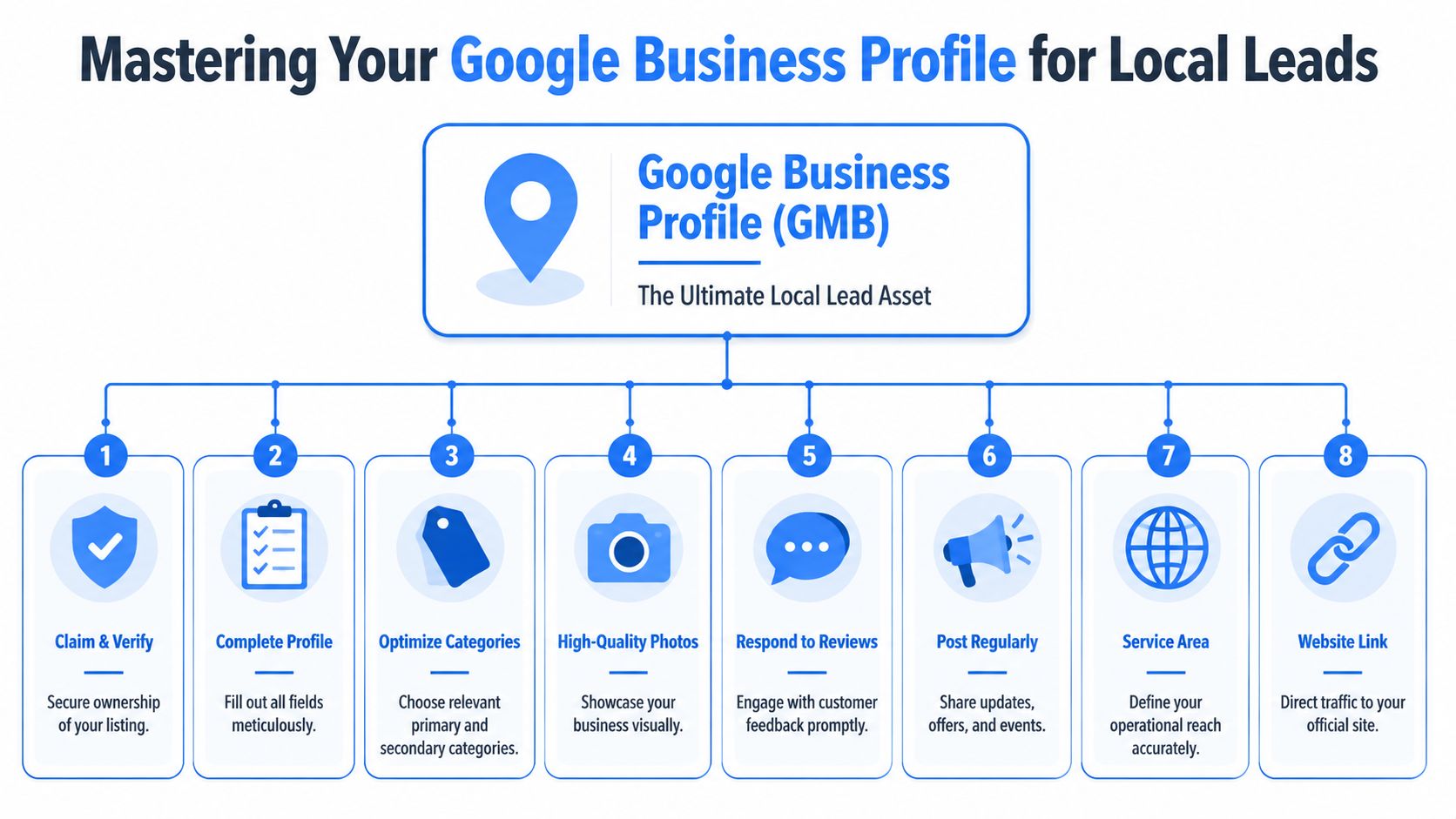
Your Google Business Profile is not a directory listing. It’s a frontline sales asset.
For a local company, especially in home services, dental, pest control, med spa, and similar categories, the map result often gets judged before the website ever does. If the listing looks incomplete, stale, or thin on proof, people move on.
Build the profile like a sales page
A strong profile answers the buyer’s first questions fast. What do you do, where do you work, can I trust you, and what should I do next?
That means the basics have to be right, but “right” goes beyond name, address, and phone.
- Claim and verify the listing so you control edits, categories, and responses.
- Complete every field that helps a customer understand your services.
- Choose the right categories based on what you most want to rank for.
- Set service areas carefully so your profile matches where you want leads.
- Add services and descriptions using plain language that reflects real searches.
- Use the Q&A section to answer transactional questions before someone asks them.
- Keep the profile active with fresh updates and visual proof.
- Link to the right page on your website, not always the homepage.
For a deeper primer on setup and purpose, this guide on what a Google Business Profile is and why it matters is a useful reference.
The activity level matters
Profiles that sit untouched lose momentum. Google wants confidence that the listing reflects a real, active business serving a real area.
Two actions stand out. Optimizing your GMB with 100+ photos can boost clicks by 42%, while posting twice a week can lift engagement by 35%, based on this technical local SEO framework.
Those aren’t decorative tasks. They help your listing compete.
A thin profile looks like a business that might answer the phone. A complete profile looks like a business that probably will.
What to upload and publish
A lot of businesses add a logo, one exterior photo, and then forget the listing exists. That wastes the asset.
Use a steady publishing rhythm with content such as:
- Job photos that show the work clearly. Before and after images help in trades.
- Team photos that make the business feel real and local.
- Vehicle photos that support brand recognition when crews arrive on site.
- Location-specific updates tied to the cities or neighborhoods you serve.
- Short Google Posts about seasonal services, availability, or common service requests.
Common profile mistakes
Some problems are subtle and still hurt lead flow. Others are obvious.
| Problem | What it does |
|---|---|
| Wrong primary category | Pulls the profile away from the searches you actually want |
| Generic descriptions | Makes the listing blend in with every competitor |
| Weak service area settings | Brings the wrong leads or limits visibility |
| No Q&A strategy | Leaves high-intent questions unanswered |
| Few recent photos | Reduces trust at the moment of comparison |
| Inconsistent posting | Makes the profile look unattended |
The businesses that dominate maps usually don’t have one secret trick. They treat the profile like an active conversion asset and maintain it with discipline.
Create Content That Captures 'Near Me' Searches
Most local content fails because it’s written for generic awareness instead of local buying intent.
A post called “Top Tips for Choosing a Contractor” might be fine for broad education, but it won’t carry the same weight as a tightly built service page targeting a specific need in a specific place. If you want more transactional leads, your website needs pages that mirror the way people search.
Hyperlocal beats generic
A local website should be built around service and geography combinations, not just broad service lists.
For example, an HVAC company shouldn’t stop at one “Services” page. It needs focused pages such as:
- Air conditioning repair in Phoenix
- Furnace installation in Scottsdale
- Emergency AC service near Tempe
- Ductless mini split repair in Mesa
A dental office needs the same kind of specificity:
- Emergency dentist in Chandler
- Dental implants in Gilbert
- Teeth whitening near me
- Same day dental appointment in Mesa
These pages work because they match the searcher’s context. They also give AI systems clearer material to pull from when they summarize local options.
AI optimization changes how local businesses get found
AI optimization isn’t separate from SEO. It sharpens it.
Local businesses now need content that can perform in standard search results, map-assisted searches, and AI-assisted discovery. That means writing in a way that clearly answers service questions, states service areas, uses natural language, and organizes information so a system can interpret it quickly.
A useful starting point is to build topic clusters around one core service and then support it with related pages, FAQs, and city variants. This resource on content marketing for local businesses outlines how that structure supports local visibility.
Here’s a simple content model that works:
- One core service page for the primary money term
- City pages for each target location
- FAQ content answering objections and urgent questions
- Support articles that clarify timing, pricing factors, or service options
- Schema and clean page structure so search engines and AI tools can understand the content
Field note: “Near me” visibility often comes from pages that never use the exact phrase as a headline. They rank because the page makes service, location, and intent unmistakable.
This short video gives a useful visual on how search visibility shifts when content aligns with real local intent.
What weak local content looks like
Weak local content usually has one or more of these problems:
- It’s copied across cities with only the location name changed.
- It targets broad educational terms instead of service-buying queries.
- It buries the offer under long introductions and vague language.
- It ignores natural phrasing that customers use in voice and AI search.
The strongest local pages don’t try to sound clever. They sound useful. They answer the question, confirm the area served, prove the business does the work, and make the next step obvious.
Build Landing Pages and Ads That Convert
Clicks don’t pay the bills. Conversions do.
A local landing page has one job. It has to take a person who already showed intent and help that person call, book, or request service without friction. That means fewer distractions, tighter copy, and stronger alignment between the search, the ad, and the page.

What a local landing page needs
A homepage is usually too broad for paid traffic. Someone who clicked an ad for “emergency plumber near me” shouldn’t land on a page that talks equally about remodels, water heaters, financing, company history, and careers.
A focused landing page should include:
- A headline that matches the search intent such as emergency service, same-day repair, or specific treatment.
- A visible click-to-call button placed high on the page for mobile users.
- A short form that asks only for what your team needs to follow up.
- Trust proof such as reviews, certifications, badges, or recent work photos.
- A clear service area mention so the visitor knows you serve their location.
- One primary call to action instead of multiple competing offers.
If your forms need work, this guide on how to build high-converting lead forms covers the friction points that usually kill submissions.
For a practical look at site-side improvements, this article on how to improve website conversion rate is worth reading.
Why Local Services Ads fit transactional intent
Google Local Services Ads are especially useful for local lead generation because they sit at the top of the page and align with urgent, service-based searches. They’re built for people who want to hire, not just browse.
For home services verticals, Google Local Services Ads can deliver a 2-5x ROI, and the 'Google Guaranteed' badge alone can boost conversions by 25%, according to Google’s LSA lead generation resource.
That combination matters because it pairs visibility with trust. In local services, trust often decides the click before price ever comes up.
The trade-offs most businesses ignore
LSAs are powerful, but they’re not automatic.
A poor setup can send junk leads, weak geographic coverage can waste budget, and sloppy follow-up can burn good opportunities. Paid leads also create urgency on the operations side. If your office misses calls or takes too long to respond, the platform didn’t fail. The process did.
Compare the two main paths:
| Channel | Best use | Main risk |
|---|---|---|
| Local SEO | Builds durable visibility for service and city terms | Takes consistency and patience |
| LSAs | Captures immediate high-intent demand at the top of results | Needs tight setup and fast response |
A strong local system usually uses both. SEO builds staying power. LSAs accelerate the lead flow while organic visibility expands.
Conversion check: If a landing page makes the visitor think, compare, or hunt for the next step, it’s doing too much and converting too little.
Develop a Powerful Local Referral System
Search drives intent you don’t control. Referrals create intent inside a network you do control.
The best local referral systems aren’t casual favors. They’re structured relationships between businesses that serve the same customer at different moments. A roofer and a solar installer. A plumber and a water damage restoration company. A family dentist and an orthodontist. A chiropractor and a med spa with overlapping wellness audiences.

What a good referral partner looks like
The right partner doesn’t compete with you. They complement you.
A good partner usually has three traits:
- They serve the same local audience but solve a different problem.
- They have a reputation worth being associated with.
- They communicate consistently enough to keep the relationship active.
A bad partner sends random names, forgets the arrangement, and expects referrals without creating any shared process.
Build a system, not a hope
A simple referral system can be more reliable than a vague “let’s send business to each other” conversation.
Use a setup like this:
- Choose a narrow partner group instead of trying to network with everyone.
- Define what a qualified referral means so both sides know what to send.
- Create a tracking method such as unique forms, dedicated intake questions, or tagged URLs.
- Share quick updates so both businesses know whether leads turned into jobs.
- Review performance regularly and drop inactive partnerships.
That tracking piece matters more than most owners realize. While 78% of SMBs using partnerships report lead growth, a staggering 78% fail to track the ROI, according to this local partnership analysis.
A practical example
Take a pest control company and a local insulation contractor. They aren’t selling the same service, but both often work with homeowners dealing with attic issues, moisture problems, or property maintenance concerns. If each company trains staff to spot the adjacent need and pass the lead through a simple tracked handoff, both sides win.
The strongest referrals feel like service, not selling. One business solves the current problem and points the customer to the next trusted provider.
That’s what separates a real referral engine from occasional word of mouth. It’s deliberate, documented, and easy for both teams to use.
Measure What Matters and Prove Your ROI
Most local businesses don’t need more reports. They need clearer ones.
A useful dashboard should answer a short list of hard questions. Are you ranking for the terms that bring buyers? Are you visible across the map area you serve? Are calls and forms increasing? Which channels create booked jobs, and which ones just create activity?
That’s how you measure lead generation for local businesses in a way that connects to revenue.
The metrics that matter
A clean local marketing dashboard usually includes these layers:
| Metric | What it tells you |
|---|---|
| Transactional keyword rankings | Whether you’re gaining visibility for revenue-driving searches |
| Map ranking heat maps | Where you appear across your target service area |
| Phone call volume | Whether visibility is turning into direct inquiries |
| Form submissions | Whether the website converts non-call visitors |
| Search Console queries | Which terms are actually bringing impressions and clicks |
| Landing page performance | Which pages deserve more optimization or more traffic |
The order matters. Rankings without calls are incomplete. Calls without booked jobs need operational review. Form submissions without source data are hard to trust.
For a practical framework, this guide on how to measure marketing effectiveness gives a good baseline for tying activity back to outcomes.
How to read the numbers correctly
A lot of owners overreact to one metric and miss the pattern.
If map visibility improves but calls don’t, your profile or offer may be weak. If calls rise but booked jobs don’t, intake or follow-up may be the bottleneck. If one city page starts pulling leads while another sits flat, that usually points to a content, competition, or geographic relevance issue.
What matters is not one isolated reading. It’s the chain from visibility to inquiry to booked work.
A simple decision framework
Use reporting to make decisions, not just observe movement.
- Keep investing in pages and profiles that produce calls from transactional terms.
- Refine messaging on pages that get traffic but weak conversion.
- Adjust targeting when leads come from the wrong towns or the wrong service type.
- Fix response gaps if inquiries arrive but the close rate stays soft.
- Cut low-value activity that looks busy but doesn’t produce customers.
Good reporting doesn’t just prove performance. It shows you where the leak is.
That’s the point of measurement. Not more charts. Better decisions.
If you want help turning local searches into booked jobs, Transactional LLC focuses on exactly that. The company helps service businesses win transactional search terms, improve Google Maps visibility, build AI-optimized content, and track results through transparent local SEO reporting.