


You're already doing the hard part. You run a real service business, answer the phone, dispatch crews, handle reviews, and try to stay visible in a market where every competitor claims to be “trusted” and “local.”
Then a homeowner searches “roofer near me”, “emergency plumber near me”, or “dentist near me”, and your business is buried under directories, lead sellers, and the same tired SEO playbook everyone else bought.
That's where industry partnerships become a serious advantage.
Most owners think partnerships mean referrals, chamber events, or swapping business cards. In local search, they can do far more than that. Done right, they create the kind of local authority Google Maps, organic search, and AI-driven answer engines look for when deciding which business to surface for transactional search terms. Those are the searches that matter most because the customer is ready to book, call, or schedule now.
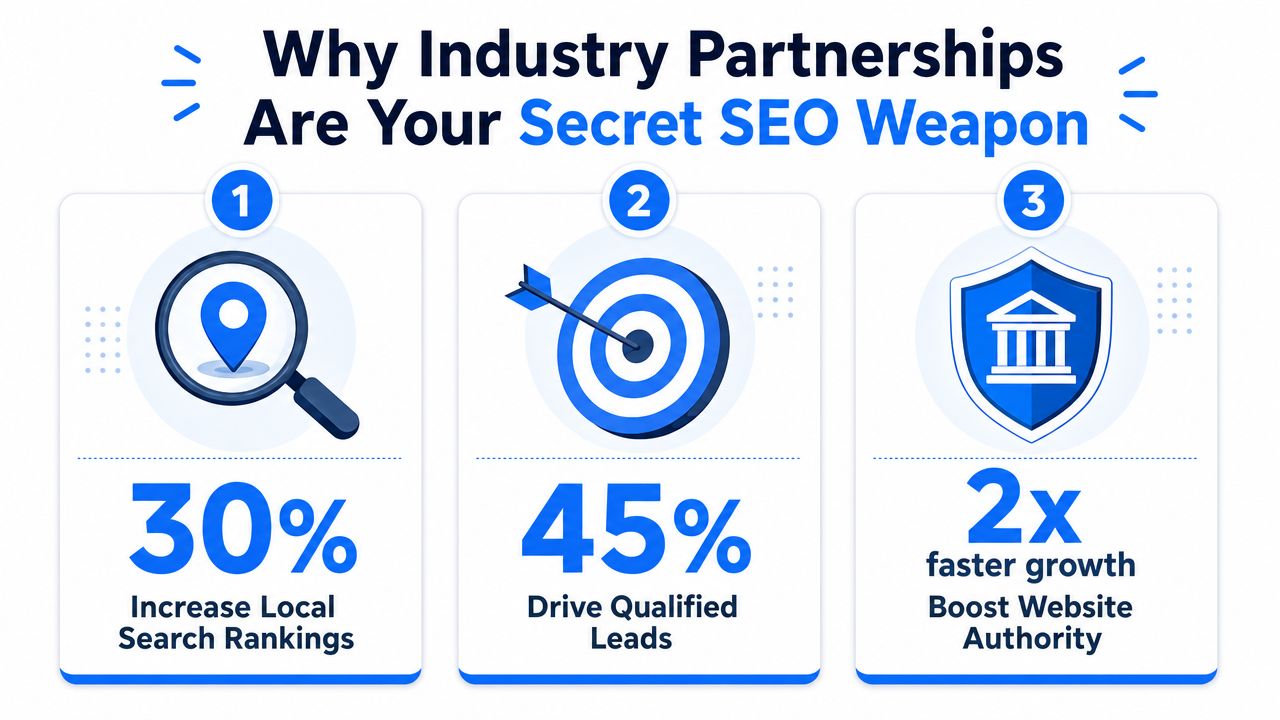
Why Industry Partnerships Are Your Secret SEO Weapon
Most local businesses treat partnerships like a nice extra. That's a mistake.
Partnerships have become a real growth channel. In one industry roundup, mature partnership programs were cited as generating 28% of revenue on average, and deals were 53% more likely to close and 46% faster when a partner was involved, according to Breezy's strategic partnership statistics roundup. That matters because it shows partnerships aren't just social. They affect revenue and conversion speed.
For a service business, that commercial impact translates directly into search visibility.
What Google and AI systems actually see
When a local roofer partners with a realtor, insurance agent, gutter company, or solar installer, those relationships can produce signals search systems understand:
- Relevant local mentions from nearby businesses
- Contextual backlinks from pages tied to the same service area
- Co-branded content that reinforces topical authority
- Referral traffic from users who require the service
- Brand association across multiple trusted local entities
That's different from buying random backlinks from sites with no relationship to your market.
A local algorithm doesn't just need proof that your website exists. It needs proof that your company is part of the business ecosystem in the city you serve. AI search and LLM-based discovery work the same way. They lean on connected mentions, recurring associations, and clear local context.
Practical rule: A partnership that creates trust signals online is usually more valuable than a cold backlink from a site nobody in your market knows.
Why this works for transactional search
Transactional search is where calls come from. Not broad vanity terms. Not informational fluff. The goal is to appear when someone searches with intent to hire.
Industry partnerships help you get there because they support the exact layers that influence local visibility:
| SEO layer | What a partner adds | Why it matters |
|---|---|---|
| Local authority | Mentions from known nearby businesses | Builds geographic relevance |
| Website trust | Quality links and co-created content | Strengthens organic rankings |
| Conversion | Warmer traffic and stronger credibility | Helps turn visits into calls |
If you want a deeper breakdown of why local collaboration beats random link building, this piece on industry collaboration networks outperforming generic backlinks for local contractor authority gets into the mechanics.
The short version is simple. Industry partnerships create a moat. Competitors can copy a service page. They can copy your title tags. They can't easily copy a real network of local businesses reinforcing your authority in the same market.
How to Find and Vet High-Value Local Partners
The best partner usually isn't your direct peer. It's the business that serves the same customer right before you, right after you, or alongside you.
A plumber should look at restoration companies, HVAC shops, remodelers, realtors, and property managers. A dentist should think about orthodontists, pediatric providers, oral surgeons, and nearby wellness businesses that share audience overlap without creating direct competition.

One reason this is still an opening is that many businesses still haven't built a system around it. 39% of companies do not have a formal partner management strategy, according to PartnerPlace's partnership facts collection. For a local service company, that means disciplined operators can gain ground fast by being organized.
What to look for in a partner
Don't chase logos. Chase fit.
Use this filter before reaching out:
- Audience overlap: Their customers are also your ideal customers.
- No direct conflict: They shouldn't compete with your core service.
- Local credibility: They already have a decent reputation in your city or service area.
- Usable online presence: Their website, Google Business Profile, and social channels show signs of life.
- Responsiveness: If they're impossible to reach now, they'll be worse after the handshake.
A strong partner doesn't need to be huge. In many local markets, a smaller business with a clean reputation and engaged customer base is far more useful than a bigger company with weak follow-through.
Vet the business before you pitch
Check a few assets manually:
Google Business Profile
Does it look active? Are categories accurate? Do recent reviews mention the type of work they do?Website quality
Is the site service-area specific, or does it read like generic brochure copy?Local relevance
Do they publish city pages, local case examples, or neighborhood-specific content?Brand alignment
Would you feel comfortable having your name on the same page as theirs?
If you need help tightening up your target customer definition first, build from actual search behavior and pain points. A clear framework for that sits in this guide on user personas.
A bad partner can waste more time than no partner at all. Weak brands drag down trust. Strong local brands amplify it.
A simple outreach email that works
Keep the first message short and practical:
Subject: Local referral and content partnership idea
Hi [Name],
I run a [service] business in [city], and we serve a lot of the same homeowners/customers you do. I think there's a good fit for a simple local partnership that helps both businesses generate better leads.I had two ideas:
- a referral arrangement when a customer needs the other service
- a co-branded local resource or page that helps both of us show up better online
If that sounds useful, I'd be happy to jump on a short call and see if there's a fit.
Thanks,
[Name]
That email works because it respects time, names the overlap, and hints at both offline and SEO value.
Activating Partnership Models That Generate Leads
Most partnerships die because they never move past “let's send each other referrals.” That's too vague. Good partnerships run on specific plays.
The strongest local partnerships also give each side more than one way to contribute. A project-based study on partnership durability emphasized the basics that keep partnerships alive: a clear kick-off to set goals, consistent communication through written updates and virtual meetings, and multiple participation modes beyond simple referrals, as discussed in this ASEE paper on sustaining partnerships.
The digital referral network
This is the easiest model to launch.
A digital referral network means partners don't just mention each other verbally. They build lightweight online assets that support the referral path. That can include partner pages, “trusted local providers” sections, FAQ mentions, shared review prompts, and intake forms that ask how the customer heard about the business.
This matters for SEO because it creates attribution and relevance. If a water damage company regularly refers a plumber, and that relationship also appears on both websites in a useful local context, search engines get a clearer picture of who is connected to what service need.
What works
- A dedicated partner page with real descriptions
- Shared service-area mentions
- Staff training so office teams know when to refer
What fails
- Random logo farms
- “Partners” pages with no context
- Referral agreements nobody remembers after two weeks
Co-marketing that targets buyer intent
A better local content strategy is often joint content, not solo content.
A plumber, electrician, and HVAC company can create a homeowner maintenance guide for a specific city. A dentist and orthodontist can build a family treatment resource. A roofer and insurance agent can publish a storm-damage checklist tied to local conditions.
If you've looked at broader media partnerships, even outside local SEO, you'll notice the same principle in Scaling branded podcasts for B2B. The lesson is useful here too: distribution gets stronger when multiple trusted participants contribute to the same asset.
The best partnership content answers a real buying question and gives both companies a reason to promote it repeatedly.
For service businesses, this approach also opens up natural cross-selling opportunities. This overview of cross-selling strategies is useful if you want to connect partnership content to actual booked work.
Bundled offers that shorten the buying decision
Some services naturally pair together. Think move-in services, post-inspection repairs, cosmetic dental packages, or seasonal home maintenance bundles.
The mistake is making the offer too broad. The better move is a narrow package tied to a clear use case. A customer doesn't want “home services solutions.” They want “everything needed after buying an older home” or “a clean path from diagnosis to treatment.”
Bundled offers can help rankings when they lead to:
- clearer service pages,
- stronger local landing pages,
- better partner-linked navigation,
- and more persuasive review language from actual customers.
Keep the structure simple. Start with one offer, one city, and one partner who will reliably follow through.
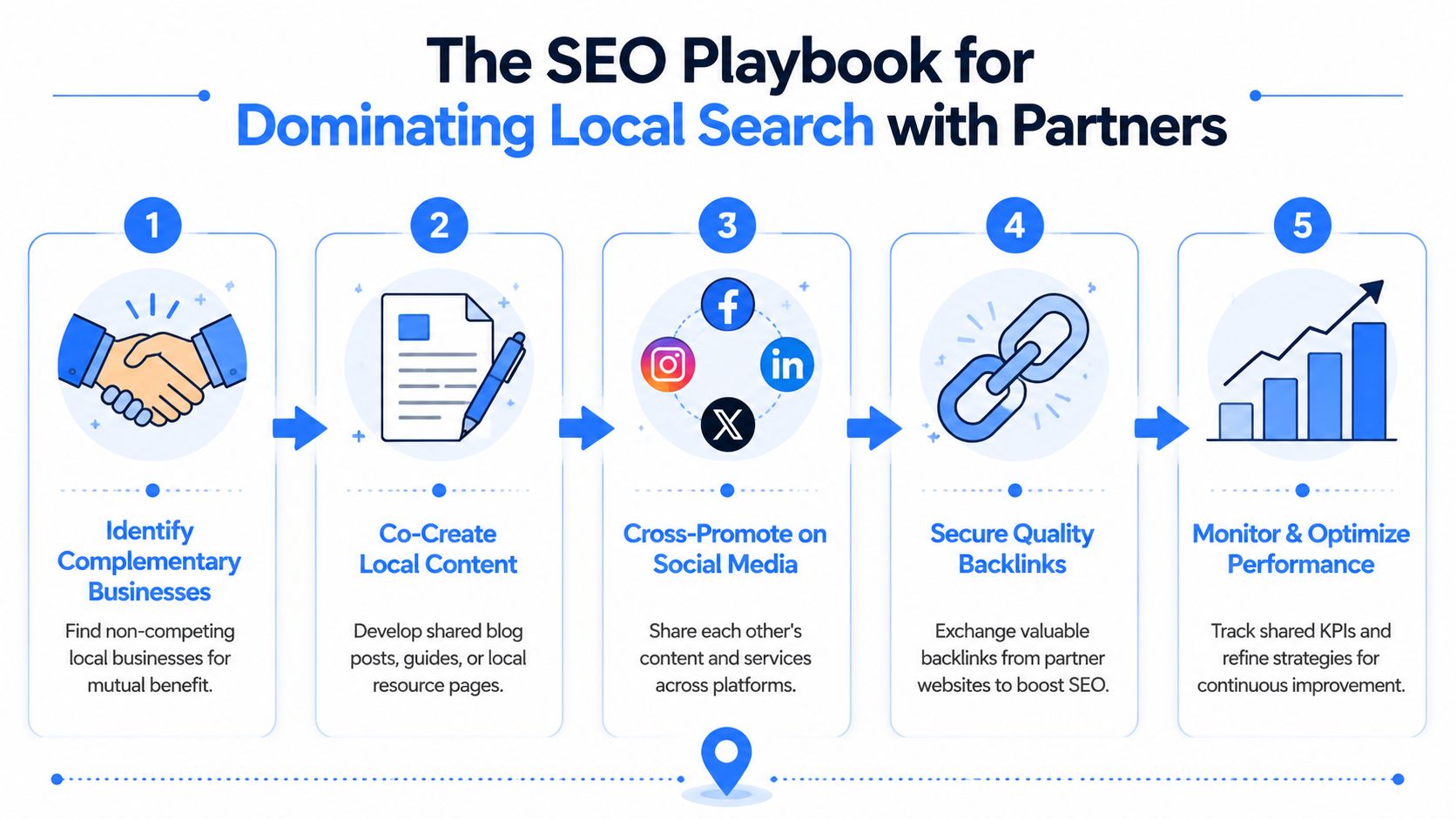
The SEO Playbook for Dominating Local Search with Partners
Partnerships stop being abstract and start helping you rank for transactional keywords.
A local service business doesn't need a giant alliance program. It needs a repeatable way to turn local relationships into search signals. The playbook below works because it creates a network of relevance around the exact places and services you want to own.
Build a local expert hub
Create a section of your website that highlights trusted local businesses tied to your customer journey. Don't make it a junk directory. Make it editorial.
A strong local expert hub might include:
- a short profile of each partner,
- where they fit in the service process,
- the cities or neighborhoods they serve,
- and links to useful local pages or guides.
This works because it gives search engines a structured local neighborhood of entities. It also gives AI systems more context about who belongs in the same service conversation.
For a deeper look at this network effect, read how industry-specific SEO networks build local authority and ranking for service-based businesses.
Use review velocity and local proof together
Google Maps visibility is heavily influenced by trust, consistency, and customer feedback. Partnerships can support all three.
Ask partners to refer customers in ways that naturally improve review opportunities. For example, if a realtor sends a homeowner to your plumbing company after closing, your follow-up process should be ready to request a Google review at the right moment. If your team needs a better process, this practical resource on Twizzlo's guide to Google reviews is worth studying.
Here's the key point: partnerships don't fake reviews. They create more legitimate service interactions, which creates more chances to earn them.
A quick visual example helps tie the moving parts together:
Tie every asset to a transactional phrase
Local businesses often waste partner content on general awareness topics. Don't do that.
If your market pays for emergency AC service, cosmetic dentistry, pest control, or roof replacement, then the content and hub pages should support the phrases buyers type when they need help now. That includes city modifiers and “near me” behavior.
Use a tight structure:
| Asset | Better angle |
|---|---|
| Joint blog post | City-specific problem and solution |
| Partner page | Who to call for the next step |
| FAQ section | Questions asked before booking |
| GBP posts and updates | Seasonal or urgent service triggers |
Feed AI discovery with consistent local entities
AI search doesn't rank businesses the same way traditional blue links do, but it still depends on reliable signals. When multiple local websites, profiles, reviews, and content assets consistently connect your brand with a service category and a geography, that association becomes easier for AI systems to surface.
That's why industry partnerships are future-proof. They don't depend on one tactic. They reinforce your business across content, maps, mentions, and entity relationships.
Measuring What Matters The KPIs for Partnership ROI
If you can't measure the partnership, you can't improve it.
Too many local businesses stop at “we've been getting some referrals.” That's not enough. You need to know which partner is producing calls, which one is helping rankings, and which one is just consuming time.
One useful benchmark set for partner performance includes revenue generated, customer acquisition cost reduction, lead generation and conversion rates, and customer lifetime value, with companies using top-down alignment being nearly 60% more effective at driving adoption, according to Partnership Leaders on measuring partner ecosystem success.
The scoreboard that matters
A service business owner doesn't need a fancy BI stack to start. A shared dashboard in Looker Studio, a CRM report, or even a disciplined spreadsheet can do the job if the fields are clean.
Track these items first:
- Partner-sourced leads: Count every lead tied to a specific partner.
- Partner-sourced calls: Use call tracking or intake tags so front-desk staff can log the source.
- Conversion rate by partner: Which relationships send buyers, not browsers?
- CAC trend: Compare partner-acquired customers against your other channels.
- Keyword lift: Watch rankings for service-plus-city and “near me” intent terms influenced by partner pages.
- Map visibility: Monitor whether partnership activity correlates with better Google Business Profile exposure.
- Revenue by partner: Not every lead source deserves equal attention.
Separate activity from results
A lot of partnerships look busy and still underperform.
Use this distinction:
| Activity metric | Outcome metric |
|---|---|
| Emails exchanged | Jobs booked |
| Joint posts published | Calls generated |
| Referral mentions | Closed customers |
| Meetings held | Lower acquisition cost |
Operator mindset: If a partner sends traffic but not jobs, the relationship may still help branding. It isn't yet proving commercial value.
This is also where internal alignment matters. The office team, sales team, and whoever handles follow-up need to treat partnerships like a channel, not a side hobby. If intake staff forget to ask where the lead came from, attribution falls apart.
A simple monthly review process
Run one short review each month and ask:
- Which partner sent the best leads?
- Which content piece produced search movement or referral clicks?
- Which relationship needs clearer next steps?
- Which partner should get more attention next month?
- Which one should be paused?
That rhythm keeps the program honest. Industry partnerships should earn their place by helping you win more transactional searches, more calls, and more booked work.
Simple Legal Guardrails and Your First Action Plan
You don't need a massive contract to start a useful local partnership. In most cases, a short written agreement covering expectations, referral handling, branding use, and communication cadence is enough to keep everyone on the same page.
If money changes hands, if you're sharing customer data, or if one business is publicly promoting another in a structured program, get cleaner documentation in place. A practical reference for thinking through the basics is this guide to legally sound affiliate terms. It's not a substitute for legal advice, but it helps clarify what should be written down.
Keep the agreement lightweight
A simple good-faith agreement should cover:
- Purpose of the partnership: What both sides are trying to accomplish
- Lead handling: How referrals will be passed and tracked
- Brand usage: Where names, logos, and testimonials can appear
- Review process: How often you'll check performance
- Exit terms: How either side can stop the relationship cleanly
The goal is clarity. Most local partnerships fail because no one defined what “working together” meant.
Check partnership health before it fades
A smart way to assess whether the relationship is still healthy is to ask for direct feedback. One recommended practice is using Net Promoter Score segmentation to group participants into promoters, passives, and detractors, based on the guidance in North Dakota's best practices for evaluating industry partnerships.
That matters because a partnership can look active on paper and still be experiencing an erosion of support from the people involved.
Ask one blunt question every quarter: “Would you want to keep doing this partnership if we were starting over today?”
Your first three moves this week
Don't overcomplicate the launch.
- List three local businesses that serve the same customer without competing directly.
- Send the outreach email from earlier, customized for each one.
- Book a short call and propose one small pilot, not a giant strategy.
Start with one city, one service line, and one transactional goal. That could be more visibility for “AC repair near me,” “emergency dentist near me,” or “roof replacement near me.” Keep it narrow enough that you can track whether it's producing jobs.
If you want help building industry partnerships into a real local search strategy, Transactional LLC helps service businesses turn partnerships, Google Maps optimization, and AI-driven SEO into visibility for the transactional search terms that bring calls, booked jobs, and new patients.