

Your phone probably doesn't ring in a straight line.
You get a burst of calls after a storm. Then a slow patch. Then a few price shoppers. Then a homeowner who's serious, but they found you through a referral, not your marketing. That pattern is common in roofing, and it's exactly why most roofers get frustrated with marketing agencies. They're paying for “visibility” while still guessing where the next real job will come from.
A good roofer marketing agency doesn't chase vanity. It builds a system that puts your company in front of people searching with money in hand. That means transactional searches like “roofer near me,” “roof repair [city],” and “roof replacement [city].” Those searches matter because they come from buyers who want action, not education.
The other shift happening right now is AI search. Homeowners still use Google the old-fashioned way, but they're also asking AI tools for local recommendations and summaries. If your company isn't structured for search engines, maps, reviews, and AI-readable local relevance, you'll lose calls to roofers who are easier to find and easier to trust.
Why Your Roofing Business Needs More Than Just a Website
A basic roofing website is like a wrapped truck parked in your shop. It proves you exist. It doesn't create demand by itself.
A lot of roofers built a site years ago, added a few service pages, and assumed that would handle marketing. It won't. In roofing, you're competing in a large, fragmented market. The U.S. roofing contractors market was valued at $92.5 billion in 2026, with about 109,000 roofing businesses competing, according to IBISWorld's roofing contractors industry data. If you look ordinary online, you disappear.
What a passive website actually does
A passive website usually has the same problems:
- It waits instead of selling: The site sits there with generic copy and no real local targeting.
- It mixes all services together: Roof repair, replacement, storm damage, gutters, and inspections get buried on one page.
- It gives Google weak signals: No strong service-area relevance, no clear transactional intent, no review support, no conversion setup.
- It makes lead quality worse: Price shoppers and junk form fills slip through because the pages aren't built to qualify buyers.
That's why a specialized agency matters. You don't need a prettier brochure. You need a lead engine built around local demand, calls, form submissions, booked inspections, and closed jobs.
Practical rule: If your website can't clearly target a city, a service, and a next step, it's not a sales tool. It's a placeholder.
Why specialized help pays off
Roofing buyers don't spend weeks browsing for fun. A lot of them search when there's urgency, uncertainty, or a specific project timeline. Your marketing has to meet that moment. A roofer marketing agency should organize your site around transactional pages, map visibility, and conversion tracking. That's the difference between “getting traffic” and getting jobs.
If you want a strong outside perspective on roofing-specific positioning and lead generation, Recepta.ai's guide for roofers is worth reading because it reinforces the idea that roofing marketing has to be built around actual buying behavior, not generic brand activity.
Your site also needs to convert on mobile, load fast, and support local service pages. That's why the foundation matters. If your current site looks decent but doesn't help you win calls, review website design for roofers with conversion in mind, not just appearance.
The Core Services of a Transactional Roofer Marketing Agency
Most agencies talk about “full service.” That phrase means nothing unless the services point at transactional searches and booked jobs.
A real roofer marketing agency should center everything around buyers who are ready to act. In roofing, that means showing up for terms like “roofer near me,” “roof repair [city],” and “roof replacement [city]” instead of bloating your strategy with random traffic.

The channels that actually matter
Effective roofing marketing combines SEO, PPC or Google Ads, and content marketing to reach homeowners searching for high-intent phrases like “roof repair [city],” with the goal of generating measurable leads and tracking them into booked jobs, as noted in this roofing lead generation guide.
That sounds simple. It isn't. Each channel has a specific job.
SEO captures demand already in the market
This is how you rank for local service terms over time. Not blog fluff. Not broad awareness pieces. Service pages, city pages, internal linking, and content clusters built around how people search.PPC gets you into the fight immediately
Google Ads lets you target urgent searches while SEO gains ground. But the traffic has to land on the right page, not your homepage.Website design turns clicks into leads
A strong roofing site needs clear service segmentation, trust signals, short paths to contact, and pages built for local intent.
What “transactional-first” really means
Traditional agencies often push broad brand-building. That approach has its place, but it's rarely the first priority for a local roofer. You need visibility where homeowners are making decisions now.
A transactional-first strategy looks like this:
- Target high-intent keywords: Focus on service plus city and “near me” searches.
- Build service-specific landing pages: Separate pages for repairs, replacements, storm damage, inspections, and financing-related intent if relevant to your process.
- Use AI-readable structure: Clean headings, entity clarity, local context, FAQs, and schema-friendly content help search engines and AI systems understand what you do and where you do it.
- Track every path to contact: Calls, forms, booked inspections, and sales outcomes need attribution.
If your intake process is weak, forms become a leak in the bucket. For agencies thinking seriously about lead capture quality, these marketing agency forms are a useful reference for how form design affects lead handling, qualification, and follow-up.
AI optimization matters now
AI optimization isn't some separate gimmick. It's an extension of SEO. Large language models surface businesses based on clear relevance, location context, authority signals, and structured content. If your site says vague things like “quality roofing solutions for all your needs,” AI systems won't know when to surface you.
They need specifics. Services. Cities. Proof. Reviews. Clear business identity.
Paid search still matters, and when you want to capture demand fast, PPC for roofers should connect directly to transactional keywords, strong landing pages, and tracked phone calls.
Buyers don't care whether a lead came from SEO, ads, maps, or AI. You should care because attribution tells you what's producing jobs.
Dominating Google Maps Where Most Roofing Jobs Are Won
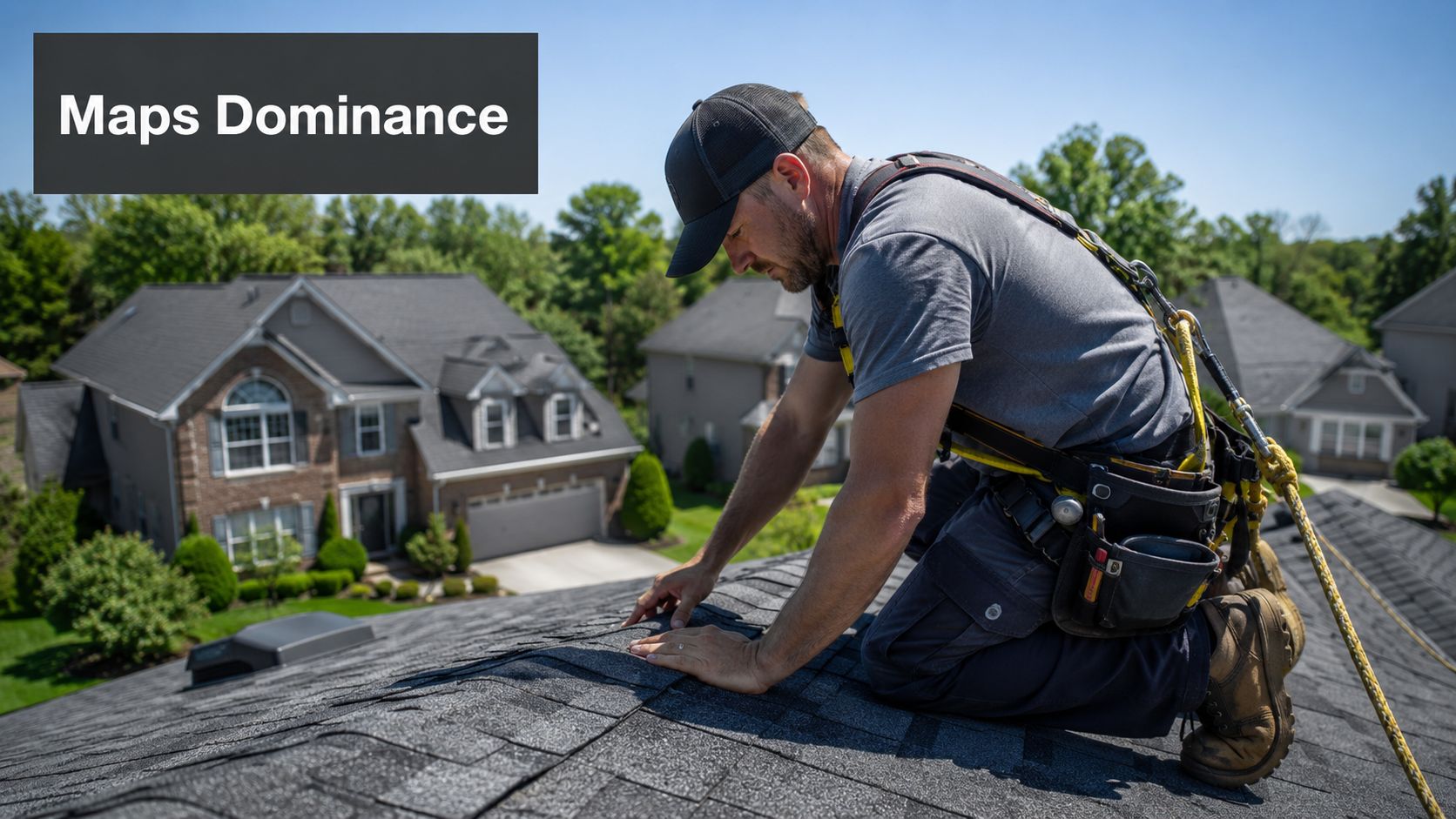
If you're a local roofer, Google Maps is not a side channel. It's the front line.
When homeowners search “roofer near me,” many of them don't scroll through ten blue links. They look at the map pack, compare reviews, glance at service relevance, and call one of the businesses that feels credible and close.
Why maps beat broad ranking for local roofers
A lot of agencies still sell roofing SEO like it's a national publishing contest. It isn't. Local roofing is won by relevance, proximity signals, trust, and conversion readiness.
Top-tier roofing marketing agencies treat Google Business Profile optimization, review velocity, and call-tracked lead attribution as core operational systems because local buyers search online first and want proof of quality and location, according to Thrive's roofing marketing analysis.
That last part matters. Your Google Business Profile isn't a listing you set up once. It's an active sales asset.
The pieces that move map rankings
A strong map strategy usually includes:
- A complete Google Business Profile: Correct categories, services, business description, photos, hours, and consistent business details.
- Review velocity: Not a one-time push. Ongoing review acquisition that shows fresh customer trust.
- Location-specific website support: Service pages and city pages that reinforce where you work.
- Call tracking: So you know whether map visibility is producing phone calls that become inspections.
- Operational responsiveness: If leads call and nobody answers, rankings won't save you.
The roofer who answers quickly and looks trustworthy in Maps often wins before the homeowner ever visits a website.
There's also a strong conversion advantage when paid traffic and local SEO both feed into specialized pages instead of a generic homepage. Guidance for roofers recommends service-specific landing pages plus analytics and call tracking so marketers can tie clicks to calls and compare organic versus paid performance, as outlined by One Thing Marketing's roofing strategy guide.
Here's a quick breakdown:
| Maps Priority | What to focus on | Why it matters |
|---|---|---|
| Profile quality | Accurate categories, services, photos, business info | Helps Google understand your offering |
| Review system | Consistent request process and steady new reviews | Builds trust and strengthens local signals |
| Website support | Service-area pages and conversion-ready pages | Reinforces relevance beyond the profile |
| Attribution | Call tracking and lead source tracking | Proves what turns visibility into jobs |
A lot of roofers need help seeing what real map optimization looks like in practice. This walkthrough on how to rank higher on Google Maps is useful if you want to understand the mechanics instead of relying on vague promises.
This short video is also worth watching if you want a visual explanation of local search positioning and why maps carry so much weight for service businesses.
Measuring Success KPIs That Actually Impact Your Bottom Line
If your agency sends a monthly report full of impressions, clicks, and ranking screenshots, that's not accountability. That's decoration.
Roofers don't stay in business because traffic went up. They stay in business because the phone rang, the lead was qualified, the inspection got booked, and the job closed at a profit.
The numbers that matter
The most common failure in roofer marketing is focusing on lead volume instead of profitability. An effective agency has to track leads through to booked inspections and closed jobs because low-intent inquiries can distort ROI, as explained in this roofer marketing commentary.
That means your KPI stack should include operational metrics, not just marketing metrics.
- Lead source: Did the call come from Google Maps, organic search, paid ads, or another channel?
- Qualified lead volume: How many inquiries were relevant to your services and territory?
- Booked inspections: How many leads became scheduled opportunities?
- Closed jobs: How many booked opportunities turned into signed work?
- Cost per booked job: What did it cost to create a real revenue opportunity?
- Close rate by channel: Which channels bring serious buyers versus noise?
What to stop obsessing over
A few common distractions waste time:
- Raw traffic growth: More visitors doesn't automatically mean better business.
- Ranking reports without context: Ranking for a keyword nobody buys from is useless.
- Form fill totals: Some forms are junk. Some are wrong numbers. Some are outside your service area.
- Cheap leads: Low cost can still mean low quality.
Hard truth: A lead that never books isn't a win. It's a cost.
A better reporting conversation sounds like this:
| Bad agency question | Better owner question |
|---|---|
| How many clicks did we get? | How many qualified calls did we get? |
| Did rankings improve? | Which keywords produced booked inspections? |
| How many leads came in? | How many leads turned into jobs? |
| Is traffic up? | Is revenue opportunity up? |
If you want a clearer framework for separating vanity from business value, read how to measure marketing effectiveness. It'll help you push your agency toward the metrics that directly affect payroll, crews, and growth.
Your Agency Evaluation Checklist Questions to Ask
Most roofing companies hire agencies the wrong way. They listen to a pitch, like the sample reports, hear a few SEO buzzwords, and sign. Then they spend months trying to figure out what the agency is doing.
You need sharper questions.
If you want a broader framework for evaluating AI capability alongside marketing execution, this article on choosing the right AI agency is a useful companion read because AI search readiness is now part of local visibility, not a side topic.
Ask about strategy before you ask about price
Price matters. Strategy matters more. A cheap agency with no local search system will cost you more than an expensive one that produces jobs.
Ask direct questions like:
What transactional search terms are you targeting first?
If they can't name the actual buyer-intent terms they want to win, they don't have a plan.How do you approach Google Maps for roofing companies?
You want specifics around profile optimization, review systems, service-area relevance, and map reporting.How do you handle AI optimization?
They should talk about site structure, topical clarity, local relevance, entity consistency, and content that LLMs can interpret cleanly.What happens after a lead comes in?
Serious agencies care about intake speed, form routing, call handling, and CRM follow-up because lead quality depends on operations too.
Agency vetting checklist
| Question Category | Key Question to Ask | What a Good Answer Sounds Like |
|---|---|---|
| Keyword strategy | Which search terms will you target first? | Clear focus on “roofer near me,” service plus city terms, and other high-intent local searches |
| Google Maps | How will you improve map visibility? | A concrete plan for Google Business Profile, reviews, local pages, and map tracking |
| Reporting | What will you report every month? | Calls, qualified leads, booked jobs, and source-level attribution |
| Website | Will you build pages for each service and city? | Yes, with conversion-focused page structure and clear local relevance |
| Paid ads | Where will ad traffic go? | Service-specific landing pages, not a generic homepage |
| AI search | How are you preparing us for AI discovery? | Structured content, local business clarity, FAQs, and strong semantic coverage |
| Ownership | Who owns the website, content, and ad accounts? | You do |
| Contract terms | What happens if we want to leave? | Transparent terms, no hostage tactics, no asset lock-in |
Watch for answers that sound polished but say nothing
Bad agencies hide behind broad language. They say things like “we improve your online presence” or “we use a customized omnichannel approach.” That's fluff.
Good agencies answer in operational terms. They talk about pages, profiles, review requests, call tracking, booked inspections, and closed jobs.
If an agency can't explain its plan in plain English, it probably can't execute it cleanly either.
Comparing Agencies How Transactional Marketing Is Different
Most roofing agencies sell the same promise with different packaging. Better rankings. More visibility. More leads. The problem isn't the promise. The problem is what they optimize for.
A typical agency often spreads effort across broad SEO, generic content, and polished reports. That can create activity without creating enough buying intent. For roofing companies in competitive local markets, that's a bad trade.
Standard agency model versus transactional-first thinking
Here's the split:
| Typical agency approach | Transactional-first approach |
|---|---|
| Broad keyword targeting | Focus on high-intent local searches |
| Homepage-driven ad traffic | Service-specific landing pages |
| General SEO content production | City and service relevance built for action |
| Reporting on traffic and rankings | Reporting on calls, lead quality, and jobs |
| Brand awareness first | Revenue intent first |
| Maps as a side service | Maps as a core acquisition channel |
The biggest philosophical difference is this. Traditional agencies often treat Google Maps like an add-on. A transactional-first approach treats Maps as one of the most valuable assets in local roofing.
That's not theory. A contrarian but effective strategy in saturated markets is to prioritize Google Maps and reputation defense over broad SEO because local intent is heavily concentrated around map results and review signals, according to Cinch Local's analysis of local search behavior.
Why that difference matters more as AI search grows
AI search changes the value of informational content. A homeowner asking a basic roofing question may get an answer without clicking ten blog posts. But when they need a roofer, they still need a business they can call, evaluate, and trust locally.
That means these assets matter more:
- Strong map visibility
- Recent reviews
- Clear service-area pages
- Structured content AI can understand
- Fast paths to contact
A transactional-first agency leans into that reality. It doesn't waste months chasing empty traffic. It builds around bottom-of-funnel intent.
What roofers should prefer
If you need brand polish for a multi-state expansion, the broad-agency model may fit. If you're a roofing company trying to win more local jobs now, you should prefer an agency that asks:
- Which searches lead to calls?
- Which map positions generate action?
- Which pages drive booked inspections?
- Which leads turn into profitable jobs?
That's a better standard. It's closer to how roofing businesses make money.
Onboarding and Timeline What to Expect in the First 90 Days
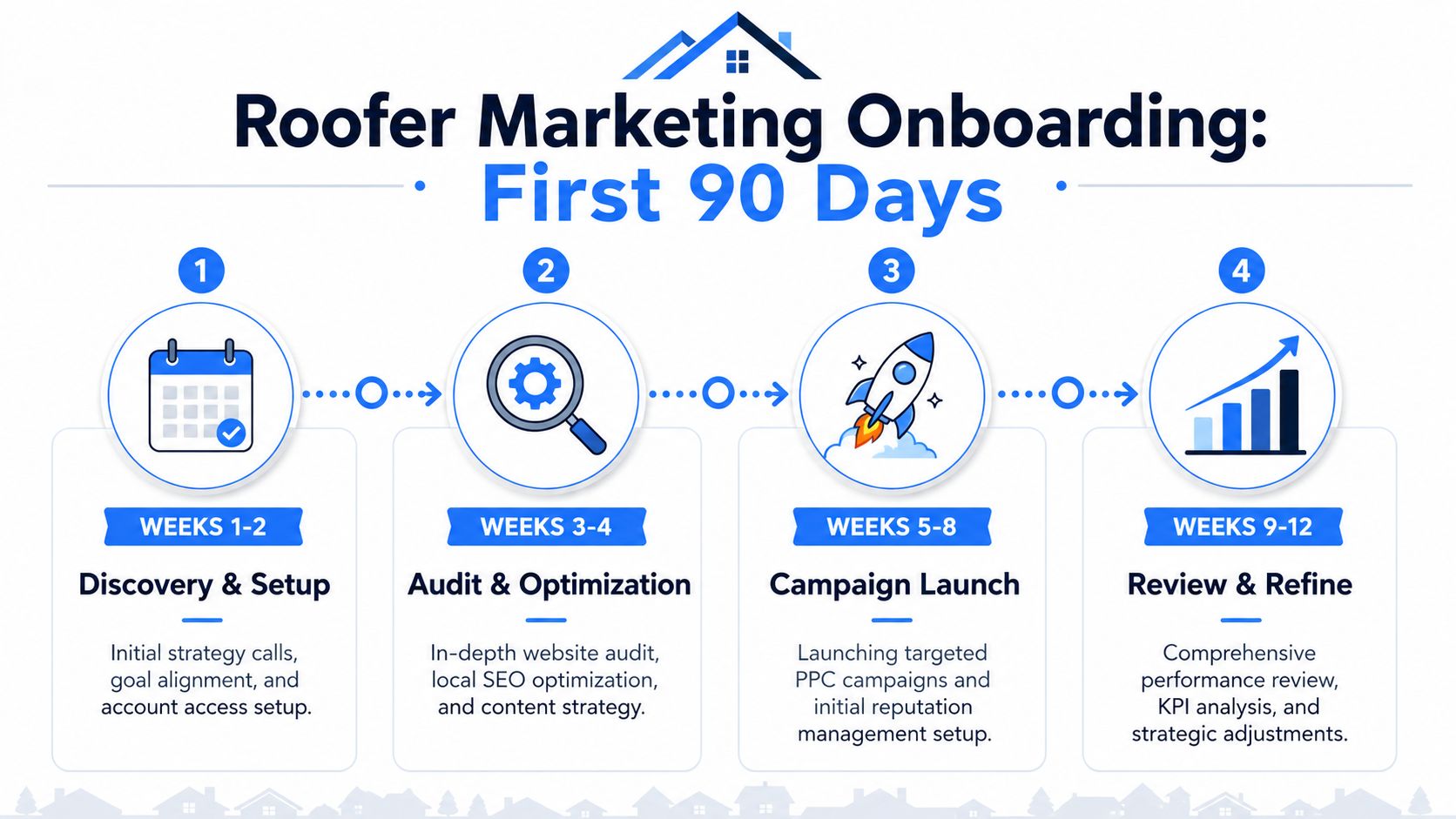
A strong agency relationship should feel organized from day one. Not chaotic. Not mysterious. Not “wait three months and trust the process.”
The first ninety days should produce visible setup progress, better local search alignment, cleaner tracking, and early movement around your transactional targets.
What the first month should look like
The agency should start with access, audit work, keyword targeting, page planning, Google Business Profile review, and tracking setup. They should also identify the exact transactional terms and cities that matter most to your business.
If they're serious, they'll tighten your service pages, fix weak conversion paths, and align paid traffic with dedicated landing pages instead of dumping everything onto the homepage.
What should happen next
By the middle stretch, campaigns should be live or close to live. Local SEO improvements should be in motion. Review acquisition should have a process. Reporting should show real lead attribution, not just abstract movement.
By the end of the first ninety days, you should be able to answer a few practical questions:
- Are we more visible for transactional local searches?
- Are more calls and form leads being tracked properly?
- Which channels are producing qualified demand?
- What needs to be adjusted next?
For agencies that specialize in transactional local SEO, meaningful page-one movement for targeted local terms can happen fast when the site, maps, and content structure are already close. But speed only matters if the visibility turns into calls and booked work.
If you want a partner focused on transactional searches, Google Maps visibility, AI-ready local SEO, and measurable lead generation for roofers, talk to Transactional LLC. They help service businesses show up where buyers are ready to act, then track performance in a way that ties marketing to real business outcomes.