
You're probably in one of two spots right now. Either you've tried PPC for your roofing company and got a pile of weak calls, junk form fills, and people outside your service area. Or you haven't started yet because every agency pitch sounds the same, and none of them explain how to turn ad spend into booked roofing jobs.
That frustration is justified. PPC for roofers is expensive, competitive, and brutally unforgiving when the setup is sloppy. But it also works fast when you build it around the only searches that matter: transactional searches. Terms like roofer near me, emergency roof repair near me, and roof replacement contractor in [city] are where buyers show intent and money at the same time.
That's the lane to own. Not broad awareness. Not vanity traffic. Not random clicks from people reading about shingles for a school project. If you want profitable roofing PPC, you need a system built for high-intent search, local visibility, tight tracking, and a plan to turn paid demand into long-term SEO, Google Maps, and AI search dominance.
Beyond Clicks Turning PPC into Profitable Roofing Jobs
Most roofers don't have a traffic problem. They have a lead quality problem.
You can buy clicks all day. Google will happily take your money. What hurts is paying for calls from renters, DIY searchers, job seekers, or homeowners in towns you don't even serve. That's what happens when a campaign chases volume instead of intent.

Transactional searches are the only ones worth paying for
A homeowner searching how to patch a roof leak is doing research. A homeowner searching roof leak repair near me is trying to hire somebody. Those are two completely different users, and if your campaign treats them the same, your budget disappears fast.
That's why ppc for roofers should start with transactional search terms. Focus your budget on searches that signal immediate buying intent, local relevance, and service alignment. You want people searching for a contractor, not people searching for information.
Use this filter before you bid on any keyword:
- Local intent: Does the search include a city, neighborhood, or “near me” behavior?
- Service intent: Is the user asking for a roofing service, not roofing knowledge?
- Hiring intent: Does the query suggest urgency, estimate requests, repair needs, or replacement needs?
Practical rule: If a keyword sounds like something a homeowner would search right before making a call, keep it. If it sounds like something they'd search while browsing at night on the couch, cut it.
Profit starts with tracking revenue, not lead counts
A lead isn't automatically a win. One roof repair call might turn into a small one-time job. Another call might become a high-value replacement, a referral source, and future work. If you don't track that difference, you'll make bad decisions with confidence.
That's why measuring PPC ROI for roofing contractors has to come down to Customer Lifetime Value versus Cost Per Acquisition, not just immediate lead profit. The same source also points out that high-performers improve results by testing CTAs and targeting profitable segments instead of guessing.
Here's the blunt advice. Stop asking, “How many clicks did we get?” Start asking:
- Which keywords produced qualified calls?
- Which campaigns produced booked inspections?
- Which jobs closed?
- Which service lines produced the best profit?
If your office struggles to answer inbound leads fast, that bottleneck will wreck good PPC. Tools like Voicedial.ai's AI solutions can help handle appointment-setting and response speed so hot leads don't cool off while your team is on another call.
If you need the ad side built correctly in the first place, look at roofing-focused PPC ad management support that prioritizes buyer intent over empty traffic.
Building Your Transactional Keyword Playbook
A bad keyword list burns cash. A good one prints opportunities.
The mistake most roofers make is building campaigns around broad roofing terms because they “get searches.” That logic is backward. Search volume means nothing if the traffic doesn't hire you. Your keyword playbook should be built around intent tiers, not popularity.
Split keywords by buying temperature
Start with three buckets.
Emergency intent sits at the top. These are the searches from homeowners with an active problem. Think roof leaks, storm damage, tarping, and urgent repairs. These users want speed, trust, and a phone number.
Core service intent comes next. These are replacement, repair, inspection, and installation searches from people who know the service they need and are comparing providers.
Research-heavy terms belong on your SEO content plan, not your paid search budget. PPC is too expensive to fund curiosity traffic.
A practical way to organize your list:
- Emergency group: leak repair, storm damage, emergency roofer, roof tarp
- Replacement group: roof replacement, new roof installation, shingle roof replacement
- Inspection group: roof inspection, hail damage inspection, insurance roof inspection
- Commercial group: commercial roof repair, flat roof contractor, roof coating company
Add location and service modifiers
Generic keywords are weak. Localized transactional keywords are stronger.
The best PPC for roofers uses keyword combinations that mirror how buyers search:
- Service plus city: roof repair in [city]
- Service plus urgency: emergency roof leak repair
- Service plus property type: residential roof replacement
- Service plus local behavior: roofing contractor near me
PPC targeting for roofing contractors works because it lets you target specific local keywords tied to buying intent. That geographic and keyword customization is what separates high-intent lead generation from broad ad waste.
Your negative keyword list is your shield
Negative keywords aren't optional. They are one of the main controls that keep you from paying for the wrong searches.
Most junk traffic falls into predictable buckets. Job seekers. DIYers. Material shoppers. People looking for unrelated roofing information. Add negatives from day one, then expand the list every week by checking search term reports.
Here's a starter table.
| Category | Example Negative Keywords |
|---|---|
| Employment | jobs, hiring, careers, salary, apprentice |
| DIY research | how to, diy, tutorial, instructions, guide |
| Materials shopping | shingles, metal sheets, supplies, home depot, lowes |
| Education | class, course, training, certification |
| Irrelevant intent | images, pictures, free plans, pdf |
The fastest way to wreck a roofing campaign is to pay for searches from people who never intended to hire a roofer.
Build ad groups around service reality
Don't throw every roofing keyword into one ad group. Separate them by service line and customer intent so your ads can match the search tightly.
For example, emergency roof leak repair shouldn't share ad copy with commercial flat roof replacement. Different pain point. Different sales cycle. Different landing page. Different close process.
If you want a stronger process for sorting search intent and building cleaner keyword clusters, review these keyword research best practices for local campaigns.
Architecting Campaigns for Local Dominance
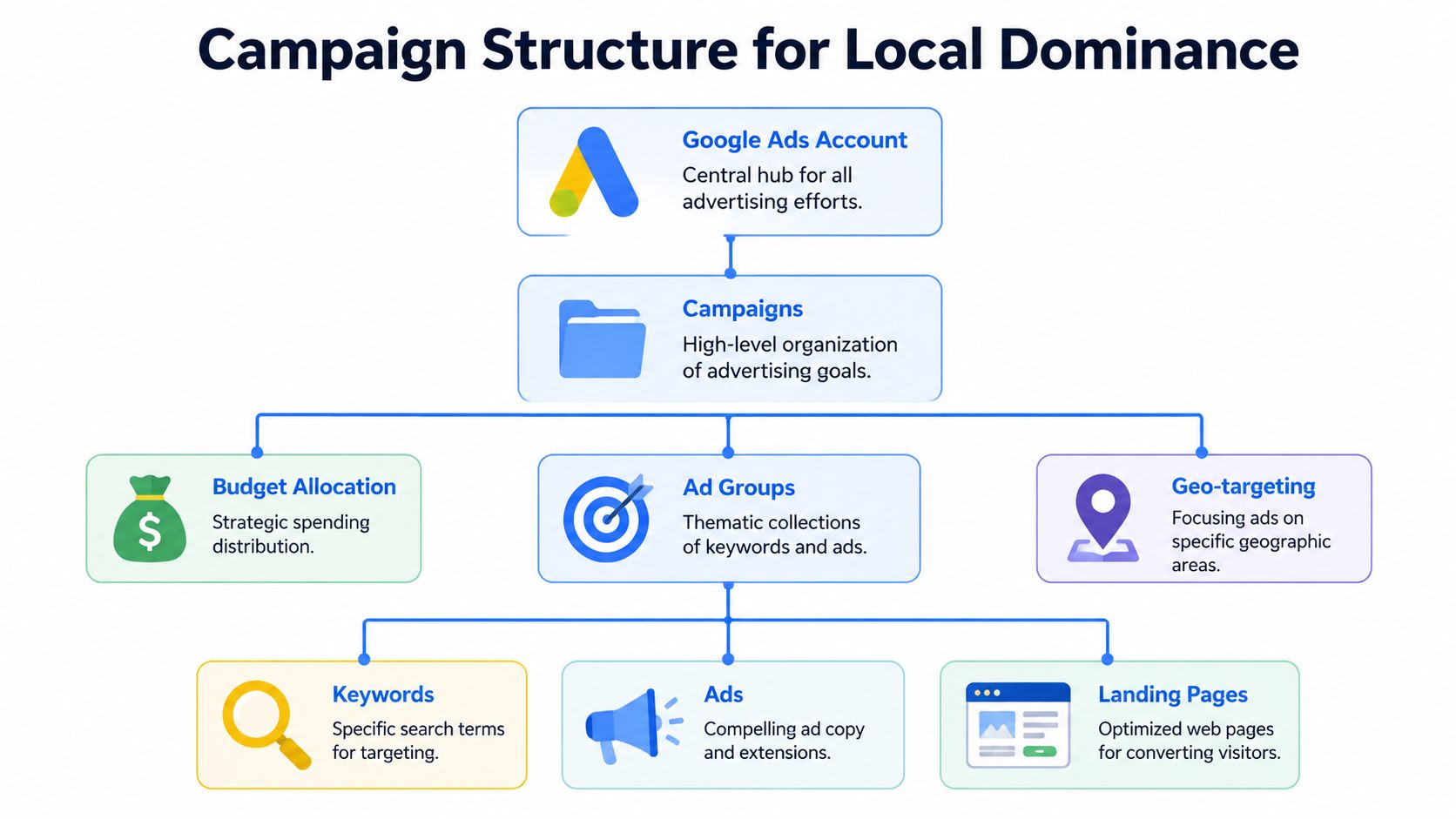
A homeowner in your target city searches “roof leak repair near me” at 8:12 a.m. If your account structure mixes repair, replacement, commercial, and every town you vaguely serve, Google gets weak signals, your ad gets generic, and that lead goes to a competitor with a cleaner setup.
Build campaigns around profit centers and buying intent
Your account should mirror the way roofing jobs are sold and fulfilled. Separate high-intent service lines so you can control budgets, ad copy, landing pages, and follow-up without guesswork.
A clean structure usually includes:
- Residential roof replacement campaign
- Residential roof repair campaign
- Emergency storm damage campaign
- Commercial roofing campaign
- Brand campaign
Then tighten the structure again inside each campaign. Break out ad groups by service type, roof system, or problem if that distinction matters to the customer and to your sales process. “Metal roof replacement” and “shingle roof replacement” often need different messaging, different proof, and different pages.
Keep campaigns narrow enough to steer spend with precision, but not so fragmented that you choke volume.
Put budget where job value is highest
Budget allocation should follow gross profit, close rate, and average ticket. A replacement lead and a small repair lead do not deserve the same bidding strategy if one produces far more revenue and stronger margins.
Google's Local Services and home services ad benchmarks from WordStream are a useful reference point for how expensive this category can get. Use that reality to set priorities early. Give your best service lines their own budgets. Protect branded search. Cap spend in lower-value segments until they prove they can produce qualified jobs.
This is also where landing page structure matters. If you need a better system for matching campaigns to pages and forms, review these website conversion rate improvement strategies.
Control geography like a contractor, not a tourist
Do not target every city within two hours just because Google says you can.
Target the places where your crews can respond fast, your reviews are strongest, and your close rates hold up. If one county produces replacement jobs and another mostly sends small repairs, split them. If a city performs well, give it its own campaign or its own location-focused assets so you can bid harder there.
Google's location targeting settings documentation explains how presence settings work. Use “Presence” targeting where possible so you focus on people in your service area instead of everyone who happened to type that city name.
Align PPC with Google Maps and local SEO
PPC should do more than buy clicks. It should reinforce your local authority signals across search.
Your ads, landing pages, city pages, and Google Business Profile need to say the same thing about your service areas and core jobs. That alignment helps you capture transactional searches now while strengthening the local relevance that supports Maps rankings and long-term SEO.
This is the bridge strategy roofers miss. Paid search captures demand today. Maps optimization and local SEO compound that demand capture over time. Together, they increase your visibility for “roofer near me” searches in paid results, map packs, and AI-generated local recommendations.
Use location extensions. Match city names on the ad and the landing page. Send traffic to pages built for that service and that market. If you want a smart outside perspective on page structure, even this guide on optimizing landing page conversions for designers is useful for tightening layout and reducing friction.
Local dominance comes from repetition and consistency. Show Google, and the buyer, the same service, the same market, and the same offer everywhere.
Crafting Ads and Landing Pages That Convert
A homeowner searches “roof leak repair near me” at 8:12 PM during a storm. They click your ad. If they land on a generic homepage with a hero slider, five service lines, and no clear next step, you just paid for a bounce.
That is where roofing PPC campaigns waste money. The keyword had intent. The click had urgency. The ad and landing page failed to carry that intent through to a call, form, or booked inspection.
Write ads for buyers, not browsers
Your ad should answer one question fast. “Am I in the right place for the job I need in my city?”
Write ads around high-intent service terms and local proof. Use the exact job type. Use the city or service area. Use a direct action. Add one trust cue that lowers risk.
Strong roofing ads usually include:
- Exact service match: roof repair, roof replacement, storm damage repair
- Local relevance: city name, county, or service area
- Direct CTA: call now, schedule inspection, request estimate
- Trust cue: licensed and insured, financing available, insurance claim help, same-day response
Skip vague branding lines. “Quality you can trust” says nothing. “Roof Repair in Plano. Call for Same-Day Inspection” gives the searcher a reason to act.
Use the ad assets that support action:
- Call extensions for immediate phone leads
- Location extensions to reinforce proximity and support Maps visibility
- Sitelinks for repair, replacement, financing, inspections, and insurance claims
This is the Transactional Marketing angle in practice. Your PPC ad captures the buyer who is ready now, while the service, location, and offer consistency also support your Google Maps signals and long-term local SEO.
Send every click to a page built for that search
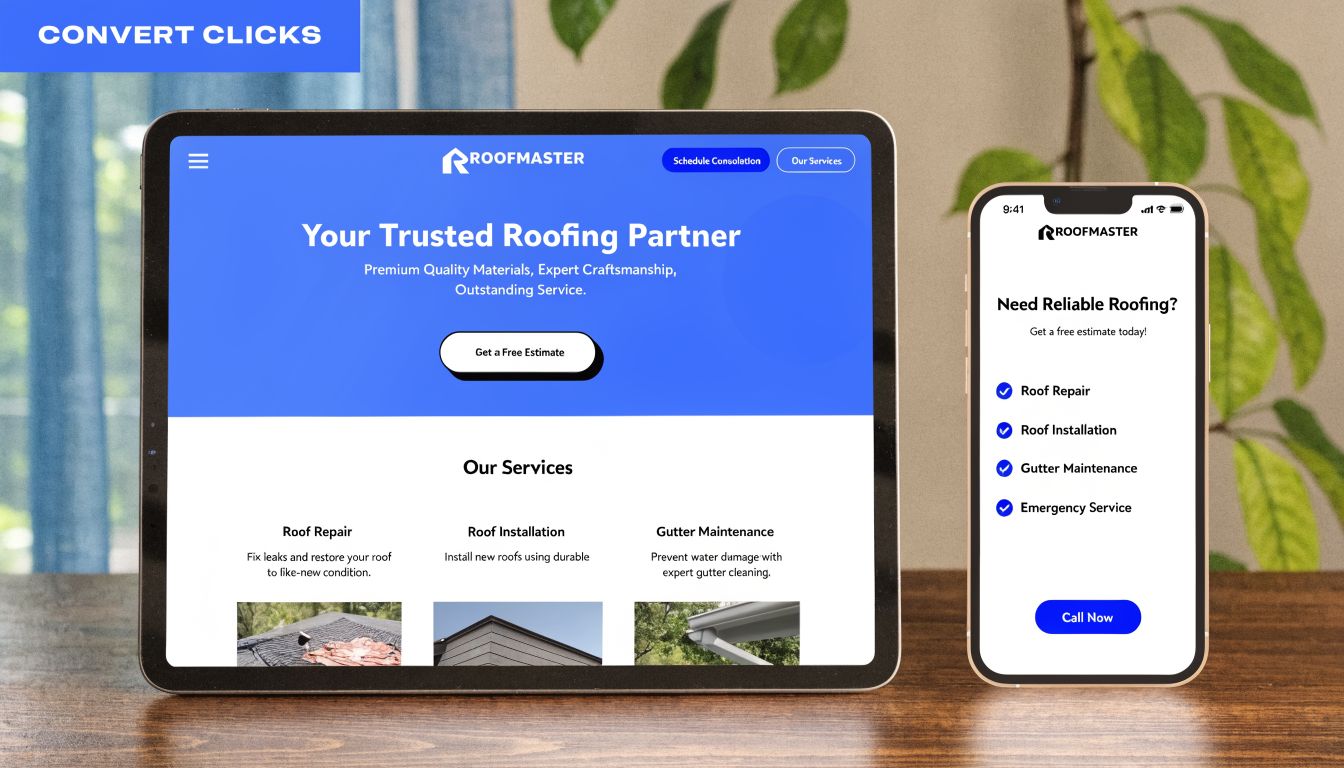
Paid traffic needs message match. If the ad is about emergency roof leak repair in Arlington, send the click to an Arlington emergency leak repair page. Same service. Same market. Same offer. Same CTA.
Homepages dilute intent. Dedicated landing pages convert it.
Clicks in roofing are expensive enough that sloppy routing kills margin fast. Budget allocation across repair, replacement, storm work, and commercial only works when each service has its own page and its own conversion path. Otherwise you blend different buyer intents into one weak experience and wonder why lead quality is inconsistent.
A paid click should feel like the next sentence of the ad.
Build landing pages that remove doubt
Roofing landing pages do not need clever copy. They need clarity, proof, and an easy next step. For a practical framework, review this guide on how to improve website conversion rate.
Include these elements on every PPC page:
Headline match
Repeat the service and location clearly in the headline.Primary CTA above the fold
Put a click-to-call button and short estimate form at the top.Proof near the CTA
Add reviews, star ratings, certifications, insurance badges, financing options, and recent project photos.Service scope
State exactly what jobs you handle, what areas you serve, and what happens after the form fill or call.Mobile-first layout
Roofing buyers often call from a phone. Buttons need to be obvious. Forms need to be short. Load speed needs to be fast.Local relevance throughout the page
Use the city name naturally in the headline, subheads, proof sections, and FAQs so the page reinforces transactional local intent instead of reading like a generic national template.
If you want extra design inspiration on page structure, this piece on optimizing landing page conversions for designers is useful because it breaks down the mechanics of focused landing page building without overcomplicating the process.
Video walkthroughs can also help your team think about page flow and message match:
Measuring What Matters Calls Jobs and ROI
Clicks are not the scoreboard. Booked jobs are.
Roofing owners get misled when they stare at impressions, click volume, and average position while ignoring the numbers that control profit. You need a measurement system that follows the lead from search to call to CRM to closed revenue.
Start with call tracking
Phone calls drive a huge share of roofing conversions, especially for urgent searches. If you're not tracking calls correctly, your reporting is wrong from the start.
Roofing PPC performance benchmarks show average campaigns convert at 2.35 percent, while optimized campaigns can reach 10 percent or more. The same source says 30 to 40 percent of leads are missed without proper call tracking, and it recommends targeting CTR above 4 percent, CPA between $150 and $300 per qualified lead, and Quality Score above 7, which can cut costs by up to 50 percent.
That one paragraph should reset how you look at reporting. If your setup misses phone leads, you're not optimizing based on reality.
Track qualified leads, not raw conversions
Not every form submission matters. Not every call is worth counting. A conversion should only matter if it has buying potential.
Use a process like this:
- First layer: track calls, forms, and chats inside Google Ads and analytics
- Second layer: push those leads into your CRM
- Third layer: mark lead quality, estimate status, and closed job status
- Final layer: compare cost against actual revenue and customer value
Measurement filter: A click is interest. A lead is contact. A qualified lead is opportunity. A booked job is what pays payroll.
Attribution based solely on a thank-you page often causes many roofing accounts to fail. This practice represents shallow reporting. You need visibility into whether the lead was good, whether your team answered fast, and whether the job closed.
Watch the right KPIs every week
The best weekly review isn't long. It's disciplined.
Focus on:
| KPI | Why it matters |
|---|---|
| Qualified calls | Shows whether your traffic has intent |
| Cost per qualified lead | Tells you if lead generation is sustainable |
| Close rate by campaign | Exposes where sales and marketing align |
| Cost per booked job | Connects ad spend to outcomes |
| Search terms | Finds waste and new keyword opportunities |
Don't overreact to one day of data. But don't let campaigns drift either. Weekly reviews catch wasted spend, ad fatigue, and search term pollution before they become expensive habits.
If you need a clean framework for evaluating spend against outcomes, this breakdown of how to calculate cost per acquisition is the right place to tighten your process.
From Paid Clicks to Sustainable Growth
A storm hits your service area on Tuesday. Search volume spikes that afternoon. Your ads start pulling in calls for "roofer near me," "emergency roof repair," and "roof leak repair." Good. Now decide what happens next. You can keep paying for that demand forever, or you can use PPC to identify the searches, locations, and offers that deserve permanent investment across Maps, SEO, and AI search visibility.
That second path wins more market share.
PPC should sit at the front of your local growth system, not in a silo. It captures high-intent transactional demand fast. Then it gives you direction. You see which service terms bring booked jobs, which ZIP codes produce real revenue, and which messages get homeowners to call now instead of "looking around."
Use that information to strengthen assets you own:
- SEO pages built around proven transactional terms
- Google Business Profile categories, services, posts, and photos aligned to those same terms
- City and service area pages based on search demand that already converts
- FAQ and service content written to answer the local buying questions AI search systems surface
The goal is simple. Paid search finds the signal. Maps and SEO turn that signal into a durable lead source.
This analysis of long-term PPC strategy for roofing contractors gets the big idea right. PPC works best as a demand capture channel and a research engine. Use it to get leads now while you build stronger organic visibility for the same searches that already produce revenue.
Roofers that dominate locally usually do three things well. They show up in paid results for transactional searches. They show up in the map pack with strong reviews, accurate categories, and recent activity. They show up organically with location and service pages that match what buyers are searching. That overlap matters because homeowners compare options fast, and repeated visibility builds trust before your salesperson even answers the phone.
This is also where the Transactional Marketing approach matters. You are not chasing traffic for its own sake. You are building control over local buying intent. PPC gets you immediate coverage on high-intent searches. Google Maps gives you durable visibility where local buyers make decisions. SEO expands your footprint over time. AI-driven search pulls from that broader local authority and rewards businesses with clear, relevant, location-specific content.
Protect the business behind the lead flow too. This comprehensive guide for roofing businesses is a useful resource for handling the operational side of growth, risk, and scale.
If you still treat ppc for roofers as a standalone lead source, you will keep renting demand. Use it instead as the bridge to stronger Maps visibility, better SEO targets, and long-term local dominance.