

You've built the treatment menu. You've invested in staff, devices, training, and a space that looks premium the second a patient walks in. But the schedule still has holes in it, and that's the part most med spa owners find maddening.
It usually doesn't mean your services are weak. It means your visibility is weak where it matters most.
A med spa can have beautiful branding, polished Instagram posts, and a sleek homepage and still lose the patient who searches “Botox near me” or “microneedling in [city]” and books with the first credible option they find. That patient isn't looking for a lifestyle brand. They're looking for a provider they trust enough to contact now.
Your Med Spa Is Ready Are the Patients
A common scenario looks like this. The owner has a strong injector, a capable front desk team, and a treatment lineup people want. The clinic photographs well. The reviews are decent. Yet week to week, patient flow feels uneven.
That problem usually gets misdiagnosed.
The fix is rarely “post more on social” or “refresh the brand colors.” The underlying problem is that too many med spas aren't showing up when local, high-intent patients are actively searching for treatments. They're visible in broad ways, but invisible at the booking moment.
The gap isn't quality, it's conversion path
A lot of med spas have what looks like “marketing.” They have a website, social pages, maybe a few ads running. But when you inspect the path from search to booked appointment, it falls apart.
Typical weak points include:
- Homepage-first structure: The site talks about the brand but doesn't give each treatment its own search-focused landing page.
- Soft calls to action: Visitors can browse, but they can't easily book, call, or request a consultation from every key page.
- Low-intent content: Blog posts chase broad topics instead of answering the questions that precede a booking decision.
- Poor mobile experience: Most local treatment searches happen on phones, and a clunky mobile site kills momentum fast.
If that sounds familiar, start with the basics of improving website conversion rate before you spend another dollar driving traffic.
Practical rule: If your site gets traffic but not consultations, the issue usually isn't traffic alone. It's that the wrong pages are ranking, or the right pages aren't built to convert.
The med spa owner who feels stuck often isn't dealing with an operations problem. They're dealing with a patient acquisition problem. That's good news, because acquisition problems can be fixed with focus.
Why a Transactional Marketing Agency Is Different
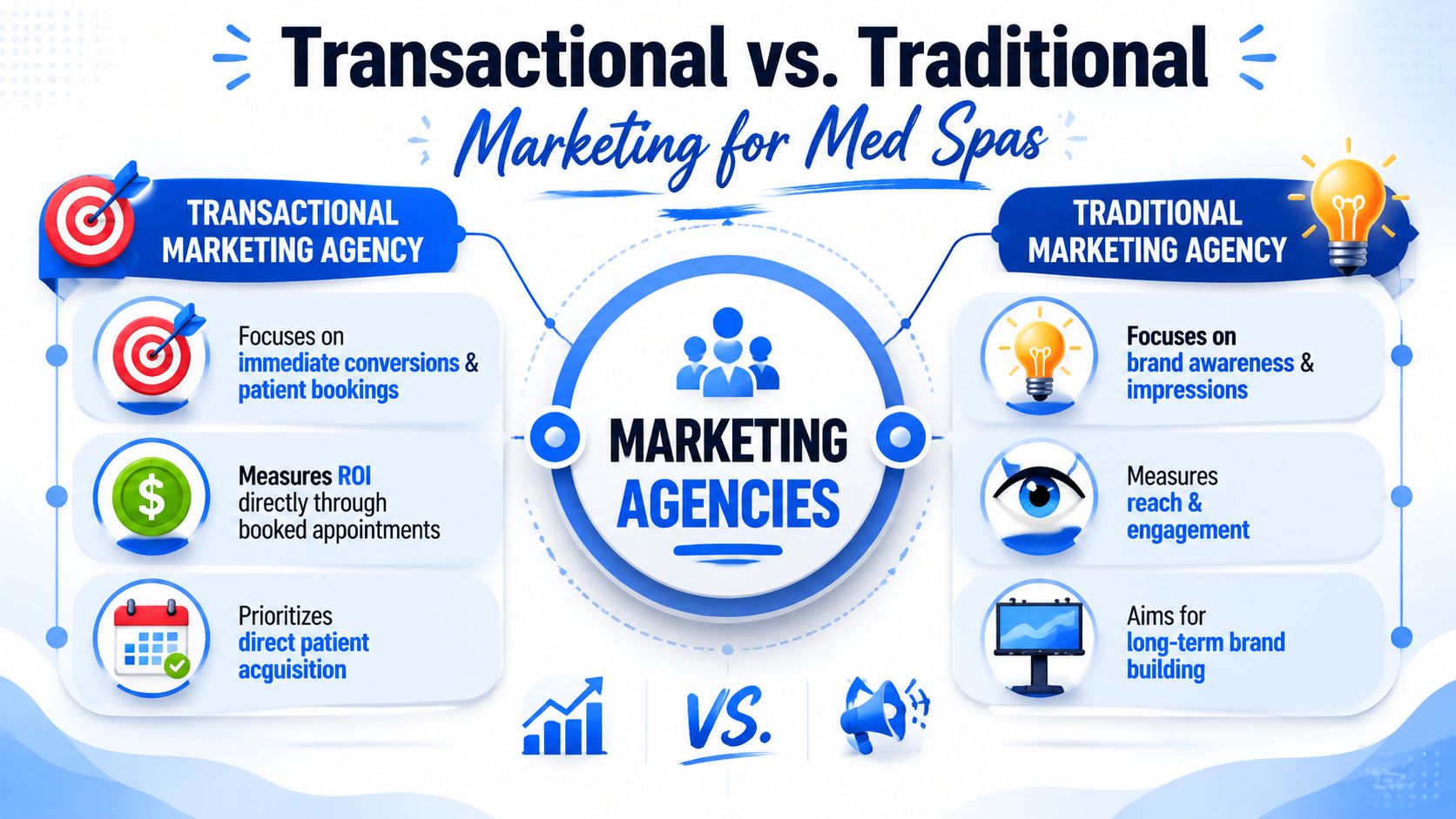
Most agencies sell visibility. A strong medical spa marketing agency should sell booked appointments.
That distinction matters more now because competition is heavier than ever. The U.S. medical spa market has grown from about 1,600 locations in 2010 to over 10,500 in 2023, which means standing out in local search is no longer optional, according to this industry roundup on med spa marketing data.
Traditional agencies chase awareness
Traditional agencies tend to emphasize reach, impressions, engagement, and “brand presence.” Those things aren't worthless. They're just not enough for a med spa that needs appointments on the calendar this month.
If an agency leads with follower growth, vague awareness campaigns, and glossy reporting, be careful. Med spas don't stay busy because people admired a reel. They stay busy because they captured high-intent demand at the exact moment someone searched for a treatment and a location.
A search like “lip filler near me” is different from “med spa skincare tips.” One is informational. The other is transactional. One person is browsing. The other is close to spending money.
Transactional agencies go after buyer-intent searches
A transactional approach starts with the search terms that signal action. Think:
- Treatment plus city: “CoolSculpting in Austin”
- Treatment plus near me: “Botox near me”
- Service plus urgency or intent: “same day lip filler consultation”
- Brand plus treatment category: “med spa laser hair removal [city]”
That's where the money is. That's where a serious medical spa marketing agency should focus.
A good agency doesn't just rank broad terms. It builds pages, map signals, internal links, and paid campaigns around terms that indicate the patient is ready to choose. That means fewer vanity wins and more phone calls, form fills, and consultation requests.
Stop rewarding agencies for traffic that doesn't turn into bookings. A med spa doesn't need more visitors. It needs more ready-to-book patients.
AI optimization changes how med spas get found
Google still matters. Google Maps matters even more for local intent. But AI search is now part of discovery.
Patients increasingly use AI assistants and large language models to ask longer, more specific questions. They don't just search “Botox near me.” They ask things like “what med spa near me offers Botox and microneedling with good reviews” or “best med spa for hyperpigmentation treatment in my area.”
That changes content strategy.
A modern medical spa marketing agency should optimize for both traditional search and AI optimization. That means publishing content and treatment pages that are structured clearly, answer decision-stage questions directly, and reinforce local relevance. AI systems tend to surface pages that are specific, trustworthy, and easy to interpret. Generic fluff won't win.
What the right metrics look like
A transactional agency measures success differently. It looks at:
- Booked consultations
- Calls from high-intent pages
- Google Business Profile visibility
- Treatment page performance
- Lead-to-booking movement
- Which channels assist the final conversion
If the reporting stops at impressions and click-through rate, you're not looking at the full picture.
Core Services That Drive Patient Bookings
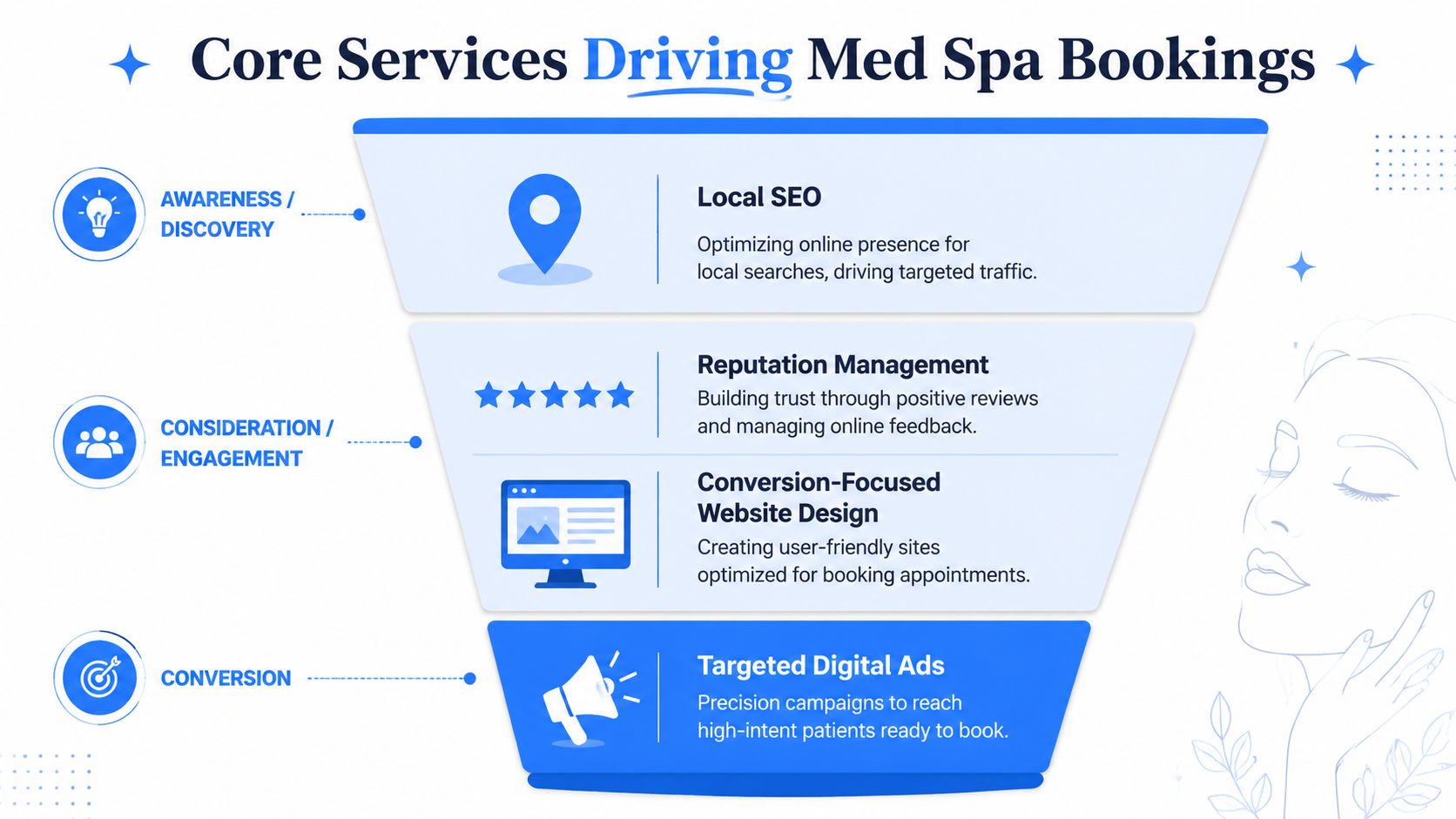
A med spa doesn't need more random marketing activity. It needs a patient acquisition system. The best medical spa marketing agency builds that system through local SEO, Maps visibility, paid search, reputation management, and conversion-focused content.
Local SEO brings in high-intent searchers
SEO for med spas shouldn't start with blogging. It should start with service architecture.
Every high-value treatment needs its own page. Not a paragraph on a general services page. A dedicated page. If you offer Botox, fillers, microneedling, laser hair removal, chemical peels, and body contouring, each one should have a page built around the language patients use when searching.
That page should include:
- Treatment-specific headings: Clear relevance for the exact service
- Location modifiers: City and service area language where appropriate
- Visible conversion points: Call buttons, booking CTAs, consultation forms
- Trust elements: Before-and-after galleries, FAQs, review snippets, provider credibility
Many clinics often find themselves stuck. They publish broad beauty content but ignore the pages that could rank for buying-intent searches. A focused approach to local SEO for med spas fixes that.
Industry guidance also points to a clear performance gap here. Organic search delivers an average conversion rate of 14.6% for med spas, while paid channels typically convert between 1.7% and 4.9%, according to PatientNow's med spa marketing analysis. That's why SEO and content built around high-intent searches deserve serious attention.
Google Maps is where local buying intent shows up
If your med spa isn't visible in the map pack, you're missing some of the best traffic available.
Maps visibility matters because local treatment searches often trigger immediate action. Patients compare reviews, proximity, hours, and photos in a few seconds. Then they tap call, directions, or website. That's not passive awareness. That's bottom-funnel behavior.
A proper Maps strategy includes:
- Category alignment so the profile matches the services you want to win
- Service-area relevance through location consistency and page support
- Review acquisition that builds trust around the right treatments
- Photo and profile activity that makes the listing look alive and credible
This is also where many agencies overpromise and under-explain. Ask them how they improve local prominence, proximity relevance, and treatment-page support for the profile. If they can't answer cleanly, they're guessing.
Field note: A Google Business Profile is not a side asset. For many med spas, it's the highest-intent storefront they have online.
Paid ads should support demand, not replace strategy
Paid search works best when it captures intent that already exists. It works worst when it tries to manufacture interest with broad targeting and weak landing pages.
For med spas, the right paid campaigns usually revolve around treatment terms, local modifiers, and strong call-to-action landing pages. The wrong campaigns chase vague beauty interests and produce low-quality leads.
Use ads to reinforce your organic strategy, not compensate for a broken one.
Social can still help, especially for retargeting and trust-building, but it needs discipline. If your team wants a stronger framework for campaign planning, these strategies for agency social media campaigns offer useful ideas on organizing messaging and creative by audience intent.
Content should answer patient decision questions
A lot of med spa content is written for nobody. It sounds polished, but it doesn't answer the questions patients ask right before they book.
Better topics sound like this:
- Is this treatment right for my age
- How long is recovery
- What does Botox feel like
- How many microneedling sessions do I need
- What's the difference between filler and Botox
- Which treatment helps with acne scarring
Those are decision-stage questions. They build trust, support SEO, and feed AI discovery.
The content should also be compliant. If you use patient imagery, testimonials, or automated email and SMS follow-up, the strategy has to respect consent, avoid unnecessary clinical detail in marketing copy, and separate promotional workflows from protected clinical information. Good agencies understand that the creative side and the compliance side can't be separated in this industry.
How to Evaluate and Hire the Right Agency
Most med spa owners don't hire the wrong agency because they're careless. They hire the wrong agency because the sales process rewards presentation, not proof.
A polished deck is easy to produce. A reliable patient acquisition system is harder. If you're evaluating a medical spa marketing agency, your job is to force specificity.
Ask how they think, not just what they sell
Start with the operating model. Don't ask “Do you offer SEO, paid ads, and social?” Every agency will say yes.
Ask questions that reveal whether they understand local, transactional demand:
- Which treatment terms would you target first in my market, and why?
- How would you structure the site so treatment pages rank and convert?
- What would you do to improve Google Maps visibility?
- How do you report on booked appointments, not just leads?
- How do you show when SEO, ads, email, and social influence the same patient journey?
That last question matters more than most owners realize. A 2025 analysis found that 75% of med spas could not identify which specific channel combination drove their highest-intent leads because agencies report isolated metrics. The better standard is reporting that explains how channels work together, not in silos.
Questions to ask your potential med spa marketing agency
| Question Category | What to Ask | What a Good Answer Sounds Like |
|---|---|---|
| Strategy | Which transactional search terms would you target first for my med spa? | They name treatment-plus-location terms and explain priority by intent and service value. |
| Local SEO | How will you improve my visibility in local organic results? | They talk about treatment pages, internal linking, local relevance, and on-page structure. |
| Google Maps | What is your approach to Google Business Profile and map rankings? | They explain profile optimization, review strategy, category alignment, and local landing page support. |
| Website | What changes would you make to my site first? | They focus on conversion paths, mobile UX, booking CTAs, and treatment-specific pages. |
| Reporting | What metrics will you show me every month? | They emphasize leads, booked appointments, page performance, call quality, and channel interaction. |
| Content | How do you decide what content to publish? | They mention decision-stage patient questions, AI visibility, and treatment-specific educational content. |
| Compliance | How do you handle testimonials, imagery, and email or SMS workflows? | They discuss consent, audience segmentation, and avoiding risky use of clinical details in marketing. |
| Contract terms | What happens if results stall? | They give a clear process for adjustment and don't hide behind vague long-term promises. |
Watch for reporting that hides the truth
A weak agency report looks busy. A strong report looks useful.
You want to know:
- Which pages brought consultation-ready traffic
- Which keywords showed purchase intent
- Whether calls came from Maps, organic pages, or ads
- How follow-up channels helped recover missed opportunities
- What changed this month that affected patient acquisition
If an agency can't connect those dots, you're paying for activity reporting.
For a broader comparison of team structure and ownership, REACH offers a useful take on in-house marketing vs agency support. It's worth reading if you're deciding whether to build internally, outsource, or use a hybrid model.
Don't let jargon replace accountability
Agencies love terms like omnichannel, full funnel, brand lift, and engagement ecosystem. Most of the time, those phrases are substitutes for clarity.
Push for plain English. Ask them to explain exactly how a stranger searching for a treatment becomes a booked consultation. Then ask how they track that path. If the answer feels slippery, move on.
The right agency should make your growth model easier to understand, not harder.
If you want a sharper checklist before signing anything, use a guide on how to choose a digital marketing agency and compare every proposal against it. You'll spot weak operators fast.
The 60-Day Difference Real Results for Med Spas
The fastest visible wins in med spa marketing usually come from focus, not volume. You don't need fifty random tactics. You need the right pages, the right local signals, and the right search terms.
Here's what a disciplined rollout often looks like in the first couple of months for a med spa entering a competitive local market.
First the strategy gets narrow
Start with a shortlist of treatments that matter most to revenue and demand. Then match each one to local buying-intent searches. Not broad beauty phrases. Actual transactional terms such as treatment-plus-city, treatment-plus-near-me, and consultation-oriented variants.
That's followed by page-level rebuilds. The strongest agency partners treat a med spa website as a conversion system, not a brochure. Guidance from Aesthetix CRM's med spa marketing plan stresses treatment-specific SEO pages, clear calls to action, and mobile-first design because traffic only matters if it turns into bookings.
A realistic first-phase checklist often includes:
- Treatment page rebuilds: Clear search intent, local relevance, FAQs, and booking prompts
- Map support work: Stronger Google Business Profile alignment with target services
- Call tracking and form tracking: So the clinic knows what generates inquiries
- Content expansion: Decision-stage pages that support both search engines and AI assistants
Then the conversion path gets cleaned up
A hypothetical med spa might start with a decent-looking site and weak performance. The homepage gets most of the attention. Service pages are thin. Mobile booking is clumsy. The profile ranks inconsistently in Maps.
Once the treatment pages are rebuilt and local signals are tightened, the whole system starts making more sense. Searchers land on the exact service page they wanted. They see proof, answers, and a direct next step. Front desk staff get better calls because the messaging is more specific before the patient even contacts the clinic.
That's also when measurement starts to matter. If you aren't tracking page-level and channel-level effectiveness, you can't improve intelligently. A clean framework for measuring marketing effectiveness helps clinics see whether growth came from local SEO, Maps, paid search, or the combined lift of all three.
Later in the process, video can reinforce trust and clarify your offer. This kind of media works best after the core search foundation is in place.
What owners usually notice first
The first signs of progress usually aren't abstract. They're operational.
Front desk teams notice better-quality calls. Owners see more searches landing on treatment pages instead of only the homepage. Consultation requests become more specific. The business stops relying on random bursts of attention and starts building a steadier pipeline.
That's the key difference. A strong medical spa marketing agency doesn't just “do marketing.” It builds search visibility where patient intent already exists, then removes friction between that search and the booking.
Your Next Step to a Fuller Appointment Book
If your med spa is delivering good treatments but your schedule still feels too dependent on chance, stop blaming the service side. The issue is usually acquisition.
A strong medical spa marketing agency should help you win transactional search terms, strengthen Google Maps visibility, and turn your website into a booking tool. That's the work that drives patient flow. Not vague awareness campaigns. Not pretty reports. Not content that never reaches decision-stage searchers.
Use a simple standard when you evaluate your current marketing. Ask three questions:
- Are we visible when local patients search for the treatments we sell?
- Does our Google Business Profile help us win high-intent local clicks and calls?
- Does our website make it easy for a ready-to-book patient to take action now?
If the answer is no to any of those, your marketing isn't doing its job.
The med spa category is crowded. Patients have options. The clinics that win are the ones that show up first, answer the right questions, and make booking easy. That applies to classic search and to AI-driven discovery through LLMs and answer engines.
Don't spend another quarter funding marketing that looks active but doesn't produce consultations.
If you want help applying this approach to your med spa, Transactional LLC focuses on local SEO, Google Maps visibility, AI-driven content, and conversion-focused search strategy built around transactional terms. If your goal is to show up when patients are ready to book, they're worth talking to.