


You're probably looking at ad reports right now and asking the same question most local business owners ask after wasting money for a few months: why did I get “visibility” but not enough phone calls? That's the trap. A dashboard full of impressions doesn't book jobs. Clicks don't matter either if they come from the wrong person at the wrong time.
For a home service company, the key question isn't just CPM or CPC. The fundamental question is this: which ad model puts you in front of someone searching a transactional term like “AC repair near me,” “emergency plumber near me,” or “roof leak repair near me” when they're ready to hire?
If your goal is local dominance, you have to think like a buyer with a problem, not like an ad platform selling reach. That means focusing on the channels and bidding models that line up with high-intent local searches, Google Maps visibility, and the way AI-driven search tools decide which businesses deserve attention.
Choosing an Ad Model for Transactional Customers
A lot of service businesses get sold the wrong outcome.
A marketing rep tells them their ads were seen by thousands of people. The owner hears that and assumes the phones should ring. Then the month ends, the spend is gone, and the only thing that increased was confusion. The report says impressions went up. The calendar says open slots are still open.
That's what happens when you optimize for being seen instead of being chosen.
Why local service companies can't afford soft metrics
If you run HVAC, plumbing, roofing, electrical, pest control, or a dental office, your best leads come from transactional searches. These are searches from people with a real problem and a real budget. They aren't browsing for entertainment. They want someone now.
Examples are easy to spot:
- Urgent repair searches: “furnace repair near me,” “24 hour electrician near me”
- Local buyer searches: “roofing company in [city],” “dentist near me”
- Decision-ready searches: “best AC repair company near me,” “same day plumber near me”
That's the traffic worth paying for.
Most local businesses don't need more exposure. They need more exposure to people ready to call.
This is also why ad structure matters. Your bid model, keyword intent, landing page, call tracking, and map visibility all need to support the same outcome. If your ad says one thing, your page says another, and your Google Business Profile is weak, you lose the lead even if you win the click.
The basics of strong ad construction still matter. If you want a sharper breakdown of headlines, offers, calls to action, and page alignment, review these core elements of advertisements.
The right customer is worth more than broad reach
A display campaign can put your name in front of a lot of people. That doesn't mean those people need a water heater today. A search campaign built around transactional terms can reach fewer people and still drive more booked jobs because the buyer's intent is stronger.
That's the lens you should use for every decision in this article. Not reach. Not vanity traffic. Not “awareness” for its own sake.
Booked work wins.
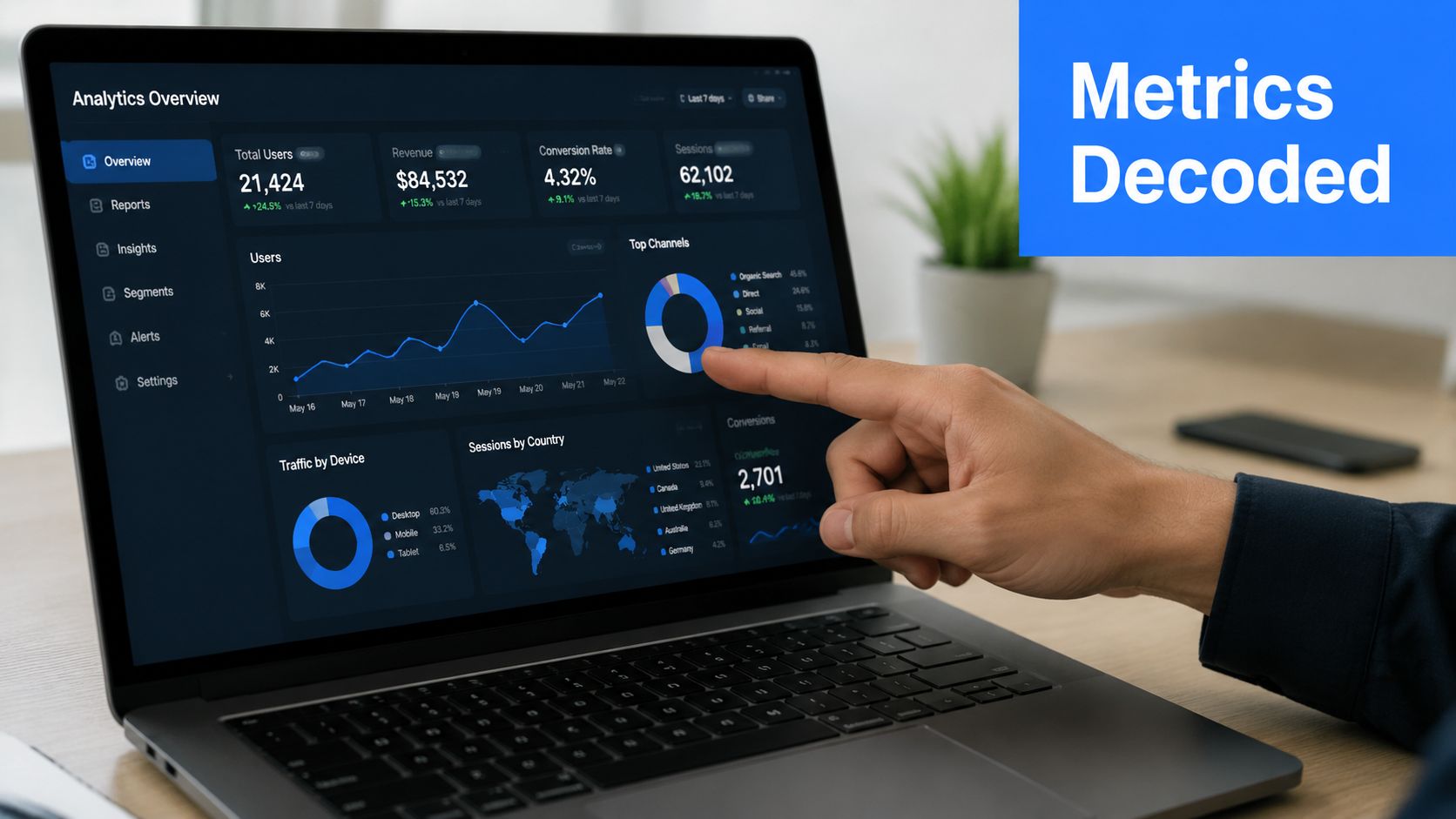
Decoding Ad Metrics CPM vs CPC
CPM and CPC are two of the oldest and most important ad pricing models in digital marketing. They exist because advertisers don't always want to buy the same thing.
According to Epom's guide to CPM, CPC, and CPA, CPM charges for every 1,000 impressions, while CPC charges only when a user clicks. That same guide notes a historical milestone in 1995, when a brand paid a website for 1,000 ad impressions, and in 1996 DoubleClick helped standardize CPM for digital buying. It also gives the core formulas: CPM = campaign cost / impressions × 1,000 and CPC = campaign cost / clicks.
What CPM actually means
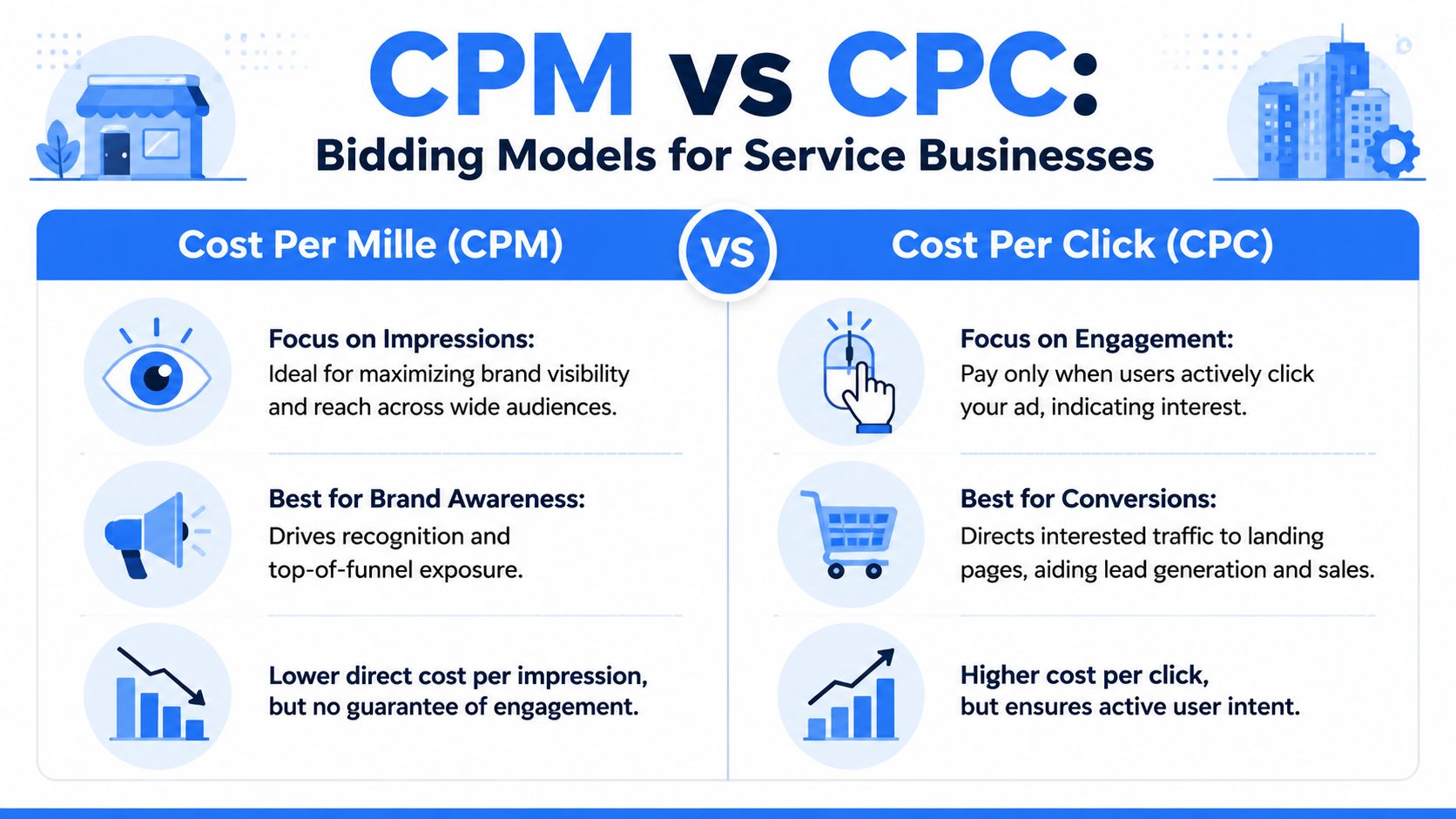
CPM stands for cost per mille, or cost per thousand impressions. In plain English, you pay to get your ad shown.
That's useful when your main goal is visibility. Maybe you want more people in your city to recognize your company name. Maybe you're entering a new market and need your trucks, logo, and offer seen across local websites, YouTube, social feeds, or display networks.
But there's a problem for service businesses. An impression is not a lead. It's not even interest. It only tells you the ad was served.
What CPC actually means
CPC stands for cost per click. You pay only when someone clicks the ad.
That makes CPC more attractive for businesses that care about action. A click still isn't revenue, but it's a stronger signal than an impression. Someone saw the offer, thought it was relevant, and took the next step.
For local search, that matters a lot. Someone searching “emergency AC repair near me” and clicking your ad is far more valuable than someone casually scrolling past your banner ad while reading sports news.
Practical rule: If the campaign's job is to make the phone ring, CPC is usually the cleaner model.
Why the distinction matters in local search
Here's the simplest way to think about CPM or CPC.
| Model | What you pay for | Best fit |
|---|---|---|
| CPM | Ad views | Reach, brand awareness, repeated local visibility |
| CPC | Ad clicks | Intent, traffic, lead generation, booked jobs |
If you buy ads without understanding this difference, you'll judge success by the wrong metric.
If you want more context on search-side pricing and what paid traffic really costs in competitive markets, this breakdown of Google paid search cost is worth reading.
Comparing Bidding Models for Service Industry Campaigns
A local service company shouldn't evaluate ad models the way a national brand does. Coca-Cola can pay for broad visibility. You need calls from people in your service area who need help now.
That changes the answer to CPM or CPC fast.
CPM vs CPC at a glance for service businesses
| Criterion | CPM (Cost Per 1,000 Impressions) | CPC (Cost Per Click) |
|---|---|---|
| Primary goal | Brand awareness and local visibility | Lead generation and action |
| What triggers cost | Every 1,000 ad impressions | Every click |
| Best fit for local services | Retargeting, broad awareness, market entry | Search campaigns targeting transactional terms |
| Risk level | Higher risk if the audience isn't ready to hire | Lower waste because a user has to act |
| Budget control | Can burn through budget with passive audiences | Tighter connection between spend and intent |
| Best channel types | Display, social awareness, some programmatic | Search, local service ads, high-intent social offers |
| Phone call potential | Indirect | Stronger when paired with intent-driven keywords |
What the economics tell you
A practical benchmark from Bidscube's breakdown of CPM, CPC, and CPA puts CPM at about $1 to $25 per 1,000 impressions and CPC at about $0.20 to $10 per click, depending on channel and competition. The same guide gives simple examples: at a $2 CPM, 2 million impressions cost $4,000, and at a $1 CPC, 3,000 clicks cost $3,000. It also reinforces the bigger point: CPC is usually treated as a performance model, while CPM remains standard for broad visibility and awareness.
For a home service owner, that should trigger one immediate thought. You don't deposit impressions. You deposit revenue from jobs.
Where CPM fits and where it doesn't
CPM has a place. I wouldn't throw it out.
Use it when you want your brand in front of a defined local audience repeatedly. That can help if you've already got trucks on the road, reviews coming in, and strong Maps visibility. In that case, CPM can support recall. People may not click today, but they'll recognize your name later when they do need you.
CPM also works for retargeting. If someone already visited your site, saw your Google Business Profile, or clicked a service page, impression-based follow-up can keep your name in front of them.
Where CPM falls short is direct-response local search. If someone needs a plumber at 9 p.m., you don't want to pay to “raise awareness” with a general audience. You want to intercept the search.
Why CPC is the better default for transactional terms
CPC forces discipline.
You write better ads because weak ads don't get clicked. You target better keywords because broad junk traffic gets expensive. You improve landing pages because every click has a cost attached to it.
For service businesses, this creates the right pressure. It pushes you toward terms that indicate commercial intent. It also pairs well with protecting your brand in search. If you've never looked into running search ads for brand terms, it's a smart move when competitors are bidding on your business name and trying to intercept demand you already earned.
If you're building or restructuring campaigns around local service keywords, this guide on how to set up a Google Ads campaign will help you avoid the usual setup mistakes.
Calculating ROI With Real-World Examples
Most business owners don't need another theory lesson. They need a simple way to decide if ad spend is turning into booked work.
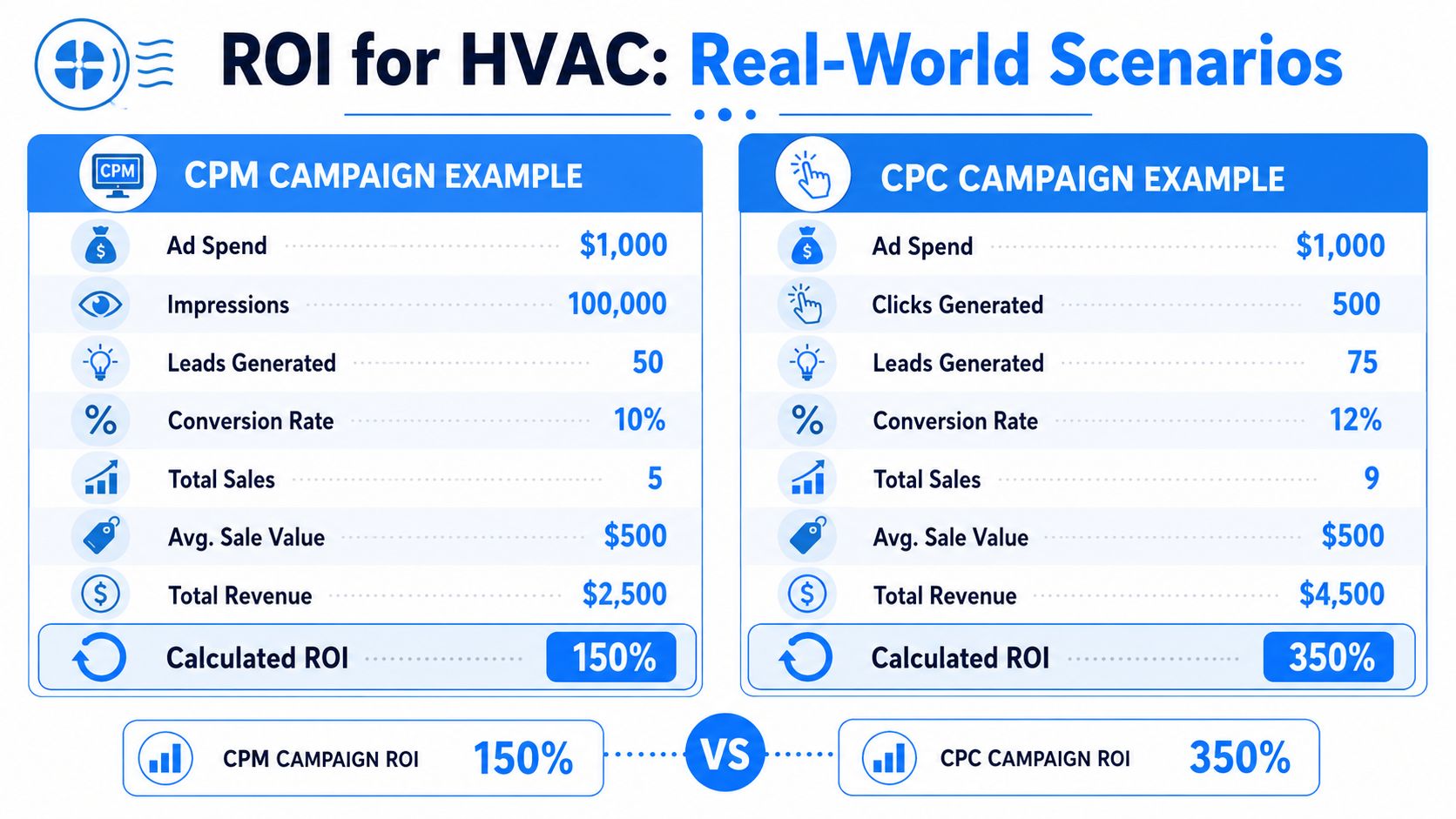
So let's use an HVAC example and keep it grounded in what matters. Calls, appointments, and revenue.
Example one with a CPM campaign
Say an HVAC company runs a CPM campaign across local display inventory. The business gets broad local visibility. Plenty of people see the brand. Some visit the site later. A few call.
That's not useless. It may help with recognition, especially if the same prospect later searches the company by name. But the path from impression to job is indirect. That makes ROI harder to attribute and harder to improve.
The problem isn't that CPM never works. The problem is that local service businesses usually need a shorter path from ad spend to phone call.
Example two with a CPC campaign
Now take the same HVAC company and shift the budget to a CPC search campaign built around transactional terms:
- Emergency-focused terms: “AC repair near me,” “air conditioner not cooling”
- Location terms: “HVAC company in [city]”
- Service terms: “same day furnace repair”
This campaign doesn't try to reach everyone. It tries to reach the right person at the right moment.
That usually gives you a cleaner chain of evidence:
- Search happened.
- Ad got clicked.
- Visitor landed on a relevant page.
- Call or form submission came in.
- Job got booked.
That's the kind of campaign you can manage.
If you can't trace a keyword to a call, you're not advertising. You're guessing.
What real platform testing suggests
A controlled Facebook ads comparison from Two Six Technologies found that the CPM model produced about $0.90 per 1,000 impressions, while the CPC model produced about $0.05 per click. In the same experiment, CPC generated 2.8× more clicks and 1.8× more impressions than CPM, while CPM delivered only about 1.1× more combined reach than CPC.
That's not a local search case study, but it does support the practical takeaway. Paying for clicks can produce stronger engagement than paying for impressions, even inside the same platform test.
The ROI formula you should care about
A lot of owners stop at click cost. That's too shallow.
What matters is:
- Cost to generate the click
- Rate at which clicks become calls
- Rate at which calls become booked jobs
- Revenue from those jobs
If you need a simple framework to calculate return on ad spend, use that as your baseline. Then go one step further and look at customer acquisition by service line, because an emergency replacement call isn't worth the same as a tune-up.
To tighten that side of the math, review how cost per acquisition is calculated. That's where bad campaigns get exposed fast.
Our Recommendation When to Choose CPM or CPC
My advice is simple. If you run a local service business and need leads now, choose CPC first.

Choose CPC for active lead generation
If your business depends on inbound calls, estimate requests, appointment bookings, or same-day service demand, CPC is usually the right answer. It aligns with how local buyers behave when they have intent.
That's especially true on Google Search. Someone types the exact problem, includes the city or “near me,” and wants a solution fast. CPC lets you bid for that moment.
For most home service operators, these are the campaigns that deserve the bulk of the budget:
- High-intent search terms: repair, install, emergency, same day, near me
- Geo-modified service terms: service + city
- Brand protection campaigns: your business name and close variants
- Call-first mobile traffic: ads built to generate phone calls, not idle browsing
Choose CPM for support, not for the core engine
CPM should play a supporting role.
Use it when you already have strong search demand capture in place and want to reinforce your name locally. It can work for retargeting past site visitors, keeping your company visible across display placements, or building familiarity in a new service area before your organic rankings and Maps presence mature.
But don't let CPM become the main thing if your schedule isn't full. Awareness without demand capture is weak.
Bottom line: CPC drives demand capture. CPM supports memory.
The smartest setup isn't either-or
The best local strategy usually looks like this:
| Priority | Channel role | Best model |
|---|---|---|
| First | Capture transactional searches | CPC |
| Second | Own local map visibility | Organic and Maps optimization |
| Third | Follow previous visitors around the web | CPM retargeting |
| Fourth | Expand branded recognition in-market | Selective CPM awareness |
A lot of owners frame this as CPM or CPC because platforms make you pick a bid model. In practice, the answer is more practical. Use CPC as the main engine. Layer CPM where it helps support recall and follow-up.
This short video does a good job showing how business owners think through branching marketing decisions in practice.
Advanced Bidding and Tracking for Local Dominance
Once you've picked the right bid model, execution matters more than theory.
A bad CPC campaign can still waste money if your keywords are sloppy, your landing page is weak, or your tracking is broken. A decent CPM campaign can still help if it's used for retargeting with a clear audience and message. The difference comes down to measurement and control.
Track calls, forms, and booked jobs
This is not optional.
You need to know which keyword, ad, and landing page drove the call. You also need to know whether the call was junk, a real estimate request, or a booked appointment. If all you can see is traffic, you're blind. If all you can see is clicks, you're half blind.
For service businesses, at minimum, track:
- Phone calls: from ads, landing pages, and mobile tap-to-call buttons
- Lead forms: estimate requests, service requests, appointment forms
- Service pages: which offers pull the best lead quality
- Location signals: which cities and service areas convert best
Use AI bidding carefully
Automated bidding inside Google Ads can help. It can adjust bids faster than a human can when enough clean conversion data exists.
But AI only works if you feed it the right signals. If the system optimizes for page visits instead of actual leads, it'll happily buy junk traffic. If it optimizes for real calls and qualified conversions, it gets much more useful.
That's where local search is heading in general. AI systems and LLM-driven search experiences don't just reward ad spend. They reward businesses that show consistent relevance across paid search, organic rankings, and Google Maps.
Normalize performance before making the wrong call
When you compare campaigns, you need a common frame. Moloco's explanation of CPM and CPC notes that eCPM can be derived from CPC and CTR using the formula eCPM = (CPC × CTR) × 1000. That gives you a way to translate click-based performance into an impression-based metric when comparing campaign efficiency on a normalized basis.
That won't matter to every owner every day, but it matters when agencies start cherry-picking numbers to make weak campaigns look better.
If you're studying how other teams approach generating leads for home service contractors, pay attention to how they handle intake speed and lead qualification too. Better bidding helps, but fast response closes more revenue.
The businesses that win local search over the next few years won't rely on one channel. They'll show up in paid search, organic search, AI-generated search experiences, and the Google Maps results where buyers make fast decisions. That's local dominance now.
If you want help building that kind of system, Transactional LLC helps local service businesses dominate transactional search terms, strengthen Google Maps visibility, and turn search demand into more phone calls, booked jobs, and long-term local market control.