


You're probably here because your Google Ads account feels busy but not profitable. Clicks come in. Spend goes out. The phone stays quiet, or worse, the wrong people call. Tire-kickers. Job seekers. People outside your service area. That's what happens when a campaign is built around activity instead of buyer intent.
For a local service business, the primary job isn't “running ads.” It's capturing transactional search terms. Searches like “roofer near me,” “emergency plumber,” “AC repair in Dallas,” or “dentist near me.” Those are the searches that matter because the person typing them usually wants help now, not next quarter.
Most business owners asking how to set up a Google Ads campaign are asking the wrong question. The better question is this: how do you build a system that turns local search intent into calls, appointments, and booked jobs?
Stop Burning Cash Start Winning Transactional Searches
A local business owner opens Google Ads, clicks through the setup wizard, picks a few keywords, writes a generic ad, and launches. A week later, the account has traffic but no clear path to revenue. That story repeats every day.
The problem usually isn't effort. It's the setup logic.

The wrong goal is traffic
If you're an HVAC company, plumbing shop, roofing contractor, dental office, or chiropractor, you don't need random visitors. You need the person searching with a problem and a wallet. That's the whole point of transactional search terms. They signal urgency, need, and buying intent.
A campaign that chases cheap clicks instead of qualified leads burns cash fast. A campaign built around “near me” searches, city-plus-service terms, and urgent problem searches has a much better chance of producing immediate work.
Practical rule: If a keyword sounds like research, treat it carefully. If it sounds like someone needs service now, lean in.
The real first step is measurement
Most guides obsess over buttons in the interface. That's not where profitable campaigns start. Google's own setup flow says that if you want online conversions, you should set up conversion tracking before going live, and for local businesses that matters because a campaign can look “set up correctly” while still optimizing toward weak leads if the conversion model is poor, as explained in Google's business ad setup guidance.
That's the part many owners skip. They count form fills, but not whether the form came from a real prospect. They count calls, but not whether the calls were from actual local buyers. They launch before deciding which actions deserve bidding priority.
If you want stronger lead quality, start with intent and tracking, not ad aesthetics. A solid process for SEM keyword research for transactional terms makes that much easier because it forces you to sort buyer keywords from curiosity clicks.
Build Your Foundation Campaign Goals and Structure
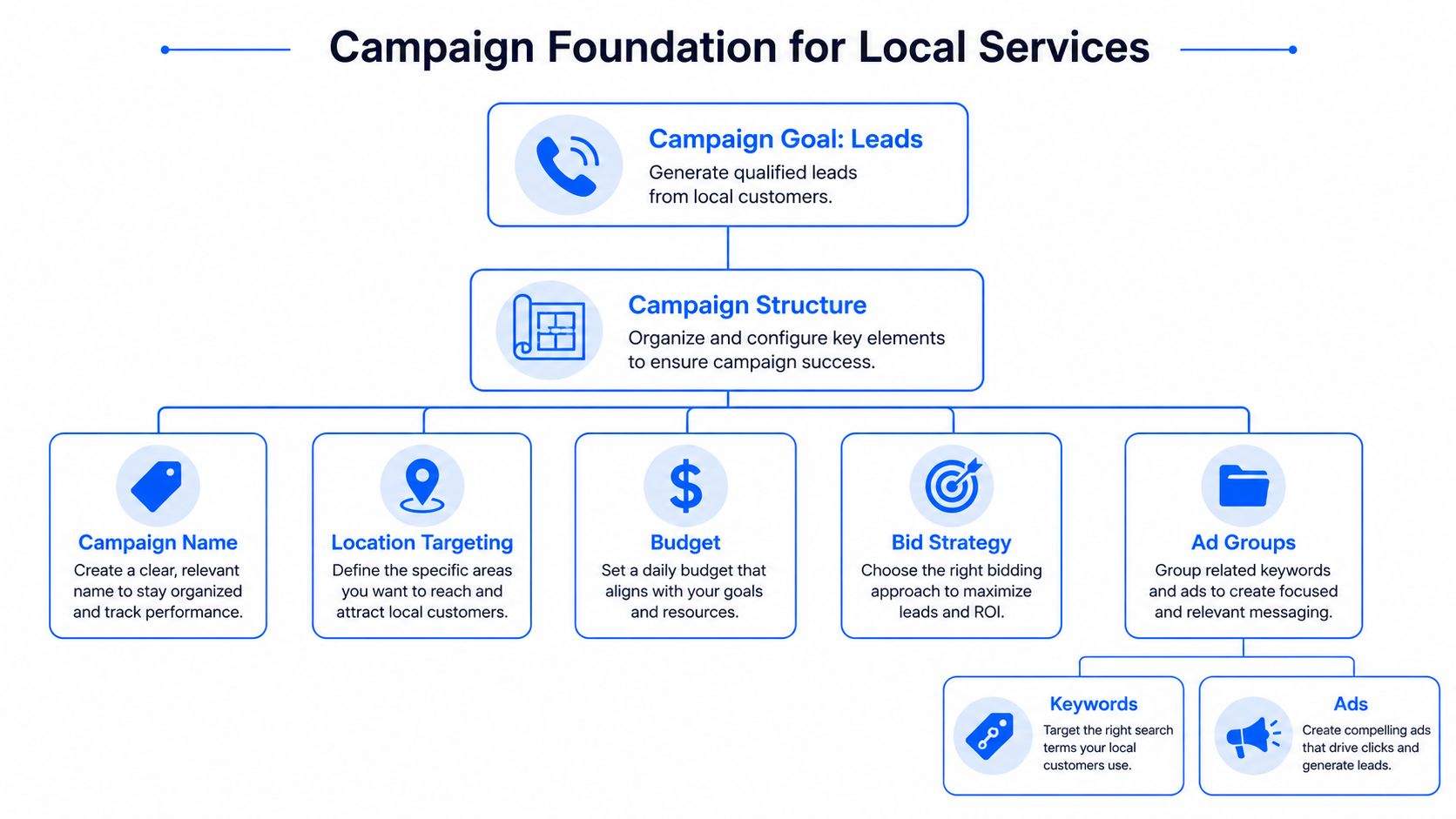
Google Ads works best when the foundation is simple and controlled. Google Ads is built on a three-part model of budget, bidding strategy, and targeting, and a campaign is a set of ad groups that share those settings, according to Google's API documentation summarized in this Google Ads campaign framework reference. That's not trivia. That's the blueprint.
Pick the goal that matches the business
For most local service businesses, the campaign objective should be Leads. Not “Website Traffic.” Not vague awareness. If the business wins when a person calls, books, or submits a form, then the campaign should be built around lead generation.
That choice affects everything after it. It shapes bidding, conversion setup, and how Google interprets success.
Here's the clean sequence I recommend:
- Choose the business outcome. Leads is the right choice for most service companies.
- Choose Search as the campaign type if your goal is high-intent local demand capture.
- Set shared controls. Budget, bidding strategy, and location targeting.
- Build ad groups by service theme so your ads stay relevant.
Later, when you want more scale, you can test broader systems. But for a first campaign, control beats complexity.
Structure the account like a contractor, not a hobbyist
A sloppy account mixes everything together. That kills relevance.
A roofing company shouldn't cram “roof repair,” “roof replacement,” “emergency tarp,” and “storm damage” into one messy ad group. Build it in service themes instead:
- Campaign for a primary market or service bucket
- Ad group for “Roof Repair”
- Ad group for “Leak Repair”
- Ad group for “Emergency Tarping”
An HVAC company could break out ad groups for “AC Repair,” “Furnace Repair,” and “Emergency HVAC Service.” A dental office might split “Emergency Dentist,” “Dental Implants,” and “Teeth Cleaning.”
That structure lets you write ads that match the search.
A useful outside perspective on PPC campaign setup strategies can help if you've never built campaigns this way before. If you want a stronger grasp of how pros organize and manage local paid search, reviewing examples of PPC ad management services also helps sharpen your setup decisions.
Here's a quick walkthrough before you build:
Tight structure gives you control. Control gives you cleaner traffic. Cleaner traffic gives you better calls.
Capture Intent with Keywords and Local Targeting
At this stage, most campaigns win or lose.
If you want to know how to set up a Google Ads campaign for a local service business, stop thinking like a general advertiser. Think like someone trying to intercept a buyer at the exact moment they need help. That means targeting transactional search terms, not broad topic phrases.
Stop buying research clicks
A person searching “how does AC work” is not the same as a person searching “AC repair near me.” One is researching. One is trying to solve a problem.
Start with terms like:
- Service plus near me such as “plumber near me”
- City plus service such as “electrician in Phoenix”
- Urgent need terms such as “emergency dentist” or “same day HVAC repair”
- Problem-based service terms such as “roof leak repair” or “clogged drain service”
These terms line up with immediate demand. They usually produce the calls local businesses want.
Use tighter match types early
Most local owners get into trouble because they trust broad matching too early. Early-stage campaigns need discipline. That's why I recommend starting with Phrase Match and Exact Match for your core terms.
| Match Type | Example Keyword | A Search That Could Trigger Your Ad | Transactional Marketing Advice |
|---|---|---|---|
| Exact Match | [ac repair near me] | ac repair near me | Best for tight control on your highest-intent terms |
| Phrase Match | "ac repair near me" | best ac repair near me now | Good starting point for expansion while staying focused |
| Broad Match | ac repair near me | home cooling tips | Don't lead with this in a new local campaign unless you're ready to police search terms aggressively |
This is one of the clearest differences between amateur setup and serious setup. New local campaigns need cleaner intent signals, not wider reach.
Fix your location targeting before launch
One of the most expensive mistakes in local Google Ads is loose geography. Recent practitioner guidance for 2026 emphasizes disabling broader expansion settings, using phrase and exact match early, and setting location targeting to presence instead of “presence or interest” to protect spend and lead quality in local markets, as discussed in this 2026 Google Ads setup tutorial.
That setting matters because local service businesses usually want people in the service area, not people elsewhere who happen to be interested in it.
Use this standard:
- Target the actual service area you can serve profitably
- Set location option to presence
- Exclude areas you don't want
- Keep audience segments in observation mode if you use them at all
A strong local paid search setup also works better when the business has its local presence cleaned up. If your Google Business Profile still needs work, this guide from Circle Monkeys Web Design & SEO on Google Business Profile setup is worth reviewing because local visibility and local ads feed each other.
The easiest way to waste ad spend is to show ads to the wrong geography with the wrong intent.
Write Ads That Demand a Click and a Call
A Google ad for a local service business has one job. It needs to match the search, prove relevance fast, and make calling feel like the obvious next move.
Mirror the search in the headline
If someone searches “emergency plumber near me,” your ad shouldn't sound clever. It should sound useful.
Bad ad:
“Trusted Home Service Experts”
Better ad:
“Emergency Plumber Near You”
Bad ad:
“Quality Roofing Solutions”
Better ad:
“Roof Leak Repair in Tampa”
The headline should echo the keyword. That reassures the searcher that they found the right business.
Use a direct response formula
Keep the ad simple:
- Headline that mirrors the service and location
- Proof point that reduces hesitation
- Call to action that tells them what to do next
A practical version looks like this:
- Headline ideas: AC Repair in Dallas, 24 Hour Plumber Near You, Emergency Dentist in Mesa
- Description ideas: Fast local service. Licensed team. Call now to book.
- Second description: Same-day appointments available. Speak with our office today.
This works because the ad becomes a promise to solve the exact problem the user just searched.
Extensions are not optional
For local service campaigns, ad assets matter because they make the ad bigger, more useful, and easier to act on. The most important ones are:
- Call assets so mobile users can call directly
- Location assets so your business feels local and established
- Sitelink assets to route people to urgent service pages, financing pages, or appointment pages
If your ad is relevant but hard to act on, you'll lose calls to a competitor with a more complete search result.
A lot of owners also underwrite the ad itself and ignore the rest of the message path. This is where understanding the elements of advertisements that drive response helps. Strong ads don't rely on hype. They rely on message match, local trust, and a clear next step.
Your ad should answer three questions in seconds. Do you handle my problem, do you serve my area, and can I contact you right now?
Set Your Budget and Measure What Actually Matters
Budget matters. Bidding matters. But neither works if the campaign doesn't know what success looks like.
Google's own Search campaign guidance says a technically sound setup includes choosing a measurable objective like Leads and defining conversion goals before building ad groups and keywords, and it recommends setting at least one conversion goal because launching without it weakens optimization and can make reporting misleading, as stated in Google's Search campaign setup documentation.

Choose a budget with enough room to learn
Google Ads uses a daily budget setting. Treat it like a control lever, not a random number.
Set a budget that gives the campaign room to collect real intent and enough signal to compare services, keywords, and ad groups. If your budget is so low that the campaign barely enters the auction, you won't get useful learning. If it's high but poorly targeted, you'll just waste money faster.
For most local service businesses, the smarter move is narrower targeting first. Tight geography, strong buyer keywords, and service-specific ad groups.
Start with a bidding strategy tied to outcomes
For lead generation campaigns, I like Maximize Conversions once the campaign is built correctly and the tracking is clean. That aligns the system with actual business actions instead of raw clicks.
What counts as a conversion?
- Phone calls from the ad or website
- Lead form submissions
- Appointment requests
- Chat starts if those conversations are handled properly
Not every action deserves equal value. A junk call isn't the same as a booked estimate request. A weak form isn't the same as a new patient inquiry. The campaign should optimize toward the actions that are closest to real revenue.
Teach the system what a good lead is
Many campaigns fall apart here. Owners ask why Google's automation isn't working, but they fed it poor signals.
If you count every call, every accidental click, and every low-intent form as a conversion, the system will chase more of that. If you define conversions around genuine business outcomes, the campaign gets smarter over time.
That's why measurement design matters more than vanity metrics like traffic. If you want a better framework for turning raw lead information into better decisions, this overview of sales data analysis for growth is a useful complement to campaign reporting.
You should also understand your local paid search economics before setting expectations. A practical review of Google paid search costs for local campaigns can help you frame budget decisions with more discipline.
Field note: Clicks are not the win. Qualified actions are the win.
The Pre-Launch Checklist and Optimization Method
Most local campaigns don't fail because of one giant mistake. They fail because of several small ones that stack up. Bad location settings. Weak negatives. Tracking that never fired. Search Partners left on. Display left on by accident. Generic ads. A homepage landing page.
That's why launch day should feel like an inspection, not a celebration.

What to check before you publish
Google advises reviewing campaign settings such as budget, schedule, location and audience targeting, confirming conversion tracking before publishing, checking ad copy and landing pages, and auditing keywords and negative keywords to reduce irrelevant clicks, as summarized in this Google Ads setup and review guide.
Use a short pre-launch checklist:
- Confirm location settings are limited to the service area you cover
- Verify conversion tracking is firing on the actions you care about
- Review keywords and negatives so junk searches don't eat the first wave of spend
- Check ad copy for message match and clear calls to action
- Test the landing page on mobile and desktop
Control automation or it will control you
The default settings in Google Ads are not designed to protect a small local budget. They're designed to expand reach. That's not always what you want.
For pure Search campaigns, start with a tighter setup:
- Disable Google Search Partners if your goal is clean search intent traffic
- Turn off Display Network when you want a pure Search campaign
- Use phrase and exact match on your core buyer terms
- Keep audience layers observational, not restrictive or overly broad
That's the discipline behind a campaign that produces calls from transactional search terms instead of random traffic. The work doesn't stop after launch either. Review search terms, tighten negatives, compare ad groups, and trim waste aggressively. A campaign should be managed like an asset, not left alone like a yard sign.
Set it up tight, watch it closely, and earn the right to expand.
If you want help building a Google Ads system that targets high-intent local searches and turns them into calls, jobs, and booked appointments, talk to Transactional LLC. They help service businesses dominate transactional search terms, strengthen Google Maps visibility, and build lead-generation campaigns that focus on real buyer intent instead of empty traffic.