


Most local businesses start keyword research the wrong way. They list their services, open a tool, sort by volume, and chase the biggest terms they can find. That usually leads to broad clicks, expensive traffic, weak lead quality, and no clear path into the Google Maps pack.
The better approach is narrower and more profitable. In keyword research sem, the goal isn't to find the most searched phrase. It's to find the phrases typed by people who need help now, are in your service area, and are ready to call, book, or buy. For a local roofer, dentist, pest control company, or med spa, those are transactional searches. Terms like "roofer near me," "emergency plumber [city]," or "Botox near me" are the terms that turn into revenue.
The Foundation of Transactional Keyword Research
Transactional keywords are the center of any serious local SEM strategy. They aren't just relevant phrases. They're phrases that signal buying intent. When someone searches "AC repair near me" or "emergency dentist [city]," they aren't doing casual research. They're looking for a provider.
That mindset changes everything. Instead of asking, "What services do we offer?" ask, "What does a customer search when they need this solved today?" That shift is what separates vanity traffic from booked jobs.

Start with a seed list built from buyer language
A seed list should be short, direct, and service-first. For local service businesses, that usually means your core money services plus local modifiers.
Examples:
- HVAC: AC repair, AC installation, furnace repair, emergency HVAC
- Dental: emergency dentist, dental implants, Invisalign, tooth extraction
- Pest control: termite treatment, rodent control, bed bug exterminator
- Roofing: roof repair, roof replacement, storm damage roofing
Then pressure-test that list with real search behavior. Google Keyword Planner is a strong starting point because it shows volume and advertiser competition in a way that's useful for paid search planning. SEMrush adds another layer with search volume, difficulty, competition labels, and intent signals. Iowa State's overview of SEM keyword research basics notes that keyword research in SEM relies on metrics like search volume, keyword difficulty, and competition, and that higher-volume terms with lower difficulty often create the best opportunities.
Practical rule: If a keyword sounds like something only an industry insider would say, it probably isn't your best starting point.
A business owner may describe a service one way internally, while searchers use a different phrase. That's why the tool doesn't replace judgment. It sharpens it.
Use the core metrics correctly
A lot of businesses look at only volume. That's a mistake.
Three inputs matter most early on:
- Search volume: This tells you whether people search the phrase often enough to matter.
- Keyword difficulty: This helps you avoid terms dominated by stronger sites.
- Competition: In SEM tools, this reflects advertiser demand and often points to commercial value.
The same Iowa State source explains that tools like SEMrush can surface realistic targets by showing average monthly search volume, difficulty scores, and competition levels in one place. It even gives a sample keyword, "statistics minor," showing 590 AMSV in the U.S. and a difficulty score of 50% in SEMrush's Keyword Magic Tool, which is a useful reminder that numbers only become useful when they're paired with intent and attainability.
If you want a practical walkthrough outside the usual generic advice, this real-world keyword research example does a good job of showing how a list turns into an actual targeting plan.
Think local from the first pass
For local SEM, a keyword isn't complete until geography enters the picture. That can mean city names, neighborhood names, zip-based modifiers, or "near me" phrasing. A pest control company doesn't need visibility for "ant control" everywhere. It needs visibility where it can dispatch crews.
A simple framework works well:
- Service term
- Urgency or qualifier
- Location modifier
That produces phrases like:
- AC repair near me
- emergency plumber in Phoenix
- same day dentist Chicago
- termite treatment Dallas
Broad service labels still belong in research, but they shouldn't dominate the campaign. High-intent local combinations usually produce better lead quality because the searcher is already narrowing the decision.
For businesses trying to systemize this process, these keyword research best practices are worth reviewing before building out campaigns or content clusters.
Expanding and Classifying Keywords for Maximum Intent
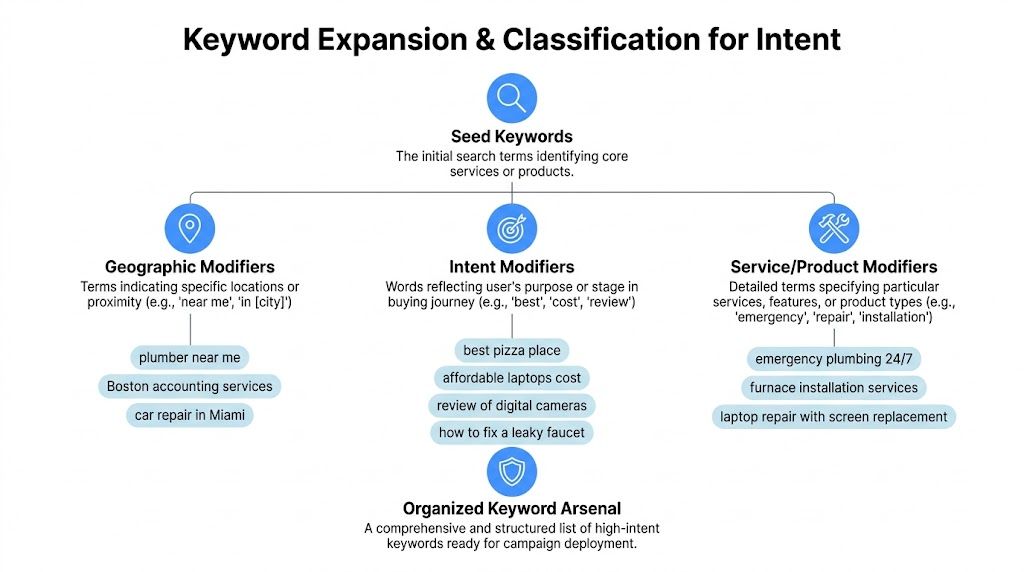
Once the seed list exists, the next job is expansion. This expansion holds most of the hidden revenue. A short list of service terms can turn into a strong keyword set when you add the right modifiers and classify each phrase by intent instead of treating every keyword the same.
Expand with modifiers that signal action
The fastest way to improve keyword research sem for local lead generation is to build around modifiers that indicate urgency, locality, and service specificity.
The useful groups usually look like this:
- Geographic modifiers: near me, in [city], [city] [service], [service area]
- Urgency modifiers: emergency, same day, 24 hour, open now
- Problem modifiers: leaking, broken, clogged, cracked, infected, damaged
- Commercial modifiers: cost, pricing, estimate, quote, best
- Service modifiers: repair, installation, treatment, replacement, removal
A plumbing company can start with "water heater" and expand to "water heater repair near me," "emergency water heater repair [city]," and "water heater replacement [city]." A dental office can start with "dentist" and move toward "emergency dentist near me," "same day tooth extraction [city]," or "dental implant consultation [city]."
At this stage, broad traffic starts turning into buyer traffic.
Classify by intent before spending a dollar
Every keyword should be tagged by intent. That's how you stop mixing top-of-funnel curiosity with bottom-of-funnel demand.
A simple classification model works:
| Intent Type | What the searcher wants | Example |
|---|---|---|
| Informational | Learn something | how long does AC last |
| Commercial | Compare options | best roofing company in [city] |
| Transactional | Hire or book now | roofer near me |
| Navigational | Find a specific business | [brand name] dentist |
For local service campaigns, transactional terms deserve the first budget allocation. Commercial terms can work well when the ad and landing page handle comparison intent correctly. Informational queries usually belong in content, FAQ, or retargeting support, not in the core lead-generation campaign.
Wpromote's paid media guide on SEM keyword research highlights the core trade-off clearly: high-intent local terms like "pest control Chicago" may average 100-500 AMSV but can deliver 5-10% higher conversion rates than broad terms, and using negative keywords can save 20-30% of ad budget by excluding irrelevant searches.
A keyword with less volume can still be the better business keyword if it produces calls instead of empty clicks.
That principle matters even more in local markets where budgets are tight.
Build a working keyword map
Don't keep the research as a flat export. Organize it into a sheet that connects keywords to campaigns, landing pages, and intent. A simple working map might include:
- Keyword
- Intent
- Primary service
- Geo modifier
- Landing page
- Ad group
- Negative keyword risks
That structure makes campaign buildout easier and keeps the SEO side aligned later. The same keyword families that drive paid leads often shape service pages, city pages, FAQs, and Google Business Profile categories.
If you want another practical framework for list-building, Austin Heaton's guide on how to build a keyword list is useful because it keeps the process grounded instead of turning it into spreadsheet theater.
Use negative intent to sharpen the list
Some keywords look relevant but attract poor-fit traffic. That's why negative thinking matters in expansion.
Examples of phrases that often need filtering:
- DIY searches: how to fix, tutorial, homemade
- Job seekers: jobs, hiring, salary, training
- Research-only searches: what is, definition, course, certification
- Low-value qualifiers: free, cheap, sample
For local service companies, this matters immediately. If you're paying for search traffic, every irrelevant click weakens the campaign. The earlier you classify intent and identify exclusion patterns, the cleaner the account becomes.
Analyzing Competition and Gauging Market Viability
A keyword list isn't a strategy until you know what you're up against. Some terms look perfect in a tool and still aren't worth pursuing yet because the local search results are crowded with strong domains, aggressive advertisers, and map-heavy layouts. Other terms look modest and turn out to be the easiest path to fast wins.
Use difficulty as a filter, not a verdict
Keyword difficulty is useful when it's treated as directional. It helps narrow the field, especially for newer local sites that don't have much authority yet.
Orbit Media's article on keyword research mistakes notes that targeting keywords with a difficulty score of 50 or less can lead to 2-3x faster top-10 rankings for local businesses, and that 60% of failures come from ignoring competition. That's exactly why local campaigns should screen aggressively instead of chasing every attractive phrase.
A lower-difficulty keyword doesn't automatically mean easy. It means easier relative to the market.
Search the SERP manually before you commit
Open Google and search the exact phrase. Don't rely on the tool alone.
Look for these patterns:
- Map pack dominance: If Google gives most of the screen to the local pack, maps optimization matters as much as the landing page.
- Directory saturation: If directories and national lead-gen sites dominate, the page may need stronger trust signals and backlinks.
- Service mismatch: If the results skew informational, the keyword may not be as transactional as it looked in a spreadsheet.
- Ad crowding: Heavy paid competition can raise costs and squeeze visibility.
This quick manual check often tells you more than a dashboard. It shows what Google believes the searcher wants.
Search intent isn't what your team calls the keyword. It's what Google is rewarding on the results page.
Pull competitor gaps from local rivals
The best competitor research isn't done against giant national brands. It's done against the companies already taking leads in your city.
Use tools like SEMrush, SpyFu, Ahrefs, or Google Ads Auction Insights to ask:
- Which transactional keywords are they already covering?
- Which city-service combinations are they missing?
- Which services are weakly represented on their sites?
- Are they pushing one category hard and neglecting another?
That gap analysis is often where the next landing page or ad group comes from. If three local HVAC competitors are all active on repair terms but light on ductless installation variants, that may be the opening.
A business also needs the off-page side in view. If the SERP leaders have strong authority signals, understanding the role of a backlink profile in local rankings helps explain why some pages hold top positions even when the content itself isn't impressive.
Build a market-level template before campaign launch
A simple template prevents random campaign structure and keeps paid and organic teams aligned.
| Core Service (Seed) | Transactional Keyword | Intent | Est. Monthly Volume | Est. CPC | Ad Group |
|---|---|---|---|---|---|
| AC repair | AC repair near me | Transactional | Tool estimate | Tool estimate | AC Repair |
| Furnace repair | emergency furnace repair [city] | Transactional | Tool estimate | Tool estimate | Furnace Emergency |
| AC installation | AC installation [city] | Transactional | Tool estimate | Tool estimate | AC Install |
| Indoor air quality | air duct cleaning near me | Transactional | Tool estimate | Tool estimate | Duct Cleaning |
The exact numbers belong in your tools, not in guesswork. The point of the template is decision clarity. Each row should earn its place based on intent, viability, and local relevance.
Structuring Campaigns for Local Service Dominance
Good research still fails if the account structure is sloppy. Consequently, local service campaigns frequently leak budget. Keywords get grouped too broadly, ad copy gets generic, and search terms with different intent end up fighting inside the same ad group.
Tight structure fixes that.

Keep ad groups narrow and service-specific
A local campaign should be organized by what the customer wants done, not by broad business category.
Bad grouping:
- AC repair
- AC installation
- furnace repair
- heat pump replacement
All in one ad group.
Better grouping:
- Emergency AC repair
- Standard AC repair
- AC installation
- Furnace repair
- Heat pump replacement
That structure improves message match. Someone searching "emergency AC repair near me" should land on an ad and page that speak directly to emergency repair, not a generic HVAC page.
Match type discipline matters
In local lead generation, control matters more than reach. That's why phrase and exact match usually do the heavy lifting. They keep the account focused on searches with clearer buying intent and make search term review more manageable.
Broad match can still have a role, but it needs tighter oversight, stronger negatives, and enough conversion history to guide the platform. If the campaign is new, phrase and exact match usually create cleaner learning conditions.
A useful starter approach:
- Exact match: Core highest-intent service terms
- Phrase match: Close variants and modifier combinations
- Broad match: Limited testing only after the account has enough signal
This is also where budget decisions become strategic. If a med spa is deciding between generic category terms and treatment-specific local terms, the right answer usually isn't subtle. The source video on med spa keyword strategy explains that service-specific, location-modified terms like "Botox Portland" generate thousands of monthly searches, while generic "med spa Portland" terms generate 100-200, and that "Botox near me" should receive a 3-5x higher bid allocation because of its stronger transactional intent in SMB campaigns, as discussed in this med spa keyword strategy video.
Add negatives from day one
Negative keywords aren't cleanup. They're campaign structure.
Start with a practical exclusion list such as:
- Job intent: jobs, career, salary, hiring
- DIY intent: how to, do it yourself, tutorial
- Low-value traffic: free, cheap, sample
- Education intent: school, course, training, certification
- Irrelevant modifiers: wholesale, supplies, parts, amazon
Then review the search terms report regularly. New negatives should come from actual search behavior, not just assumptions.
A clear cost framework helps here because every wasted click has an opportunity cost. Businesses that want to understand how click costs relate to local paid search planning can compare that against a broader Google paid search cost breakdown.
Align campaigns with Google Maps visibility
Paid search and Google Maps shouldn't be treated as separate systems. They reinforce each other when the service, geo, and category targeting are aligned.
If you're bidding on "emergency plumber [city]," your landing page, Google Business Profile categories, service descriptions, and local relevance signals should support that same theme. The account gets stronger when the ad, page, and map presence point in the same direction.
A quick explainer on campaign execution helps here:
A few practical habits matter:
- Mirror service categories across assets. If the campaign is segmented by repair, installation, and emergency work, your site and profile structure should reflect that.
- Use local landing pages carefully. Each page needs a distinct service-and-city focus.
- Watch map-heavy keywords closely. If the SERP is dominated by the local pack, your maps optimization work isn't optional.
- Write ads for calls, not curiosity. Local service buyers want confidence, availability, and relevance.
The strongest local accounts don't just target transactional searches. They build the whole search presence around them.
Activating Your Research and Optimizing for AI Search
Launch isn't the finish line. It's the point where the keyword list starts proving itself. In local SEM, the metrics that matter are the ones tied to action: calls, form submissions, booked appointments, and closed jobs. If a keyword brings traffic but not revenue activity, it needs to be questioned.

Measure outcomes by keyword theme
Don't evaluate the account only at the campaign level. Review performance by service cluster and intent class.
Useful buckets include:
- Emergency terms
- Near me terms
- City-modified service terms
- Comparison terms
- Question-based long-tail terms
That view makes optimization easier. It shows whether the account is strongest on immediate-demand searches, whether location modifiers are carrying the load, and where landing page alignment is weak.
Add an AI search layer to your keyword research sem process
Traditional keyword research still matters, but it isn't enough by itself anymore. Search behavior is shifting toward natural-language questions, treatment comparisons, and problem-outcome phrasing that feeds AI-generated summaries.
That changes local visibility in a practical way. Pages need FAQ structures, review language that reflects real services, and content built around the actual questions prospects ask. Google's AI systems are using those elements to summarize providers.
The article on AI-focused med spa keyword strategy says Google now scans structured data, FAQs, and reviews to summarize providers, and that businesses optimizing for AI Overviews with long-tail, question-based keywords are seeing 15-30% higher click-through rates from those featured snippets.
Build pages that answer and convert
For local businesses, AI optimization shouldn't mean vague blog content. It should mean tighter coverage around real decision queries, such as:
- Botox vs Dysport
- how fast can a cracked tooth be repaired
- what's included in emergency pest control service
- should I repair or replace my AC unit
Those aren't just content ideas. They're visibility assets for both classic search and AI-generated answer layers. Businesses that want a more direct framework for this shift should study how AI search engine optimization changes content structure, schema usage, and local entity signals.
The local winners in the next phase of search will be the businesses that do both well. They will target transactional terms for immediate demand and publish AI-ready support content that helps search engines trust them enough to cite and surface them.
Frequently Asked Questions about SEM Keyword Research
How often should keyword research be updated
Review it regularly, especially after campaign launch. Search terms reports, competitor movement, seasonality, and service changes all affect performance. Local businesses should treat keyword research sem as an active process, not a one-time setup.
Should every service target near me keywords
No. "Near me" matters, but it shouldn't be the only location pattern. Strong local campaigns usually include city-modified terms, neighborhood terms where relevant, and service-specific variations. Some searches trigger map-heavy behavior without the words "near me" appearing in the query.
What matters more, volume or intent
Intent. A lower-volume keyword with clear hiring intent is usually worth more than a broad term that attracts research traffic. That's especially true for home services, dental, pest control, and med spas where one good lead can justify the spend.
Can I use the same keywords for SEO and Google Ads
Often yes, but not in exactly the same way. Paid search needs tighter control, match type discipline, and negatives. SEO can support those same keyword families through service pages, city pages, FAQs, and Google Business Profile relevance signals.
What's the biggest mistake in local SEM keyword targeting
Going too broad. Businesses waste budget when they bid on category terms that sound important but don't reflect immediate buying intent. The tighter the keyword matches the service, urgency, and location, the better the lead quality usually is.
If you want help turning keyword research into booked jobs, map pack visibility, and stronger local search coverage, talk with Transactional LLC. Their work is built around transactional search terms, Google Maps performance, and AI-driven local SEO systems that help service businesses show up where buyers are ready to act.