

Most advice about PPC for small businesses is wrong.
It tells you to chase cheaper clicks, broader reach, and more traffic. That sounds efficient, but it usually produces the same ugly result: a business owner pays Google, sees activity in the dashboard, and still doesn't get enough booked jobs, patients, or quote requests to justify the spend.
If you're buying clicks, you're playing the wrong game. If you're buying transactional intent, you're finally acting like an owner.
For local service companies, the right search isn't “what is water heater repair.” It's “water heater repair near me.” It's not “how does Invisalign work.” It's “orthodontist near me.” Those are money-in-hand searches. The person isn't browsing. They're trying to hire someone.
That's the entire job of smart small business PPC services. Show up when a local buyer is ready to act, make the next step easy, and track whether the ad produced a real lead.
Why Most Small Business PPC Fails and How to Fix It
The biggest mistake in PPC isn't bad luck. It's bad priorities.
Too many campaigns are built to win vanity metrics. They optimize for clicks, push broad match keywords, send traffic to a generic homepage, and celebrate activity that doesn't turn into revenue. That's why owners get burned. The ad account looks busy while the phone stays quiet.
Cheap clicks are often expensive mistakes
Local PPC works best when it's tightly geofenced and optimized around actions like calls and bookings, not traffic, and the main challenge is structuring campaigns so phone calls and quote requests are the primary metrics rather than clicks, as noted in this local PPC guidance.
That point matters because a cheap click from the wrong search has no value. A more expensive click from someone searching for a service in your exact city, on the device they're using to call you, can be worth far more.
Practical rule: If a keyword doesn't show clear buying intent, it shouldn't get much budget.
A plumber doesn't need more visitors who want DIY tips. A med spa doesn't need curiosity clicks from people comparing treatments with no intention of booking. A dentist doesn't need students researching procedures for a paper. Those clicks drain budget and create fake confidence.
The fix is transactional intent
A strong PPC strategy starts with one question: Would I want this exact searcher to call my business today?
If the answer is yes, target it. If the answer is maybe, be careful. If the answer is no, block it.
This is why the smartest advertisers build campaigns around transactional search terms such as service plus city, service plus “near me,” emergency service phrases, and appointment-driven searches. Then they tighten targeting by geography, time of day, and device behavior.
If you're troubleshooting weak account performance, it also helps to review common setup errors that prevent advertisers from getting results when they optimize your Google Ads campaigns.
What success actually looks like
A successful campaign doesn't brag about traffic. It answers questions like these:
- Did the phone ring: Calls from qualified local prospects matter more than visits.
- Did forms come through: Quote requests and appointment bookings are the ultimate scoreboard.
- Did lead quality improve: Fewer, better leads beat a pile of junk submissions.
- Did booked revenue justify spend: If the numbers work, scale. If they don't, fix the setup.
That's the mindset shift. PPC isn't a visibility product. It's a lead acquisition system for transactional searches.
Understanding Your PPC Arsenal for Local Services
Most small business owners don't need every ad type. They need the right mix.
For local service businesses, your PPC arsenal has a clear hierarchy. Search Ads and Local Search Ads in Google Maps do the heavy lifting for immediate demand capture. Display Ads and Remarketing can help, but they support the main strategy. They shouldn't lead it.

Search Ads bring in the buyer who is already looking
Search Ads are the core of good small business PPC services. These are the text ads that appear when someone types a service query into Google.
If you run HVAC, plumbing, pest control, dental, chiropractic, roofing, or med spa services, you directly intercept active demand. The user is telling you what they want with their search. Your job is to match that intent with the right keyword, the right ad, and the right landing page.
Use Search Ads for:
- Urgent service terms: “emergency electrician near me”
- High-intent local terms: “dentist in [city]”
- Quote-driven searches: “roof replacement estimate”
- Appointment searches: “same day chiropractor appointment”
These aren't awareness searches. They're buyer searches.
Local Search Ads in Google Maps are built for action
Google Maps ads matter because local service buyers often want one of three things fast: directions, a phone number, or proof that you're nearby.
A Maps placement is especially strong on mobile. Someone searching “pest control near me” or “air conditioning repair near me” often wants to call from the results page without reading five blog posts first. That's why Maps ads deserve serious attention from businesses that rely on local demand.
Display Ads are support, not the star
Display Ads show visual ads across websites and apps. They can help with awareness, brand familiarity, and staying in front of prior visitors, but they usually aren't the first place I'd tell a local service company to put its core lead-generation budget.
Display makes more sense when:
| Ad type | Best use for local businesses | Priority |
|---|---|---|
| Search Ads | Capture active service demand | Highest |
| Local Search Ads | Win local mobile actions and map visibility | Highest |
| Display Ads | Awareness and visibility support | Lower |
| Remarketing | Re-engage visitors who didn't convert | Medium |
Remarketing recovers missed opportunities
Remarketing is useful because many prospects don't convert on the first visit. They compare providers, get distracted, or need a spouse or office manager to approve the decision.
A remarketing campaign can bring those people back with a focused message tied to the exact service they viewed. For a dental office, that might mean nudging a visitor back to a booking page. For a roofer, it might mean returning them to the estimate request page.
Search and Maps should generate demand capture. Remarketing should recover the people who slipped away.
If you're allocating budget, keep the order simple. Start with Search and Maps. Add Remarketing when tracking is reliable. Use Display only when you have a clear reason.
Anatomy of a High Converting Transactional PPC Campaign
A campaign that converts isn't built from one tactic. It's built from a system.
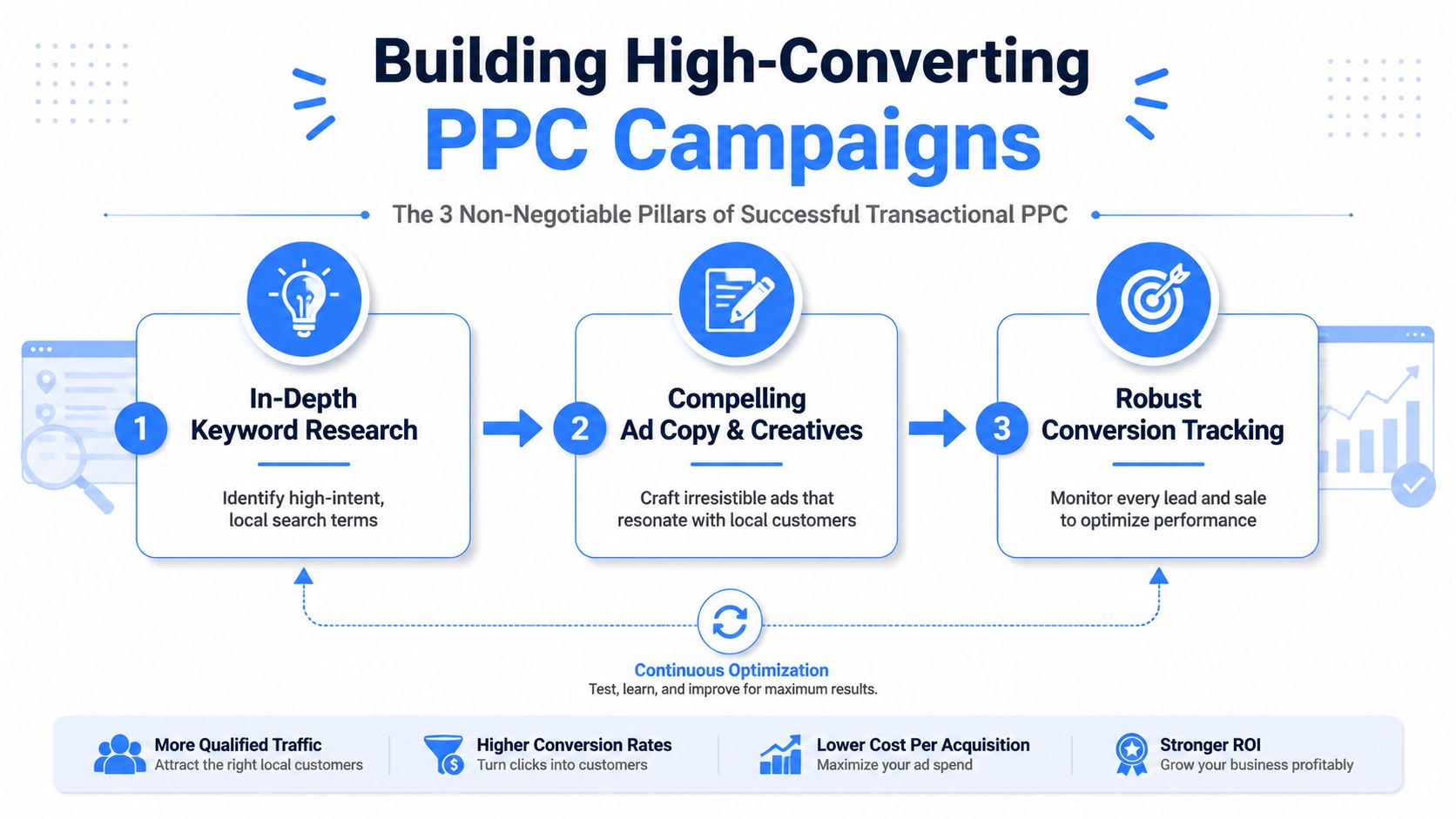
The three pieces that matter most are keywords, landing pages, and conversion tracking. If one breaks, performance drops. If all three line up, your campaign gets sharper, more efficient, and easier to scale.
Start with high-intent keyword structure
Good keyword selection isn't about stuffing a campaign with every phrase you can think of. It's about separating buyer intent from research intent.
Use tight keyword clusters around one service and one local outcome. “Emergency plumber,” “drain cleaning,” and “water heater repair” should not live in one lazy ad group if they need different messages and different landing pages.
Build clusters around:
- Core service terms: exact services you sell
- Location modifiers: city names, neighborhoods, “near me”
- Urgency signals: “same day,” “emergency,” “open now”
- Commercial intent: “quote,” “cost,” “book,” “appointment”
Then review search terms every week and add negative keywords aggressively. That keeps junk traffic out.
Google Ads guidance for small businesses emphasizes judging performance on conversions, not clicks, and it recommends pairing high-intent keywords with dedicated landing pages, installing conversion tracking, and filtering irrelevant traffic with negative keywords to improve efficiency and Quality Score, according to this optimization guidance.
For a more detailed campaign framework, review this guide on how to set up a Google Ads campaign.
Your landing page must match the search
Sending paid traffic to your homepage is one of the fastest ways to waste money.
If someone searched “emergency AC repair near me,” they should land on a page about emergency AC repair, in the service area you cover, with a clear phone number, strong call-to-action, and zero confusion about the next step.
A good landing page does four things well:
- Matches the exact service intent
- Confirms the location served
- Makes calling or submitting a form easy
- Removes distractions
If the keyword says one thing and the landing page says another, Google notices and the customer notices.
That mismatch hurts conversion rate and can also hurt ad efficiency through weaker relevance.
Here's a useful visual overview before you start building or rebuilding your account.
Track leads, not website activity
If you aren't tracking calls, booked appointments, and form submissions, you don't know what's working.
That means installing form tracking, call tracking where appropriate, and clean reporting for the actions that produce revenue. Once tracking is live, bidding decisions become obvious. Increase bids on searches that generate good leads. Cut spend on terms that attract noise.
This is also where many agencies fail. They report impressions and clicks because those metrics are easy to inflate. Real accountability starts when every campaign is tied to a lead outcome.
Dominating Local Search with Google Maps Ads
If you're a local service business, Google Maps isn't a side channel. It's a frontline sales channel.
A huge share of high-intent local searches happen on phones, and those users often don't want to browse websites for long. They want a nearby provider they can trust, contact, and hire. That's exactly why Maps matters so much.
Why Maps ads are so powerful
Maps ads put your business where local intent is strongest. The person searching is usually close, often on mobile, and often ready to take immediate action. For a roofer, that might be a homeowner after a storm. For a chiropractor, it might be someone trying to book around work. For a pest control company, it might be a family that wants service fast.
That behavior matters because Maps compresses the buying process. Search. Compare. Call.
Maps supports the exact searches that produce revenue
Transactional searches often include location intent even when the city isn't typed. “Near me” tells Google enough. Your business needs to be positioned for that reality.
For many service businesses, the map pack becomes the shortest route from search to lead because it supports:
- Tap-to-call behavior: people can contact you immediately
- Direction requests: critical for offices and clinics
- Local proof: reviews, proximity, and business details appear in context
- Fast comparison: buyers can choose without leaving the local results view
That's why Maps optimization and Maps ads work so well together. The ad can create visibility, but your business profile quality still influences whether the click turns into a call.
What to tighten before spending more
A weak Google Business Profile will drag down your Maps performance. Before increasing budget, check the basics.
| Maps factor | What to verify |
|---|---|
| Service alignment | Your primary services are clearly represented |
| Local accuracy | Address, service areas, and phone details are consistent |
| Conversion path | Calling and directions are easy from mobile |
| Landing page match | The page supports the location and service promised |
If your business depends on neighborhood-level visibility, this guide on how to rank higher on Google Maps is worth reviewing before you expand spend.
The best local ad isn't the one that gets seen most. It's the one that gets tapped by the person who needs you now.
For local lead generation, that distinction changes everything.
Budgeting for PPC and Calculating Real World ROI
PPC isn't cheap anymore. That's not a reason to avoid it. It's a reason to run it correctly.
A lot of owners ask the wrong first question. They ask, “How much does PPC cost?” The better question is, “What does a qualified customer cost, and does that math work for my business?”
Start with the benchmarks that matter
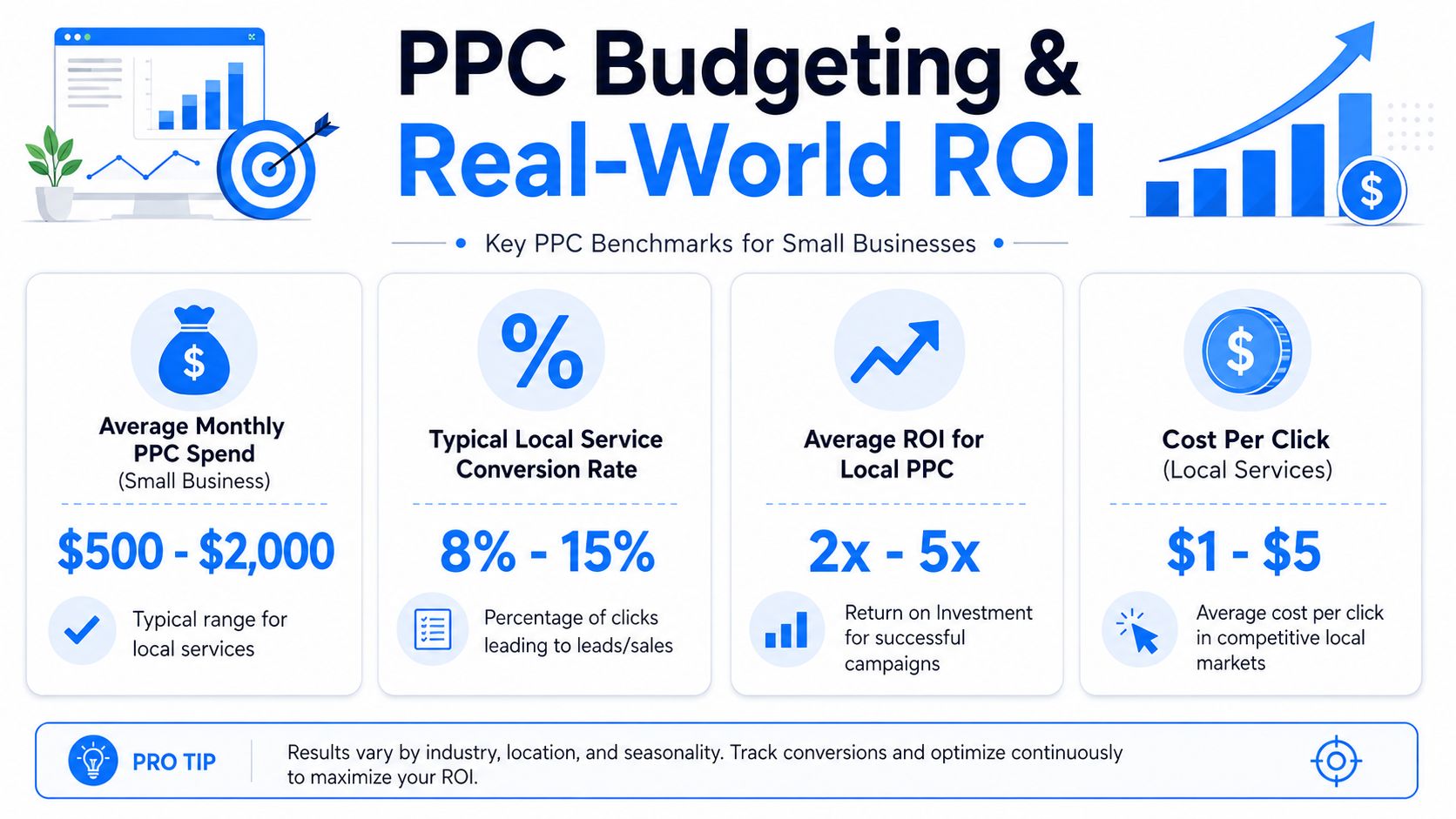
Across industries, businesses typically earn $2 in revenue for every $1 spent on Google Ads, which is a 200% ROI, and monthly PPC costs for small to mid-sized companies can range from $100 to $10,000, while the average paid search cost per lead was $70.11 in 2025. The same data also notes that 72% of companies don't review their ad campaigns in over a month, which is a strong argument for active management rather than neglecting the account (verified benchmark summary).
In the current cost environment, the average Google Ads CPC is $5.26, with 87% of industries seeing search engine CPC increases in 2025. Relevant service examples vary, including $5.70 for beauty and personal care and $3.90 for automotive repair services, while the average Google Ads conversion rate sits at 7.52% and the average click-through rate is 6.66% (industry PPC benchmarks).
Those numbers don't tell you whether your campaign will work. They tell you that cost pressure is real, and sloppy setup gets punished fast.
How to calculate ROI like an owner
Use simple math.
Start with the value of a lead that closes. Then ask how many leads become customers, what the first sale is worth, and whether that customer buys again. For many service businesses, repeat business and referrals make the first conversion more valuable than it looks on paper.
Use this sequence:
- Find your average lead value: What is one qualified call or form submission worth to you on average?
- Estimate close quality: Which lead types usually turn into revenue?
- Compare lead cost to revenue: If a lead costs less than it's worth, you're in business.
- Include follow-up capacity: Missed calls destroy ROI even when campaigns generate demand.
If your team struggles to answer calls quickly, an AI receptionist ROI calculator can help you think through the revenue impact of missed or captured calls.
You can also tighten your financial model with this guide on how to calculate cost per acquisition.
The right budget mindset
Don't try to “win PPC” on day one. Start with a controlled budget, narrow service scope, and one or two high-intent offers. Prove that the traffic turns into calls and booked work. Then scale the campaigns that produce margin.
Reality check: A smaller budget with tight intent usually beats a larger budget pointed at broad, low-quality traffic.
Many small business PPC services falter by spreading spend across too many services, too many locations, and too many weak keywords. Concentration usually wins first. Expansion comes later.
A Checklist for Choosing the Right PPC Partner
Most PPC providers know how to talk about platforms. Fewer know how to generate qualified local leads. That's the gap you need to close before you hire anyone.
A weak agency will drown you in dashboards. A strong one will show you how it plans to turn transactional searches into calls, bookings, and revenue.
Ask questions that expose the truth
Don't ask whether they “do Google Ads.” That's meaningless. Ask how they make decisions.
Use this checklist in the sales conversation:
- How do you define success: If they lead with clicks, impressions, or traffic, that's a warning sign.
- How do you choose transactional keywords: They should talk about service intent, geography, search terms, and negative keywords.
- What happens after the click: They should care about landing pages, call flow, forms, and tracking.
- How do you manage Google Maps visibility: If local service is your business, they need a real answer here.
- How often do you review search terms and optimize spend: You want an active manager, not a set-it-and-forget-it vendor.
- What happens if a campaign produces low-quality leads: Good partners change structure, targeting, and exclusions. Bad ones keep billing.
- Do you lock clients into long contracts: Be careful with agencies that need a contract to hide weak performance.
Watch for these red flags
Some agencies look polished and still do terrible work. The warning signs are usually obvious once you know where to look.
| Red flag | What it usually means |
|---|---|
| They report mostly on clicks and impressions | They don't want accountability for lead quality |
| They send all paid traffic to the homepage | They haven't built a real conversion system |
| They can't explain negative keyword strategy | They waste budget on irrelevant searches |
| They avoid discussing call tracking | They don't want revenue tied to performance |
| They push long contracts early | They rely on retention more than results |
If a PPC partner can't explain how your phone will ring more often, keep looking.
Choose a partner that thinks like an operator
You don't need a vendor who wants to “increase visibility.” You need one who understands local buying behavior, service-area targeting, and what happens when a lead hits your business.
That means they should ask about your best services, your service radius, your close rates, your office hours, and your intake process. If they never ask how your business handles incoming calls or form leads, they aren't serious about ROI.
If you're comparing options, this framework for how to choose a digital marketing agency will help you filter out the smooth talkers.
Your First Steps to Transactional PPC Success
The strategy isn't complicated. The discipline is.
Good small business PPC services focus on buyers, not browsers. They target transactional searches, match those searches to the right landing pages, dominate local visibility where intent is highest, and track the actions that create revenue.
If you want a practical starting point, do these three things this week.
Pick the searches that matter most
Write down your top five transactional search terms. Use the phrases your best customers would type when they're ready to hire, book, or call. Keep them local and service-specific.
Audit your lead path
Check what happens after the click. If a prospect lands on your homepage, gets confused, or can't call easily from mobile, fix that before you spend more. Your ad account can't save a weak conversion path.
Set up accountability
Decide now what counts as success. Calls. Quote requests. Appointment bookings. Those are the metrics. If your current setup can't report them cleanly, you aren't ready to scale.
The businesses that win with PPC don't try to attract everyone. They show up for the right searches at the right time and make it easy to become a customer.
If you want help building a PPC system around transactional search terms, Google Maps visibility, and real lead tracking, Transactional LLC is built for exactly that. They help local service businesses show up where buyers have money in hand, target the searches that lead to booked jobs and patients, and do it without locking clients into long contracts.