
If you're a plumber running Google Ads right now, there's a good chance you've felt the same pattern. The phone rings a little, the bill arrives on time, and you're left trying to figure out whether you bought real jobs or just paid for traffic that never turned into booked work.
That frustration usually starts with the wrong target. Most campaigns chase impressions, clicks, and broad plumbing terms. The better path is transactional intent. That means showing up when someone searches terms like “plumber near me,” “emergency plumber near me,” or a service-specific phrase tied to a real problem they need fixed now. Those are transactional search terms. The customer isn't researching for fun. They have money in hand and need help.
That same principle now matters beyond classic search results. AI optimization is changing how local businesses get discovered through LLM-driven search experiences, summaries, and recommendations. If your website, Google Business Profile, maps presence, and service pages aren't aligned around high-intent local searches, you'll lose visibility in both traditional search and AI-assisted discovery. For plumbing companies, that means your digital presence has to be built around the exact services and cities that produce calls, not vague brand awareness.
Why Most Plumbers Get Google Ads Wrong
A plumber in a competitive city often starts the same way. They boost a campaign, add broad keywords like “plumbing services,” send traffic to the homepage, and hope Google sorts it out. A month later, they've paid for a pile of clicks from people looking for DIY answers, jobs, parts, or service areas they don't even cover.
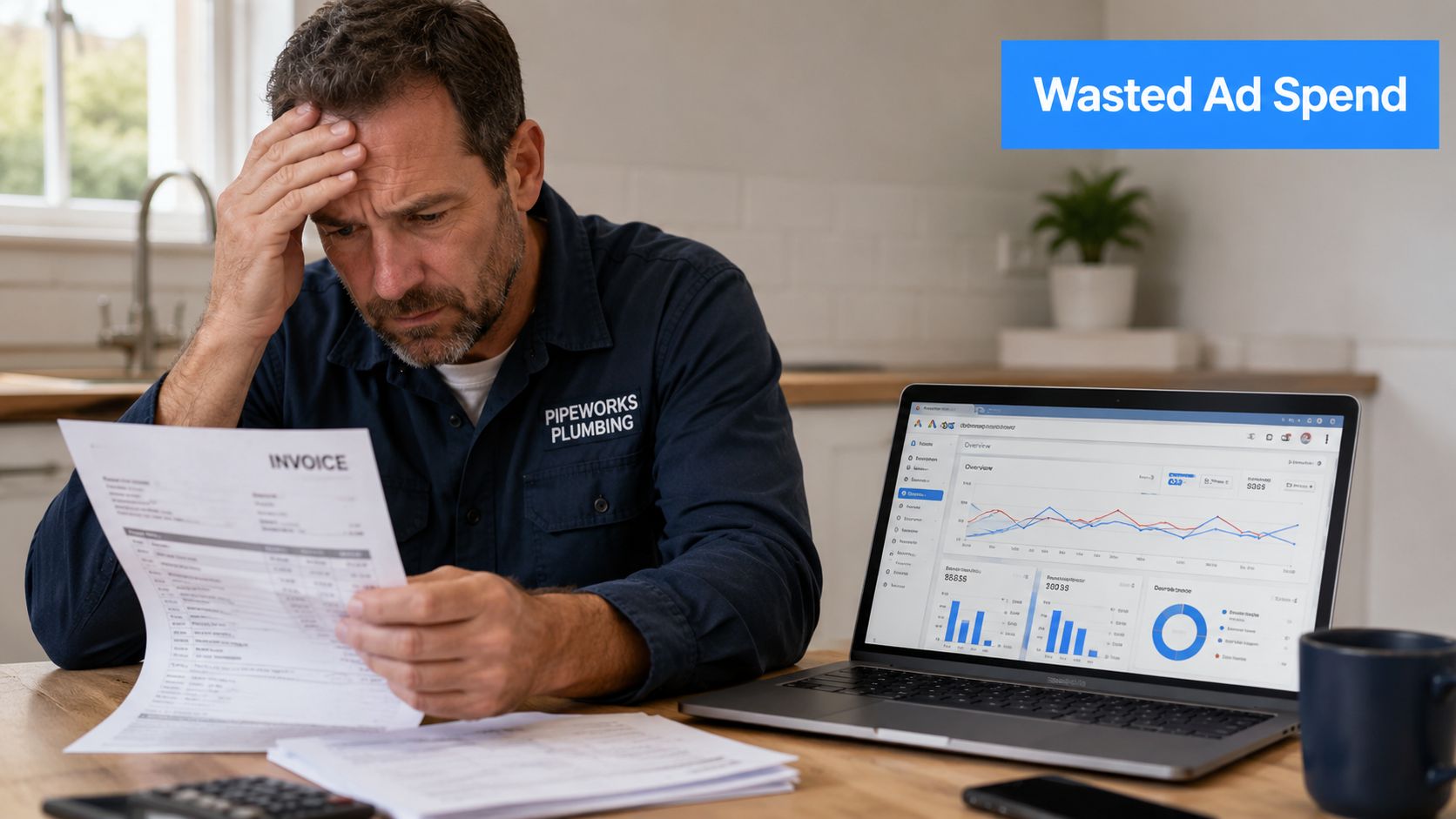
The problem usually isn't that Google Ads can't work for plumbers. It's that most setups ignore transactional search terms. When someone searches “water heater repair near me,” “toilet repair near me,” or “24 hour plumber [city],” they're much closer to calling than someone typing a broad phrase like “plumbing.”
Clicks aren't the job
A lot of agencies still talk like more traffic automatically means better marketing. It doesn't. Plumbers don't deposit clicks. They deposit revenue from service calls, booked estimates, emergency dispatches, and repeat work that starts with an urgent search.
At Transactional Marketing, the philosophy is simple. Go after the searches that show buying intent. That's why the company name matters. Transactional Marketing is built around getting businesses found for terms that signal action, not curiosity. If somebody searches “roofer near me,” “dentist near me,” or “air conditioning repair near me,” that person is ready to spend. For plumbers, the same applies to searches tied to leaks, clogs, broken heaters, and emergencies.
Practical rule: If the keyword doesn't look like something a stressed homeowner would type with a credit card nearby, it probably shouldn't lead your budget.
The full local buying path matters
Google Ads is only one part of local demand capture. A homeowner might see a paid ad, then check the map pack, then read reviews, then call the business that looks closest, fastest, and most trustworthy. That's why the best system isn't just about ads. It's search, maps, and the business profile working together.
Google Maps optimization matters because local service companies win a lot of calls there. Transactional Marketing focuses heavily on that side of visibility, including technology built to help businesses show in the top three map results in their service areas. That kind of placement can translate into hundreds more phone calls each month and thousands more over a year, especially in high-intent categories.
For owners who want a broader view of how local businesses approach paid Google visibility, this overview of Google marketing help for UK businesses gives useful context on campaign setup and search positioning.
AI optimization changes discovery
Homeowners aren't only using the old ten blue links anymore. They're also getting answers through AI-generated summaries and LLM-driven search experiences. That means your service pages, Google Business Profile signals, local relevance, and intent matching need to be clean enough for both Google Ads traffic and AI discovery systems to understand exactly what you do and where you do it.
A plumbing company that wants better results from Google Ads for plumbers should think less like an advertiser and more like a demand-capture operator. The job is to appear when urgency is high, trust is low, and the customer wants a direct path to a phone call.
The Foundation of Your Transactional Ad Account
Most weak plumbing accounts fail before the first click. The structure is sloppy. Services are mixed together, locations are too broad, and nobody separates a midnight pipe burst from a routine faucet issue. A strong account starts with campaign architecture that mirrors how people buy.
Start with three core campaign types
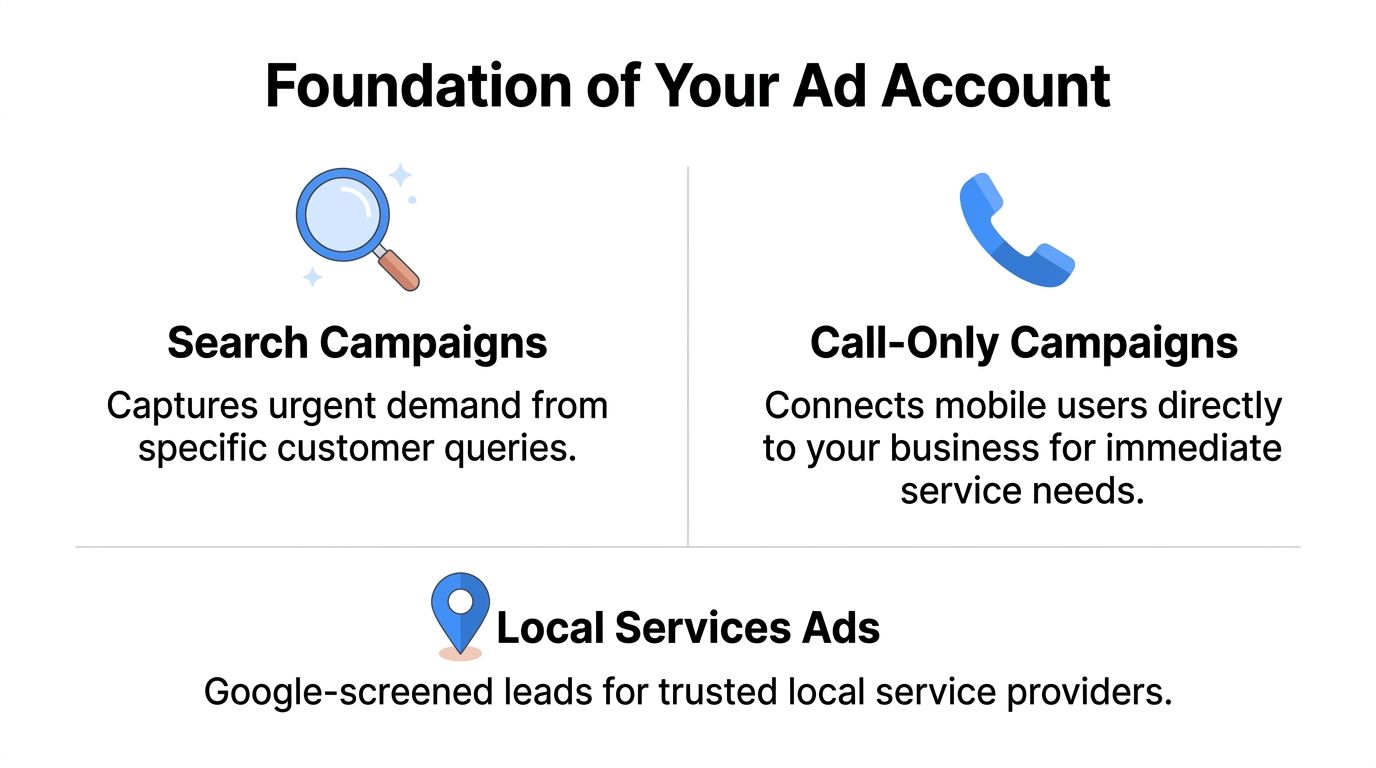
Plumbers usually need three distinct acquisition layers.
- Search campaigns capture typed intent. These are your service-keyword campaigns for terms such as drain cleaning, leak repair, and water heater repair.
- Call-only campaigns help mobile users skip the website and call immediately. They're useful when urgency is high and the person doesn't want to browse.
- Local Services Ads should not sit on the side as a small experiment. In many U.S. markets, traditional search ads have plateaued as a scaling tool and now act more like a defensive layer to LSAs, while LSAs take top-of-page visibility for urgent queries like “emergency plumber near me,” making them more cost-effective for many local plumbers according to Blue Corona's review of plumbing ad types.
That trade-off matters. Search ads give you more control over keywords, ad copy, and landing pages. LSAs often grab the highest-intent local lead before a search ad gets the click. If you're only managing search, you're leaving part of the market uncovered.
Build around service intent, not one giant campaign
A common mistake is creating one campaign called “Plumbing” and stuffing every service into it. Google then blends different intents together, and your ad copy gets generic fast.
A better structure looks like this:
| Campaign Group | What belongs in it |
|---|---|
| Emergency plumbing | burst pipes, emergency plumber, urgent leak repair |
| Drain work | drain cleaning, clogged drain, sewer backup |
| Water heater | repair, replacement, no hot water |
| Leak and pipe repair | pipe leak, slab leak, pipe burst |
| Fixture and toilet work | toilet repair, faucet repair, garbage disposal |
Each campaign should have its own keyword set, ads, location settings, and landing page. That lets you match the search to the exact problem. It also makes reporting usable. You can see whether drain cleaning is profitable without emergency terms hiding the true picture.
The account should look like your service menu, not a junk drawer.
Geography has to match your trucks
A plumbing business doesn't need to advertise to an entire state when crews only serve specific cities or a tight radius. Local targeting needs to reflect dispatch reality. If your team won't drive there, don't buy clicks there.
This is where maps visibility and service-area precision matter. Businesses that want a cleaner starting point can follow a practical framework for setting up a Google Ads campaign and then tighten it around true service boundaries.
Why this structure also supports SEO and AI optimization
A tightly structured ad account does more than improve paid search. It reveals the exact services and cities that deserve dedicated pages, Google Business Profile categories, and content support. That helps traditional SEO, Google Maps visibility, and AI optimization because LLM-driven systems can more easily interpret a business with clear service segmentation.
If your account has one mixed campaign and one generic page, Google sees noise. If it has clear service lines, localized relevance, and matching assets across ads, maps, and website content, Google sees a local service brand built for transactional searches.
Targeting Transactional Keywords That Drive Calls
Keyword strategy for plumbers isn't about collecting every phrase related to plumbing. It's about filtering for searches that signal urgency, service intent, and location intent. That's where the money is.
In competitive local markets, plumbing keywords on Google Ads can cost between $6 and $35 per click, and emergency terms like “emergency plumber near me” sit at the high end because the searcher is ready to act, according to Built Right Digital's guide to Google Ads for plumbers. That pricing is exactly why bad keyword selection gets expensive fast.
What a transactional keyword actually looks like
The best keywords usually combine three things. A specific service. A local modifier. A problem that needs solving now.
A homeowner searching “drain cleaning” might still be comparing. A homeowner searching “drain cleaning near me” or “clogged drain plumber [city]” is much closer to calling.
Here are sample keyword categories worth building around:
| Keyword Type | Example Keywords |
|---|---|
| Emergency | emergency plumber near me, 24 hour plumber [city], urgent pipe repair |
| Drain and sewer | drain cleaning near me, clogged drain plumber, sewer line repair |
| Water heater | water heater repair near me, no hot water plumber, water heater replacement |
| Leak repair | leaking pipe repair, slab leak plumber, burst pipe repair near me |
| Toilet and fixture | toilet repair near me, leaking faucet plumber, garbage disposal repair |
Negative keywords save real money
Most plumbing accounts don't just have a traffic problem. They have a filtering problem. If you don't block irrelevant searches, Google will keep finding them for you.
Use negative keywords to cut off non-buyers such as:
- DIY intent like diy, how to, tutorial, fix it yourself
- Career searches like jobs, salary, apprentice, training
- Product-only searches like parts, tools, supply, wholesale
- Research traffic like free, image, definition, school
The goal isn't to shrink traffic for the sake of it. The goal is to remove searches that won't become calls.
Think in service clusters and city modifiers
A plumbing business usually serves a fixed geography. That means your keyword list should include city names, neighborhood names, and service-area phrasing where it makes sense. Don't cram every city into one ad group. Keep the account readable.
Good keyword strategy also supports local SEO and AI optimization. When your paid campaigns, service pages, and Google Business Profile all reinforce the same transactional terms, your visibility improves across search surfaces, including LLM-driven results that rely on clear relevance signals.
For owners refining this process, these keyword research best practices are useful for organizing terms by intent instead of chasing volume alone.
Cheap clicks can still be expensive if they come from people who were never going to call.
A disciplined plumber running Google Ads for plumbers should be willing to pay more for the right search and nothing for the wrong one. That's the whole game.
Writing Ad Copy and Extensions That Convert
Good keyword targeting gets you into the auction. Good ad copy gets the call. If your ad reads like every other plumbing ad in town, Google has no reason to reward it and the customer has no reason to trust it.

Say the problem back to the searcher
A person searching for an emergency plumber doesn't want clever branding. They want confirmation that you solve the exact issue and can respond now. Strong ads usually do three things fast.
- Match the service in the headline
- Signal trust with licensing, insurance, reviews, or years in business
- Give a direct action such as Call Now, Book Today, or Same Day Service
That means headlines like these are usually more effective than vague branding lines:
- Emergency Plumber Near You
- Drain Cleaning Available Today
- Water Heater Repair Call Now
- Licensed Insured Local Plumber
Descriptions should continue that same logic. Mention service availability, local coverage, and the next step. Keep it plain. Busy homeowners scan, they don't study.
Urgency works when the offer is real
One plumbing strategy used urgency-based copy such as “Same Day Plumbing Help” and saw a 77% drop in cost per lead, from over $70 to $16, along with a 3.4X return on ad spend within the first week, based on this documented plumbing campaign example on LinkedIn.
That doesn't mean every plumber should copy that exact wording. It means urgency, specificity, and offer alignment matter. If you can dispatch fast, say so. If you answer live during business hours, say so. If you offer service for water heaters, drains, or burst pipes today, make that visible.
Extensions are part of the ad, not optional extras
Extensions turn a basic ad into a stronger local decision point. The minimum setup should include:
- Call extensions so mobile users can tap and call
- Location extensions to reinforce local credibility through your business profile
- Sitelink extensions pointing to service-specific pages like drain cleaning or water heater repair
- Callout and structured snippets for trust markers and key services
Video can help owners think through how messaging and presentation affect lead quality:
Message test: If your competitor removed the logo from your ad, would the wording still tell the customer exactly why they should call you now?
The best Google Ads for plumbers don't sound polished for the sake of it. They sound useful, credible, and immediate.
Bidding Budgeting and Tracking for Profitability
A plumbing ad account doesn't fail only from bad keywords or weak ads. It also fails when the owner has no financial model behind it. If you don't know what a lead costs, what a paying customer costs, and which calls became jobs, you're not running a marketing system. You're buying activity.
Start with realistic benchmarks
As of Q1 2026, the average non-branded plumbing Google Ads cost per lead in the U.S. is $183, based on $14.6 million in observed spend across 524 plumbing contractors and 2,554 non-branded and PMAX campaigns tracked from January through March 2026 by SearchLight. In that same data set, the median contractor spent $5,055 per month, and the median cost per paying customer was $333, according to SearchLight's plumbing Google Ads benchmark report.
Those numbers matter for one reason. They reset expectations. If a plumber thinks quality leads should cost almost nothing, the campaign gets judged too early and optimized too aggressively in the wrong direction.
Budget around customer value, not emotion
A smart starting budget depends on service mix, close rate, and average ticket. Emergency jobs, water heaters, and sewer work can support more aggressive bidding than lower-value calls. But the budget still has to reflect acquisition math.
Use this approach:
- Estimate your best service categories. Separate emergency work from lower-value maintenance calls.
- Track lead to booked-job movement. A lead isn't revenue.
- Judge the account by cost per paying customer, not just form fills or call volume.
Owners who need a cleaner way to model this can use a practical framework for calculating cost per acquisition.
Bidding only works when tracking is clean
Google can optimize toward conversions, but only if you feed it useful conversion data. For plumbers, that usually means tracking:
- Phone calls from ads
- Phone calls from the website
- Form submissions
- Booked jobs inside your CRM or call tracking workflow
If call tracking isn't connected, Google may optimize for low-quality actions instead of real opportunities. That's how businesses end up with reports that look healthy while the dispatch board stays thin.
The account should know the difference between a visitor, a lead, and a paying customer. If it doesn't, bidding decisions get worse over time.
Choose bidding strategies based on data maturity
A newer account often needs a simple structure and enough clean conversion signals before automation can help. Once tracking is reliable, conversion-focused bidding can work well because plumbing searches are highly intent-driven. But no bidding strategy can rescue bad geography, mixed campaigns, or irrelevant search terms.
Profitability comes from connecting spend to jobs. Everything else is a dashboard decoration.
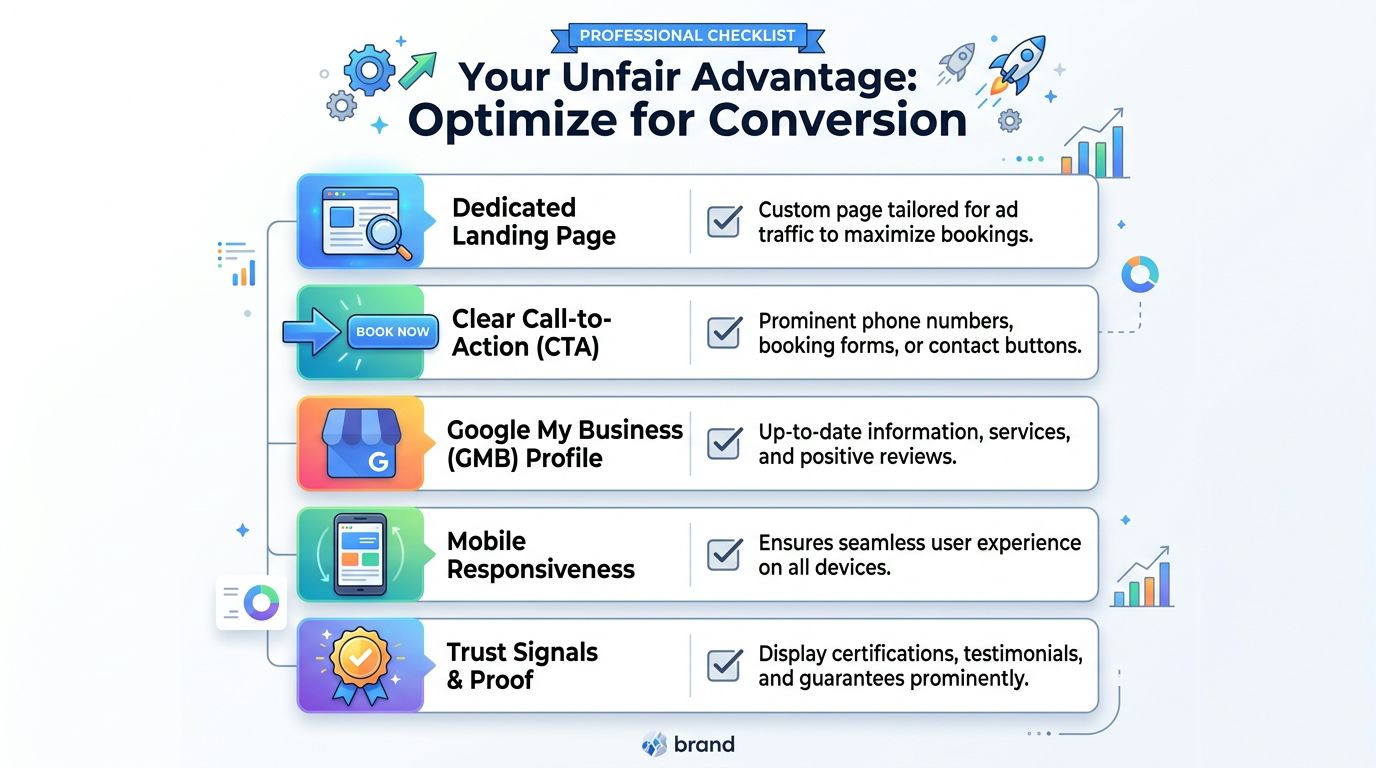
The Unfair Advantage Your Landing Page and GMB
A lot of plumbers pay premium click prices and then send traffic to a homepage that tries to do everything. Residential, commercial, remodels, about us, blog, careers, coupons. That's not a landing page. That's a detour.
A paid click needs a dedicated destination
Well-optimized plumbing landing pages should convert in the 8% to 15% range, and if a page falls below 5%, that points to a page design problem more than a traffic problem, according to Clicks Geek's plumbing performance benchmarks.
That benchmark tells you where to look first. If traffic is highly transactional and the page still doesn't convert, the issue is usually friction.
A plumbing landing page should include:
- A visible click-to-call button above the fold
- A short form for customers who don't want to call immediately
- Service-specific headlines that match the ad they clicked
- Trust signals such as license status, reviews, guarantees, and service-area clarity
- Mobile-first layout because a large share of urgent searches happen on phones
Google Business Profile reinforces the ad click
The ad gets attention. The landing page gets action. The Google Business Profile often closes the trust gap.
A homeowner may click your ad, then search your company name, scan reviews, check your hours, and look at your map location. If that profile is neglected, the paid click has to work harder than it should. If the profile is complete, active, and accurate, it supports the conversion path.
This is why Google Maps optimization matters so much for local service businesses. Showing strongly in the map pack can drive a high volume of direct local calls, and it also strengthens confidence when someone finds you through ads first. Businesses that want to improve this side of local visibility can review a clear process for optimizing a Google Business Profile.
This is where SEO, maps, and AI optimization overlap
A dedicated landing page and a strong business profile aren't separate assets. They form a trust loop.
- The ad promises a specific service.
- The landing page confirms it.
- The business profile validates the company locally.
- Reviews, photos, categories, and service descriptions reinforce relevance for both search engines and AI-driven discovery systems.
When the ad says one thing, the page says another, and the business profile looks half-finished, the customer hesitates and the click gets wasted.
For plumbers, the unfair advantage isn't a trick. It's alignment.
Your 30 Day Optimization Cadence to Dominate Locally
Most plumbing campaigns don't need constant reinvention. They need disciplined review. Google Ads for plumbers usually shows early movement fast, but serious optimization requires enough data to make decisions without guessing.
Campaigns generally need 2 to 4 weeks to gather enough data for optimization, and visible results often appear within 7 to 14 days, according to Housecall Pro's Google Ads guidance for plumbers. That timing is useful because it keeps you from making major changes too early while still forcing regular inspection.
Week one and two
The first stretch is about signal collection and damage control.
- Review search terms and add negatives for junk traffic you missed at launch.
- Check call handling to make sure leads are being answered and logged.
- Compare service groups so you can spot whether emergency, drain, or water heater traffic is behaving differently.
- Watch ad message fit. If users click but don't call, the message or landing page may be mismatched.
Week three
By now, patterns usually start to show.
| Review Area | What to look for |
|---|---|
| Search terms | irrelevant traffic, missed negatives, new high-intent phrases |
| Ad copy | stronger response to urgency, service-specific headlines, mobile call behavior |
| Landing page | call clicks, form friction, mismatch with ad promise |
| Local coverage | wasted clicks outside service zones, weak city alignment |
This is also the point where AI optimization starts to benefit from your paid search learnings. The exact terms generating qualified calls should influence your city pages, service pages, Google Business Profile updates, and content planning for LLM visibility.
Week four
Use the data to simplify and strengthen.
- Shift budget toward profitable service clusters
- Pause weak themes that attract poor-fit calls
- Expand keyword variants around proven transactional searches
- Refine extensions and call routing based on when leads convert
A disciplined local campaign often improves because the business gets sharper about what it won't pay for. That's how local dominance happens. Not from more complexity, but from tighter alignment around transactional terms, service areas, maps visibility, and assets that support both search engines and AI discovery.
If you want help building that kind of system, Transactional LLC focuses on high-intent local visibility for service businesses. The work centers on transactional search terms, Google Maps optimization, Google Business Profile setup and growth, local SEO, AI-driven content planning, web support, and paid campaigns that aim to generate calls from people ready to book. For plumbing companies that want to show up for the exact searches that produce jobs in their local cities, that's the right place to start.