


$786 billion is big enough to attract a flood of buyers, operators, and career switchers. It also creates a false sense that any entry path into digital marketing is a good one.
A marketing agency franchise sells certainty. You get a brand, a process, and a faster start than building from zero. That pitch worked better when digital marketing moved at a slower pace and local search was easier to standardize across dozens of territories.
That era is over.
AI search is changing how local businesses get discovered. Google Maps, AI-generated search results, review signals, structured data, local content depth, and location-level authority now shape who shows up when someone searches with buying intent. A rigid franchise playbook struggles here because local visibility is no longer a templated service. It is an execution problem that changes city by city, category by category, and even ZIP code by ZIP code.
That shift exposes the core weakness in the traditional franchise model. Standardization helps with onboarding and sales. It hurts when clients need fast decisions, custom local pages, better entity signals, stronger review acquisition, and content built for both human searchers and AI systems that summarize results.
If your goal is to own a business that serves local companies well, the question is not whether digital marketing has demand. It does. The key question is whether a franchise structure gives you enough flexibility to win in a market shaped by AI search and hyperlocal competition. In many cases, it does not.
The Allure of Owning Your Own Marketing Agency
Roughly 60 percent of searches now end without a click, which changes the economics of local marketing fast. Owning an agency still sounds attractive. Owning one under a rigid system is a tougher bet than many buyers realize.
The appeal is obvious. Agency ownership offers recurring revenue, strong margins when delivery is efficient, and a path to building something you can eventually sell. You are not buying inventory, leasing trucks, or managing a storefront. You are selling expertise, process, and client results.
That model draws three distinct buyers:
- Career switchers who want to replace salary income with recurring client revenue.
- Existing business owners who understand sales and want a service business without the overhead of retail, trades, or logistics.
- Agency operators who know the work and want a faster path than building a brand, delivery team, and sales process from zero.
The dream is clear. You win local clients, keep them on monthly retainers, build a team, and turn service revenue into an asset.
The complication is that people assume demand alone makes the business safer. It does not. It raises the standard.
A local agency used to survive on packaged SEO, basic websites, and generic content. That playbook is weaker now. Buyers want phone calls, booked jobs, and visibility in the exact neighborhoods they serve. AI search, Google Maps, review signals, local content depth, and business entity trust all affect whether a client shows up for high-intent searches.
That matters more than the agency dream itself. If you want to own a marketing business now, you need a model that can adapt city by city and category by category. A fixed system can help you start. It can also slow you down when local rankings depend on quick decisions, custom execution, and service offers that change as search changes.
So yes, the business is attractive. The better question is what kind of ownership gives you real control over growth, margins, and local performance. In this market, flexibility beats polish.
What Is a Marketing Agency Franchise Exactly
A marketing agency franchise is the business version of buying a restaurant franchise. You get the brand, the methods, the templates, the training, and the operating rules. You also inherit the limits.

The basic structure
At the top sits the franchisor. That's the parent company that owns the brand, systems, sales process, service menu, and intellectual property. The franchisor usually controls the playbooks, approved vendors, software stack, and how the brand is presented in the market.
In the middle sits the franchisee. That's the local owner. The franchisee pays for the right to operate under the parent brand, usually in a specific territory. They're responsible for sales, staffing, client management, and local execution.
At the bottom are the actual marketing services delivered to clients. Those can include local SEO, website work, paid media, social content, reporting, and lead generation support.
What you usually get
A real franchise package often includes the following:
- Brand license so you can operate under a known company name instead of inventing one.
- Training on sales, onboarding, fulfillment, and reporting.
- Playbooks for services, pricing, proposals, and account management.
- Territory protection so another franchisee from the same system isn't competing in your assigned market.
- Vendor access to preferred tools, software, and approved service workflows.
That structure helps new owners get moving faster than they would on their own. It can also reduce some early mistakes. You don't have to invent every process from zero.
What you give up
The trade-off is autonomy. That's the part buyers underestimate.
You usually can't change the offer however you want. You may not be able to reposition around AI optimization, restructure pricing, add a niche-specific SEO package, or redesign the website stack without approval. If the system sells broad digital marketing packages but you want to specialize in transactional terms like roofer near me or dentist near me, you may be stuck coloring inside the lines.
Practical rule: If a franchise sells “support” but limits your ability to adapt service delivery, it's not support. It's control.
That distinction matters more in marketing than in simpler franchise categories. Search behavior changes fast. Google Business Profile workflows change. Local SEO requirements evolve. AI systems reward clear entities, structured pages, and crawlable content. If your model can't pivot, you're not running a modern agency. You're running someone else's frozen template.
The Key Benefits and Hidden Risks of Franchising
A marketing agency franchise has real benefits. It also has liabilities that become obvious only after you're inside the contract.

Where franchising helps
The strongest argument for franchising is speed. You don't spend months naming the company, designing sales materials, writing onboarding docs, or testing service delivery from scratch. The system already exists.
Here are the practical upsides:
- Turnkey operations that shorten the startup phase.
- Brand recognition that may make early sales conversations easier.
- Support and training when you hit your first operational problems.
- Peer network access with other franchisees facing similar challenges.
For someone who's never sold SEO, managed retainers, or built local lead generation systems, that scaffolding can reduce panic. A blank page is hard. A script, checklist, and onboarding path feel safer.
Where the franchise model breaks down
The weakness is rigidity. A lot of franchise systems are built for consistency first, not performance first. That sounds harmless until you're competing in local search.
The local business owner doesn't care that your proposal matches the master brand. They care whether you can get them found for buying phrases. They care whether their Google Business Profile is optimized, whether their location page is indexable, and whether they're visible in Maps when someone searches for service plus city.
That's where the model often gets jammed. Corporate wants control. Local operators need agility.
A sharp example comes from Google Business Profile management. Data shows 68% of multi-location businesses lose 30–50% of local visibility due to inconsistent GBP management, according to Right Left Agency's franchise marketing analysis. That's not a branding problem. It's an execution problem.
The corporate versus local conflict
This is the hidden risk most buyers miss. Multi-location systems frequently centralize approval for listings, location pages, and local content. The intent is understandable. Corporate wants consistency. But local search doesn't reward consistency alone. It rewards relevance, completeness, freshness, and local precision.
If a franchisee can't quickly update categories, services, photos, posts, Q&A, local content, or page structure because corporate is gatekeeping every move, visibility slips. Then everyone wonders why the system “isn't working.”
| Franchise benefit | Real-world risk |
|---|---|
| Standardized brand | Standardized messaging can become generic locally |
| Central support | Slow approvals can block local optimization |
| Shared technology | Shared tools may not fit every market |
| Proven playbook | Old playbooks decay fast in SEO and AI search |
The more local the search, the less useful a rigid national template becomes.
The expensive comfort of certainty
There's another risk people don't admit out loud. Franchising can become a way to buy emotional comfort at a high operational price. You pay for certainty, but in marketing, certainty has a short shelf life.
What worked in lead generation, local landing pages, or Google Maps optimization last year may not work now. If your franchisor updates slowly, your local office still pays the price. Not the parent company. You do.
That's why I don't dismiss the franchise route. I just don't romanticize it. The strengths are real. The weaknesses are expensive.
Understanding Franchise Costs and Revenue Models
At this juncture, the brochure language ceases to be helpful. The question isn't whether you can afford the initial franchise fee. The question is whether the full structure leaves enough margin for you to build a durable agency.
The visible costs
Most buyers focus on the upfront number because it's clean and easy to compare. But that number is only the entry ticket. Once you're operating, the actual cost stack shows up in layers.
Expect to evaluate items like these:
- Initial franchise fee for the right to operate under the brand
- Royalties taken from top-line revenue
- Brand fund contributions for system-wide marketing
- Technology charges tied to the required software stack
- Training and onboarding expenses for travel, setup, and internal ramp-up
- Local sales and staffing costs that aren't covered by the parent company
If you're financing the business, the math gets tighter. Before signing anything, it helps to review a practical lending breakdown like GoSBA Loans' 7(a) loan insights. Not because a loan solves the problem, but because debt changes how patient you can afford to be.
The hidden margin squeeze
A lot of franchise buyers underestimate what recurring royalties do to a service business. In a local agency, profit doesn't come from selling one giant product. It comes from keeping clients, fulfilling efficiently, and controlling acquisition cost.
When someone else takes a cut off the top every month, your room to hire, test, and improve shrinks. That doesn't mean the deal is bad. It means your margin needs to be strong enough to survive both normal churn and platform volatility.
Disciplined client economics matter more than branding. If you don't know how each channel contributes to revenue, you'll confuse gross sales with healthy growth. That's why smart operators obsess over attribution and client economics, including fundamentals like how to calculate cost per acquisition.
A franchise fee is a one-time pain. Royalty drag is a permanent tax on your upside.
How franchisees usually make money
Most marketing agency franchises rely on recurring monthly services. That part is attractive. Retainers can stabilize cash flow better than one-off projects.
Common revenue buckets include:
- Monthly managed services such as SEO, paid ads, reputation work, websites, or content.
- Setup fees for onboarding, website builds, analytics configuration, or local listings work.
- Add-on projects when clients need redesigns, new pages, or campaign expansions.
- Cross-sold services approved by the franchisor's service menu.
The issue isn't whether recurring revenue exists. The issue is whether you control enough of the offer to increase lifetime value without bloating delivery costs.
Questions that expose the real economics
Before buying, ask these hard questions:
- What services carry the best margin? If the answer is vague, that's a warning.
- Which tools are mandatory? Required software can erode profit.
- How much of fulfillment is centralized? Central fulfillment can help, or it can trap you in mediocre delivery.
- What can you customize? If you can't refine offers around transactional search and local Maps visibility, your ceiling may be lower than advertised.
The financial picture of a marketing agency franchise isn't simple. It's a tug-of-war between support and drag. The wrong structure leaves you working hard to feed the system. The right structure gives you enough flexibility to build an actual business.
How to Evaluate a Franchise Opportunity
Most buyers ask weak questions. They focus on startup support, branding, and “culture.” Those matter, but they don't tell you whether the franchise can win online.
For a marketing business, the first due diligence test is brutally simple. Can the franchisor market itself?
Start with the franchisor's own demand generation
Digital marketing remains the strongest driver of new franchise leads, with 65% originating from online campaigns, according to Amra & Elma's franchise marketing statistics. If digital is the main lead engine for franchise recruitment, then the franchisor's own search visibility, paid acquisition, content quality, and conversion flow should be under a microscope.
If they claim to be digital experts but their own presence is weak, you have your answer.
Look at:
- Their rankings and intent targeting for franchise-related searches
- Their paid search discipline and landing page quality
- Their local strategy if they support franchisees at the location level
- Their content depth on SEO, Google Maps, AI search, and local lead generation
A niche-specific resource like SEO services for franchisees is the kind of subject matter a serious operator should understand well. If the franchisor stays shallow on topics like that, don't expect advanced support after you buy.
Read the documents like an operator, not a fan
The Franchise Disclosure Document isn't bedtime reading. It's where the risk hides.
Pay close attention to areas that affect a marketing business directly:
- Territory language that sounds protective but still leaves room for internal competition
- Technology rules that lock you into outdated systems
- Restrictive covenants that limit what you can do if you exit
- Vendor mandates that force expensive or underpowered tools
- Termination terms that give the parent company too much control
Don't skim these sections. Marketing changes fast. If the legal structure assumes a slower world, you'll feel it.
Interview current and former franchisees
Here, polished sales messaging often falls apart. Speak with operators who are still in the system and those who left.
Ask direct questions:
- What support do you get after onboarding?
- How quickly can you launch a new local offer?
- Can you adjust around AI search changes?
- Do corporate approvals slow down sales or fulfillment?
- Would you buy the franchise again?
If current franchisees sound careful and former franchisees sound relieved, pay attention.
Red flags that matter more than the brochure
A strong franchise opportunity should show competence in modern search, not just sales polish.
Watch for these warning signs:
| Red flag | Why it matters |
|---|---|
| Generic service menus | Hard to compete on high-intent local terms |
| Vague AI roadmap | Signals reactive leadership |
| Over-controlled local execution | Hurts speed in GBP and Maps optimization |
| Thin reporting | Makes it hard to defend ROI and retention |
| High turnover chatter | Usually points to weak economics or poor support |
A marketing franchise should prove it can generate demand, rank for relevant searches, and help local operators capture buyers. If it can't do that for itself, it won't do it for you.
The AI Search and Local SEO Challenge for Franchises
The old agency playbook was built around webpages, rankings, and lead forms. That still matters, but the search environment is different now. Businesses are being discovered through Google Maps, AI summaries, local packs, and large language model outputs that pull from structured, crawlable content.
That change is rough on rigid franchise systems.

Transactional intent is where the money sits
Not every search has equal value. Someone typing what is root canal therapy is researching. Someone typing dentist near me is trying to take action.
That distinction matters because transactional search terms, such as roofer near me or dentist near me, signal immediate purchase intent. Search Engine Land notes that 72% of consumers use Google Search and 51% use Google Maps to find local business information, which is why those surfaces dominate local conversion behavior for high-intent queries in this guide to near me search optimization.
That's the core operating reality for local service companies. If a franchise model isn't built to capture transactional terms, it's misaligned with buyer behavior.
The technical bar is higher than most franchise playbooks admit
Location-level search performance now depends on boring details executed well. NAP consistency. Schema markup. Crawlable pages. Fast performance. HTTPS. Clean internal linking. Accessible service and FAQ content. Those aren't optional.
According to DevHub's guide to digital franchise marketing, local franchise performance depends on precise NAP consistency across websites, Google Business Profiles, and directories, plus schema types like LocalBusiness, Organization, Service, FAQ, and Review on location pages. The same guide stresses that slow pages, JavaScript-trapped content, or blocked routes can cause indexing problems and lost visibility.
That's exactly why centralized, templated systems struggle. The parent company wants one stack. Each location needs precision.
If you're assessing whether a franchise website setup is technically capable of supporting local growth, reviewing examples of custom franchise website development helps sharpen your eye. The question isn't whether the design looks professional. It's whether the architecture supports local discovery and AI citation.
Why hyperlocal execution beats generic brand consistency
For franchise systems, broad consistency can become a handicap. A generic brand page for “services” won't beat a properly built local page tied to a city, service, and buying phrase. The locations that win usually have clearer local relevance and better technical hygiene.
That's why local operators keep pushing for more control. They need faster edits, tighter city-service targeting, and stronger Google Maps execution. A practical reference point is local SEO for franchise, because this challenge is never abstract. It shows up in rankings, map visibility, calls, and booked work.
AI search rewards businesses that are easy to understand, easy to crawl, and clearly tied to a local service area.
A franchise system can absolutely compete here. But only if it stops treating local SEO like a brand compliance task and starts treating it like a technical growth discipline.
Modern Alternatives to a Marketing Agency Franchise
A lot of people looking at a marketing agency franchise don't want a franchise. They want three things: a proven system, operational support, and a faster path to revenue. Those are reasonable goals. The mistake is assuming you need franchise baggage to get them.
What a better model looks like
The stronger alternative is a flexible partnership model built around performance, not brand obedience. That means keeping the useful parts of a system and dropping the parts that slow you down.
In practical terms, that model should give you:
- A repeatable SEO and content engine without locking you into stale templates
- Google Maps optimization at the location level
- Visibility for transactional search terms like roofer near me, dentist near me, and air conditioning repair near me
- AI-focused content and site structure that help businesses show up in modern search experiences
- Transparent reporting so you can see rankings, search terms, map movement, and lead trends
For local service companies, abstract “brand reach” isn't the goal. Instead, they need buyers. They must appear where purchase intent is highest.
Why flexibility now beats ownership theater
I've seen operators get seduced by the prestige of ownership labels. Franchise owner sounds impressive. But if your contract blocks you from moving fast, your title is mostly decorative.
The market now rewards specialists who can publish industry-specific content, build location-specific pages, and target terms with clear buying intent. It also rewards teams that understand how AI systems read websites. If you're trying to improve discoverability in emerging search surfaces, resources on how to rank in Google AI Overviews are useful because they force you to think beyond traditional rankings.
The other reason flexible partnerships win is focus. Strong operators don't lump roofing, dental, pest control, chiropractic, and med spa SEO into one vague offer. They separate industries, separate search intent, and build content silos around what each buyer types.
Here's a quick walkthrough that reinforces the point:
The system without the franchise drag
A modern partner should help businesses rank for exact local terms people use when they're ready to spend. That's the whole point of a transactional approach. If someone searches roofer near me, dentist near me, or air conditioning repair near me, the goal isn't vague visibility. The goal is to get that business into the decision set immediately.
The best setups also extend beyond rankings. They include Google Business Profile support, maps visibility, localized page structures, and software that tracks what's happening by service and city. If you're evaluating execution capability, a platform like private label SEO software shows what a more adaptable, tool-driven model can look like without forcing you into a franchise shell.
The modern alternative isn't “go build everything alone.” It's “use a sharper system without surrendering flexibility.”
That's where the traditional marketing agency franchise starts to look old. It still sells certainty. But in AI search and local SEO, speed, specialization, and hyperlocal execution matter more.
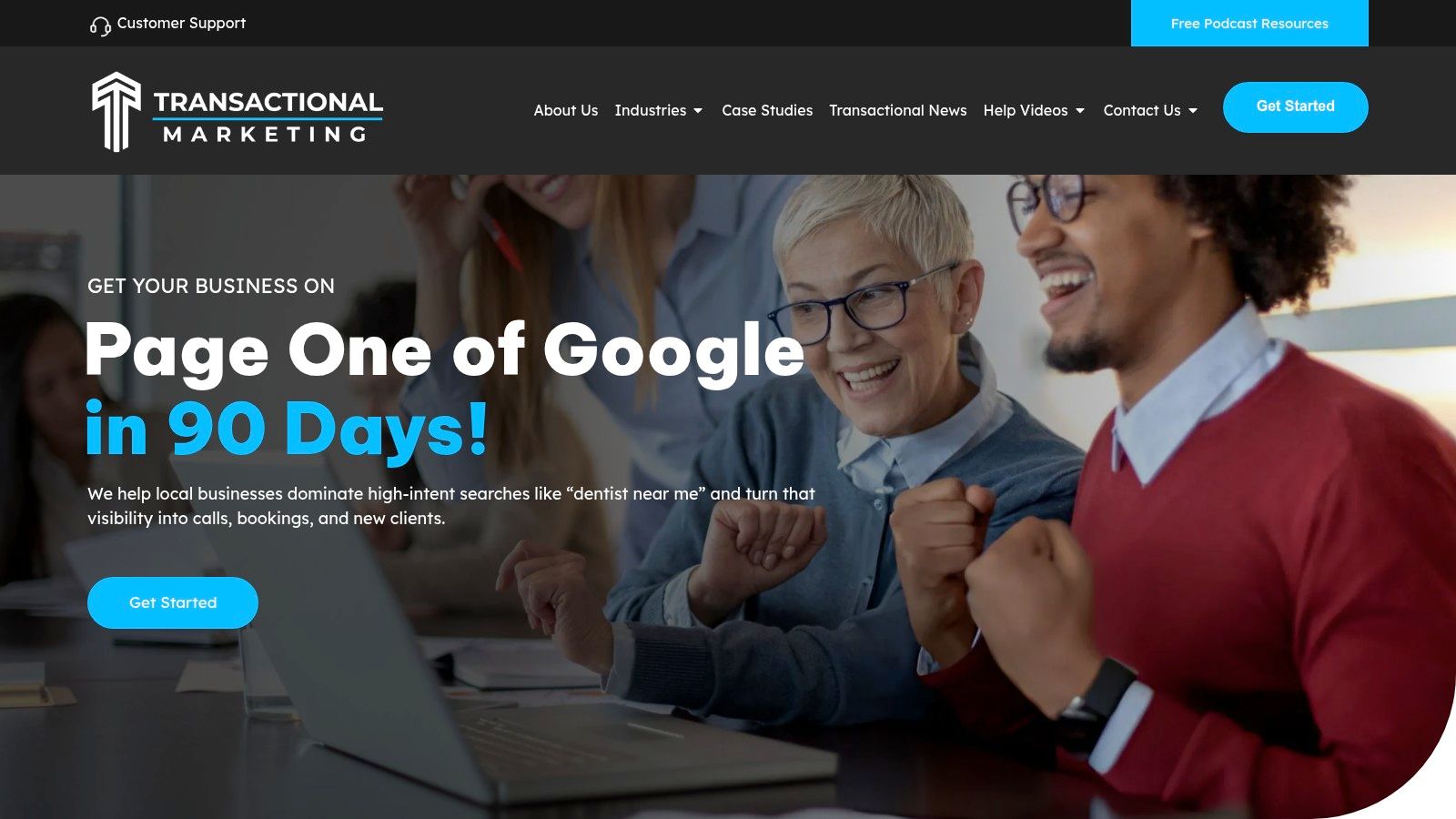
If you want help from a team that focuses on transactional search terms, Google Maps visibility, AI-oriented content, and contract-free local growth, take a look at Transactional LLC. They work with service businesses that need to rank where buyers are searching, especially for terms like dentist near me, roofer near me, and air conditioning repair near me, and they do it with a practical system built for local results rather than franchise rigidity.