

Most local business owners hit the same wall. They do solid work, customers seem happy, and the phone still isn't ringing as consistently as it should. Then they search their own service in Google, see a competitor sitting in the Maps 3-pack with a stronger review profile, and the problem gets obvious fast.
If you want to know how to get more Google reviews, stop treating reviews like a nice extra. For service businesses, reviews are part of the ranking system for the searches that matter most. Those are transactional search terms like “roofer near me,” “dentist near me,” and “air conditioning repair near me.” The person typing those terms isn't browsing. They're ready to hire.
That matters even more now because local visibility isn't just about classic SEO anymore. AI optimization is becoming part of how businesses get discovered. Large language models and AI-driven search experiences pull from the same public business signals people already rely on, including review quality, recency, service details, and business credibility. If your review profile is stale, thin, or inconsistent, you're easier for both Google and AI systems to overlook.
Why Reviews Are Your Key to Winning Transactional Search
A weak review profile doesn't just hurt trust. It costs you placement where the best local leads happen.
For businesses that depend on calls, booked jobs, and patient appointments, reviews are one of the clearest levers for Maps visibility. Review count and quality represent the heaviest signal for Google Maps prominence, and an analysis of over 30,000 listings found that average rating, review freshness from the last 30 days, and review response rate collectively explain 91% of position variation for businesses in the top 3 on Google Maps according to this Google Maps ranking analysis.
That changes the conversation. Reviews aren't about ego. They're about whether your business shows up when someone searches a term with buying intent.
Reviews influence who gets the call
When someone searches “plumber near me” or “orthodontist near me,” they usually don't open ten websites and do a full comparison. They look at the map results, scan the stars, scan the volume of feedback, and call one of the businesses that feels safest.
That means reviews shape three things at once:
- Visibility in Maps because stronger review signals help your profile compete for local prominence
- Click and call behavior because buyers compare star ratings and review depth in seconds
- AI discoverability because review language gives systems more context about what you do and how customers describe the experience
Practical rule: If your review generation system is inconsistent, your rankings for transactional terms will be inconsistent too.
Transactional Marketing focuses on those bottom-of-funnel phrases for a reason. Ranking for “dentist near me” matters more than ranking for vague informational traffic if your goal is booked patients. The same logic applies to “roof repair near me,” “HVAC repair near me,” and every other local service query where the searcher has money in hand.
A review strategy that feeds those searches is a revenue strategy. That's the lens to use for every tactic in this playbook.
Build a Five-Star Foundation on Your Google Business Profile
Before you ask for a single review, your Google Business Profile has to be clean, complete, and aligned with the searches you want. If the profile is sloppy, you'll waste review momentum on a listing that isn't set up to rank for the right terms.
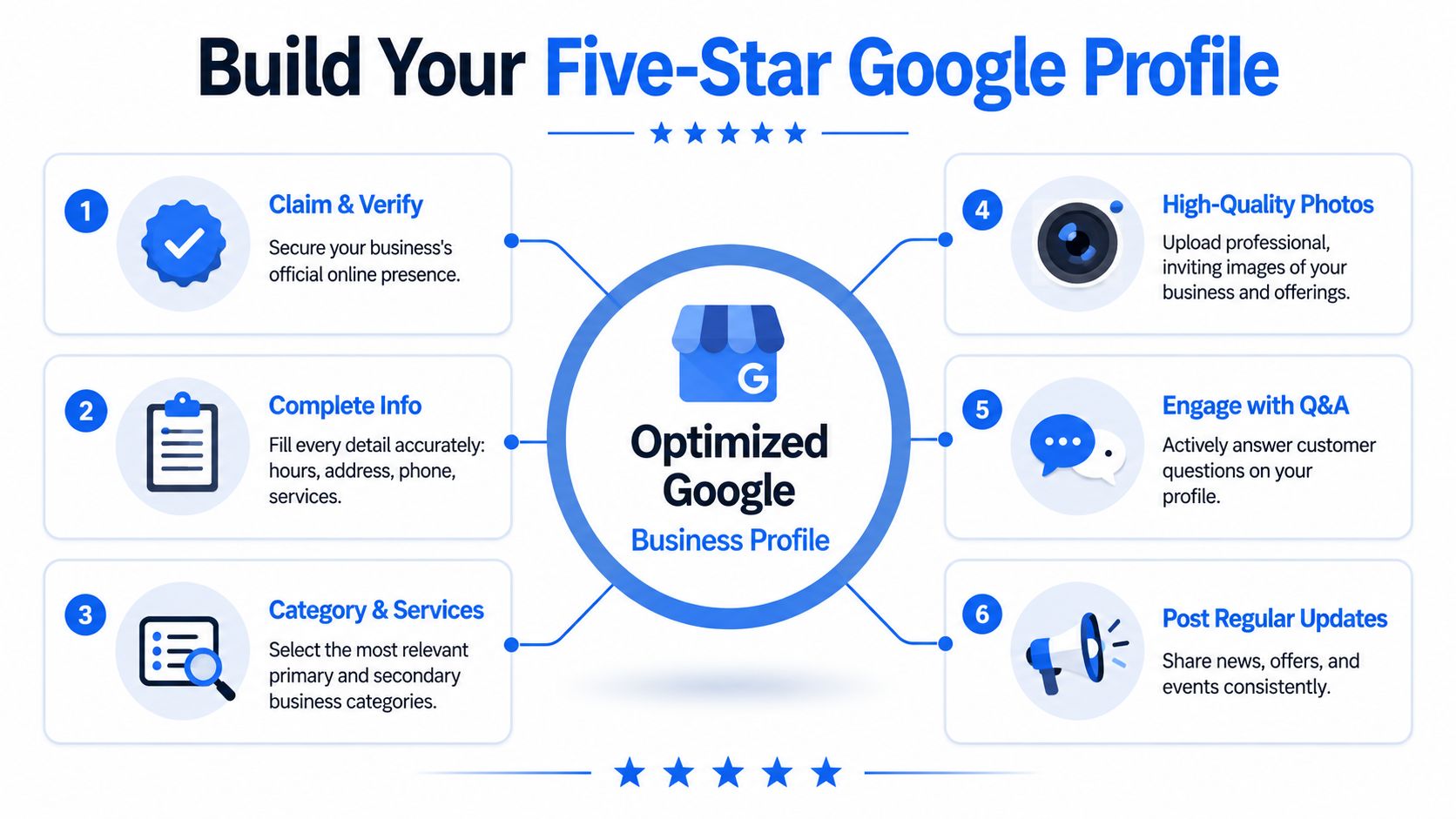
Get the core fields right
Google still relies on relevance, distance, and prominence. Relevance starts with profile structure.
Your first checklist is simple:
- Match your NAP everywhere. Your name, address, and phone number need to appear the same across your site, your directories, and your Google Business Profile. Even small formatting differences can create confusion for Google's local systems, as explained in this overview of local search optimization factors.
- Fill every usable field. Hours, services, service areas, business description, appointment links, and categories should all be completed.
- Upload real photos. Use current photos of trucks, staff, office interiors, treatment rooms, storefronts, completed work, and branded assets. Generic stock images weaken trust.
If you want a solid outside checklist for profile cleanup, this guide on how to attract more local customers is useful. For a more direct implementation reference, Transactional's own walkthrough on optimizing your Google Business Profile is worth reviewing alongside your current setup.
Category selection decides what you can rank for
Many businesses underperform in this aspect. They pick a broad or inaccurate primary category, then wonder why they don't appear for the terms that bring revenue.
Selecting the correct primary business category is the single most influential field in a Google Business Profile, and adding 2 to 3 relevant secondary categories can expand visibility without overdoing it based on this breakdown of Google Maps ranking priorities.
If you're an HVAC company, your primary category should reflect the service you most want to rank for locally. If you're a dental office, the same rule applies. Don't dilute the profile with categories that sound related but don't support your highest-value search terms.
Your primary category tells Google what game you're playing. Your reviews help decide whether you deserve to win that search.
What a trustworthy profile looks like
A strong profile usually has these traits:
| Profile Element | What to check | Why it matters |
|---|---|---|
| Primary category | Closely matches your main service | Supports relevance for transactional searches |
| Secondary categories | Limited to closely related offerings | Expands reach without muddying focus |
| Services list | Includes real service lines and locations | Helps searchers and platforms understand intent |
| Photos | Current, branded, and specific | Improves trust and conversion |
| Q&A | Monitored and answered | Removes buyer hesitation |
A polished profile doesn't generate reviews by itself. It gives those reviews a place to do useful work.
Mastering the Ask with Compliant Request Strategies
The businesses that win reviews don't rely on luck. They ask at the right moment, in the right channel, with almost no friction.

The biggest mistake is waiting too long. Asking within 24 hours of a positive experience yields significantly higher conversion rates, and response rates drop by over 50% if the request is delayed beyond two days. Personalization also matters, with messages that use the customer's name and service increasing completion by 22% according to Backlinko's review timing data.
Ask in person when the satisfaction is obvious
For home service businesses, the best moment is often right after the technician solves the problem and the customer can see the result. For a dental office, it's often at checkout or right after a smooth appointment.
Use language that sounds natural, not scripted beyond belief.
HVAC technician example
“Glad we got your AC running again. I'll text you the invoice and a quick review link. If you'd be willing to share how the repair went, it helps other homeowners find us.”
Dental front desk example
“We're glad everything went smoothly today. I'll send you a quick text with a Google review link. If you have a minute later, we'd appreciate your feedback.”
A good ask does three things:
- Ties the request to the completed service
- Sets the expectation that a link is coming
- Keeps the tone light
Use SMS and email that remove friction
Text usually works well because it meets the customer where they already are. Email still has a role, especially for practices and businesses with longer customer communication cycles.
Keep the request short. Direct. Personalized.
SMS template
Hi Sarah, thanks for choosing us for your HVAC repair today. If you have a minute, we'd appreciate your Google review: [link]
Email template
Subject: Quick favor about your recent service
Hi Michael, thanks again for trusting us with your dental visit. If you'd be open to sharing your experience, you can leave a Google review here: [link]
For teams that want more examples, Netco Design LLC has a useful playbook for increasing Google reviews. If you need copy you can deploy immediately, these review request templates give your staff a cleaner starting point.
Make the path stupid simple
Every extra click loses people. The cleanest setups usually include:
- A direct review link so customers don't have to search for your business
- A QR code on invoices or receipts for field techs, front desks, and checkout counters
- Business cards or leave-behinds with a scan option after the job
- A short message under 160 characters for SMS, especially if your team texts often as part of service communication
This walkthrough is worth watching if you want to tighten the workflow around the ask and the follow-up.
Stay compliant and avoid the junk tactics
Don't buy reviews. Don't offer rewards for positive reviews. Don't gate requests in a way that turns the process into manipulation.
You can absolutely build a system. You just can't fake trust.
Ask after a real win, send the direct link fast, and make it easy enough that the customer can finish the review before the moment fades.
That's what works in the field. The fluff doesn't.
Automate Your Review Engine for Consistent Velocity
One-off review pushes create uneven results. Google Maps doesn't reward random bursts the way business owners hope it will. A steady stream of fresh feedback is more useful for rankings, more believable to customers, and more helpful for AI systems that rely on current signals.
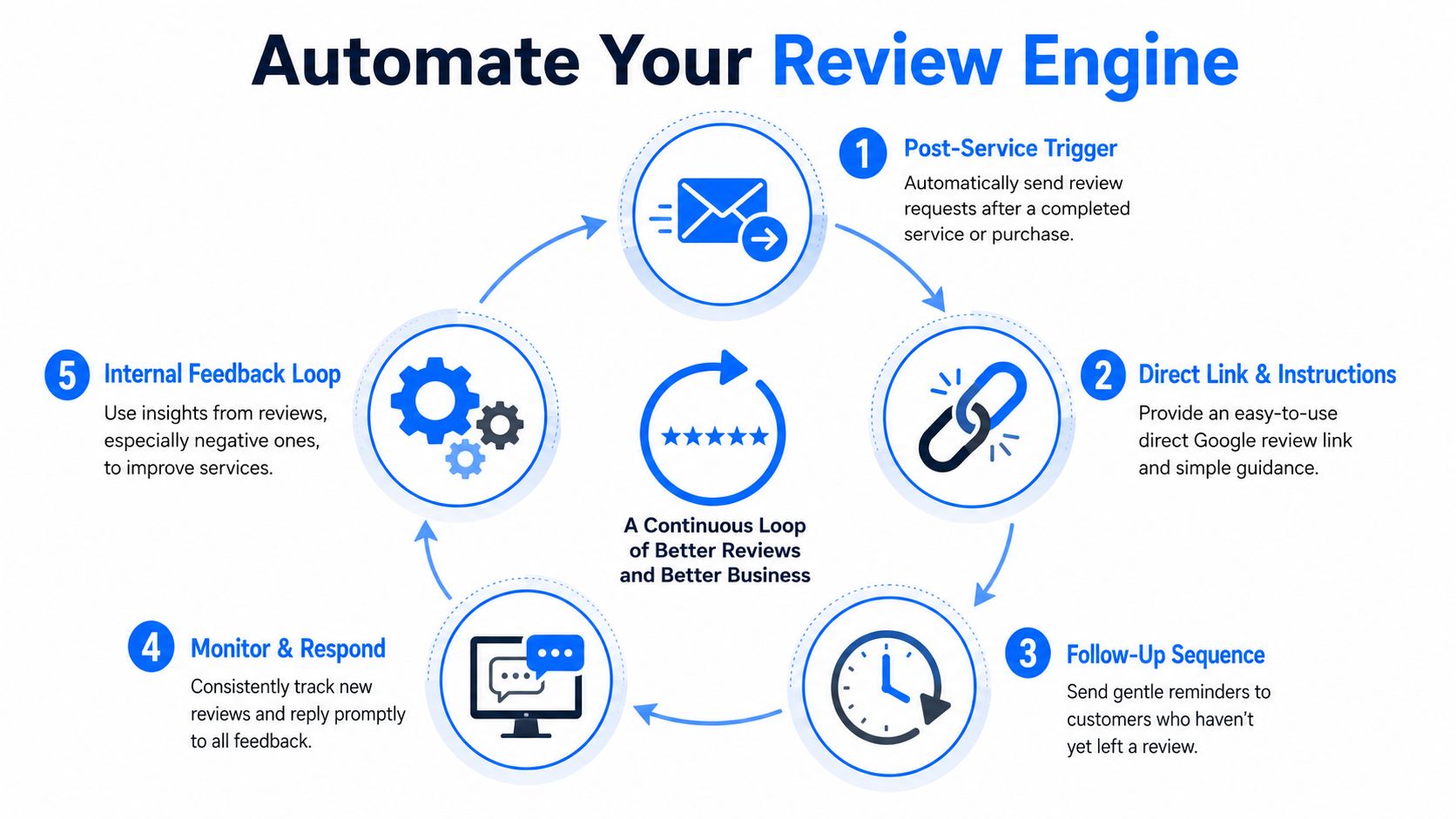
Maintaining a steady review velocity of 2 to 5 new reviews per week is far more powerful for ranking than acquiring 50 reviews in a single month followed by zero reviews for six months, because consistency signals ongoing customer engagement to Google, based on this analysis of Google Maps ranking factors.
What automation should trigger
The cleanest systems start with an operational event, not a marketing reminder. In home services, that might be when a job is marked complete in ServiceTitan or Housecall Pro. In dental, it might be after checkout in Dentrix or the practice management system your office already uses.
A reliable workflow usually looks like this:
- Service completed and status updated in your CRM or management tool
- Review request sent automatically by SMS or email
- Direct Google review link delivered with minimal text
- Reminder sent later if no review comes in
- Team notified when feedback arrives so someone can respond
Why review velocity matters beyond Google
Consistent review flow does more than support map rankings. It keeps your public reputation current. It gives future customers recent proof. It also gives AI-driven search systems fresh language about your services, locations, and outcomes.
That matters if you're trying to rank for phrases like “roofer near me” or “emergency dentist near me.” AI systems don't just look for a business that exists. They lean toward businesses with strong, recent, descriptive public signals.
Operator insight: Manual review requests fail because busy staff forget, not because customers hate leaving feedback.
Transactional LLC is one option businesses use to build this kind of repeatable review workflow alongside Maps tracking and local SEO. The important part isn't the vendor. It's whether the request is tied to the completed transaction and sent without relying on memory.
What doesn't work
A lot of owners still try one of these:
- The review blitz. Everyone asks for reviews for a week, then nobody follows up next month.
- The passive hope strategy. You add a review link to your website footer and expect customers to find it.
- The owner-only bottleneck. One person manually texts every customer when they remember.
Those approaches create gaps. Gaps kill momentum. An automated review engine closes them.
Managing Your Reputation with Smart Review Responses
A review without a response is a missed public conversation. Potential customers aren't just reading what the reviewer said. They're studying how your business reacts when things go well and when they don't.
Response behavior also matters operationally. It helps you protect trust, show accountability, and create a better feedback loop for the team.
Build a recovery-first workflow
Most review advice tells you to ask happy customers and ignore the rest. That's incomplete.
Routing detractors with scores of 0 to 6 into an internal recovery workflow before requesting a public review helps prevent filtered negative reviews and can increase positive review volume by converting unhappy customers into promoters, based on AskNicely's review recovery guidance.
That means your system shouldn't send the same follow-up to everyone. If a customer signals frustration, send them to a service recovery path first. That can be a call from a manager, an internal form, or a direct outreach process that resolves the issue before you ever ask for a public review.
For a broader operational perspective, this guide to online reputation management is a useful companion read. If you're building the workflow internally, this resource on online review management helps map the pieces together.
Use response templates without sounding canned
Templates are useful. Copy-paste replies that sound robotic are not.
Here are practical starting points:
| Review Type | Response Goal | Template Example |
|---|---|---|
| 5-star review | Reinforce trust and mention the service naturally | Thanks for the feedback, [Name]. We appreciate you trusting us with your HVAC repair and we're glad the visit went smoothly. |
| 3-star review | Acknowledge mixed feedback and open the door to resolution | Thanks for the honest review, [Name]. We appreciate the feedback and would like to learn more about what could've made the experience better. |
| 1-star review | Stay calm, protect the brand publicly, move the issue offline | We're sorry to hear this, [Name]. This isn't the experience we aim to provide. Please contact our team directly so we can review the situation and work toward a resolution. |
What strong responses do
A useful response usually includes some combination of these elements:
- Specific acknowledgment of the service or visit
- Professional tone even if the review is unfair
- A clear next step when the issue needs offline follow-up
- No defensiveness in public
Don't over-explain. Don't argue. Don't imply the customer is lying in the public thread unless you're dealing with clear policy violations through Google's reporting channels.
The audience for your response is usually the next customer, not the last one.
Separate false reviews from real complaints
Some negative reviews reflect a real service problem. Some are spam, confusion, or competitor nonsense. Handle those differently.
If it's a legitimate complaint, respond and try to fix it. If it violates platform rules, flag it through the proper process while still posting a calm public reply if needed. Either way, silence makes the profile look neglected.
The businesses that earn trust at scale don't just collect praise. They show they can manage friction without losing control.
Tracking Your ROI from Reviews to Revenue
If you can't connect reviews to leads, you're guessing. Star ratings alone won't tell you whether the review program is helping your business win more transactional searches and more calls.
The right way to track performance is to follow the chain from review activity to Maps visibility to inbound lead behavior.
Watch the terms that bring buyers
Don't obsess over broad vanity keywords. Track the searches that signal purchase intent in the exact cities and service areas you care about.
That usually means monitoring terms like:
- “AC repair near me”
- “plumber near me”
- “dentist near me”
- “chiropractor near me”
- service-plus-city combinations tied to your core offers
Your review strategy matters most when it supports placement for those bottom-of-funnel terms. If rankings improve for random informational phrases but your Maps visibility for buyer queries doesn't move, you haven't fixed the actual problem.
Tie reviews to lead flow
A practical dashboard should show:
| Metric | What to look for | Why it matters |
|---|---|---|
| Review recency | New reviews landing consistently | Keeps your profile active and credible |
| Average rating trend | Stable or improving quality | Influences buyer confidence |
| Maps placement | Movement in the local 3-pack | Strong signal of local visibility |
| Call volume | More calls from profile and local search | Connects visibility to pipeline |
| Booked jobs or appointments | Higher close-ready demand | Confirms revenue impact |
Many businesses also benefit from call tracking, form attribution, and city-level rank tracking so they can see where review momentum is translating into real demand. If you want a cleaner framework for that analysis, this guide on how to measure marketing effectiveness is a good reference.
Look for correlation, not isolated snapshots
One week of new reviews doesn't prove much. What matters is the pattern. When a business improves review collection, responds consistently, and keeps its profile current, you should start to see stronger local visibility for transactional terms over time.
That's the difference between vanity marketing and operational marketing. One counts stars. The other tracks whether the phone rings more often from the right searches.
For service businesses, reviews should end in booked work. If they don't, fix the profile, the process, or the targeting.
Turn Your Reviews into Your Most Powerful Marketing Asset
A lot of advice on how to get more Google reviews stops at “ask your customers.” That isn't enough if you're trying to dominate local search.
The businesses that win build a system. They clean up the Google Business Profile. They ask at the right moment. They automate the request so staff doesn't forget. They route unhappy customers into recovery before pushing them toward a public review. They respond to feedback like adults. Then they track whether those efforts improve visibility for transactional search terms that lead to calls and revenue.
That's where reviews become more than social proof. They become part of your SEO infrastructure and part of your AI optimization footprint.
If your goal is to show up when someone searches “roofer near me,” “dentist near me,” or “air conditioning repair near me,” this work isn't optional. It's one of the clearest ways to improve your position in Google Maps, strengthen your public trust, and give search systems more evidence that your business deserves to be recommended.
Own the process and your reviews become an asset you control, not a reputation problem you react to.
If you want help building a review system that supports Google Maps visibility, transactional search rankings, and AI-driven discovery, Transactional LLC works with service businesses to align review generation, local SEO, and conversion tracking around the searches that produce calls and customers.