

A customer searches “dentist near me,” “emergency plumber near me,” or “AC repair near me” because something needs to happen now. They're not browsing for fun. They have a problem, money in hand, and they want the safest choice fast.
At that moment, your website usually isn't the first filter. Your reviews are. The stars, the recency, the language people use, and the way you reply all shape whether your business gets the call or gets skipped.
That's why online review management has to be treated like a revenue system. For local service businesses, it sits right in the middle of Google Maps visibility, local SEO performance, and the new AI-driven discovery layer that pulls business recommendations from public feedback.
Why Reviews Are Your #1 Sales Tool for Transactional Searches
When someone's AC dies on a hot afternoon, they don't open ten tabs and study brand stories. They search, scan the map results, look at stars, read a few recent comments, and call the business that feels like the least risky option.
That's the whole game in transactional search. You're not trying to win a curious visitor. You're trying to win the person who's ready to book now.
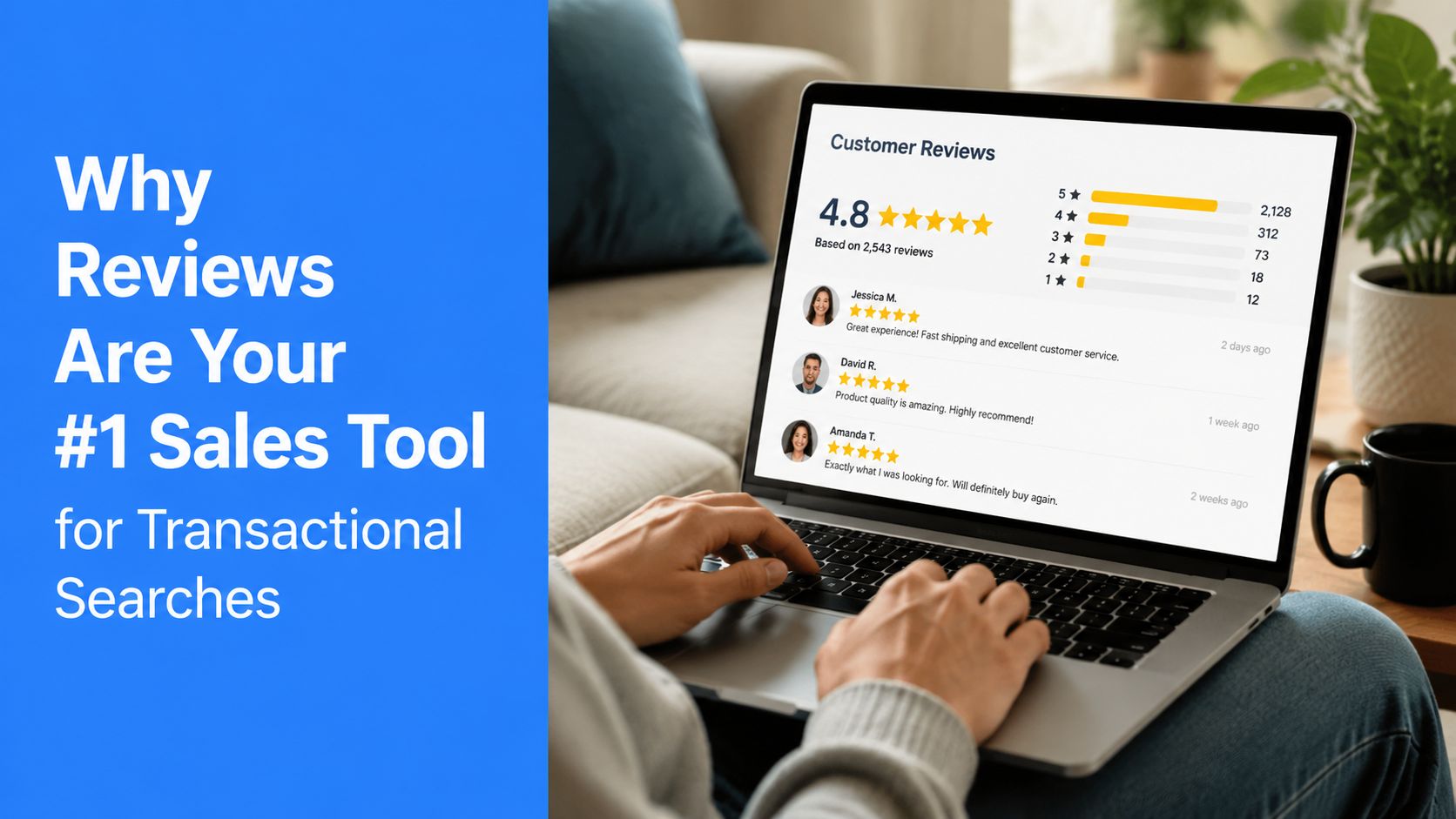
The first trust test happens before the click
The strongest local businesses understand one thing. Reviews are not a side metric. They are the first sales asset most buyers see.
81% of shoppers check Google Reviews first, a single additional star can boost revenue by 5 to 9%, and 97% of consumers read reviews according to Reputation X review statistics. For a local business, that means your review profile is often the deciding factor before someone ever visits your site or fills out a form.
If your Google Business Profile is part of your lead flow, this matters even more. A solid overview of how that profile works is covered in this guide to Google Business Profile.
Reviews influence who gets the phone call
A lot of owners still treat reviews like a cleanup task. They check them when they remember, reply when they have time, and ask for them inconsistently. That approach loses transactional searches to competitors who look more current, more trusted, and easier to choose.
What works is simpler and more disciplined:
- Keep reviews fresh: Recent feedback tells searchers your business is active now, not just historically.
- Build review depth: A strong average rating helps, but buyers also read the written details.
- Control the public conversation: Responses show whether your team is organized, accountable, and professional.
- Use reviews to support Maps visibility: In local search, trust signals and visibility work together.
Practical rule: If your team depends on inbound calls, reviews are part of sales operations, not just reputation management.
The mistake I see most often is businesses chasing rankings while ignoring the trust layer attached to those rankings. A top map placement with weak, stale, or unanswered reviews leaks calls. A slightly lower placement with a stronger review profile often wins the lead because it feels safer.
Transactional search buyers want proof, not promises
Service businesses love to say they're reliable, honest, fast, and affordable. Reviews are where customers confirm whether that's true.
That's why online review management matters so much for terms like “roofer near me” or “chiropractor near me.” In those searches, the buyer is looking for evidence. They want to see that real customers got fast service, clear communication, clean work, and a result that solved the problem.
If your review profile provides that proof, you don't just get seen. You get chosen.
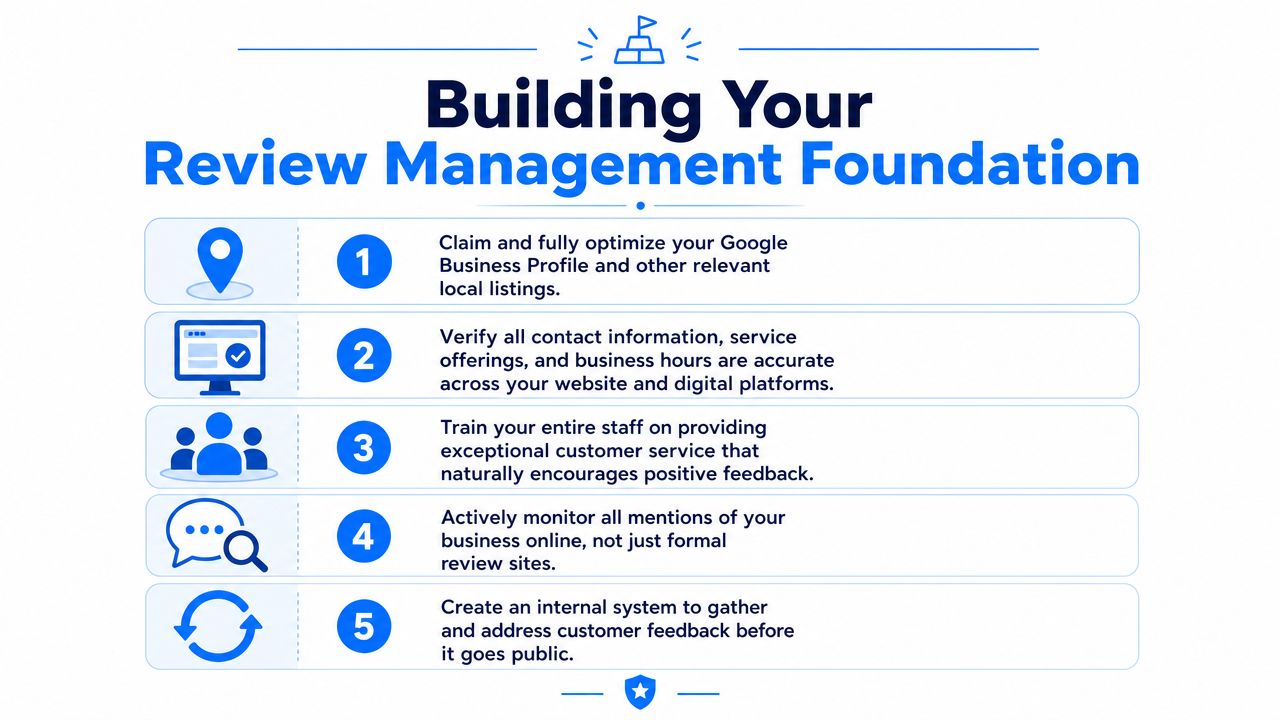
Building Your Review Management Foundation
Most review strategies fail before the first review request goes out. The business asks for more feedback, but the profile people land on is incomplete, inconsistent, or weakly positioned for local search.
Your foundation starts with the platforms that shape first impressions, especially Google Business Profile. If that profile is sloppy, every review you earn does less work than it should.
Get the profile right before you chase volume
A review profile performs best when the underlying business listing is accurate and specific. That means:
Choose the right primary category
Don't get cute here. Use the category that matches the core service you want to rank for.Define service areas clearly
If you work across multiple cities or neighborhoods, your profile needs to reflect the places where you want transactional calls.List real services using customer language
Add the services buyers search for, not internal company jargon. Think “water heater repair,” “emergency electrician,” or “Invisalign consultation” if those match your business.Upload useful photos
Skip random filler. Add team photos, jobsite photos, exterior shots, branded vehicles, treatment rooms, before-and-after work where appropriate, and anything that reduces buyer uncertainty.Keep hours, phone, and website details exact
If a prospect sees conflicting information, trust drops fast.
A broader set of practical reputation basics is covered in these reputation management tips.
Document the workflow
A lot of owners think review management means “ask more and respond faster.” That's too loose. It needs a real workflow with ownership.
A formal online reputation management workflow had a significant positive effect on performance and explained 35% of the variance in small business success in the study discussed by The Journal of Small Business Strategy.
That matters because businesses don't improve review outcomes by accident. They improve when someone defines the process.
Build one system for generation, monitoring, response, escalation, and analysis. If the process lives only in the owner's head, it breaks under pressure.
The foundation should answer five operational questions
Use this checklist internally:
- Who asks for reviews: Front desk, technicians, office staff, or an automated follow-up.
- When they ask: Immediately after the successful job, appointment, install, or service moment.
- Where reviews are routed: Usually Google first, plus any industry-specific sites that matter to your niche.
- Who watches incoming reviews daily: One person needs clear accountability.
- How issues get escalated: Negative reviews shouldn't bounce around the team with no owner.
Here's the trade-off. A simple system starts faster. A documented system scales better. For most local businesses, the documented version wins because it removes inconsistency.
Strong foundations make every future review count more
If your profile is optimized, each new review reinforces an already clear local relevance signal. If your profile is messy, each new review lands on a weak asset.
That's the practical difference between businesses that “have reviews” and businesses that use online review management to pull more calls from transactional searches.
Creating a Proactive Review Generation Engine
Passive review collection doesn't work well. Happy customers get busy, move on, and forget. Unhappy customers remember.
If you want a review profile that supports rankings and conversions, you need a system that asks consistently and makes leaving a review easy.

Ask at the moment of relief
The best time to request a review is right after the customer feels the problem is solved. For a plumber, that might be when the leak is fixed and the area is clean. For a dentist, it might be after a smooth visit and clear communication from the team. For a pest control company, it's when the technician explains what was done and what happens next.
That timing matters because satisfaction is highest at the point of relief.
A practical breakdown of review acquisition tactics is covered in this guide on getting more reviews.
Use multiple request paths
One channel won't catch everyone. The strongest review generation systems use a few low-friction options together.
- SMS follow-up: Fast, direct, and easy to act on from a phone.
- Email request: Useful when the customer needs a little more context or reminder language.
- In-person ask: Still powerful when staff asks confidently and naturally.
- QR code leave-behinds: Good for invoices, countertop signs, treatment follow-ups, or service folders.
- Tablet handoff: Effective when a customer is already engaged and willing.
The weak version of this is blasting generic requests days later. The stronger version is matching the ask to the actual customer interaction.
Train staff on the verbal handoff
Scripts help, but they need to sound human. The technician or front desk team should not mumble, “If you want, maybe leave us a review.”
Use cleaner language. Something like: “If everything went well today, we'd appreciate a Google review. It really helps other local customers find us.”
That phrasing works because it's direct, short, and easy to say without sounding awkward.
For a visual walkthrough, this video covers practical review generation ideas:
Remove friction everywhere
Most review requests fail for one simple reason. The next step isn't obvious.
If you send an email, include the direct review link. If you hand out a card, the QR code should point straight to the review form. If the office staff texts the customer, the link should open cleanly on mobile. Don't make people search for your business and figure it out.
The easier you make the action, the more often satisfied customers will complete it.
Don't script the customer's words
A lot of business owners try to overcontrol what people say. That usually backfires. You don't want robotic reviews that all sound the same. You want authentic language that reflects real service experiences.
That helps in two ways. First, future buyers trust it more. Second, the wording customers naturally use often matches the transactional phrases other people search. A customer might mention fast same-day AC repair, emergency roof leak help, or painless cleaning for nervous patients. That language is valuable because it mirrors real demand.
The businesses that win long term aren't the ones begging for reviews once a quarter. They build a repeatable engine that turns satisfied jobs into public proof every week.
Mastering the Art of Monitoring and Responding
Generating reviews is only half the job. The management side is where many local businesses fall apart. They collect feedback, but nobody owns the inbox, nobody has response standards, and negative reviews sit in public unanswered.
That sends a bad signal to buyers. It also wastes useful feedback that could improve operations.
Monitor more than one platform
Google usually gets the most attention, and for good reason. But a real online review management process watches every platform that influences buying decisions in your category. That often includes Facebook and industry-specific sites, plus any place customers regularly mention the business.
The practical model is continuous monitoring, then using recurring feedback themes to improve the business. That aligns with findings summarized by Curogram's guide to online review management, which notes that customer orientation and internet self-efficacy were strongly tied to ORM performance.
Response speed matters less than response quality if the quality is poor
Fast replies are useful. Bad replies are harmful.
The worst responses usually sound defensive, generic, or legally risky. The best responses do three things well:
- Acknowledge the customer's experience
- Reinforce professionalism in public
- Move sensitive problem-solving offline when needed
Here's a practical template set you can adapt.
| Review Type | Key Elements | Example Template |
|---|---|---|
| Positive | Thank them, mention the service, reinforce the value | “Thanks for the review, [Name]. We're glad we could help with your [service]. We appreciate you trusting our team.” |
| Neutral | Acknowledge the mixed experience, invite follow-up | “Thank you for the feedback, [Name]. We appreciate you sharing your experience and would like to learn more about how we can improve. Please contact our office so we can follow up directly.” |
| Negative | Stay calm, avoid blame, invite offline resolution | “We're sorry to hear this, [Name]. We take feedback seriously and want to understand what happened. Please contact our team directly so we can review the issue and work toward a resolution.” |
What not to do in public replies
Some mistakes make a bad review worse:
- Don't argue point by point: Public debates make the business look unstable.
- Don't imply the customer is lying: Even if you suspect that's true, handle it through the platform's review procedures and your internal process.
- Don't copy-paste the same response everywhere: Buyers can spot canned replies immediately.
- Don't confirm sensitive details: This matters a lot in healthcare-adjacent fields.
For dental, orthodontic, chiropractic, and med spa businesses, never confirm someone was a patient or discuss case details in a public reply.
That caution aligns with best-practice guidance summarized by Need Momentum's online review management advice. In regulated or privacy-sensitive categories, a public response should stay general, professional, and careful.
Build a simple escalation ladder
Not every negative review should be handled by the same person. A useful internal ladder looks like this:
Frontline reply for routine complaints
Late arrival, scheduling issue, basic communication problem.Manager review for operational complaints
Billing dispute, repeat service issue, staff conflict.Owner or compliance review for sensitive situations
Privacy concerns, alleged harm, legal threats, protected personal information.
That structure protects the business from emotional, inconsistent replies.
Good responses are public sales assets
Most owners think a review reply is for the reviewer. It isn't only for them. It's also for the next prospect who reads the thread and decides whether your company feels trustworthy.
A clean, respectful response can soften the impact of a bad review. A defensive one can cost future calls long after the original incident is over.
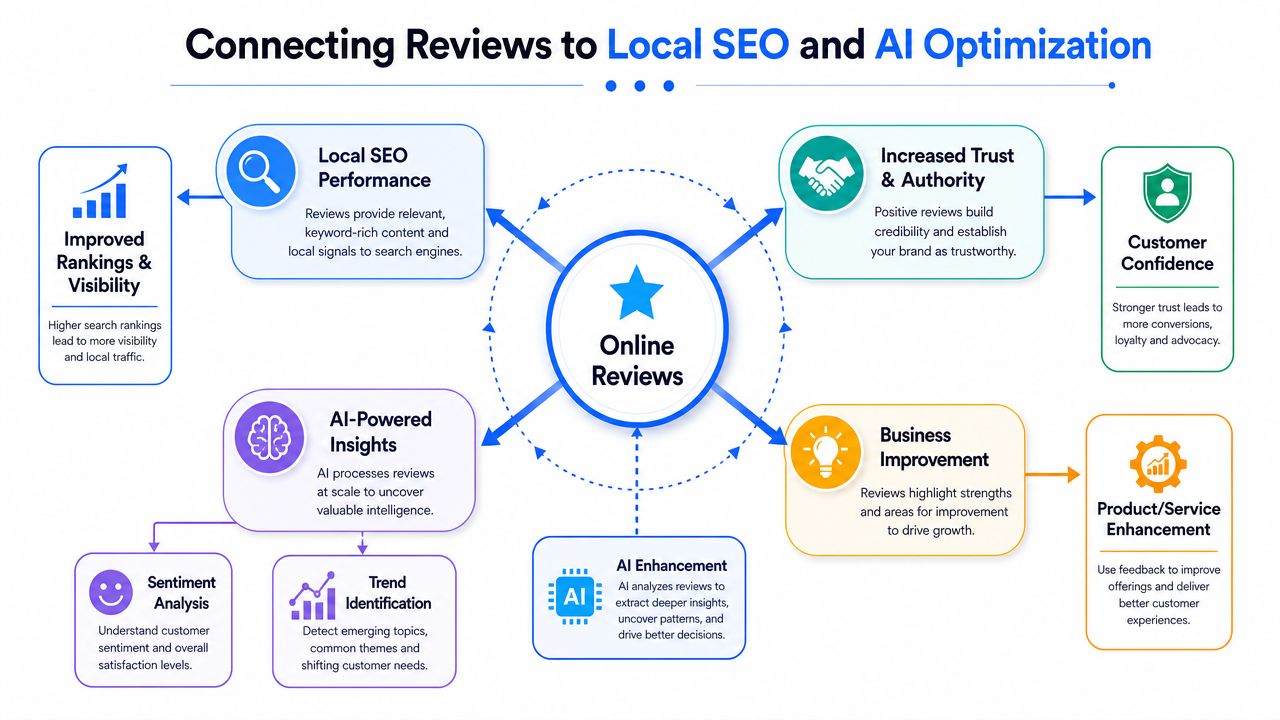
Connecting Reviews to Local SEO and AI Optimization
Reviews don't just influence trust. They also shape how search engines and AI systems understand your business.
That matters because local discovery is no longer limited to the old pattern of search, click, compare. Buyers still use Google Maps, but they're also starting to ask AI tools direct questions about who to hire nearby.
Reviews contain the language buyers actually use
Your service pages can say “residential electrical services in Phoenix.” A customer review might say, “They fixed my breaker issue fast and showed up the same day.”
That second version is often closer to how real people search and speak. Reviews give you a stream of natural language tied to your services, geography, reliability, speed, and customer experience.
A good resource on this connection for local companies is this guide to reviews for local business.
Why this matters for transactional local SEO
Google has always needed signals to understand relevance and trust. Reviews help supply both. They tell search engines what customers experienced, what services were delivered, and what locations or contexts matter.
That doesn't mean you should manipulate review wording. It means you should notice the recurring language customers already use and let it inform:
- Service page copy
- Google Business Profile service descriptions
- FAQ content
- Photo captions and update posts
- Internal staff training on what outcomes customers value most
Reviews are market research written in the customer's own words. Smart local SEO teams mine that language and use it across the site and profile.
AI discovery changes the stakes
Many local businesses are behind on this point. They still think reviews only matter inside the Google interface.
According to Birdeye's online review statistics roundup, the use of generative AI tools for local business discovery rose from 6% to 45% in a single year, making AI tools the third most popular source for local recommendations. Even if that behavior keeps evolving, the direction is clear. AI-driven discovery is becoming part of local search behavior.
When someone asks an AI system a question like “Who's the most reliable roofer near me?” or “What dentist has the best reviews for nervous patients?”, those systems need public evidence to form an answer. Reviews are one of the most useful evidence layers available.
Optimize for recommendation, not just ranking
Traditional local SEO often focuses on placement. AI optimization adds another challenge. Your business has to sound like the best answer.
That means your public review profile should consistently reflect themes such as:
- Responsiveness
- Specific service outcomes
- Professionalism
- Communication quality
- Location relevance
- Special situations you handle well
If enough reviews consistently mention those themes, they become part of your business's public identity across search and AI surfaces.
The next era of local SEO won't just reward businesses that rank. It will reward businesses that are easy for AI systems to summarize and recommend with confidence.
Your Action Plan to Dominate Local Search
Most local businesses don't have a review problem. They have a system problem.
They rely on random customer generosity, inconsistent follow-up, and occasional responses from whoever happened to notice the notification. That approach won't reliably win “near me” searches, map pack clicks, or AI-driven recommendations.
The playbook in plain terms
If you want online review management to produce actual revenue, tighten these five areas:
- Fix the foundation: Your Google Business Profile and core listings need complete, accurate service and location information.
- Ask consistently: Build review requests into the normal workflow after successful jobs and appointments.
- Remove friction: Use direct links, SMS, QR codes, and simple staff scripts.
- Respond with discipline: Thank happy customers, de-escalate negative situations, and protect privacy in regulated industries.
- Use reviews as intelligence: Pull recurring phrases, service themes, and customer concerns into your SEO, Maps, and AI optimization work.
What works and what doesn't
The businesses that improve fastest treat reviews like an operating system. Someone owns the process. Staff knows when to ask. Negative feedback gets routed properly. Useful language from reviews gets reused in the right places.
What doesn't work is chasing volume with no process behind it. More reviews won't solve a weak profile, poor response habits, or a broken customer experience.
A strong review strategy doesn't just make you look better online. It helps the right buyers feel safe calling you first.
Why this ties directly to phone calls
The whole point of local SEO isn't vanity. It's to capture transactional searches from people ready to book, buy, or schedule now.
Reviews help you do that because they influence the exact decision point where buyers compare local options. They support visibility, strengthen trust, and supply the natural language that search engines and AI systems use to understand who you are.
If you want more calls from people searching terms like “plumber near me,” “med spa near me,” or “orthodontist near me,” this process is not optional. It belongs in your daily operations.
If you want help building a review system that supports Google Maps visibility, transactional search rankings, and AI discovery, Transactional LLC can help. Their approach is built for local service businesses that want to show up for high-intent searches, earn more qualified calls, and turn online visibility into booked jobs and patients.