


You've probably seen it before, a homeowner searches “air conditioning repair near me”, clicks a result, and lands on a page that says almost nothing about the exact service, the service area, or who performs the work. That gap is where schema markup for services earns its keep. It gives search engines a cleaner way to understand the page, connect it to a business entity, and decide whether it belongs in the local results that matter for transactional search terms.
For service businesses, that matters because the buyer intent is already high. Someone typing “roofer near me”, “dentist near me”, or “air conditioning repair near me” is not browsing. They're looking for a provider right now, and the page that answers that intent fastest has the best shot at getting the click, the call, or the booking.
Google's structured data guidance, as summarized in Schema App's service-schema overview, treats markup as a way to make service pages more explicit and location-aware, not as a magic ranking switch. It recommends validating markup, confirming Google has found it, then comparing Search Console performance over “a few months” before and after implementation, which is exactly how serious local SEO work should be measured. That's why schema belongs inside a broader Google Maps optimization and local visibility strategy, not in a silo by itself. Google-oriented service schema guidance makes the same basic point through the lens of service entities, page validation, and measurement.

The practical advantage is simple. Schema helps search engines resolve what a page offers, who provides it, and where it's available. That's especially useful when a site serves one city, several suburbs, or an entire service area, because on-page copy alone can be ambiguous, while structured data leaves less room for guesswork.
What Google Business Profile does for local visibility matters here because schema and Maps usually rise or fall together. If the business profile, page content, and markup all describe the same service, the same provider, and the same geography, the page becomes much easier to trust in local search.
Practical rule: schema should clarify the page, not decorate it. If the page is vague, markup can't rescue it.
Why Schema Markup Matters for Transactional Service Searches
A transactional search is the moment a buyer raises their hand. They're not researching a theory, they're looking for a provider who can solve a problem now. That's why schema markup for services matters so much for queries like “roofer near me” or “dentist near me”, because the markup helps search engines interpret the page as a real service offering from a real business in a real geography.
Google's structured-data documentation, as reflected in the service-schema guidance above, encourages validation and measurement rather than promising a direct ranking boost. That's the right expectation. Schema usually improves machine readability, which can support better understanding, better presentation in search, and stronger eligibility for enhanced features where the page qualifies. It's an indirect win, but in local search, indirect wins often compound.
What schema changes in practice
Without structured data, a search engine has to infer that a page about furnace repair is a service page, that the business operates in a defined area, and that the page belongs to a specific company entity. With Service schema, those relationships become explicit. The result is cleaner entity understanding, which is especially useful when the same business has multiple pages for multiple services or multiple cities.
That's where the transactional angle connects to Google Maps optimization. When the search intent is local and urgent, the map pack and the organic result are often competing for the same click. Clear schema helps reinforce the business's service identity, which supports the broader local profile rather than standing apart from it.
Search engines don't need more prose when the page already says enough. They need less ambiguity.
A lot of site owners still think schema is a direct ranking factor. It isn't treated that way in the guidance summarized in the research brief. The value is in precision, not hype. If the page, the schema, and the business profile all agree, the business has a better shot at being understood correctly for the exact search term the buyer typed.
This is why service schema belongs on every serious local-service page. It doesn't replace content, reviews, or citations. It makes those signals easier for search engines and AI systems to parse when someone searches with money in hand.
Choosing the Right Schema Types for Your Service Business
The biggest schema mistake I still see is overloading the wrong page with the wrong entity. A homepage marked only as a vague business, a service page marked like a product listing, or a page stuffed with unrelated service types creates confusion instead of clarity. The cleanest implementations keep each schema type tied to the page where it naturally belongs.
For service businesses, the core types are Service, LocalBusiness, Offer, AggregateRating, Review, and ServiceArea. The one that causes the most trouble is Product. Multiple service-schema references in the brief agree on this point, do not use Product schema for services. A plumbing drain-clearing page is a service, not a product catalog entry.
Placement rules that actually hold up
Service schema belongs on individual service pages. LocalBusiness belongs on the homepage and contact page, where the business identity is the main subject. That separation keeps the page-level intent clean. GetAhana's contractor guidance makes the same distinction and also notes that privacy policy and terms pages don't need service markup, which is exactly the kind of discipline that prevents bloated sitewide schema habits. schema strategy for contractors is worth reading if you want a practical contractor-focused comparison of page types and markup choices.
What NAP means in local SEO matters because Name, Address, Phone has to stay consistent across schema, the website, and business profiles. If the markup says one thing and the contact page says another, you've weakened the signal you were trying to strengthen.
| Schema Type | Page Placement | Primary Use Case |
|---|---|---|
| Service | Individual service pages | One service, one page, one clear offering |
| LocalBusiness | Homepage, contact page | Business identity, address, phone, hours |
| Offer | Service page or booking page | Availability, pricing context, call-to-action support |
| AggregateRating | Pages with visible rating data | Summary of overall rating signals |
| Review | Pages with individual visible reviews | Specific customer feedback tied to the page |
| ServiceArea | Usually within Service or LocalBusiness markup | Geographic scope of service |
A simple decision filter
If the page is about what the business does, start with Service. If the page is about who the business is, start with LocalBusiness. If the page is about where the business works, add ServiceArea. If you're showing a price or booking entry point, Offer may fit. If you don't have visible ratings or reviews on the page, don't force them into markup.
That structure keeps the site readable to both users and crawlers. It also gives AI systems cleaner entity relationships to pull from when they're summarizing local providers.
Building JSON-LD Markup for Home Services and Medical Practices
JSON-LD is the format that makes implementation manageable. It keeps the markup separate from visible page text, which is why it's the preferred approach in modern local SEO workflows. The key isn't just writing valid JSON-LD, it's making sure the schema reflects a single service page and ties back to the business entity through a stable @id.
For a home service site, the page should describe one offering, such as HVAC repair, drain cleaning, or water heater installation. The Service entity should point to the parent business entity with provider, and the page should define the geography through areaServed. That lets search engines see the page as a specific service from a specific provider in a specific market.
Here's a clean home-service pattern:
{
  "@context": "https://schema.org",
  "@type": "Service",
  "@id": "https://example.com/services/hvac-repair/#service",
  "name": "HVAC Repair",
  "provider": {
    "@type": "LocalBusiness",
    "@id": "https://example.com/#business",
    "name": "Example Heating and Cooling"
  },
  "areaServed": {
    "@type": "City",
    "name": "Austin"
  },
  "serviceOutput": "Repairs for residential heating and cooling systems",
  "additionalType": "https://schema.org/HVACBusiness",
  "offers": {
    "@type": "Offer",
    "price": "Contact for quote",
    "priceCurrency": "USD"
  }
}
For a medical practice, the page structure changes because the entity type is different. A dental or chiropractic practice should still keep the service page tightly focused, but the parent entity may be a MedicalBusiness or a more specific subtype depending on the page and the practice structure. The point stays the same, one page, one service, one provider entity.
{
  "@context": "https://schema.org",
  "@type": "Service",
  "@id": "https://example.com/services/teeth-cleaning/#service",
  "name": "Dental Cleaning",
  "provider": {
    "@type": "MedicalBusiness",
    "@id": "https://example.com/#practice",
    "name": "Example Family Dental"
  },
  "areaServed": {
    "@type": "City",
    "name": "Scottsdale"
  },
  "serviceOutput": "Preventive dental cleaning and oral health evaluation",
  "additionalType": "https://schema.org/DentalService"
}
The important part is entity linking. Service schema implementation for UK electricians shows the same principle in a trade context, use a stable business identifier and connect service pages back to it instead of creating disconnected markup blocks.
If you need a model for broader service page architecture, local SEO for home services is where the page hierarchy and service-page focus really start to matter. The markup should mirror that structure, not fight it.
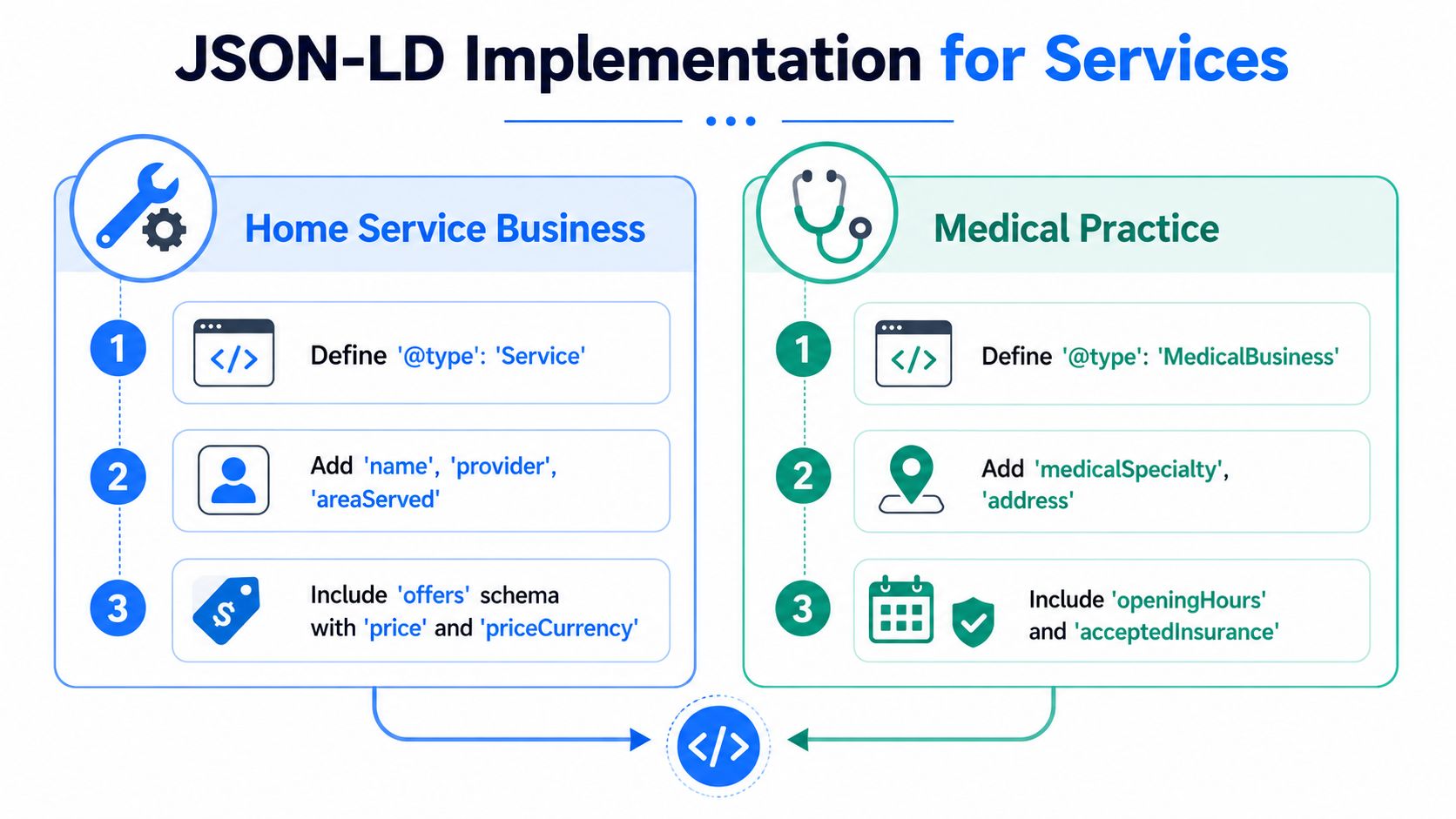
Keep the service entity narrow. The more a page tries to describe, the less precise the markup becomes.
The cleanest service pages usually avoid trying to make one block of JSON-LD do everything. They identify the service, point to the provider, define the geography, and stop there. That restraint is what makes the markup durable across CMS changes, page refreshes, and future AI-driven discovery systems.
Multi-Location Strategies and Google Maps Optimization
Multi-location service businesses run into a different problem than single-location operators. They need markup that preserves each office's identity without creating duplicate or conflicting signals. A single, generic business entity for three cities usually weakens the local picture. Separate location entities, tied to the right pages, do a better job of matching service area intent and Google Maps expectations.
The best rule is to let the page architecture reflect the operational structure. A corporate homepage can carry the main business entity, while each location page carries its own LocalBusiness data with a unique @id. Each location's service pages should then point back to that location, not to a catch-all entity that blurs geography.
How service areas should line up
The areaServed property should match the service coverage of each location and the service areas shown in the Google Business Profile. If the map profile serves one city and the page claims five, you've created tension. If the page and profile describe the same service area, the local signal is much cleaner.
The same is true for NAP consistency. The business name, address, and phone number should line up across schema markup, the visible page content, and the business profile. When those elements drift, Google has to reconcile differences instead of reinforcing a single entity.
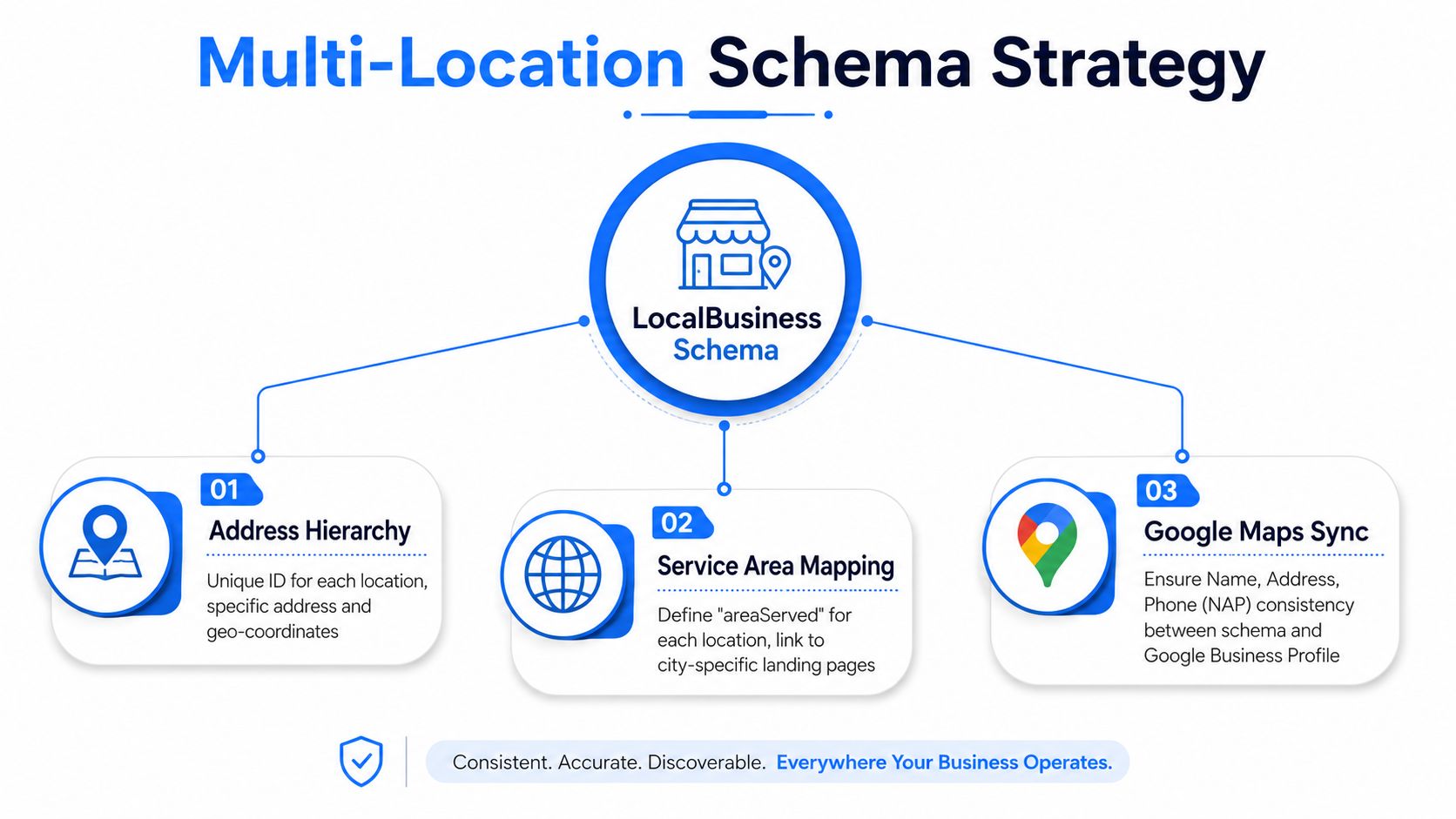
The local pack matters because it's where transactional searchers often make the decision. A user searching “roofer near me” or “dentist near me” doesn't spend long comparing abstract brand statements. They look at the map, the name, the category, and the proximity cues, then they call. That's why schema and Maps optimization should be built together instead of as separate projects.
Multi-location local SEO strategy is the right mental model for this work because it keeps each office and each service page distinct. It also reduces the temptation to merge every city into a single overbuilt page that nobody in local search wants.
Practical rule: one location, one entity, one address block, one service-area footprint.
When a business operates from several offices, consistency beats volume. The markup doesn't need to be flashy. It needs to be exact, page-specific, and aligned with the map presence the business already has.
Validating Your Markup and Troubleshooting Common Errors
Validation is where a lot of otherwise solid implementations fall apart. The code may look fine at a glance, but a missing property, a broken @id, or a mismatch between visible content and markup can make the whole thing less useful. Google's own structured-data guidance encourages site owners to validate the markup, confirm discovery, and then watch Search Console over time, which is the right workflow for any service business that cares about local visibility.
The tools that matter
Google's Rich Results Test is the first stop when the markup should qualify for enhanced search features. The Schema Markup Validator is better for syntax and structure checks across Schema.org vocabulary. Search Console then shows whether Google has found the markup and whether it is reporting structured-data issues.
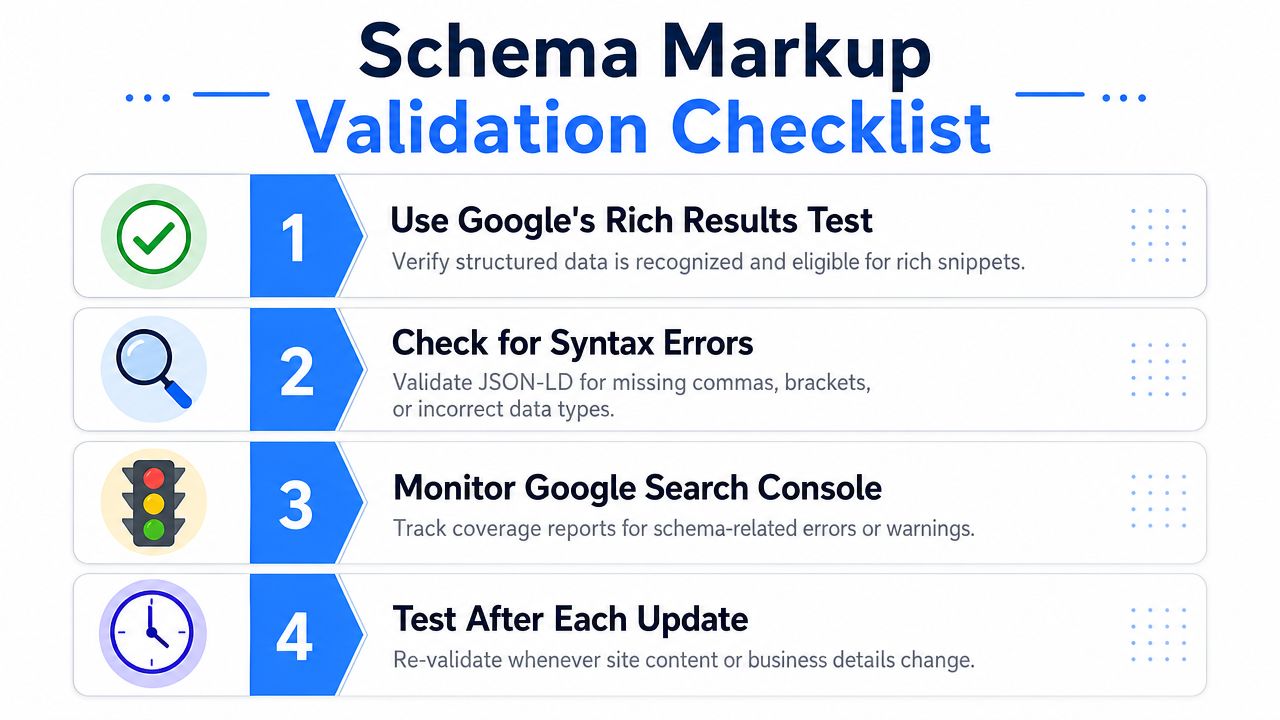
The most common failure points are predictable, and they show up again and again in service-business audits.
- Missing required properties: The markup is incomplete, often because a template only outputs part of the entity.
- Page and markup mismatch: The schema says one service, while the visible page says another.
- Invalid
areaServedformatting: The geographic scope is too vague or structured in a way the validator rejects. - Broken
@idreferences: The service page points to an entity that does not exist or changed during a site migration.
Fixes that hold up
If the page is new, validate the raw JSON-LD before publishing. If the page already exists, compare the visible copy, the business profile, and the schema line by line. Broken references often show up after redesigns or CMS migrations, so the @id path should be treated like a permanent identifier, not a throwaway URL fragment.
Search Console should stay in the regular maintenance routine. Once Google discovers the markup, the reports help spot errors early, especially after site edits or location changes. Revalidate any time the service name, address, hours, or geography changes.
Schema is part of site maintenance, just like updating hours or business details when they change.
On-Page Structure and CMS Best Practices for Service Schema
Service schema works best on a page that stays disciplined about one offer, one intent, and one entity. If a page tries to cover HVAC repair, duct cleaning, thermostat installs, and maintenance plans at once, the copy gets muddy and the markup usually follows. A one-service-per-page structure keeps the intent sharp and gives search engines a cleaner signal to work with.
That same discipline matters for AI systems and for local search visibility. Models and crawlers do a better job with pages that clearly describe one service, one business entity, and one location context. When the page and the JSON-LD say the same thing, the markup reinforces the visible copy instead of fighting it, which makes the entity easier to classify for transactional queries and map results.
CMS placement that doesn't get messy
In WordPress, JSON-LD can live in a custom field, a schema plugin, or a theme-level injection tied to the specific service template. In Webflow, a page-level embed or site custom code can work, but the cleaner approach is still to keep the Service block attached to the specific service template instead of a global footer. The same rule applies in other CMS platforms, the markup should sit on the page type that represents the service.
The separation between pages matters just as much as the implementation method. The homepage should carry LocalBusiness or the primary business entity, while each service page should carry Service markup for the specific offering on that page. That separation keeps the homepage broad and the service page specific, and it helps Google connect the business entity to the service entity through matching @id values without collapsing everything into one generic block.
A service landing page should also stay tightly aligned with the search term it is meant to capture. If someone is searching for a specific service in a specific city, the page should answer that query directly, and the structured data should reflect the same wording and entity relationship. That is the practical side of Local SEO for home services, because the page structure needs to support the transactional query instead of scattering attention across unrelated offerings.
For service businesses trying to show up for transactional search terms, that discipline matters more than clever markup tricks. Schema helps search engines understand the page, but the page still has to earn the query with focused copy, the right entity type, and a clean CMS template.
Bottom line: clean pages win because clean pages are easier to classify.
A site built this way is also easier to scale. New city pages, new service pages, and new location pages can follow the same entity pattern without creating a schema mess the next time the CMS changes.
A CTA for Transactional LLC.