

NAP can mean sleep, and in horse racing it can mean a tipster's best pick. For local businesses, NAP means Name, Address, and Phone Number, and in SEO it's one of the most significant local ranking factors because Google uses it to verify that your business is legitimate.
If you own a plumbing company, dental office, HVAC business, roofing company, med spa, pest control company, or chiropractic clinic, this matters right now. You've probably searched your service on Google, seen a competitor sitting above you in Maps, and wondered why they're getting the calls while you're not. In a lot of cases, the answer isn't complicated. Their business details are cleaner, more consistent, and easier for Google and AI-driven search systems to trust.
That's why this topic matters far beyond a dictionary definition. When someone searches a transactional term like “roofer near me,” “dentist near me,” or “air conditioning repair near me,” they're not browsing for fun. They're ready to hire. They have money in hand, and they want a business they can contact immediately. If your NAP data is messy, you make it harder for search engines, map systems, and large language models to confidently surface your business.
AI optimization is now tied to the same core local signals that traditional search has relied on for years. LLMs and AI search experiences still need clean business entity data. If your name varies, your address is inconsistent, or your phone number changes across the web, your visibility suffers where it counts most. That means fewer impressions in local results, fewer clicks, and fewer phone calls from your service area.
Beyond Sleep What NAP Means for Your Business
You're not wrong if the phrase feels confusing at first. The word “nap” already exists in everyday English as a short sleep, and it has an old linguistic history tied to dozing and light sleep, not some modern abbreviation, as noted by WordReference's discussion of the word nap. In horse racing, NAP means something completely different. It comes from “Napoleon,” a French card game term later adopted by British tipsters to mean their single best bet of the day, according to The Zebra's explanation of NAP in horse racing.
For a local business owner, none of that pays the bills.
The definition that matters is the one tied to visibility, Google Maps, and inbound calls. In local SEO, NAP stands for Name, Address, and Phone Number. That's the core identity signal attached to your business across your website, Google Business Profile, directories, map listings, industry citations, and third-party platforms.
Practical rule: If Google finds five different versions of your business identity online, it has a harder time trusting any of them.
That's the main issue. Most service businesses don't lose local visibility because they lack effort. They lose it because their business data is scattered. One site says “Suite 200.” Another says “Ste 200.” One directory has an old phone number from a tracking campaign. Another drops the legal suffix from the business name. You may see these as harmless formatting differences. Search engines don't.
If you want to rank for transactional searches, start here. Before you chase content, reviews, backlinks, or AI visibility, lock down the one thing every platform uses to confirm your business exists where you say it exists.
Defining NAP in Local SEO Name Address and Phone
In digital marketing, NAP is the acronym for Name, Address, and Phone Number, and NAP consistency is one of the most significant local SEO ranking factors because it allows search engines to verify business legitimacy, as explained by Corporate Communications on what NAP stands for.

Think of NAP as your business's digital fingerprint. If that fingerprint is clear and identical everywhere, search engines can match it to one real-world company. If it's smudged, fragmented, or inconsistent, they hesitate.
Name means your exact business name
Use your official business name exactly the same way everywhere.
That means no switching between “ABC Plumbing,” “ABC Plumbing LLC,” and “ABC Plumbing Services” depending on the platform. Pick one version and use it on your website, Google Business Profile, citations, and social profiles.
A good rule is simple:
- Keep it official: Use the official business name customers know.
- Keep it stable: Don't add service keywords unless that's part of the actual business name.
- Keep it identical: Punctuation, spacing, and suffixes should match.
Address means the physical location format must match
Your address has to be uniform down to the formatting details. “Street” versus “St.” may look minor to you, but inconsistency creates ambiguity.
Use one standard and stick to it:
| NAP element | Correct approach |
|---|---|
| Street line | Choose one format for Street, St., Road, Rd., Suite, or Ste. |
| Unit details | Include suite or unit number the same way everywhere |
| City and ZIP | Match the exact city, state, and postal code on all listings |
If you manage your Google Business Profile, your site footer, and directory listings separately, drift starts. It's also why your Google Business Profile and local SEO setup need one master version of your business details.
Phone means one primary number, not a rotating mess
Your phone number should be the main direct line for the location. Don't let directories show a mix of office lines, old call tracking numbers, and personal cell numbers.
Your phone number isn't just contact info. It's part of your business identity signal.
If you want your business found in traditional search and AI-powered local results, create one canonical NAP record and distribute that exact version everywhere. That's how you remove uncertainty and build trust.
How NAP Consistency Wins Transactional Searches
The conversation becomes about money.
A transactional search term is a query with buying intent. Terms like “buy,” “order,” “subscribe,” and location-driven phrases like “near me” signal that the user is ready to spend, as explained in SERPwizard's overview of transactional keywords. More specifically, location-based searches like “near me” or “in [city]” are transactional keywords because the user is looking for a local provider with intent to engage or purchase, according to SEOptimer's guide to transactional keywords.
That's the entire game for service businesses. You don't need vanity traffic. You need the person searching “plumber near me,” “emergency dentist in Austin,” or “air conditioning repair near me.”

Why consistency changes the outcome
When Google evaluates local businesses for a transactional search, it needs confidence. It wants to show a real company in the right place with accurate contact details. Consistent NAP data helps create that confidence across your website, maps profile, directories, and citation sources.
If your business information matches across platforms, you make Google's job easier. If your information conflicts, you make that decision harder.
Here's the practical chain reaction:
- A customer searches a local transactional phrase.
- Google checks which businesses appear trustworthy and relevant.
- Your NAP consistency supports your legitimacy.
- You're more likely to appear in local results and Maps visibility.
- More searchers can call you immediately.
Why this matters even more in AI optimization
AI optimization isn't separate from local SEO. It builds on it.
LLMs and AI search experiences need reliable entity signals. They pull together business information from indexed sources, maps ecosystems, directories, and structured business details. If your business identity is inconsistent, you weaken your chances of being surfaced cleanly in AI-generated local recommendations.
Clean NAP data gives both search engines and AI systems the same message: this business is real, active, and located exactly here.
That's why businesses chasing transactional terms need discipline. If someone searches “dentist near me,” they aren't comparing ten thought leadership articles. They want a business they can trust enough to call.
Focus on bottom-of-funnel opportunities
Not every keyword deserves your time. Some queries are research-heavy and weak on intent. Transactional searches are different. They pull people much closer to the point of conversion.
Modern SEO platforms can filter keyword datasets to isolate terms with at least 40% transactional probability, which helps remove noise and surface stronger bottom-of-funnel opportunities, as described by Rankdots on transactional keyword filtering.
For local service businesses, the smartest path is obvious:
- Target “near me” searches: These indicate immediate demand in your service area.
- Align your NAP everywhere: If you want local trust, your data can't drift.
- Support map visibility: Calls come fastest when people can find and contact you in one step.
The businesses that win local search aren't always the biggest. They're often the cleanest.
Correct vs Incorrect NAP Examples That Kill Rankings
Most NAP problems aren't dramatic. They're tiny. That's why they're so easy to ignore and so costly to leave unfixed.
Here's what this looks like for a roofing company.

Side by side example
| Listing type | Correct NAP | Incorrect NAP |
|---|---|---|
| Business name | ABC Roofing Solutions Inc. | ABC Roofing Sol. / ABC Roofings |
| Address | 123 Main St, Suite 100, Anytown, ST 12345 | 123 Main St Ste 100 / 123 Main Street |
| Phone | (555) 123-4567 | 555-123-4567 old / (555) 987-6543 new |
The “incorrect” examples look close enough to a human reader. To local algorithms, they create a trust problem. Search systems now have to decide whether these are all the same business, a duplicate listing, an outdated record, or multiple entities.
The mistakes that hurt most
Some inconsistencies are especially common in home service and healthcare businesses:
- Name drift: Your website says one thing, your Facebook page says another, and a directory shortens the brand.
- Address variation: “Suite,” “Ste,” and omitted unit numbers split the identity.
- Phone confusion: Old numbers and tracking lines show up on different platforms.
A wrong phone number doesn't just weaken your SEO. It can send a ready-to-book customer to voicemail, to the wrong office, or to a competitor.
That's why businesses often ask why they're invisible in local results even though they “have listings everywhere.” The issue isn't quantity. It's accuracy. If you're dealing with map visibility problems, this is often tied directly to the reasons covered in why a business may not be showing up on Google Maps.
What correct looks like in practice
Don't overcomplicate it. Build one master version and force every platform to match it.
A clean NAP setup means:
- One official business name
- One exact address format
- One primary phone number
- No duplicate listings with conflicting details
If your citations don't match, you're telling Google two stories. That weakens your local authority right when you need it most.
Your Guide to Auditing and Fixing NAP Inconsistencies
A NAP audit is not glamorous. It is profitable.
You don't need fancy software to start. You need a process. If you run one location, you can catch a lot of problems manually. If you run multiple locations, this gets tedious fast, which is why many businesses eventually use citation platforms and AI-assisted workflows to scale cleanup.
Start with this checklist.
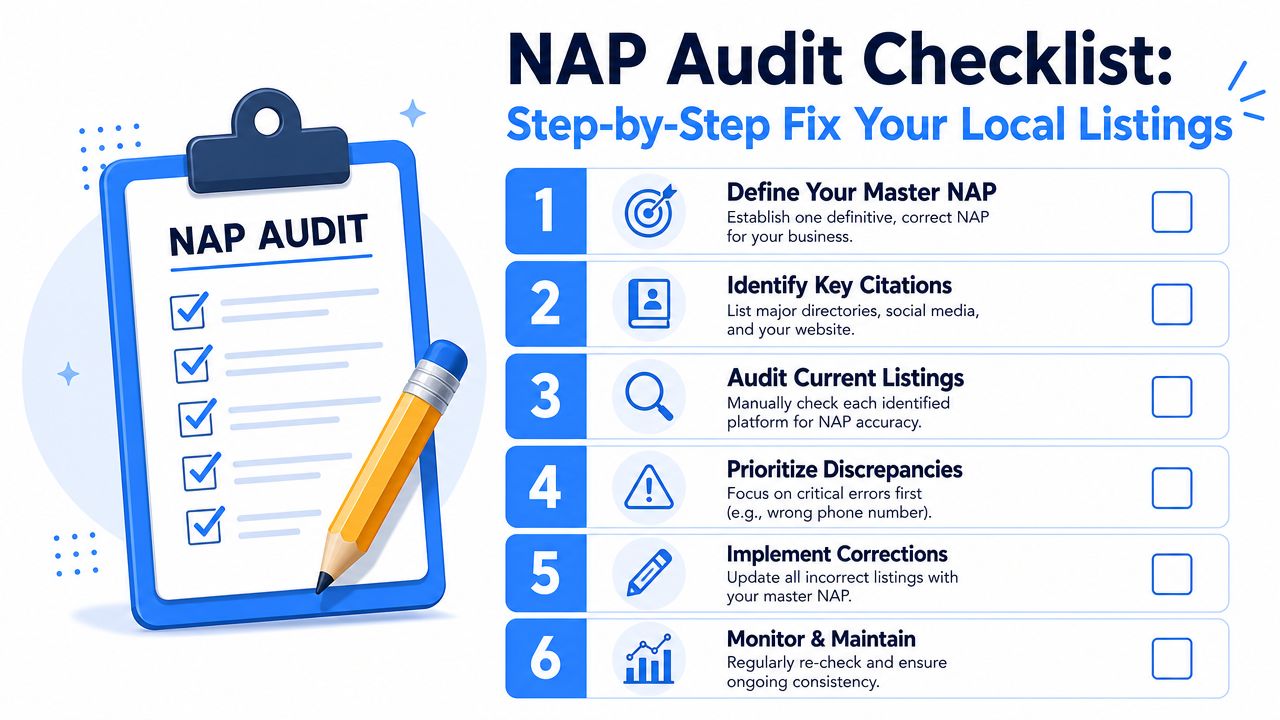
Step one through four
Define your master NAP
Write down the exact business name, address, and primary phone number you want used everywhere. This becomes the source of truth.Search your business variations
Google your business name in quotes. Search old phone numbers, former addresses, and older name variations. You're looking for stale citations and duplicate listings.Check your core platforms first
Review your website, Google Business Profile, Bing Places, Apple Maps, Facebook, major directories, and industry-specific listings.Track every discrepancy
Use a simple spreadsheet with columns for platform, listed NAP, correct NAP, login status, and fix status.
A practical citation workflow helps a lot, especially if you're handling many profiles. A good place to understand that process is citation building for local SEO.
Step five and six
The next part is where most owners stall. They find errors, but they don't finish cleanup.
Fix the most damaging issues first
Wrong phone numbers, old addresses, and duplicate Google-facing listings matter most. Correct those before you worry about smaller directory sites.Monitor and maintain
NAP consistency isn't a one-time task. Rebrands, call tracking changes, office moves, and new listings can all create fresh inconsistencies.
This walkthrough helps illustrate the process in a straightforward way:
Where AI tools fit
AI optimization is changing how local businesses get discovered, but it doesn't replace clean business data. It makes clean data more important. If you're building a stronger local workflow and want to find AI SEO software for your pipeline, that resource is useful because it helps you evaluate tools that support research, workflows, and content operations around your local search strategy.
The right software helps you move faster. It doesn't rescue bad business data.
That's the point most owners miss. AI content, page generation, and automation can support growth. None of it fixes a broken identity layer. If your NAP is inconsistent, fix that first.
Make NAP Your Foundation for Local Dominance in 2026
If you've been asking what Does NAP stand for, the useful answer is simple. It stands for Name, Address, and Phone Number, and it sits underneath nearly every local ranking outcome that matters.
This is not busywork. It's the foundation for showing up when customers search transactional terms like “roofer near me,” “dentist near me,” or “air conditioning repair near me.” Those are the searches that lead to real calls, booked jobs, and new patients. If your business data is inconsistent, you weaken your chances of appearing where those buyers are looking.
For service businesses, local SEO and AI optimization now overlap. Search engines, maps platforms, and AI-driven discovery systems all need a clear, consistent business identity. That's why NAP has to be treated as infrastructure, not an afterthought. If you care about local visibility, study the core Google Maps ranking factors and get the fundamentals right before you chase anything flashy.
Businesses that dominate local search usually aren't doing magic. They're doing the basics better than everyone else.
If you want help turning clean local signals into page-one visibility and stronger Maps placement, Transactional LLC is built for that job. The team focuses on transactional search terms like “roofer near me,” “dentist near me,” and “air conditioning repair near me,” because those are the searches from people ready to spend money now. They also specialize in Google Maps optimization and use a proven system designed to get service businesses showing up on page one, typically within 30 to 60 days. If you're done losing calls to competitors in your own service area, talk to Transactional LLC and build a local SEO strategy that targets buyers, not browsers.