

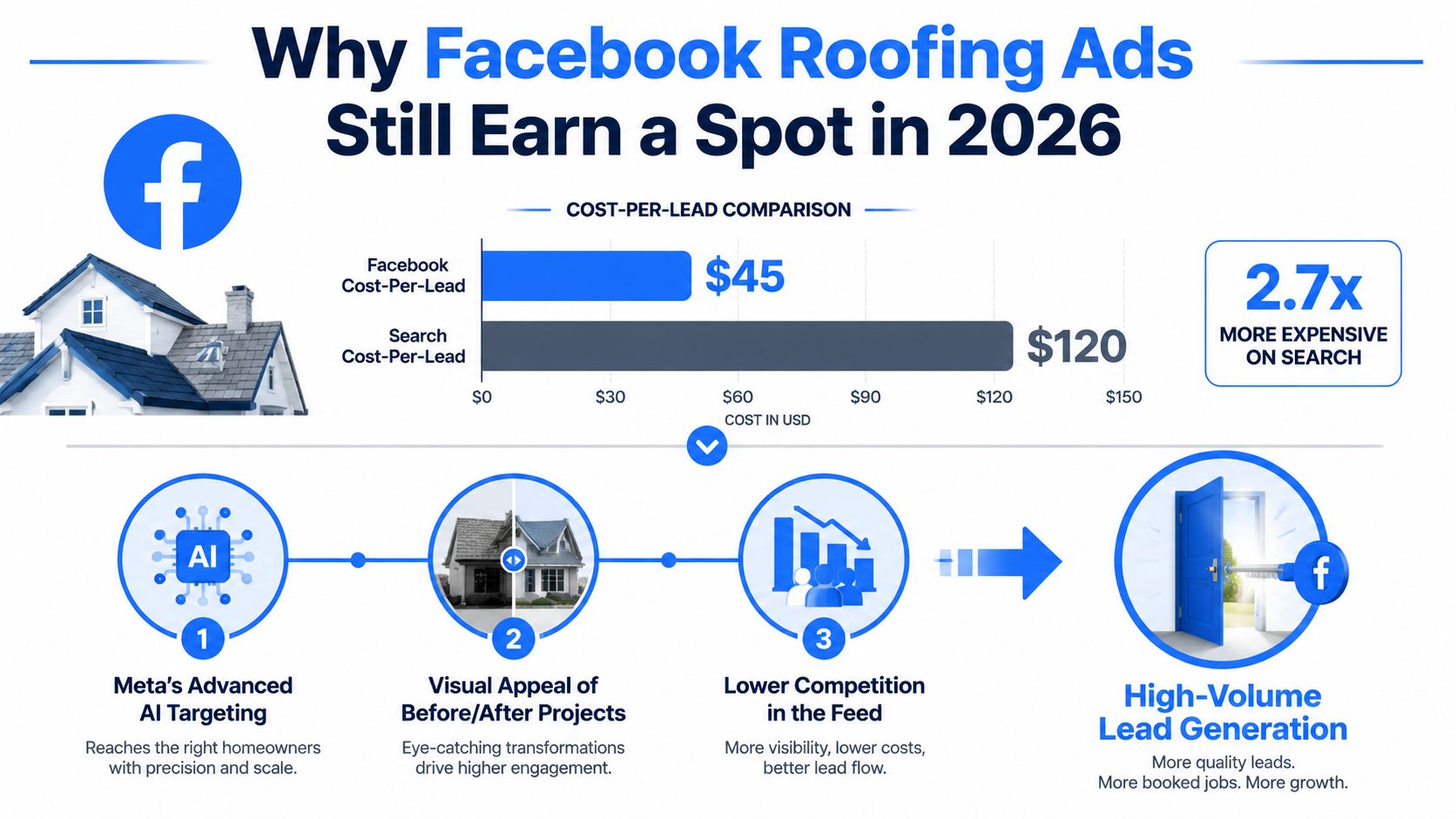
Facebook roofing ads still make sense in 2026 because the math is still better than search in the right moments. WordStream-based home and home-improvement Facebook lead campaigns averaged $41.26 CPL with a 5.22% conversion rate and about $2.23 CPC, while roofing and gutters search campaigns averaged $228.15 CPL in 2026 home-services benchmarks, which is exactly why Meta keeps a real place in a roofer's mix for prospecting and retargeting, not just vanity reach (roofing Facebook ads benchmark). The catch is that lead volume isn't the goal. Booked-job economics are.
The roofers who waste money on Meta usually do it by chasing cheap clicks, broad reach, or inflated lead counts. The roofers who win treat Facebook roofing ads as a controlled system for reaching ready-to-spend homeowners, especially those already in a transactional mindset, the same mindset behind searches like roofer near me or roof repair near me. That's the Transactional Marketing lens, show up when the buyer is closest to action, then move that person toward a real booking, not just another form fill.
Why Facebook Roofing Ads Still Earn a Spot in 2026
The first mistake in roofing Meta campaigns is treating Facebook like a branding channel that happens to generate leads. It can do both, but the better use is tighter: catch homeowner attention before they call the first contractor, keep pressure on storm-affected accounts, and move warm prospects into a booked inspection. The gap between Meta and search is still wide enough to matter, and that gap is why Facebook roofing ads still belong in a serious operator's mix.
The real job of Meta in a roofing funnel
A roofer does not need Meta to replace Google Maps or search. A roofer needs Meta to create and capture intent earlier, then stay visible to a homeowner who has not searched yet, or searched once and gone quiet. That matters most for companies built around transactional search terms, because the end goal never changes, a homeowner ready to spend, a crew ready to book, and a service area that can support the job.
Practical rule: if your campaign cannot show how it turns attention into booked inspections, it is not a roofing campaign, it is content with a budget.
For campaign structure, keep the job of each layer clear. Awareness is where short job-site video and before-and-after proof belong. Lead capture is where Instant Forms or a landing page should take over. Retargeting is where you recover the homeowner who clicked, watched, or opened a form but did not finish. Each objective should match a different level of intent, not a different department.
A clean setup usually beats a complicated one. One campaign per objective is easier to read, easier to optimize, and easier to stop when something goes sideways. Campaign-budget strategy works best when you want Meta to allocate spend across ad sets based on performance, while ad-set budgets make more sense only when you are testing audience splits in a controlled way. For roofers, sprawling structures usually leak spend through duplication and conflicting signals.
Meta's learning phase matters more than many small contractors want to admit. Lead-gen campaigns need enough real conversion activity to stabilize, which means a roofer running lean has to resist constant tinkering. If volume is low, the answer usually is not to rebuild the account every two days. It is to simplify the structure, tighten the radius, and let the system learn long enough to produce useful signals.
For a broader view of roofing lead generation structure, the service-area and search side of the equation is laid out in this roofing company marketing guide, which helps put Meta in the right role instead of treating it like a silver bullet.
A useful benchmark on Facebook roofing performance is covered in this roofing ads benchmark, and the point is simple. Meta usually wins when the goal is qualified booked work, not raw lead count. It is the channel that keeps a contractor in front of the homeowner long enough to separate curiosity from buying intent, and that is where the margin is protected.
That is also why follow-up speed and qualification friction matter more than audience wizardry. A fast call, a clean intake flow, and a tight handoff to sales will do more for booked-job economics than another round of targeting tweaks. Facebook roofing ads earn their place when they help turn storm timing, homeowner urgency, and disciplined follow-up into actual inspections on the calendar.
Segmenting Homeowners With Local Targeting and Custom Audiences
Roofing Facebook ads work best when the audience is tight enough to matter and broad enough for Meta to learn from real behavior. A 15 to 20 mile radius around the service base is usually the right starting point because roofing is local, route efficiency matters, and wider geography often adds wasted impressions without adding better jobs. Meta's housing-related ad rules also shape what you can do, so roofers have to build audience structure around compliance and practical buyer intent, not around the idea that more targeting layers automatically mean better results.
Build the audience stack in the right order
Start with the service-area radius, then layer in the audiences you can use. Past customer lists are useful for upsells, exclusions, and retention. Site visitors are the core retargeting pool. Lookalikes seeded from closed-won customers are helpful once you have enough clean conversion data to train them. Storm-event overlays work best when recent weather has already changed homeowner urgency, because the ad is entering an active problem, not trying to create interest from scratch.
Exclusions matter more than most accounts show. If a homeowner is already in one ad set, do not keep bidding against yourself in another. That is one of the easiest ways to inflate CPMs and make the whole account look weaker than it is.
A strong resource on local list building and direct outreach tactics is the direct outreach lead guide, which fits the same neighborhood-level thinking roofers need for Meta.
Tight targeting does not mean tiny targeting. It means removing dead weight until the algorithm can see who actually books.
What Meta is actually for in a roofing funnel
Meta is useful where a roofer needs to separate homeowners who are mildly interested from homeowners who are ready to talk. That is a qualification job, not a volume game. It works best when the funnel already has some friction, because that friction helps sort out people who just clicked from people who are willing to answer, schedule, and move toward an inspection.
If you already use persona work in your marketing, keep it grounded in real service behavior, not vague demographics. The logic of user personas for service businesses matters here, because the homeowner who needs inspection help now is not the same buyer as the homeowner casually browsing upgrades. Meta can find both, but your budget should not treat them the same.
Building Creative and Copy That Earn Five-Second Stops
A roof ad has a few seconds to prove it belongs in the feed. The work that wins is plain and visual, short, mobile-first video, real job-site proof, and copy that gets to the point before Meta cuts it off. ServiceTitan's ad spec guidance is useful here, because Facebook feed and carousel placements call for 1080 × 1080 px image creatives capped at 30 MB, while video can be uploaded in MP4, MOV, or GIF formats up to 4 GB depending on placement (Meta roofing ad specs).
What to launch first
The first three creatives should be simple, not clever.
- Before-and-after image. Show the damage and the finished roof in one clean visual. That tells the story fast.
- Testimonial clip. A real homeowner, even if it is short and imperfect, usually beats polished corporate footage.
- Job-site time-lapse. Fast movement, visible progress, and real crew activity make the work feel tangible.
RoofPredict's roofing-focused format guidance points to short videos in MP4/MOV, H.264 encoding, and 1080×1080 or 1920×1080 resolution, trimmed to roughly 5 to 15 seconds for better mobile engagement. The same source says 12-second videos achieved a 78% 5-second view rate, which is a strong reminder that concise footage can outperform longer edits when the feed is moving fast (roofing video ad format guide).
Copy has to earn the first stop, then the click. JobNimbus notes that Facebook ad copy in the primary text area is often truncated after about 125 characters, so the offer and CTA need to appear early (roofing Facebook ads copy guide). The first line carries the weight, not the last sentence.
The practical way to write roofing ads is to build the message the way elements of advertisements work in any direct-response offer, clear headline, visible proof, one offer, and a next step that does not make the homeowner think too hard.
A few hook angles tend to hold up in roofing:
- Storm damage urgency for recent-weather markets.
- Insurance claim help for homeowners who need clarity, not jargon.
- Financing offers for replacement jobs with price sensitivity.
- Lifetime warranty angles for trust-heavy retail campaigns.
Tight targeting does not mean tiny targeting. It means removing dead weight until the algorithm can see who converts. That is where qualification friction matters more than vanity reach, because roofing money leaks when ads chase curiosity instead of booked inspections.
If you want more creative examples to model against, the Facebook video ads for small business resource is useful as a creative reference point, even though roofing still needs its own visual proof and local specificity.
Choosing Between Instant Forms, Landing Pages, and Messenger
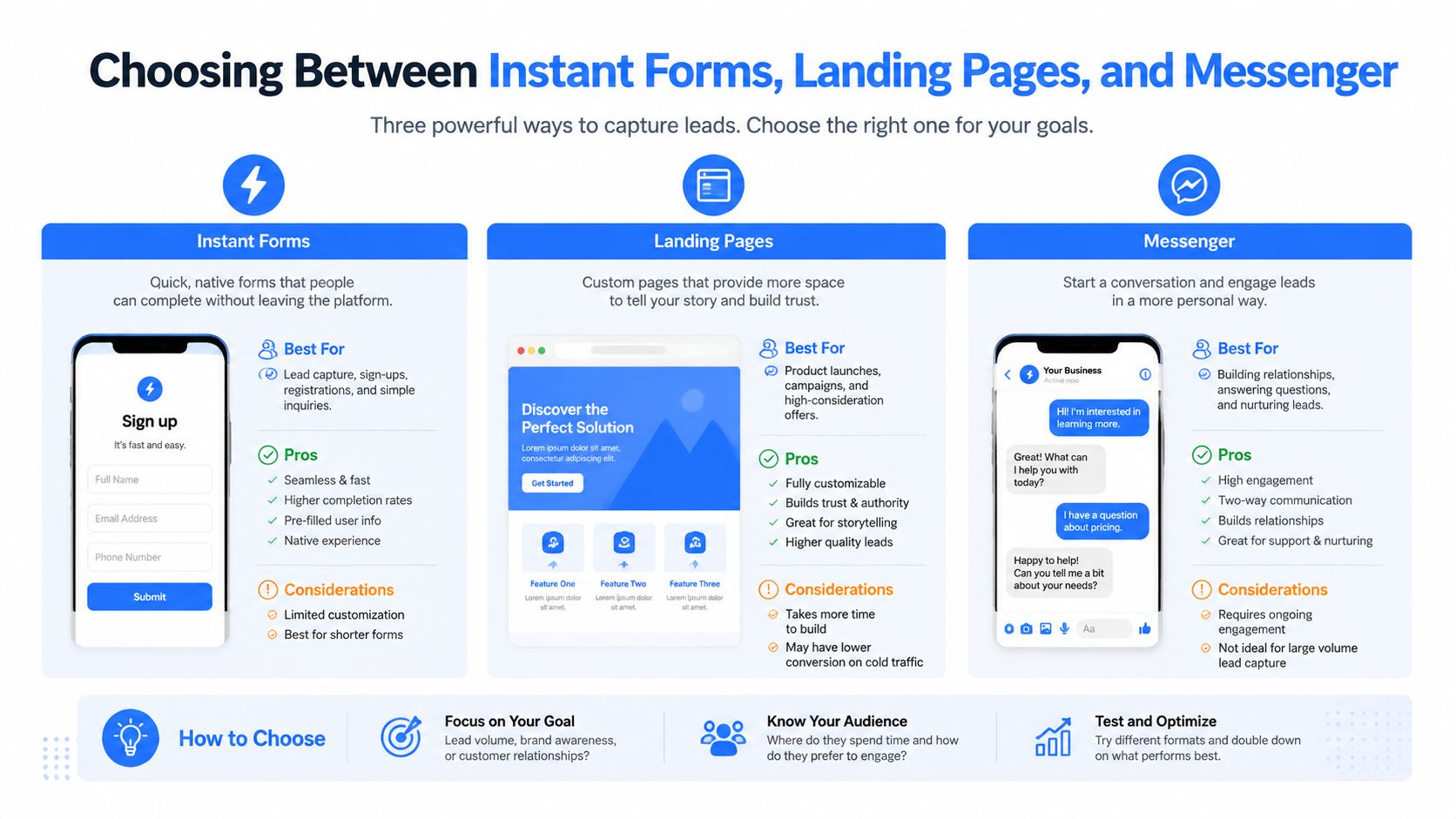
The decision is not which surface gets the most leads. It is which surface gets the most booked inspections from homeowners who can buy. Instant Forms usually reduce friction, landing pages usually add qualification, and Messenger works best when speed matters more than form detail. For roofing, that trade-off matters because crews have limited bandwidth, and a flood of cheap leads can still leave the calendar empty.
Start with higher-intent Instant Forms
Roofing guides often point to Higher Intent Instant Forms with three to four qualifying questions because they stop a lot of junk before it reaches the office. The strongest filters are straightforward, homeowner status, roof age, recent weather exposure, and decision timeline. A practical setup also asks for a street address, since that extra step cuts accidental submissions and gives the sales team something real to work with.
That extra friction costs volume. It usually improves booked-job economics.
Landing pages make more sense when the company already has local trust, recognizable proof, and a sales team that can handle a buyer who wants to read before they call. A good page can show before-and-after work, reviews, licenses, service area details, and a tighter offer path before the form appears. For a broader web conversion framework, this landing page best practices guide is useful context, especially if the page has to do more selling before the lead is captured. For more practical conversion ideas around the site itself, the website conversion rate improvement guide is worth reading alongside this choice.
Messenger is more situational. It can work during storm-response windows when homeowners want a fast reply and a conversation feels easier than filling out a form. It also demands strict response speed, because a slow thread dies fast and the lead usually goes cold before anyone books the visit.
The decision rule is simple. If the crew calendar is tight and lead quality matters most, start with Instant Forms plus qualifying questions. If the brand already converts well and the team can handle warmer, more deliberate buyers, test a dedicated landing page. If the market is in a weather event and response speed is the priority, use Messenger as a backup channel, but only if someone can answer quickly and keep the conversation moving.
The surface choice should match the economics of the job, not just the number of form fills. A roofing company chasing retail replacements, storm repairs, or insurance work needs to know where the money leaks, and that leak usually shows up in weak qualification, slow follow-up, or a capture flow that makes the homeowner think too hard.
Setting Up Tracking With the Pixel and Conversions API
Roofing Facebook ads break when tracking is sloppy. The Meta Pixel still matters, but it shouldn't be the only signal source if you care about optimization stability. A clean setup starts with Pixel, then adds the Conversions API so server-side events keep flowing when browsers, ad blockers, or privacy settings interrupt client-side tracking.
The stack roofers actually need
Install the Pixel on the website first and verify the standard events you're using, especially PageView and Lead. If the campaign uses a landing page, make sure the form submission fires once and only once. If the campaign uses Instant Forms inside Meta, the lead should still be passed back into your CRM so the sales team can tag outcomes later.
That outcome tagging matters more than most roofers think. A lead that was contacted, qualified, and booked should not sit in the same bucket as a lead that never answered or lived outside the service area. Once sales status is known, feed that quality back as a conversion event so Meta can learn from the jobs you want, not just the people who clicked fastest.
The one setup mistake that wrecks optimization is duplicate Lead events. If the Pixel and CAPI both fire the same lead without deduplication, the system reads noisy data, and delivery can drift toward false positives. That error is common because it feels invisible at first. By the time the account looks unstable, the cause is often buried in the event setup rather than the ad itself.
Budget, Bidding, Seasonality, and Storm Response Timing
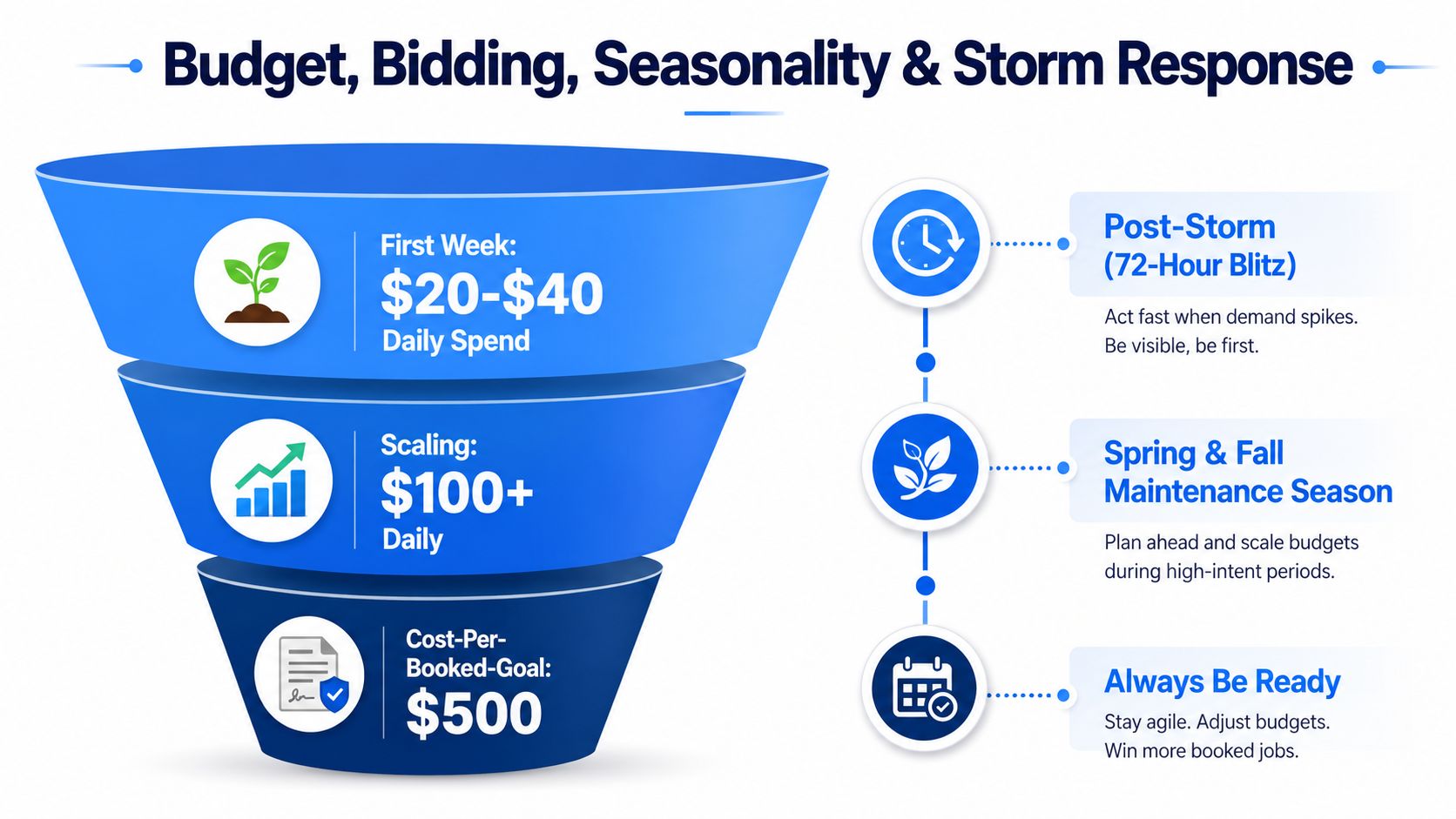
A roofer starting from scratch does not need a giant budget, but the budget still has to match the job flow. Start with a small test, enough spend to collect real leads, real sales feedback, and enough variation in creative to see what the market answers back with.
The stack roofers need
Budget should follow booking capacity. If leads are coming in but the office cannot respond fast enough, more spend just creates waste. If the sales process is tight and booked-job cost is acceptable, then increasing daily spend makes sense because the account has room to absorb it without turning into a pile of unworked forms.
Bidding should match the stage of the account. Highest volume fits most lead-gen setups early on because the system needs clean signal more than clever control. Highest value only starts to matter when quality signals are flowing back into Meta with enough consistency that the platform can separate a decent lead from a dead one.
Storm response deserves its own playbook. During the 72-hour post-hail window, roofing Facebook ads can produce lead costs in the $10 to $22 per lead range, while broader roofing Facebook averages sit at $40 to $80 per lead and booked-roof costs land at $185 to $420 (roofing storm-response benchmark). The same benchmark set shows insurance-claim retargeting audiences closing at 25% to 35%, compared with 8% to 15% for cold lead forms. That gap is the whole point. Timing and audience warmth change the economics far more than targeting tricks do.
Seasonality changes the math too. In calm months, the goal is steady qualification and predictable booked jobs. In storm weeks, the goal shifts to speed, fast qualification, and getting to the homeowner before the lead cools off or gets worked by three other contractors. A slower office can still buy leads, but it will overpay for opportunity it cannot convert.
Facebook also works best as part of a wider response path. A homeowner can see the ad first, then check a map listing, then search for roof repair near me before making a call. That multi-touch pattern matters because the buyer is usually not shopping for entertainment, they are trying to solve a roof problem and talk to someone who can schedule the work.
Optimization, A/B Testing, and a Follow-Up Workflow That Closes
The best roofing Facebook ads accounts run on a cadence, not a hunch. Launch, leave it alone for the initial learning period, then review creative, audience, and lead quality on a schedule that matches how fast the market is moving. JobNimbus advises waiting 5 to 7 days before making changes, and that patience matters because a campaign that gets edited every day never learns what it needs to learn (roofing ad optimization cadence).
What to measure after the first week
A good weekly review should answer three questions.
- Which creative is fatiguing? If the same image or clip is getting ignored, replace it before performance drops further.
- Which audience is saturating? If one local pocket is overexposed, widen only as needed, not all at once.
- Which leads book? Cost per lead is useful, but cost per booked job is the metric that pays the crew.
The follow-up workflow is where most ad accounts leak money. Leads need fast contact, clean CRM tagging, and a minimum of two touches in the first hour if you want a real shot at the appointment. Junk leads should be disqualified quickly, not left in the pipeline where they contaminate the data and make the campaign look better than the business is.
Fast follow-up is a sales habit and an ad optimization input at the same time. If your team is slow, Meta learns from bad outcomes and the account gets noisier.
After every storm event, review what worked and what didn't while the market is still hot. That includes the hook, the form friction, the service area, and whether your team answered the phone fast enough. The same operational discipline that powers transactional search visibility should govern roofing Facebook ads too, because the goal is the same, get in front of the homeowner who's ready to spend, then make it easy to book.
Transactional LLC builds search and Maps systems that help local service companies show up for transactional searches, the exact kind of intent that turns into calls and booked jobs. If you want roofing marketing that connects Facebook ads, Google Maps, and high-intent local SEO into one pipeline, visit Transactional LLC and see how the team can help your company show up where ready-to-spend homeowners are already looking.