

Google My Business was renamed Google Business Profile in November 2021, and it's now the primary surface for showing up in Google Maps and the local pack. About 225–230 million listings compete on that global platform in 2026, making it essential for high-intent searches such as “roofer near me” and “dentist near me.”
You may already know the moment. The phone sits silent while a nearby homeowner searches for air conditioning repair, a competitor appears in the map results, and that buyer calls someone else. Your business might have the right technicians, strong service, and a good reputation, but if your Google profile doesn't communicate those facts clearly, the customer may never see you.
That's the practical answer to what is Google My Business. It's the former name for Google Business Profile, Google's free business presence in Search and Maps. For a service company, it displays your business name, category, service areas, phone number, hours, services, photos, reviews, website, directions, and other customer contact options.
A profile isn't just a digital directory entry. It's a transactional search channel. Someone searching “plumber near me,” “pest control near me,” or “dentist near me” usually isn't researching the industry. They're looking for a provider who can solve a problem. Transactional Marketing focuses on those searches, where the searcher has money in hand and is ready to spend it.
The Short Answer for Local Service Owners
Google My Business, now called Google Business Profile, gives you control over how your business appears when local customers search on Google Search or Google Maps. Google uses the information in that profile to determine whether your company matches a nearby search and to show customers practical actions, including calls, directions, messages, and website visits.
For a home service, dental, or pest control business, the difference between visibility and invisibility is immediate. A homeowner searching “air conditioning repair near me” may tap a phone button directly from the map pack. A patient searching “dentist near me” may compare reviews, check hours, and request an appointment without visiting the website first. If your listing is incomplete, miscategorized, or poorly managed, the buyer has fewer reasons to choose you.
Google says complete profiles make customers 2.7 times more likely to view a business as reputable, 70% more likely to visit, and 50% more likely to consider purchasing. Those figures come from Google's own guidance as summarized in industry data at Google Business Profile statistics. The conclusion is straightforward, complete information supports trust and action.
What the profile controls
Your Business Profile can communicate:
- Who you are: Your verified business name, primary category, secondary categories, description, and attributes.
- What you do: Your services, products, service areas, photos, updates, and customer questions.
- How customers reach you: Your phone number, website, messages, appointment URL, and directions.
- How customers judge you: Your reviews, owner responses, customer photos, and visible business activity.
The profile also gives you performance data. Google separates calls, directions, messages, and website clicks, so you can evaluate actions rather than relying only on impressions. Google defines calls as clicks on the call button and directions as customers requesting directions to the location, as documented in Google Business Profile performance reporting.
Transactional Marketing builds Google Maps optimization around that behavior. The objective isn't to collect empty views. It's to help a roofing company appear for “roofer near me,” a dentist appear for “dentist near me,” or an HVAC company appear for “air conditioning repair near me,” in the cities and service areas where those searches can become booked jobs.
How Google My Business Became Google Business Profile
The naming confusion has a long history. Google's local business product began with Google Local in 2004, followed by Google Places in 2009 and Google+ Local in 2012. Google My Business launched in 2014 as a merger of Google Places and Google+ Local. In November 2021, Google renamed the product Google Business Profile.
That timeline matters because many owners still type “Google My Business” into search, while Google now uses “Google Business Profile” in its current product language. The underlying purpose remains familiar, but the workflow has moved closer to the places where customers search.
Google's product evolution reflects a shift from a separate listings tool into a more integrated local presence system. Owners can manage business information, reviews, updates, and customer actions through Google Search and Maps rather than treating the listing as a passive directory record. The profile has become the control point for local discovery.
Why the old name still matters
A business owner asking “what is Google My Business” is usually asking a more useful question: “How do I get found when someone nearby needs my service?” The answer is no longer a static listing setup. Your profile influences the information customers see, the services they associate with your company, the trust they place in your business, and the actions they can take.
The platform is also enormous. Recent industry estimates place worldwide Google Business Profile listings at approximately 225 to 230 million in 2026 (Google Business Profile statistics). That scale creates intense competition, even for businesses serving a small local market. You aren't competing with every listing on earth for every search, but you are competing with the businesses Google considers relevant and prominent in your service area.
A polished website still matters, especially for organic rankings and conversion. But a local buyer often encounters the profile first. The map result can display the phone number, reviews, hours, service information, and directions before the searcher ever reaches your homepage.
The Three Factors That Decide Your Map Ranking
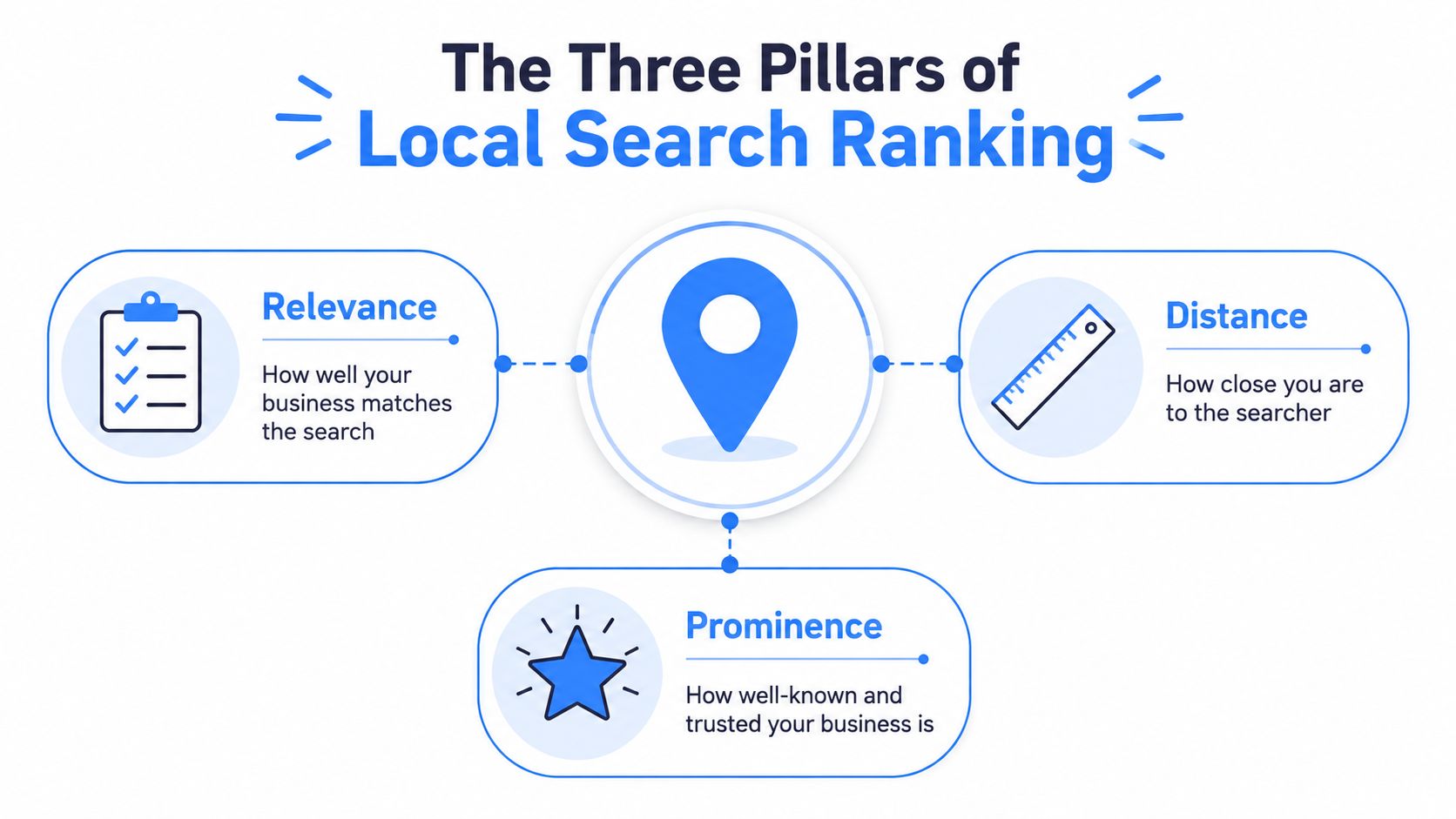
Google states that local results depend mainly on relevance, distance, and prominence. Google's local ranking guidance defines relevance as how well a Business Profile matches the search, distance as how far the business is from the searcher or the location named in the search, and prominence as how well-known the business is online and offline. You can review the framework in Google's local ranking guidance.
Relevance
Relevance answers one question: does this profile clearly match what the customer wants?
If your company repairs furnaces, your primary category, services, description, website content, and supporting profile details should make that fact unmistakable. A profile categorized too broadly can weaken matching. A company trying to rank for roofing, plumbing, electrical work, and pest control from one undifferentiated profile creates confusion for both customers and Google.
Recent local SEO coverage of the 2026 Whitespark survey reports that Google Business Profile signals remain the strongest Local Pack factor, with the primary Google Business Profile category cited as the single most influential relevance signal (2026 Google Business Profile ranking coverage). Choose the category that most accurately represents the core business, then use secondary categories and service entries to add legitimate context.
Distance
Distance limits what optimization can accomplish. Google considers the searcher's location, or the location term in the query, when deciding which businesses are eligible to appear. A perfectly completed profile can't make a business physically closer to a customer.
Service-area businesses can specify up to 20 service areas, using cities or postal codes rather than a radius. Google says the overall service area should generally be no more than about a two-hour drive from the business base (Google service-area business guidance). Don't add distant locations because you want visibility there. Accurate coverage protects customer expectations and keeps the profile aligned with Google's eligibility rules.
Prominence
Prominence reflects how established and trusted the business appears. Reviews, mentions, links, customer activity, and offline recognition can all support the broader reputation picture, but no single tactic guarantees a top-three position.
Operator's rule: Optimize relevance first, respect distance, then build prominence through real customer experiences and a consistent local presence.
For a deeper explanation of how these signals interact, use this guide to Google Maps ranking factors. Businesses can also consult maps and targeting data when planning location-focused campaigns and evaluating where transactional demand exists.
The key point is that profile completeness helps Google understand your business, but it doesn't override distance or prominence. A category stuffed with unrelated services, an inflated service area, or a business name modified with keywords won't solve the underlying ranking problem.
Core Features Every Service Business Should Use
A service-business profile should answer the customer's practical questions before the customer calls. What do you do? Where do you work? Are you open? Can I trust you? How can I contact you now?
Start with the foundation, then add features that reduce friction.
Build an accurate profile
- Primary category: Choose the category that best describes your main service. This decision affects relevance, so don't select a category only because it sounds popular.
- Secondary categories: Add legitimate supporting categories that reflect services you provide.
- Business description: Explain your customers, services, locations, and differentiators in plain language. Write for a person who needs help, not for a keyword counter.
- Contact information: Keep the phone number, website, hours, and special hours accurate. A wrong phone number can turn a qualified Maps visitor into a lost lead.
- Service and product entries: List the work customers search for, such as drain cleaning, roof replacement, termite treatment, emergency HVAC repair, or dental implants.
- Photos and videos: Show the team, equipment, storefront, completed work, vehicles, and real service environment. A practical resource on 2026 Google Maps photo strategy can help organize this content.
- Q&A: Add clear answers to recurring questions about service availability, financing, appointments, preparation, or emergency response, then monitor public questions.
- Messaging and appointments: Activate these options when your team can respond promptly. A contact method that nobody monitors creates a poor customer experience.
Manage the profile as an operating channel
Google Posts can communicate service updates, seasonal information, new offerings, and changes to hours. They shouldn't replace service pages or a local content strategy, but they can keep important information visible inside Search and Maps.
For service-area businesses, accuracy matters more than geographic ambition. Google's rules allow up to 20 cities or postal codes and generally limit the overall area to about a two-hour drive from the base (service-area guidance). Use those settings to describe where you can reliably send a crew, not to create a fictional footprint.
Google Business Profile reporting separates the actions that matter:
| Performance metric | Where it shows up | What it signals |
|---|---|---|
| Calls | Profile performance reporting | A searcher clicked the listed call button |
| Directions | Profile performance reporting and API data | A customer requested directions to the business location |
| Messages | Profile performance reporting | A customer opened a direct contact path |
| Website clicks | Profile performance reporting | A searcher visited the linked website |
Google's performance API includes the BUSINESS_DIRECTION_REQUESTS metric, which counts direction requests made to a business location (Google Business Profile Performance API). That makes direction activity a measurable customer action, not merely a vague engagement signal.
Reviews and Trust Signals That Actually Convert
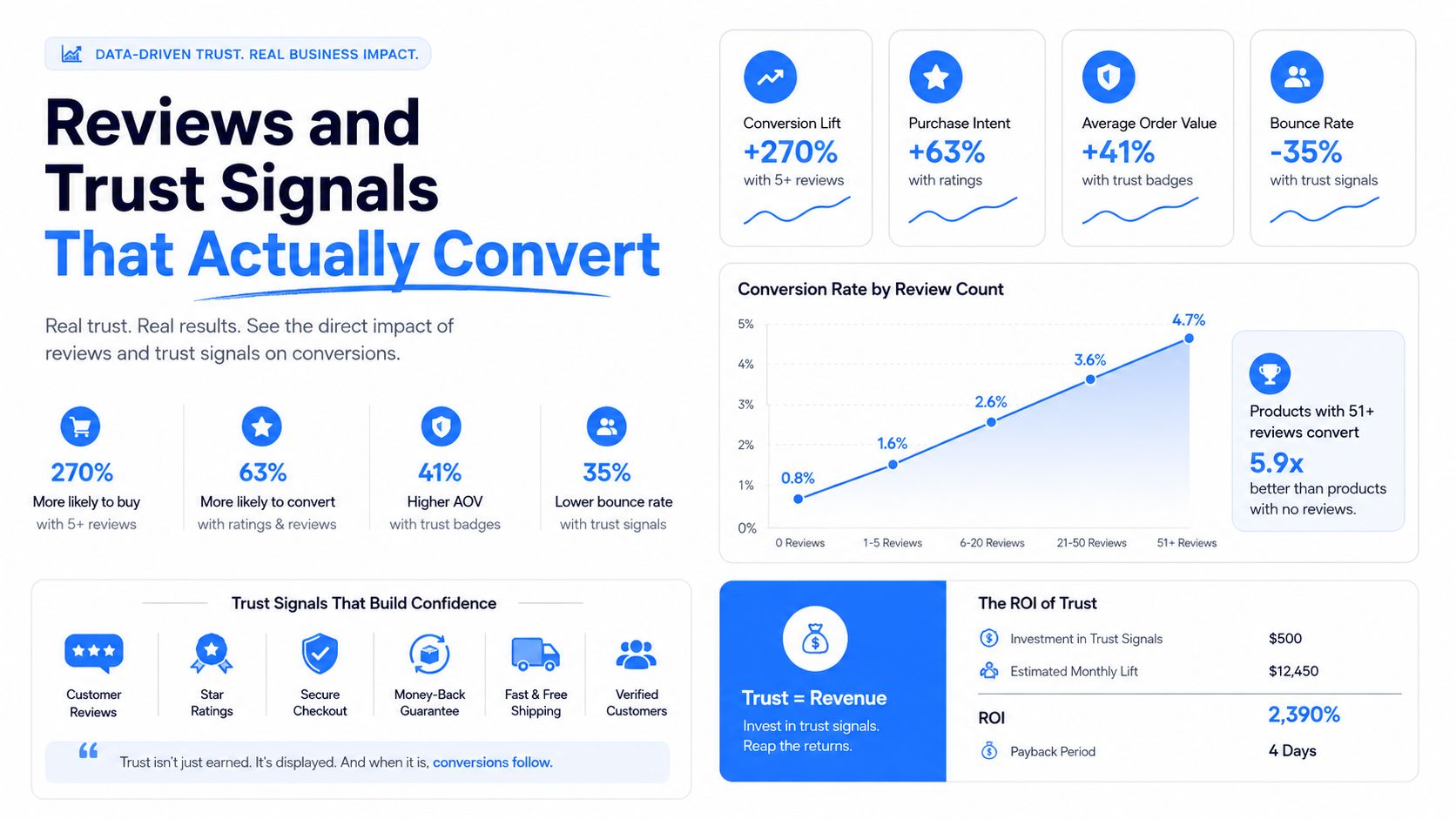
A customer searching “air conditioning repair near me” is comparing risk. They want to know whether the company answers, arrives, performs the work, and handles problems professionally. Reviews help answer those questions before the first conversation.
Treat review management as a daily operating responsibility, not a quarterly marketing task. Ask genuine customers for feedback after completed work, make the request easy to follow, and respond to both praise and criticism with specific, calm language. Don't offer incentives for reviews or pressure customers to remove honest feedback.
Use replies to demonstrate accountability
A strong reply doesn't repeat “thank you” for every review. It acknowledges the customer's experience, identifies the service when appropriate, and shows future readers that the business pays attention.
For a positive HVAC review, mention the completed repair without stuffing a location or service phrase. For a negative review, avoid arguing about private details. Invite the customer to contact the office through an appropriate channel, investigate the job internally, and document the outcome.
Review cadence matters because a profile with old activity can look abandoned. The goal isn't to manufacture a perfect-looking profile. The goal is to build a steady record of authentic customer experiences and show that the business remains engaged.
Use this review generation process to create a repeatable request and response workflow. Assign ownership inside the company. Decide who asks, who monitors, who replies, and who escalates serious complaints.
Defend the profile against spam
Google's enforcement activity shows why profile security deserves attention. In 2025, Google reported blocking or removing over 292 million policy-violating reviews, blocking 79 million inaccurate or unverified edits, placing posting restrictions on more than 782,000 policy-violating accounts, and removing over 13 million fake Business Profiles (Google Maps business protection update).
Those numbers describe the environment legitimate businesses operate in. Competitors, fake profiles, inaccurate edits, and suspicious reviews can affect customer trust and visibility. Monitor your business name, phone number, categories, hours, service area, and reviews. Save screenshots and supporting business documentation when an unauthorized change appears, then use Google's official appeal or support process.
A legitimate profile still needs defense. Accuracy is part of local SEO, but it's also part of business continuity.
Putting GBP to Work for Transactional Searches
A Business Profile earns its keep when it helps a buyer take action. Impressions and discovery are useful, but a service owner ultimately needs calls, direction requests, messages, website visits, and booked work.
That's why Transactional Marketing targets transactional search terms. “Air conditioning repair near me,” “dentist near me,” “roofer near me,” and “pest control near me” signal urgency and commercial intent. The searcher isn't asking for a general explanation of roofing or dentistry. They're looking for a nearby provider.
Industry data reports that businesses in the local map pack receive 126% more traffic and 93% more calls, website clicks, and direction requests than businesses ranked below the map pack (Google Business Profile statistics). The numbers point to a useful strategy, but the work still has to match the search. A profile must represent the service, location, and customer experience.
Follow the action path
A typical customer path looks like this:
- The buyer searches for a specific service near a location.
- Google matches profiles using relevance, distance, and prominence.
- The buyer compares categories, reviews, service details, hours, and photos.
- The buyer taps to call, request directions, send a message, or visit the website.
- Your team answers, qualifies the lead, schedules the appointment, and records the outcome.
Google reports these actions separately. The Performance API's BUSINESS_DIRECTION_REQUESTS metric also confirms that direction requests are tracked at the location level, which is valuable for businesses that receive in-person visits.
| Metric | Where it shows up | What it signals |
|---|---|---|
| Calls | Business Profile performance data | Direct phone intent from the listing |
| Directions | Business Profile reporting and API | Physical visit intent |
| Messages | Business Profile performance data | Immediate conversational intent |
| Website clicks | Business Profile performance data | Further evaluation before contact |
A dashboard becomes useful when the owner connects these actions to service cities, lead quality, response time, and booked jobs. That is more meaningful than celebrating a profile view without knowing whether anyone contacted the business.
When to DIY and When to Hire a Local SEO Partner
You can handle the basic setup yourself. Claim the profile, verify ownership, enter accurate business information, choose the correct category, add real photos, list your services, and ask satisfied customers for honest reviews. Those steps establish control and prevent obvious customer confusion.
A partner becomes valuable when the profile needs strategic management rather than data entry. Category selection, service-area tuning, spam defense, citation cleanup, review workflows, location-specific content, and performance analysis require consistent attention. AI optimization adds another layer. Your website and profile should support industry-specific content silos that answer how customers search for your service in each relevant city, without publishing generic pages that combine unrelated industries.
Use a clear decision test
DIY makes sense when:
- You have ownership access: Nobody else controls the profile or verification process.
- Your service area is simple: You work from one location or a clearly defined set of nearby areas.
- Your team can respond: Someone monitors calls, messages, questions, and reviews.
- You can maintain evidence: You keep accurate service information and real business photos available.
Bring in support when:
- Your profile has ranking problems: The category, address, service area, or business information needs diagnosis.
- Spam affects visibility: Fake listings, false edits, or suspicious reviews require documentation and escalation.
- You serve several cities: You need a local content and map strategy that reflects actual operations.
- You want measurable growth: You need reporting tied to transactional terms, calls, directions, and leads.
Tools and data sources such as MapLeads for local SEO can help teams organize location-focused prospecting and research. Transactional Marketing combines Google Maps optimization with SEO and AI-driven content planning for service businesses, including HVAC, plumbing, roofing, pest control, dental, chiropractic, and med spa companies. Its stated process targets specific transactional terms and aims to move client websites onto Google's first page within 30 to 60 days, while map work focuses on visibility in relevant service areas.
The company also describes a contract-free approach and a results dashboard that tracks keyword timelines, map-ranking heat maps, Search Console queries, and traffic. Owners evaluating outside help can review the local SEO company services and compare the reporting process with their own revenue goals.
Bookmark your profile access, document changes, and decide which searches should generate calls first. Then measure the work against actual customer actions rather than vanity metrics.
Transactional LLC helps service businesses manage Google Business Profile optimization, Google Maps visibility, SEO, and AI-driven content built around transactional searches such as “roofer near me,” “dentist near me,” and “air conditioning repair near me.” Visit Transactional LLC to review the approach, explore the dashboard, and request a plan focused on more qualified calls and booked jobs in your service areas.