


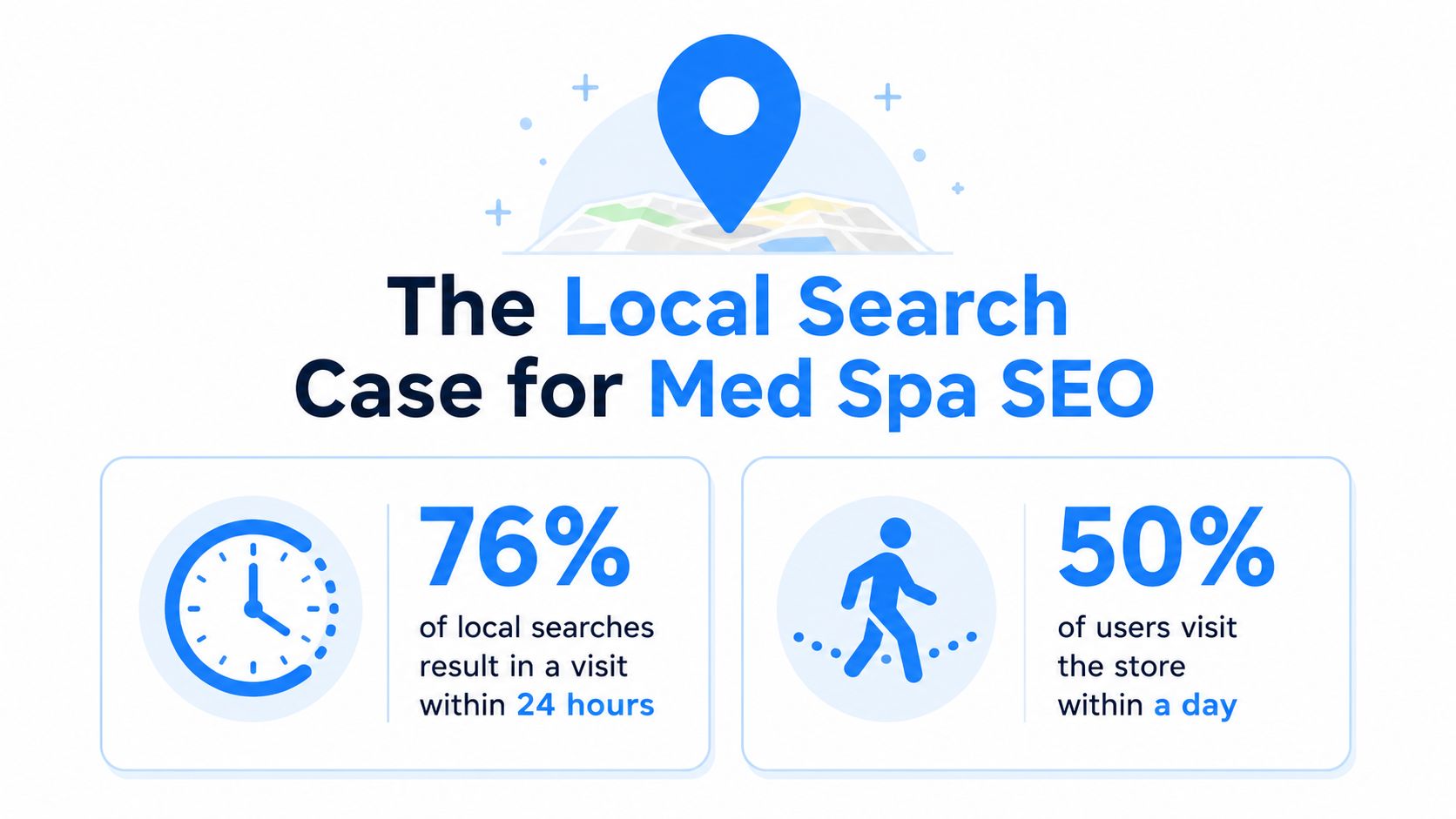
A local searcher isn't casually browsing. 76% of people who search for a local business on their phone visit it within 24 hours, according to med spa local SEO research. For a med spa, that search may be “Botox near me,” “laser hair removal near me,” or “medical spa in [city].” The person already has a treatment in mind, a location in mind, and often a willingness to book.
That's why med spa search engine optimization must focus on transactional visibility, not traffic for its own sake. Transactional Marketing targets searches where the customer has money in hand and is ready to spend it. The work centers on Google Maps, treatment-specific pages, local relevance, and AI search visibility, all connected to a path that makes booking easy.
Why Med Spa Search Engine Optimization Demands a Local-First Strategy
Google search behavior makes local visibility especially valuable for med spas. Roughly 42% of local search clicks go to the Google Maps 3-pack, as reported in local search data for med spas. Separately, 46% of Google searches have local intent, which means a substantial portion of search activity includes a geographic need, whether the user names a city or relies on “near me” behavior.
A med spa competes differently from an e-commerce store. The visitor usually needs a nearby provider, wants reassurance about credentials and results, and may be comparing only a few visible options. A clinic buried in organic results or missing from the map pack can lose the appointment before the owner ever sees the lead.
The strongest strategy separates search intent into three layers:
- Transactional booking queries: “Botox near me,” “medical spa [city],” and “laser hair removal [city]” should lead to pages with clear treatment details, location relevance, provider credibility, reviews, and booking actions.
- Educational queries: Searches such as “how long does Botox last” answer a patient's questions before they're ready to choose a provider. These pages can support visibility in AI Overviews and other answer-focused search experiences.
- Comparison queries: “Botox vs. Dysport” or “Hydrafacial vs. microdermabrasion” requires balanced explanations that help a prospective patient make a decision while showing where professional consultation matters.
A generic blog strategy treats all three searches alike. That approach often produces informational traffic without enough booking intent, while the homepage tries to rank for every service and city at once. Transactional Marketing is built around the search terms that signal immediate commercial intent, including “med spa near me,” “dentist near me,” “roofer near me,” and the med spa equivalents that lead users directly toward an appointment.
Demand is concentrated around treatment-specific phrases. Med spa search benchmarks report 165,000 monthly U.S. searches for “medical spa,” 110,000 for “med spa near me,” 74,000 for “medical spa near me,” and 201,000 for “Botox near me.” The same source reports that “med spa near me” searches have grown by more than 200% over the past three years. Those figures don't mean every clinic will capture national demand. They do show why a local-first strategy should prioritize the exact treatment and location searches that can produce booked appointments.
Practical rule: Build visibility where the searcher is ready to act, then use educational content to support the decision rather than replacing the booking path.
Google Business Profile Mastery for Med Spas
Google Business Profile is the first asset to fix when a med spa wants stronger Maps visibility. Google describes local rankings through relevance, distance, and prominence, with relevance tied to how well the profile matches the search, distance tied to proximity, and prominence influenced by recognition signals such as reviews and links, as explained in Google Maps optimization guidance for med spas.
A 2026 local-search survey reports that GBP signals account for about 32% of local pack influence, while the primary category ranks as the most important individual factor, according to Google Business Profile statistics. That makes category selection the starting point, not an afterthought.
Start with category precision
Choose the most accurate primary category for the clinic's actual business model. For many med spas, that means Medical Spa, followed by relevant secondary categories and services that reflect the treatment mix. A profile categorized too broadly may miss searches for “Botox near me,” “laser hair removal [city],” or other treatment-specific queries.
Then complete every field that reinforces relevance:
- Services: Add each major treatment separately, including injectables, laser treatments, skin treatments, and other procedures the clinic provides.
- Business description: Explain the clinic's location, treatment focus, patient experience, and differentiators in natural language.
- Attributes: Select accurate amenities and accessibility details that help prospective patients decide.
- Photos: Upload authentic images of the reception area, treatment rooms, staff, equipment, and clinic environment.
- Booking links: Send users directly to the appropriate scheduling page rather than forcing them through a generic homepage.
- Posts: Publish useful, current updates about treatments, consultations, education, and clinic activity.
Profile maintenance matters because a listing can be complete at launch and stale later. Independent local SEO guidance identifies profile completeness, review volume, review recency, and response rate as important signals, while weekly posts and fresh photos demonstrate ongoing business activity in med spa local SEO guidance for 2026.
Use this Google Business Profile optimization guide as a practical reference when auditing the listing. The objective isn't to add random keywords. It's to make the clinic's services, location, and booking path unmistakable to both searchers and Google.
Building Service and Location Content Silos That Convert
The common failure is predictable. A med spa creates one homepage, one broad services page, and a short paragraph listing every city it serves. Google then has little reason to treat that site as the strongest answer for a particular treatment in a particular market.
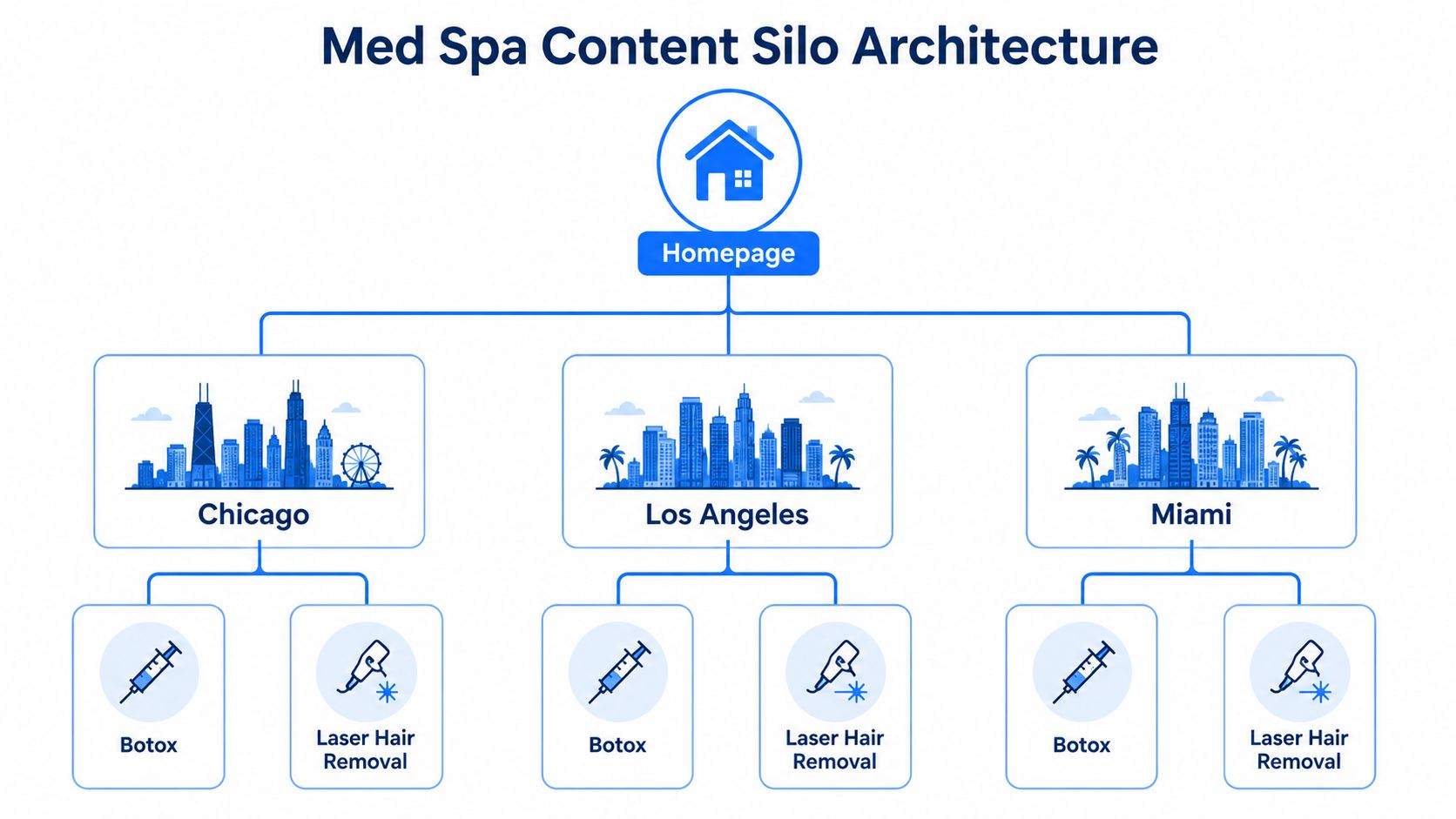
A better architecture pairs one treatment cluster with one service area. For example, a clinic might build:
- Chicago Botox: Booking-focused page for Botox consultations and treatment in Chicago.
- Chicago laser hair removal: Separate page addressing the treatment, candidacy, process, and booking path.
- Los Angeles Botox: Localized page with relevant clinic information, not copied Chicago text.
- Miami laser hair removal: A distinct page connected to the Miami service area and relevant profile signals.
Each page should answer the searcher's immediate questions without turning into a keyword list. Include the treatment's purpose, who may be a candidate, what the consultation covers, preparation and aftercare information, provider credentials, clinic location, relevant reviews, frequently asked questions, and a visible booking action.
The internal links should reinforce the same structure. The homepage can link to city hubs. Each city hub can link to treatment pages. Educational articles can link to the relevant booking page, while comparison articles can link to both treatments when that helps the reader choose the next step.
Separate conversion pages from support content
A page targeting “Botox near me” has a different job from an article targeting “how long does Botox last.” The first should reduce friction and encourage a consultation. The second should provide a concise, accurate answer and create a natural route to the Botox service page.
This separation also protects the site from thin expansion. Adding every imaginable treatment page won't automatically improve local visibility. Prioritize services with real demand, strong margins, adequate clinical capacity, and a clear connection to the clinic's GBP.
Match the page's city references to the actual business footprint. The location page should make the relationship between the clinic and the city clear, while the GBP should list accurate services and service areas. Internal links, local reviews, and consistent business information then support a unified relevance story.
For a more deliberate publishing system, use SEO content planning for service silos. A content calendar should identify whether each planned page is meant to generate a booking, answer a question, or win a comparison decision.
A useful implementation sequence looks like this:
- Map every profitable treatment to the city or service area it can realistically serve.
- Create the highest-priority service-city booking pages first.
- Add educational and comparison articles that support those pages.
- Link every supporting article to the appropriate treatment page.
- Review Search Console queries and booking behavior before adding more pages.
Here's a visual example of how a service-city silo can guide users from broad discovery to a specific appointment.
Adapting Your Content Strategy for AI Search and LLM Discovery
Traditional SEO advice often treats every keyword as a click opportunity. AI search complicates that assumption. A user searching “how long does Botox last” may receive a direct answer in an AI-generated result and never visit a clinic's article. A comparison query such as “Botox vs. Dysport” can behave the same way if the search interface summarizes the differences on the results page.
That doesn't make educational content irrelevant. It changes its role. These pages should provide clear, structured answers that AI systems can interpret, while also giving human readers a credible reason to continue to a consultation or service page.
Build three content tracks
Transactional pages should focus on local booking intent. Use explicit treatment and city language, explain the appointment path, identify the clinic and providers, and make the next action obvious. The target is not a vague phrase such as “aesthetic treatments.” It's the specific query a prospective patient types when they're ready to choose a provider.
Educational pages should answer one question directly near the top, then expand with useful context. Clear headings, concise definitions, treatment considerations, provider qualifications, and relevant internal links make the content easier for both people and machine systems to understand.
Comparison pages should avoid exaggerated claims. Explain how treatments differ, where each may fit, and why patient-specific factors affect the decision. A consultation link should appear after the explanation, not as a substitute for it.
AI discovery platforms increasingly organize information around intent classification and geographic context, as reflected in local business AI discovery technology. A med spa should therefore state what it offers, where it serves patients, and which questions it answers in language that machines can parse.
That includes consistent service names, complete location information, structured headings, descriptive internal links, provider details, and properly implemented local-business and service schema where appropriate. It also means keeping website information aligned with the GBP so an AI system doesn't encounter conflicting descriptions of the clinic.
For teams exploring a broader framework, Nuwtonic Agentic Generative Engine Optimization offers context on optimizing business discovery for generative systems. The practical lesson is simple: AI optimization supports, but doesn't replace, transactional SEO. Patients still need a nearby clinic, a relevant treatment, trustworthy proof, and a frictionless way to book.
Apply that same distinction in AI search engine optimization for local businesses. The winning content system isn't one giant blog. It's a set of connected answers, comparisons, and local booking pages, each built for a different stage of the decision.
Review Velocity and Reputation as Traffic Multipliers
Reviews influence two decisions at once. Google uses review-related signals within local prominence, and patients use the visible reputation of a clinic when choosing between map-pack listings. A med spa that collects reviews only during occasional campaigns gives competitors an advantage because freshness and ongoing activity matter.
The clearest benchmark comes from medical spa SEO statistics: med spas with 100 or more Google reviews receive 3.2 times more local-search clicks than clinics with fewer than 20 reviews. That doesn't guarantee a ranking position, but it shows why reputation volume can affect the amount of traffic a visible profile captures.
Create a repeatable request process
Ask at a natural point in the patient journey, such as after a positive follow-up or when a patient expresses satisfaction with the experience. Make the process easy with a direct review link, but never pressure patients to write only favorable feedback or offer incentives that violate platform policies.
A sound system includes:
- A clear request owner: Assign front-desk staff, patient coordinators, or an approved automated workflow to send the request.
- A consistent moment: Use the same patient-care milestone so requests don't depend on memory.
- A direct destination: Send patients to the clinic's Google review form rather than making them search for the profile.
- A response routine: Reply professionally to positive and negative reviews, protecting privacy and avoiding clinical details in public.
- A quality check: Watch for sudden patterns, duplicate language, or requests that could trigger filtering.
Review velocity is the pace at which new feedback arrives. The local-search literature cited in med spa local SEO statistics frequently references a working range of 5 to 10 new reviews per month for ongoing profile activity. Treat that as an operational benchmark, not a guarantee or a target to pursue through artificial methods.
A response can reinforce relevance without sounding scripted. Thank the patient, mention the clinic experience in general terms, and invite private follow-up where necessary. Don't copy the same reply to every reviewer, and don't include sensitive information.
Use this review-generation resource to formalize the workflow. Reviews aren't a replacement for accurate categories, strong pages, or patient service. They amplify the visibility and click-through potential of the profile you've already built.
Measuring What Matters and Setting Realistic Timelines
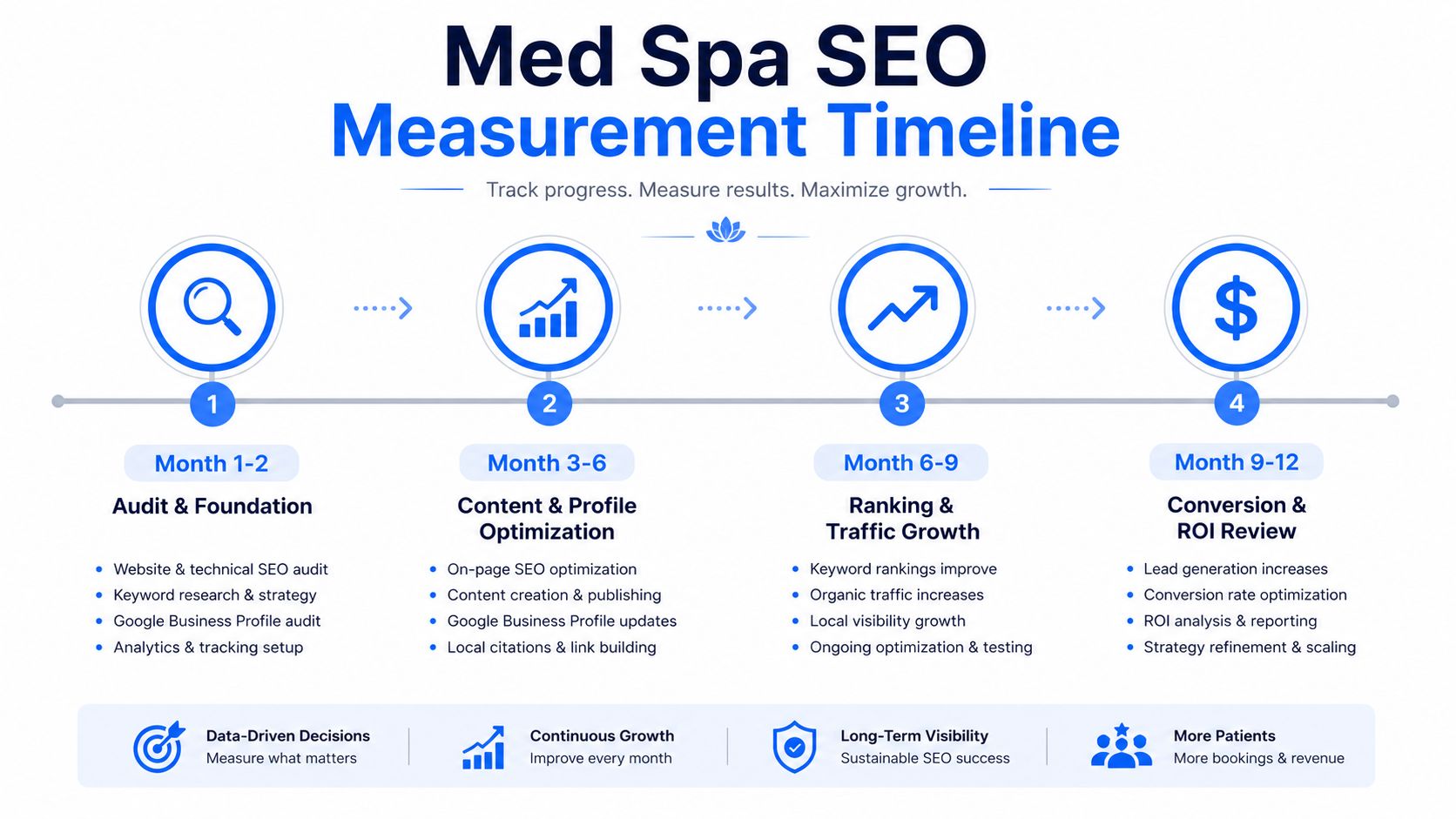
Med spa SEO earns its place in the budget when it produces booked consultations and appointments. Track the full path from visibility to action:
- Map-pack impressions: Check whether the Google Business Profile appears for target treatments and cities.
- Local organic click-through rate: Compare queries, pages, and visitors that show treatment intent.
- Phone calls and booking actions: Separate calls and appointment requests from organic results and Maps when tracking permits.
- Organic booking conversion rate: Use the health and wellness local SEO benchmarks as directional context, not a med-spa-specific promise. Report your clinic's own conversion rate by service page, source, and location.
The timeline reflects competition, profile strength, site quality, treatment demand, and execution. A clinic ranking for transactional booking terms may progress differently from one building educational pages for AI answers or comparison pages for patients weighing providers. Each intent layer needs its own reporting. Maps signals should support the booking layer, while service content, clear answers, and comparison pages show whether the other layers assist conversion.
Read early signals correctly
During the first 30 days, check technical issues, GBP accuracy, indexation, tracking, category alignment, and baseline rankings. Early gains may appear as cleaner impressions, new queries, profile actions, or visibility for less competitive terms.
By 90 days, assess whether priority service-city pages receive impressions and whether users reach booking pages. Impressions without clicks usually call for a stronger title and description. Clicks without bookings point to the offer, trust signals, page speed, form friction, or call experience.
At six months, review the complete pattern. Which treatments generate qualified calls? Which cities produce appointments? Which educational pages assist conversions, and which comparison pages influence return visits or branded searches? Stop expanding pages without a strategic role. Invest in services and locations that show genuine demand.
Paid advertising can support priority treatments while organic visibility develops. Keep paid, Maps, and organic leads separate in reporting so immediate ad volume does not conceal weak local conversion.
Transactional Marketing provides SEO, Google Maps and GBP optimization, service-city content planning, website management, AI-driven content development, and paid advertising for local service businesses. Visit Transactional LLC to request a plan focused on the transactional treatments, educational topics, comparison queries, and cities your clinic serves.