


At 7:42 a.m., a plumbing owner is halfway through a repair when the phone rings. The caller has a burst pipe and needs someone immediately. The next call comes from a homeowner asking for a ballpark price, with no address, timeline, or clear intent. Both calls may appear in the same Google Local Services Ads report, but they don't have the same value.
That difference explains why Google Local Services Ads for plumbers should be managed around booked jobs, not lead volume. The channel can put a verified plumbing business in front of people searching for urgent, transactional terms such as “water heater leaking,” “toilet overflow,” and “emergency plumber near me.” But the account only produces profitable growth when the plumbing company answers quickly, qualifies accurately, serves the right areas, and reviews every questionable lead.
Why Local Services Ads Matter for Plumbing Businesses
Google officially lists plumbing as an eligible category for Local Services Ads, and its product information explains that LSAs are available only to selected service categories. Google's Local Services Ads information for home-service businesses also requires business details such as the company name, service type, location, and verification information before advertising begins.
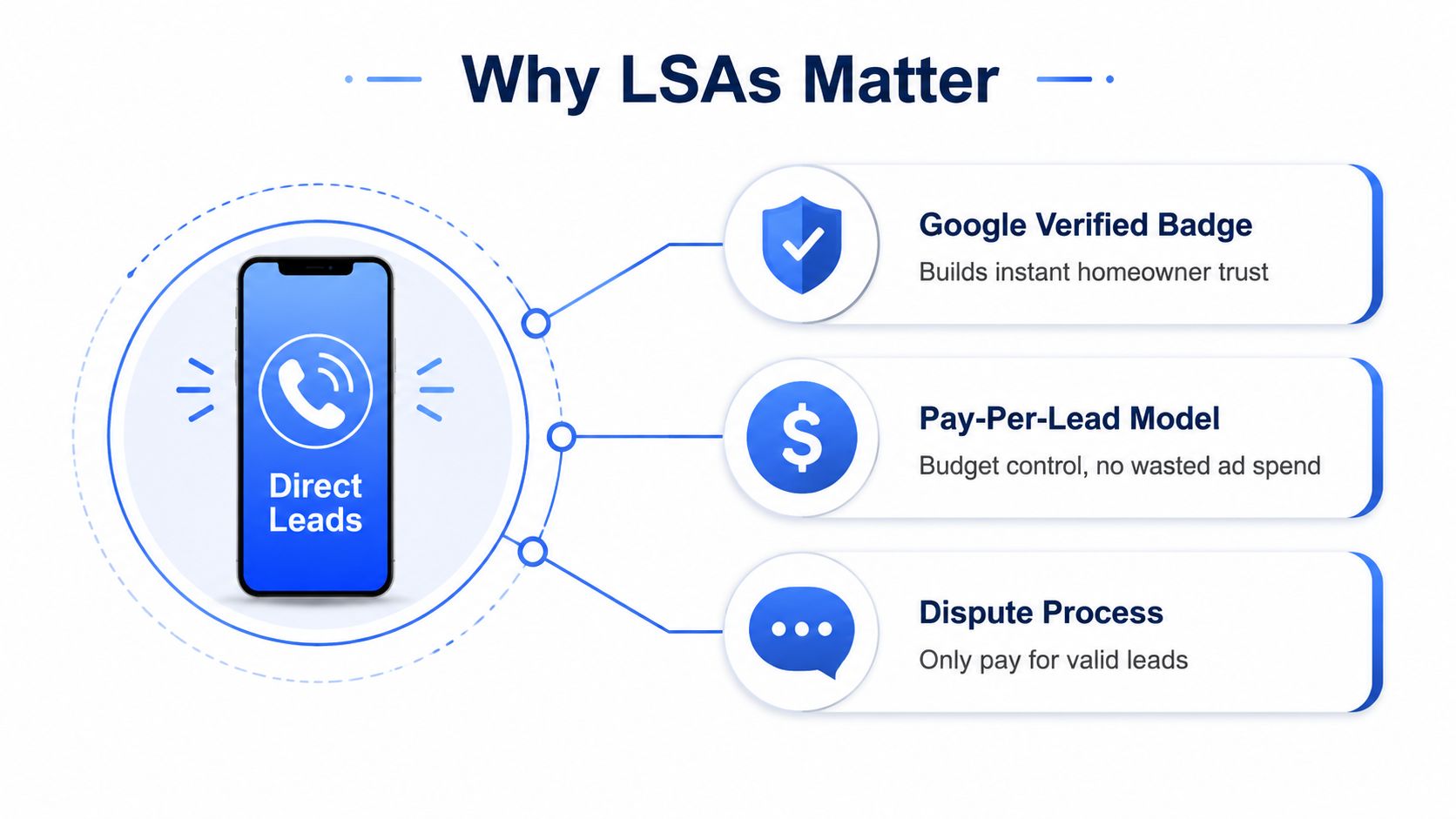
That makes plumbing a mature part of Google's local lead-generation system, not an experimental placement. LSAs appear prominently in local search, use a pay-per-lead structure, and can display verification signals that help a homeowner choose a provider before visiting a website. Standard search ads charge for clicks, while an LSA lead is connected to a contact action such as a call or message.
Where LSAs fit in the local search mix
Organic Maps visibility remains valuable because it can build a durable presence for searches such as “drain cleaning near me.” Traditional Google Ads can provide more control over landing pages, messaging, and keyword targeting. LSAs serve a different purpose. They capture immediate, high-intent demand at the moment a homeowner is ready to call.
Google's published plumbing category support also matters because the platform treats these businesses as verified local providers rather than generic advertisers. A verified badge, service description, phone option, and reviews give the searcher enough information to take action without navigating through several pages.
For a plumbing operator, the practical test is simple. If a lead comes from “water heater leaking” and produces a dispatched technician, it has direct operational value. If it comes from an irrelevant service or an area the company doesn't serve, it becomes a billing and workflow problem. That's why LSAs deserve a place in a broader paid media strategy for local service businesses, but only when the back office treats each lead as a potential service ticket.
Setting Up and Verifying Your Plumbing LSA Account
A plumbing LSA account starts with eligibility, not ad copy. Google's qualification materials state that businesses must meet insurance requirements when applicable, with the required type and minimum amount depending on the category and location. The Google qualification requirements for Local Services providers distinguish between insurance documents and the qualification rules that apply to different provider types.
Your business name should match the name on the plumbing license and insurance documents. The service area should reflect real operating territory, using locations the trucks can reach profitably rather than claiming an entire state. A broad service area may increase exposure, but it can also create calls that waste technician time and produce poor customer experiences.
Build the profile around actual dispatch capacity
Set business hours that match real call coverage. If the phone is answered only during weekday office hours, the profile shouldn't imply round-the-clock emergency service. Map job types to work the company performs, such as drain cleaning, water heater repair, sewer line work, leak detection, toilet repair, or emergency plumbing.
Add administrators with appropriate access instead of sharing one login across the company. The profile, billing access, lead review, and operational follow-up should be visible to the people responsible for those tasks.
Google's license and insurance upload instructions require license details such as the business name, license number, and expiration date, along with an attached file when an image is required. The same workflow is used to submit insurance proof.
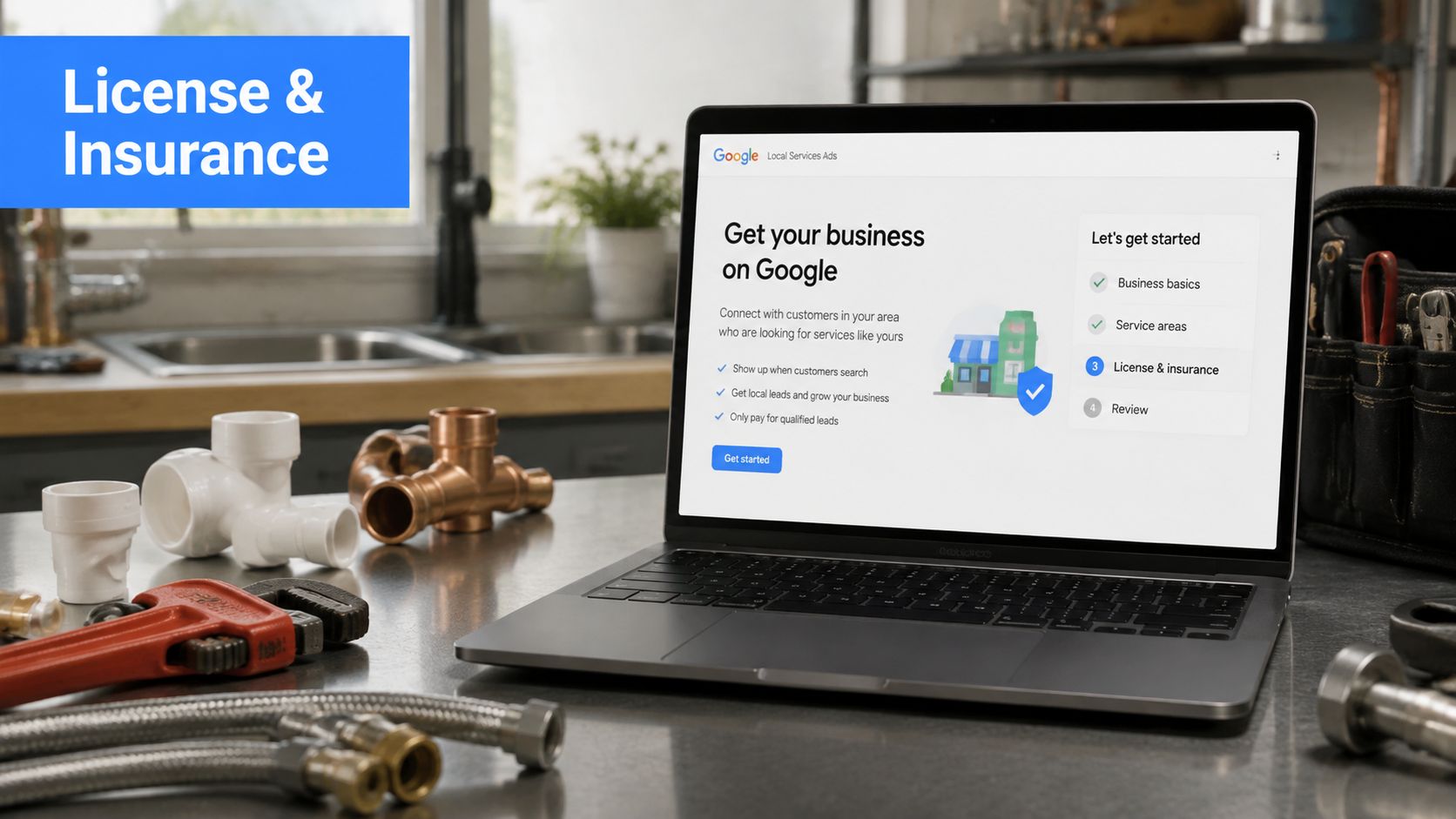
Google may also conduct business-owner and background checks, and some plumbing onboarding processes can involve additional screening activity. Verification can take time, especially when names, dates, or coverage details don't match. Review requirements also matter. Industry plumbing guidance notes that a profile may need at least 3 reviews before an ad goes live, while some categories require up to 5 reviews. See this guide to Google Local Services Ads for home services for the broader setup context.
Never purchase reviews or pressure customers into a particular rating. Ask for honest feedback after completed work, maintain accurate documents, and wait for the verification badge to activate before judging launch performance.
Bidding, Budgets, and Service Areas That Fit Your Trucks
Bidding should be reviewed as an operating decision, not left as a permanent setting. The right maximum lead price depends on the job's likely revenue, gross margin, dispatch cost, and probability of booking. A sewer line inquiry and a vague general plumbing question shouldn't receive the same economic treatment.
Google may show suggested bid guidance, but the highest suggested amount isn't automatically the right choice. Increase exposure only when the additional leads become booked work. If the marginal call fills the schedule with low-value work or long drives, a higher position can reduce profit rather than improve it.
Start with capacity, then set the budget
A weekly budget should reflect the number of calls the office and field team can handle. If the company can dispatch only a limited number of emergency jobs, buying more leads than the team can answer creates avoidable waste. If the budget runs out before the week ends, the ad may stop serving while demand is still active.
Keep service ZIPs close to real truck routes. A metro-wide footprint may look attractive in the profile, but distant jobs carry fuel, scheduling, and technician opportunity costs. Remove locations that repeatedly generate calls the company declines or cannot book.
Practical rule: Move budget toward categories and ZIPs that produce booked revenue, not toward the areas that produce the most ringing phones.
The table below is a planning framework, not a claim about market pricing. Set the actual lead-price limits from your account history and booked-job economics.
| Job Category | Typical Max Lead Price | Suggested Weekly Budget Share | Notes |
|---|---|---|---|
| Drain cleaning | Set from booked-job margin | Moderate | Watch repeat low-value calls and travel distance |
| Water heater repair | Set from replacement and repair revenue | Higher | Separate urgent repair from research-oriented inquiries |
| Sewer line repair | Set from expected project value | Higher | Route qualified calls to experienced staff |
| Leak detection | Set from service margin and follow-on work | Moderate | Confirm service area and equipment availability |
| General plumbing inquiry | Set conservatively | Lower | Review closely for fit before increasing spend |
For plumbers evaluating more advanced bidding logic, value-based bidding guidance can help connect advertising decisions to revenue quality. The weekly review should compare spend, booked jobs, revenue per lead, and service-area profitability before any bid change is made.
Measuring Booked Jobs Instead of Raw Lead Volume
A plumbing account can generate calls all day while the dispatch board stays thin. That happens when every inquiry is counted as success, even if the caller is outside the service area, cannot approve the work, or never schedules an appointment.
The useful question is, how many charged leads became booked, profitable work? Google separates charged leads, bookings, and booking rate in its reporting. The Google Local Services lead reporting guidance also explains that charged leads may later qualify for automatic credits when Google identifies applicable quality issues.
Translate platform metrics into operator language
Use the LSA dashboard with the CRM, not instead of it. Tag each lead by service type, ZIP code, time of day, call outcome, booking status, and revenue after the job closes. That record shows whether an apparent lead-volume gain produced work your trucks could complete profitably.
A plumbing benchmark covering 230 contractor accounts and $2.03 million in spend reported a $57 average LSA cost per lead, a 44.5% book rate, and 6.85× closed ROAS. The same benchmark data, referenced in independent plumbing Google Ads benchmark data, can be read alongside an average ticket of $1,714, which implies about $263 per paying customer, as detailed in this plumbing LSA cost-per-lead analysis.
Those figures are benchmarks, not a forecast for every plumbing market. They clarify why booked-job yield beats raw CPL as a management measure. One water heater replacement may justify several weaker inquiries, while a low-cost call that never reaches a decision-maker creates no revenue.
| Metric | Vanity View | Booked-Job View |
|---|---|---|
| Leads | How many contacts arrived | How many were serviceable and qualified |
| Cost per lead | What Google charged | What it cost to create a real opportunity |
| Bookings | A platform status | A dispatch-ready appointment |
| Revenue | Total attributed sales | Revenue by job type, ZIP, and technician capacity |
| Disputes | Credits as an afterthought | A control on effective acquisition cost |
Review the Leads, Reports, and Disputes areas every week. Compare charged leads with answered calls, booked appointments, completed jobs, revenue, and travel burden. Reduce categories or locations that repeatedly create unsuitable work, and protect budget for calls that consistently become profitable jobs. That is usually a better adjustment than chasing a lower lead price.
Dispute Workflows and Call Handling That Protect Margin
A plumber can have a reasonable lead cost and still lose money if the phone rings unanswered, the address is outside the service area, or the caller never reaches someone who can schedule work. The margin is often decided after the lead arrives, not when the bid is set. As noted earlier, lower CPL does not guarantee a profitable booked job.
Make the first call useful
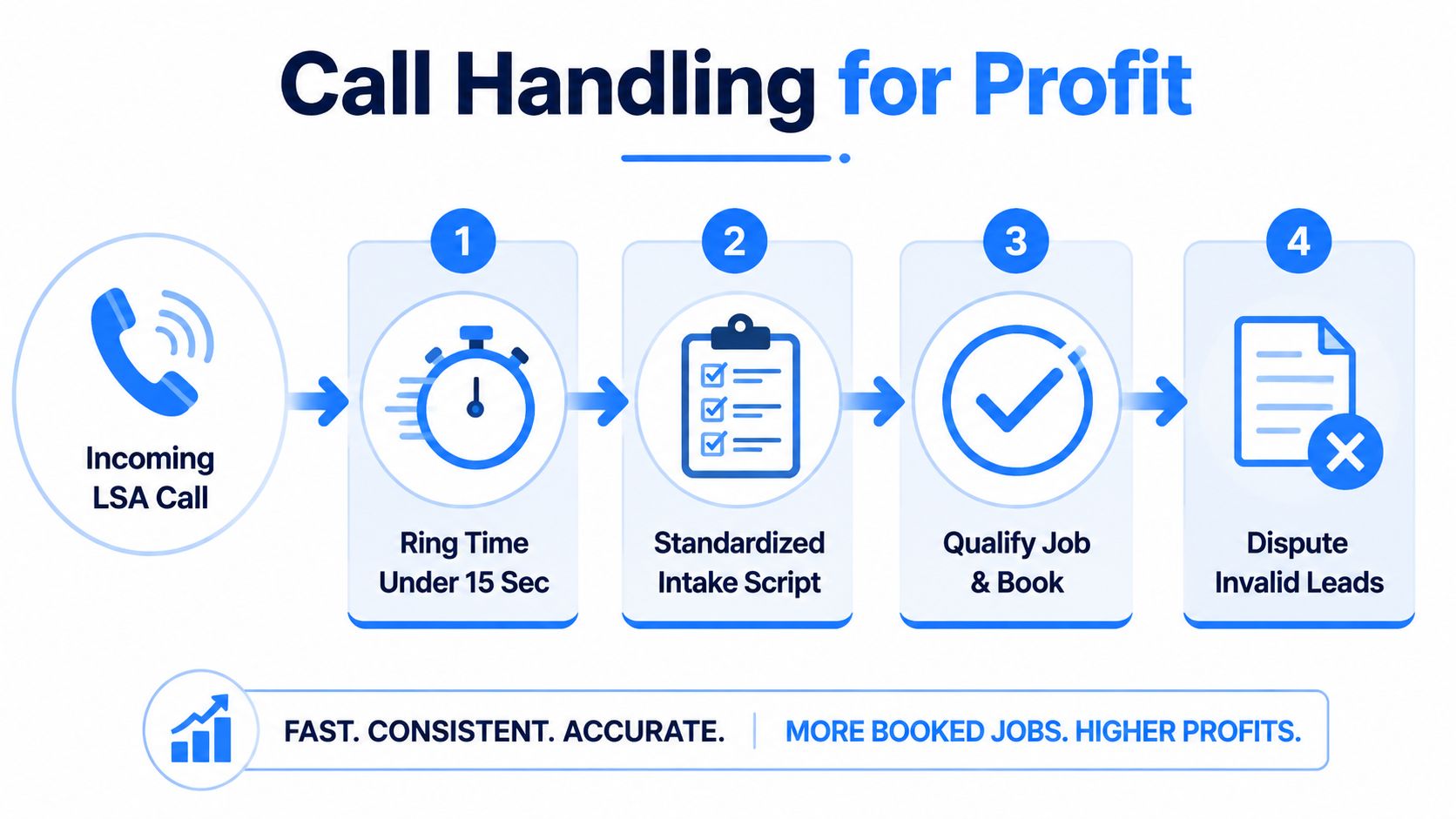
Route calls to a person or answering service that understands plumbing terms and can follow a defined intake process. Capture the details that determine whether the lead is dispatchable:
- Location: Confirm the service address and ZIP before discussing dispatch.
- Problem: Identify a burst pipe, sewer issue, leak, drain blockage, or water heater problem.
- Urgency: Ask whether water is actively flowing, the property is occupied, or damage is increasing.
- Authority: Confirm that the caller can approve the work or schedule the decision-maker.
- Next action: Book, escalate, follow up, or mark the lead as unsuitable.
A response under 15 seconds is a practical target from the prescribed call-handling workflow. Consistency matters more than treating that target as a guarantee. Missed calls need immediate callbacks. Answered calls that do not book should receive follow-up within the same business cycle and again during the next 24 hours.
Document disputes instead of absorbing them
Tag spam, wrong-service, and out-of-area contacts in the LSA workflow or connected CRM. Record what happened, retain call details where permitted, and track which disputed leads receive approval. Google separates charged leads from later credit decisions, so review billed contacts against credited leads, qualified opportunities, booked appointments, and completed work.
Dispute discipline protects the economics of the account. A team that labels unsuitable calls promptly can identify recurring bad categories or locations, then adjust service settings or routing instead of accepting the cost.
Route complex, high-value emergencies, such as sewer work, water heater replacement, or slab leak investigation, to senior staff first. Drain calls can use a separate queue with its own qualification questions. Routing should reflect job complexity and approval requirements, not just the order in which calls arrive.
Connecting LSAs to Google Maps and Local SEO
LSAs work best as part of a local visibility system. They rely on business information, service categories, reviews, and location signals that also influence how a plumbing company appears in Google Maps and organic local search.
Google's local ranking guidance identifies relevance, distance, and prominence as core factors in local results, as explained in this overview of Google Maps ranking factors. That means an LSA profile and Google Business Profile should agree on services, operating hours, service locations, business name, and contact information. Mismatches create confusion for customers and weaken the consistency of the local presence.
Build a reinforcing visibility loop
A completed LSA job creates an opportunity to request an honest review. Those reviews can strengthen the Google Business Profile, while stronger Maps visibility can increase branded searches and direct calls. The channels don't operate identically, but they can support the same transactional objective.
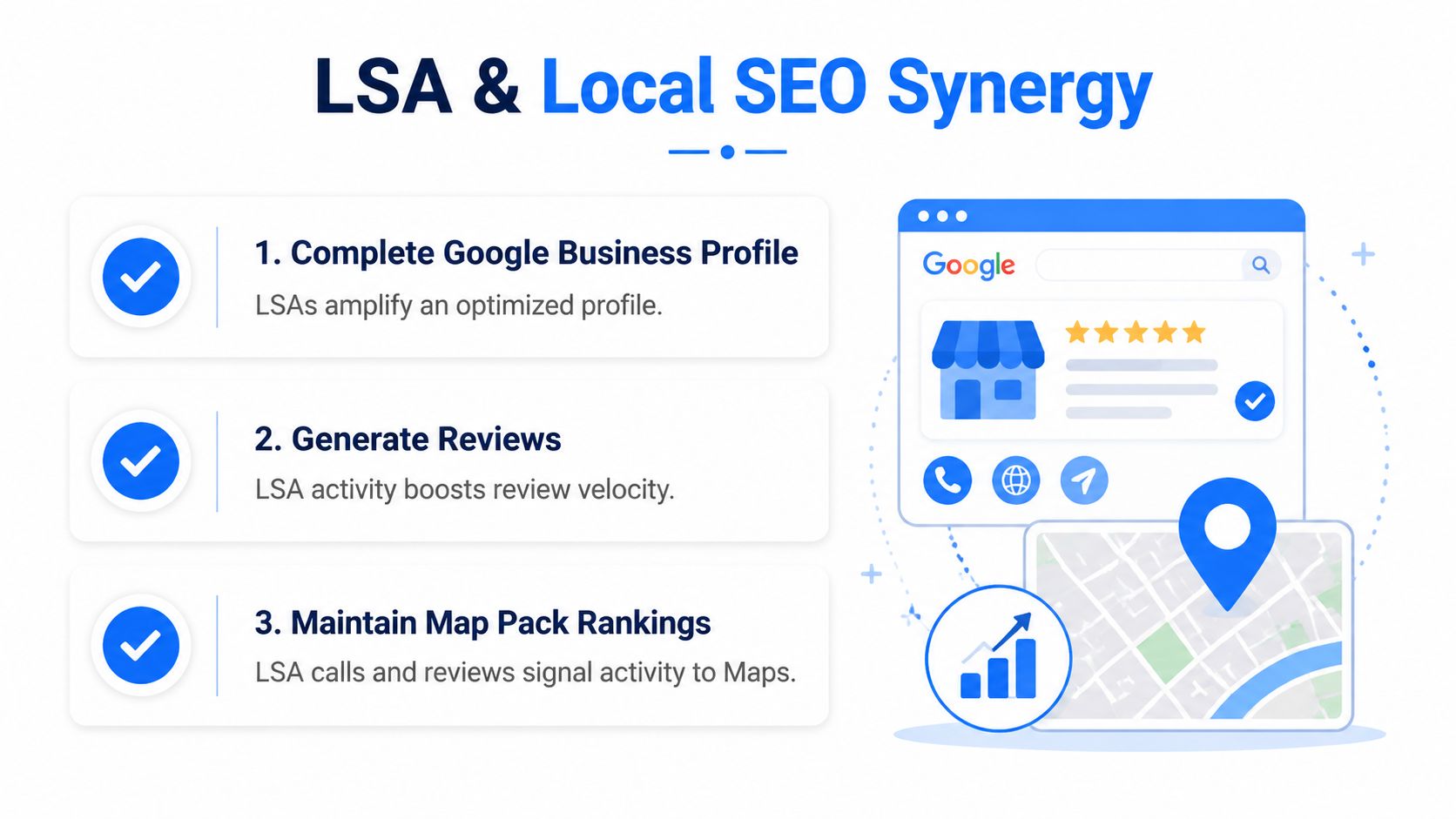
Use LSA lead data to decide which services deserve deeper Google Business Profile coverage. If water heater searches produce qualified calls in one neighborhood, update relevant services, photos, and supporting content around that real demand. If a ZIP produces weak calls, don't automatically create more pages for it. Investigate the mismatch first.
A weekly review workflow can stay simple:
- Weekly: Audit lead quality, request reviews from completed customers, and identify service or ZIP patterns.
- Monthly: Update Google Business Profile services, photos, hours, and posts based on actual demand.
- Quarterly: Review local rankings, service-area profitability, category coverage, and organic search queries.
LSAs buy speed for searches such as “emergency drain repair.” Google Maps optimization builds a longer-lasting local asset. Plumbing companies that want to strengthen that second channel can review this guide to ranking higher on Google Maps, then use LSA data to prioritize the neighborhoods and services that matter commercially.
Troubleshooting and Optimization Checklist for Plumbing LSAs
When a plumbing LSA account fails, changing the bid is often the wrong first move. Start with the signal that explains the failure. A declined verification points to documents or eligibility. A sudden lead-quality drop points to service categories, location coverage, caller intent, or intake discipline. Budget exhaustion points to pacing and capacity.
Diagnose the problem before adjusting spend
Declined verification: Compare the business name, license number, expiration date, and insurance files. Upload clear, current documents through the verification area. If the issue remains unresolved, use the support path inside the Local Services or Google Ads interface rather than repeatedly changing campaign settings.
Paused ads with no leads: Check whether verification is complete, the Google Guaranteed badge is active, the billing method works, business hours are accurate, and the service categories remain eligible. Review the profile for missing information before increasing the bid.
Lead quality drops after a busy season: Compare recent leads with the earlier mix by job type, ZIP, time of day, and booking status. Remove services the company no longer wants, tighten the service area around active truck routes, and confirm that emergency availability reflects actual staffing.
Dispute rejections: Read the lead record and compare the complaint with Google's credit rules. Record the reason consistently, use the feedback process, and separate an invalid contact from a valid caller who didn't book.
Budget runs out too early: Compare the weekly cap with dispatch capacity and booked revenue. Shift spend toward profitable categories before raising the total budget. More calls won't help if the office can't answer them.
Keep a recurring optimization routine
- Review the lead log weekly: Mark every lead as booked, unbooked, wrong service, spam, out of area, or unresolved.
- Prune service areas: Remove ZIPs that create repeated declines, excessive drive time, or weak booked-job economics.
- Adjust emergency categories carefully: Give sewer, water heater, and urgent leak services enough exposure to capture transactional searches, but judge the change by booked revenue.
- Check verification documents: Track license and insurance expiration dates before they interrupt serving.
- Compare LSA with standard search: The Q1 2026 benchmark cited earlier found $183 average non-branded Google Ads CPL for plumbing, while the independent LSA benchmark reported $57. Use those figures as market context, not as a guarantee for your account.
- Inspect the dashboard, not just the inbox: Watch booked rate, revenue per lead, disputed or credited lead share, and cost per acquired customer.
Google Local Services Ads for plumbers convert when the business process behind the ad is reliable. The winning setup captures high-intent searches, sends the right calls to the right person, and measures what reaches the schedule. That is also the foundation of transactional SEO and AI optimization. A plumbing company needs to be found for searches such as “plumber near me,” “water heater repair near me,” and “emergency drain repair,” whether the customer uses Google Search, Google Maps, or an AI system that summarizes local options.
Transactional Marketing focuses on those transactional search terms, Google Maps visibility, local SEO, paid campaigns, and AI-driven content that helps service businesses become easier to find when customers are ready to spend.
Transactional LLC helps plumbing businesses connect Local Services Ads, Google Maps optimization, local SEO, and AI-focused content around high-intent searches such as “plumber near me” and “water heater repair near me.” Visit Transactional LLC to discuss a focused visibility and lead-generation strategy for your service area.