


Most Google Ads advice for small service businesses is backwards. It tells you to get more clicks, more form fills, more leads. That's how roofers, plumbers, dentists, and HVAC companies end up paying for junk. More leads from the wrong searches don't grow a business. They drain office staff, waste estimator time, and crowd out the jobs you want.
The better target is simple. Book better jobs from transactional searches. If someone searches for roofer near me, dentist near me, or air conditioning repair near me, that person isn't browsing for fun. They're trying to hire someone. Transactional keywords like these show immediate purchase intent, and SEO traffic from these searches converts at an average rate between 1% and 4% according to Grow and Convert's analysis of average SEO conversion rates.
That same logic now applies to AI optimization. LLM-driven discovery, search summaries, and AI-assisted local search all reward businesses with clear service relevance, local authority, and strong intent signals. If your content, Google Business Profile, and ad setup aren't built around transactional intent, AI systems won't surface you when buyers are ready to act.
Stop Chasing More Leads and Start Winning Better Jobs
Local service companies don't need a bigger pile of weak leads. They need the right calls from the right neighborhoods for the right services. A search like emergency HVAC repair near me is worth far more than a casual query about how cooling systems work, because one person wants help now and the other wants information.
That's the core problem with most paid search management. It treats every conversion like it has the same business value. It doesn't. A form fill for a high-ticket install is not equal to a low-commitment question from someone who was never going to book.

Why transactional intent matters more than traffic
Transactional Marketing exists for one reason. Show businesses up for searches where people have money in hand and are ready to spend it. That means terms like roofer near me, dentist near me, plumber in [city], and air conditioning repair near me. Those are the searches that produce booked jobs and patients.
Informational visibility has a place, but local SMBs often overinvest in it. They publish broad content, chase vanity traffic, and wonder why the phone doesn't ring with qualified buyers. Traffic isn't the goal. Revenue is.
Practical rule: If a keyword doesn't look like something a ready-to-buy customer would search, it shouldn't get the same budget priority as your highest-intent local terms.
Why maps and AI visibility belong in the same plan
Google Maps isn't optional for service businesses. It's part of the transactional funnel. When someone searches near me, Google often pushes the local pack first. If your Google Business Profile has weak photos, incomplete services, wrong hours, or sloppy location signals, you lose before the click happens.
Good local SEO also feeds AI discovery. Businesses that clearly state what they do and where they do it are easier for search systems and LLM-style experiences to understand. That means service pages, city pages, and Google Business Profile details should all reinforce the same transactional message.
What Is Value Based Bidding and How Does It Work
More leads do not fix a bad Google Ads account. Better job mix does.
Value based bidding tells Google which conversions deserve more of your budget because they lead to higher-revenue work. For a local service business, that means teaching the platform the difference between a tire-kicker asking about a small repair and a buyer looking for a full replacement, emergency service, or premium install.
That changes how bidding works in every auction. Google stops optimizing around raw lead count and starts prioritizing searches, users, and clicks that are more likely to turn into profitable jobs. If you want a clearer picture of what those clicks can cost in the first place, review these Google paid search costs for local intent campaigns.
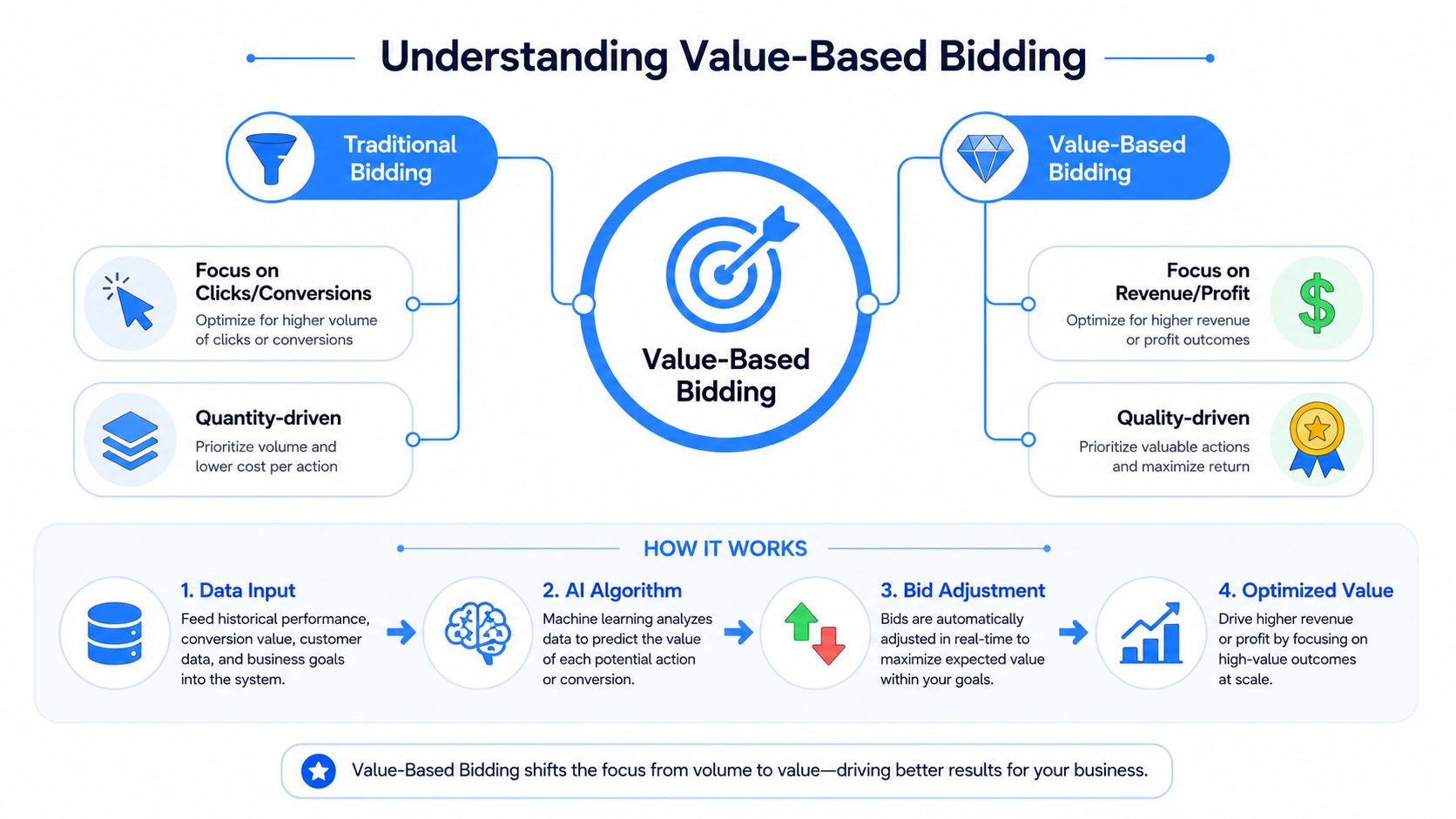
For roofers, plumbers, HVAC companies, and similar local operators, this is the whole point. You are not buying traffic. You are buying chances to win the right calls from the right searches in the right service area.
Here's how it works in practice:
Track high-intent conversions
Focus on actions tied to real buying intent. Phone calls from ads, quote requests, financing form submissions, and booked appointments make sense. Low-intent page views and soft engagement events do not.Assign different values to different lead types
A drain cleaning lead should not be treated like a sewer line replacement lead. A minor roof repair form should not carry the same value as a full reroof estimate. Google's own setup documentation for conversion value rules shows how advertisers can adjust values based on factors like location, device, and audience, which only matters if your conversions are valued differently in the first place.Use a value-focused Smart Bidding strategy
Once Google receives those values, it uses them during auctions to decide where to bid harder and where to back off. The system is trying to produce more total conversion value, not just more form fills.Feed the system cleaner signals over time
If your office team marks which leads turned into real estimates or high-ticket jobs, your bidding gets sharper. You do not need an enterprise CRM to start. A basic process beats a messy one every time.
This matters even more for local "near me" searches because intent is already compressed. The person searching often needs service now, is comparing a short list of providers, and will not give you many chances. If Google has learned that certain searches, ZIP codes, devices, or call patterns produce stronger jobs, value based bidding gives it permission to spend accordingly.
Plenty of SMBs overcomplicate this. You do not need enterprise reporting, offline sales engineering, or a custom warehouse before you start. You need enough separation between low-value and high-value leads to give the algorithm a real target. If your intake process is inconsistent, modern lead qualification tools can help clean up what gets passed back into Google Ads.
For a simple walkthrough of the concept in action, watch this:
Google's AI is a bidding engine, not a business filter. If you send weak conversion signals, it will buy more of the wrong clicks faster.
Choosing Profit Over Volume VBB vs Other Bid Strategies
Most small businesses pick bid strategies the way people order from a menu they don't understand. They click Max Conversions because it sounds safe. It isn't. It often teaches Google to find the easiest leads, not the best ones.
That's a bad trade for service businesses where one high-value job can outperform a stack of low-value inquiries.
The only comparison that matters
Google's internal data showed that advertisers using Maximize Conversion Value saw an 11% increase in total conversion value compared to advertisers optimizing for conversion count alone, as summarized in Optmyzr's guide to value-based bidding. That tells you exactly where the platform is pushing serious advertisers. Toward value, not volume.
| Strategy | Primary Goal | Best For | Transactional Marketing Take |
|---|---|---|---|
| Max Conversions | Get the highest number of conversions | Accounts that can't yet separate lead quality | Useful only when you're still building data. It can flood a service business with low-quality leads. |
| Target CPA | Hit a target cost per acquisition | Advertisers treating all conversions as roughly equal | Better than guessing, but still too blunt if install jobs and basic service calls have different value. |
| Maximize Conversion Value | Get the highest total conversion value | Service businesses with differentiated lead values | Best starting point for SMBs that know some jobs are worth chasing harder. |
| Target ROAS | Hit a return goal while maximizing value | Mature accounts with stable value tracking | Strong option once your value inputs are reliable and your account has enough data. |
Why Max Conversions often goes wrong
A roofing company running Max Conversions might get plenty of leads. The problem is that the campaign can learn to favor easier, lower-intent, or lower-value searches if those users convert more often. That means office staff waste time on weak estimates while better opportunities slip away.
A plumbing company sees the same issue when every booked call is treated equally. Emergency work, drain cleaning, and larger replacement opportunities don't have the same business impact. Your bidding strategy should reflect that.
If you're still trying to understand your current economics, this breakdown of Google paid search cost helps frame why chasing cheap leads alone can distort decision-making.
What service businesses should actually do
Use value based bidding when your goal is profitable job mix, not just activity. That means:
- Prioritize higher-value services: Emergency calls, larger installs, specialty procedures, and premium jobs should carry more influence than lightweight inquiries.
- Pair bidding with transactional keywords: Searches like roofer near me, dentist near me, and air conditioning repair near me signal commercial intent. They deserve a tighter connection between keyword, landing page, and bid strategy.
- Keep local intent front and center: For maps and SEO, location modifiers matter. Tools like Moz and Semrush let marketers filter for transactional intent, including modifiers such as buy, order, deal, and location-based language, as explained in Moz's guide to transactional keywords.
The wrong bid strategy doesn't just lower efficiency. It teaches Google to go find more of the customers you don't want.
The Data You Need for VBB to Succeed
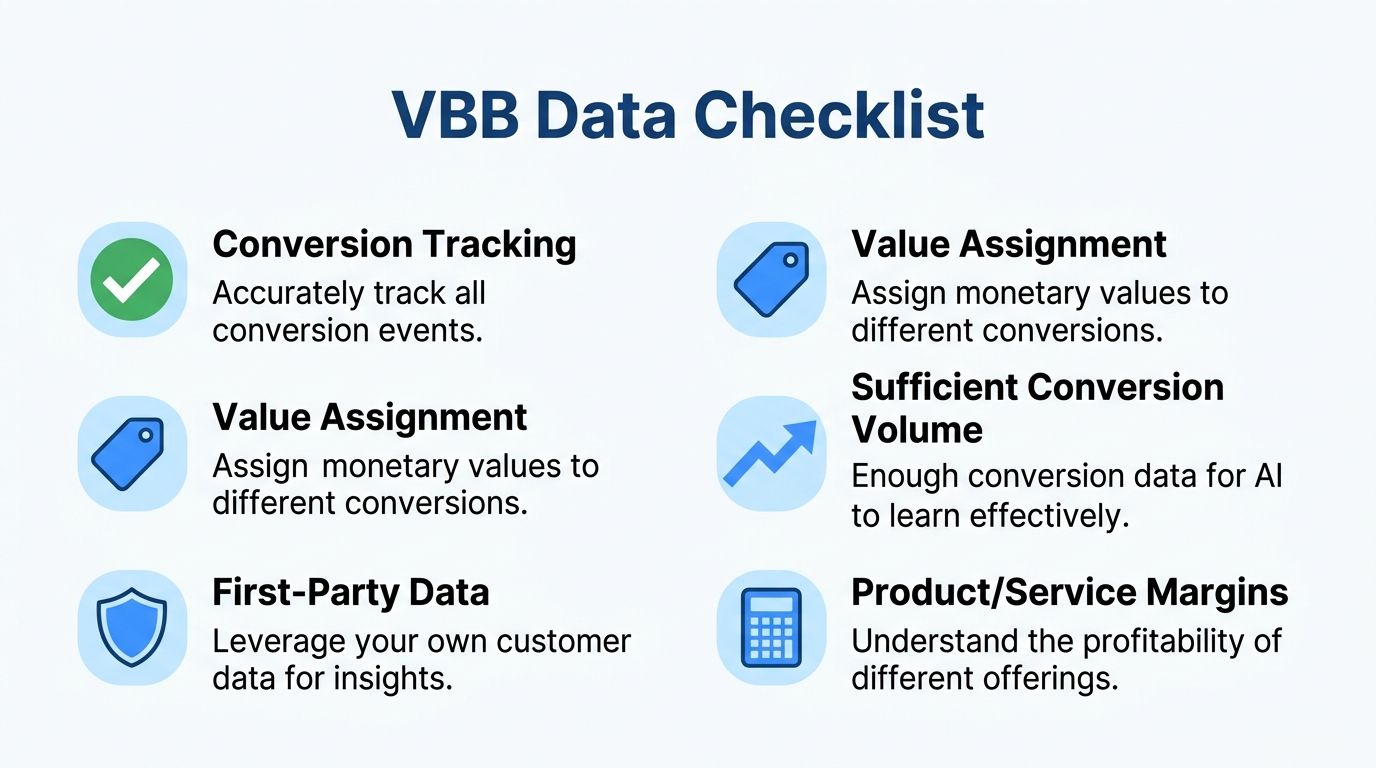
Value based bidding fails fast when the inputs are sloppy. Google Ads cannot optimize for high-value roofing jobs, emergency plumbing calls, or premium install requests if your account reports every form fill and every phone call as the same thing.
That is the primary gap for local service businesses. It is rarely a lack of AI. It is a lack of usable data.
Core Data Requirements
You do not need enterprise software or a complicated CRM rollout. You need clean signals that reflect job quality.
Start with four inputs:
- Real conversion actions: Track phone calls, booked estimates, and quote requests. Do not feed Google soft actions like page views, time on site, or button clicks that never turn into revenue.
- Different values for different lead types: A water heater replacement lead should not carry the same value as a basic drain cleaning inquiry. A roof replacement quote should outweigh a minor repair form.
- First-party business data: Use the information your team already collects, such as service type, location, call outcome, and whether the lead booked.
- Consistent value rules: Pick a simple scoring method and keep using it. If values change randomly from week to week, bidding gets worse, not better.
For local home service SMBs, that is enough to start. You are not building a data warehouse. You are teaching Google which searches produce the jobs you want.
Simple value models win
Small businesses get stuck here because they assume they need perfect attribution before they can use value based bidding. That thinking burns time and delays progress.
A simple model works fine if it matches business reality. Give higher values to leads tied to bigger revenue, stronger close rates, or better long-term customer value. If you want a smarter way to assign those numbers, learn how to calculate customer lifetime value.
Phone calls deserve special attention. Many plumbers, roofers, HVAC companies, and electricians close their best jobs over the phone, not through long web forms. If call attribution is messy, Google misses the strongest signal in the account. Fix that first with a clear process for tracking phone calls from marketing campaigns.
Bad tracking does not stay in your reports. It gets turned into bidding decisions.
Where local businesses usually break this
The usual problem is not volume. It is signal quality.
A home service company may have plenty of conversions coming in, but the account is often packed with duplicates, spam calls, wrong-number calls, and low-intent form fills. Feed that into value based bidding and the platform starts finding more of the same. That is how SMBs end up paying for "leads" that never become profitable work.
Keep your setup tight:
- Exclude junk conversions wherever possible
- Separate high-intent lead types from generic contact actions
- Use values tied to service value, not admin convenience
- Review what sales staff books, not just what marketing counts
The goal is simple. Give Google enough clean, practical data to tell the difference between a cheap inquiry and a high-value local job. Once that distinction is in place, value based bidding becomes useful for SMBs without adding enterprise-level complexity.
Setting Up VBB for a Local Home Service Business
Let's use a roofing company, because the setup is easier to understand when the money difference between job types is obvious. A new roof quote is not the same as a minor leak repair. If your Google Ads account treats them the same, it will make bad decisions.
Start with service-level values
List the lead types that matter to the business. For a roofer, that could include full replacement quotes, storm damage inspections, repair requests, financing inquiries, and generic contact submissions. Assign relative value based on business importance, close rate, or profitability.
Don't overcomplicate the first version. What matters is that the system can distinguish higher-value opportunities from lower-value ones.
A practical setup might look like this:
- Full replacement quote: Highest value because the revenue potential and business impact are larger.
- Storm damage inspection: Often strong intent and can lead to larger work.
- Repair request: Useful, but not at the same value level as replacement work.
- Generic contact form: Lowest value because intent is less clear.
Clean tracking before you touch bidding
If call tracking is broken, forms double-fire, or every thank-you page counts as the same lead, stop there and fix it. Smart Bidding doesn't correct tracking mistakes. It scales them.
Then build campaigns around high-intent local keywords. Transactional terms like roofer near me, roofing contractor in [city], and emergency roof repair near me deserve their own focused treatment. Seoptimer notes that transactional keywords often include local modifiers such as near me, in [city], and find a store, which is exactly why local service campaigns should be structured around those patterns in its overview of transactional keywords.
If you need the campaign foundation first, this guide on setting up a Google Ads campaign is a practical place to tighten structure before layering in value signals.
Pick the right strategy for the stage you're in
For most local service SMBs, Maximize Conversion Value is the cleanest starting point. It gives Google room to pursue higher-value outcomes without forcing a strict return target too early.
Target ROAS can work later, but only when your values are stable enough to support it. If you launch with aggressive constraints before the account has learned, you choke the campaign.
Start simple. Get the values right. Then tighten efficiency.
Don't ignore maps and landing page alignment
Google Ads does better when the rest of your local presence makes sense. Your landing page should mirror the keyword and service intent. Your Google Business Profile should show the correct service set, real photos, hours, address, and phone number.
For local visibility, businesses need a complete Google Business Profile and explicit local keywords on the website, not vague homepage copy, as described in this Google Maps optimization post on LinkedIn. If your ad says air conditioning repair near me and your page barely mentions the city or service, you're making both search engines and AI systems work harder than they should.
Common Pitfalls to Avoid with Value Based Bidding
Value based bidding does not fail because Google Ads is broken. It fails because local service businesses send bad signals, make changes too fast, and judge success by lead count instead of job value. If you're a roofer, plumber, HVAC company, or clinic running on spreadsheets and call notes, that is still enough to make this work. Sloppy inputs are the core problem.
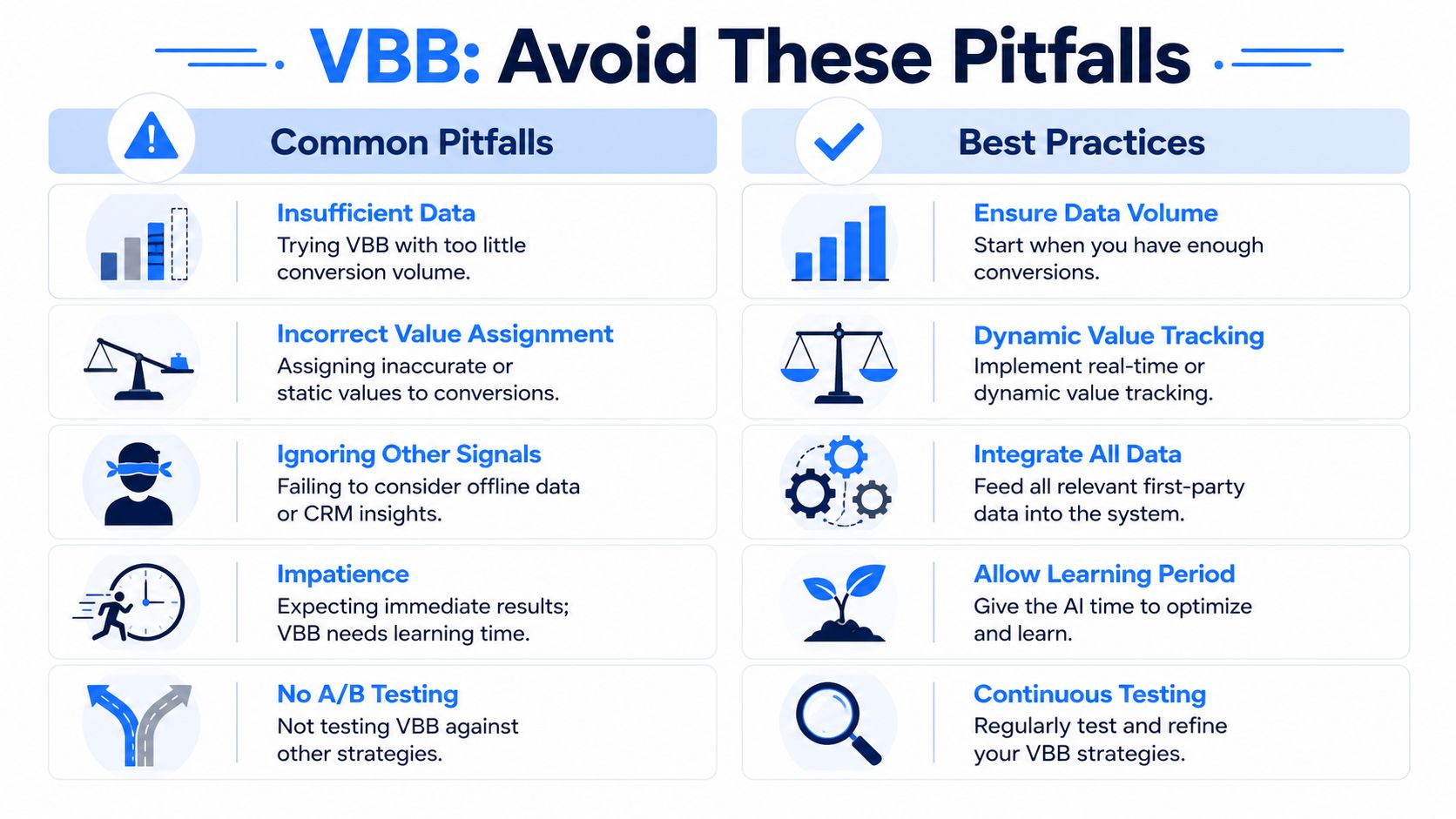
Mistake one is reacting before the campaign has learned anything useful
Business owners love to make a change on Monday and hold a trial by Wednesday. That destroys the test.
Value based bidding needs stable inputs and enough time for real conversion patterns to show up. If your best jobs take days to book, qualify, or close, early results will always look messy. Contractors who keep changing budgets, targets, ad copy, and conversion settings every few days train the system on chaos, then blame automation when performance swings.
Leave it alone long enough to judge it fairly.
Mistake two is telling Google that junk leads are valuable
If you count every form fill, call, page view, and button click as a primary conversion, Google will get you more of exactly that. More noise. More price shoppers. More weak inquiries that waste your office staff's time.
For local service SMBs, the fix is simple. Weight actions by business value, not by ease of tracking. A blocked drain call is not worth the same as a full sewer line replacement lead. A financing application for a roof replacement is not worth the same as a generic contact form.
Use the signals you already have. Service type. Zip code. Call outcome. Estimate booked. Financing selected. These are practical value inputs for businesses that do not have polished CRM setups.
Mistake three is overcomplicating the data requirement
A lot of advice on value based bidding is written for enterprise teams with clean CRM pipelines, offline imports, and analysts babysitting every campaign. That advice is useless for a shop trying to win more profitable "near me" searches with a dispatcher, a service manager, and a basic intake process.
You do not need perfect data. You need consistent data.
Start with a simple scoring system your team can maintain:
- High-ticket service categories get higher values
- Priority service areas get higher values
- Booked estimates beat unqualified calls
- Repeat customers and maintenance-plan opportunities get more weight than one-off low-margin jobs
If you want a better way to think about long-term lead quality, this guide to customer lifetime value for contact centers is useful. The principle applies here. Some leads are worth more because they produce more revenue over time, not because they were cheap to acquire.
Mistake four is using the wrong scoreboard
A campaign can produce more leads and still get worse. That happens all the time in home services.
If spend goes up and all you got was more tire-kickers, the account did not improve. If click volume jumps but booked jobs stay flat, nothing meaningful happened. If cost per lead falls while average job value falls faster, you lost money.
Track profitability first. Then use support metrics underneath it. If your reporting is still stuck on cheap lead counts, fix that with a proper cost per acquisition calculation for Google Ads, then compare it against revenue quality, close rate, and average job size.
Mistake five is changing too many variables at once
In this context, smaller advertisers waste months.
They launch value based bidding, rewrite ads, swap landing pages, change match types, and reset budgets in the same week. Then they have no idea what caused the result. Keep the test clean. If you are evaluating bidding, do not run five other experiments at the same time.
The businesses that win with value based bidding are usually boring. They define what a valuable lead looks like, score it consistently, and stay disciplined long enough for the account to optimize toward better jobs. That is how a local service company beats bigger competitors without enterprise software.
Measuring Success with the Right KPIs
Once value based bidding is live, stop grading the account like a traffic campaign. Cost per click is a minor detail. Raw lead count can mislead you. The scoreboard needs to reflect money, service mix, and close quality.
The KPI stack that matters
Track performance in this order:
- Conversion value: Are your campaigns generating more total business value, not just more actions?
- ROAS: Is spend producing the return you need from paid search?
- Qualified lead mix: Are more of your leads tied to the services you want?
- Booked jobs or patients: Did the campaign create real revenue opportunities?
- Cost per acquisition: Use it carefully, and only alongside value metrics. This guide on how to calculate cost per acquisition is useful if your current reporting is still too lead-count focused.
Look beyond the first conversion
Some service businesses still undervalue repeat business, referral potential, maintenance relationships, and higher long-term patient value. If you want a better framework for that, this resource on customer lifetime value for contact centers helps connect front-line lead handling to longer-term revenue value.
A simple rule works well here. If a campaign sends more of the right kind of customer into the business, it's winning. If it sends more noise, it's not.
Good measurement closes the loop between search intent, ad spend, and actual booked work.
The businesses that dominate transactional search don't just rank. They align SEO, Google Maps, paid search, and AI optimization around buyer intent. They show up for the searches that matter, and they train Google to value the customers they want.
Transactional LLC helps service businesses build that kind of system. If you want stronger visibility for transactional searches, better Google Maps placement, sharper local SEO, and paid campaigns built to drive profitable jobs instead of empty leads, talk with Transactional LLC.