


At 7:00 a.m., a homeowner finds water spreading across the kitchen floor. In another house across town, the air conditioner stops working during a hot afternoon. Both people reach for a phone and search for a nearby professional. They aren't looking for a general plumbing guide or an explanation of refrigerant systems. They want a company that can help now.
That moment is where plumber HVAC SEO earns its value. The companies that appear for searches such as “plumber near me,” “emergency plumber,” and “air conditioning repair near me” meet customers with money in hand and a problem to solve. Transactional Marketing is built around that kind of search visibility, including Google Maps optimization, service-area targeting, and content designed to help businesses appear where local customers are ready to call.
"Why Transactional Searches Decide Who Gets the Call"
A homeowner researching “how to fix a leaky faucet” is still gathering information. Someone searching “plumber near me open now” has moved much closer to hiring. The first person is window shopping. The second is walking toward the register.
That distinction matters because search engines interpret the words, location, and context of a query. Local transactional searches commonly include action language such as “buy,” “book,” “price,” and “near me,” and those searches should lead to pages that make contacting a provider easy, as explained in this guide to local search intent. For a plumbing or HVAC company, that means a repair query should reach a repair page, not a generic homepage buried beneath company history.
Consider two competing companies during an early-morning burst-pipe emergency. Company A has a detailed Google Business Profile, an accurate service area, recent reviews, and a page specifically about emergency plumbing in the nearby city. Company B has a broad “services” page, an incomplete profile, and no clear indication that it handles emergency calls. Even if both companies do good work, Company A gives Google and the homeowner stronger reasons to choose it.
The practical question isn't “Can we rank for plumbing?” It's “Can we appear when someone in a specific service area is ready to book plumbing?”
Google reports that 46% of all searches have local intent, and 42% of those local searches result in clicks on Map Pack listings, according to HVAC local SEO coverage. HVAC-specific coverage also reports that the Map Pack captures 42% to 44% of clicks and appears on more than 93% of mobile searches for heating and cooling services, which is why Maps visibility deserves more attention than a strategy focused only on traditional organic listings.
This guide treats plumber HVAC SEO as a revenue system. It starts with transactional intent, then moves through Google Business Profile optimization, service-city content, reviews, technical structure, AI and LLM discoverability, and measurement. The objective is clear: show up for the exact searches customers use when they need a plumber or HVAC contractor in a real location.
For a broader explanation of how search terms work, review what search queries are, then apply that thinking to the services and cities your company serves.
"Understanding Transactional Intent for Plumbing and HVAC"
Search intent describes what a person wants to accomplish. It turns a string of words into a business opportunity.
A useful way to understand intent is to compare search behavior with a store visit:
- Window shopping: “How do I unclog a bathroom drain?” The searcher wants information and may solve the issue alone.
- Walking to the register: “Plumber near me open now.” The searcher is comparing nearby providers and availability.
- Pulling out a wallet: “Emergency HVAC repair cost.” The searcher is thinking about booking and wants enough information to make a decision.
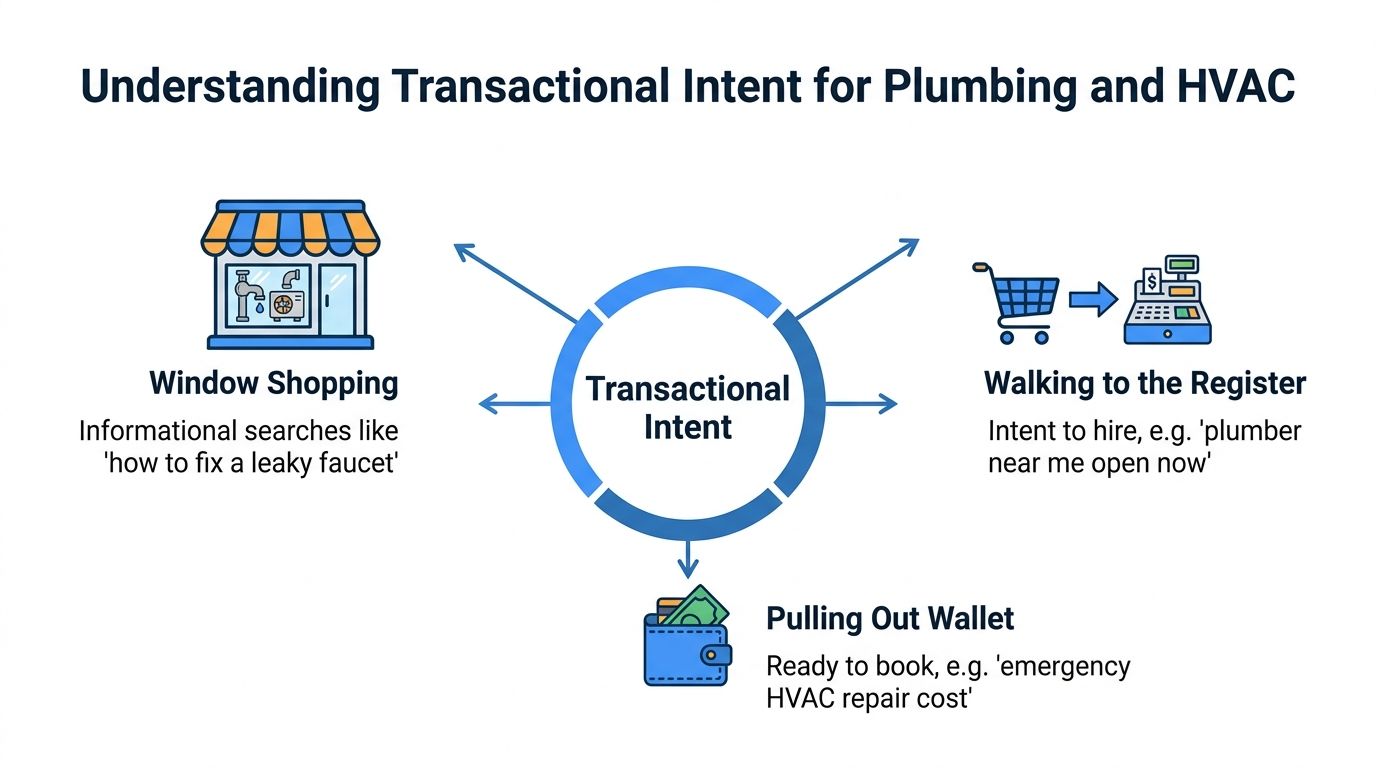
The page should match the stage. An educational article can answer a maintenance question. A service page should explain what the company repairs, where it works, what happens after contact, and how to request service. A location-specific emergency page should remove friction with a visible phone number, service area, hours, and a direct booking path.
Match the query to the page
Start by grouping search terms into three practical buckets:
- Informational searches need useful explanations, maintenance advice, and troubleshooting guidance. These pages can introduce a company, but they shouldn't pretend every reader is ready to call.
- Commercial investigation searches need comparisons, service options, warning signs, and decision support. A homeowner may be evaluating repair versus replacement.
- Transactional searches need a focused landing page, clear service coverage, trust signals, and a next step. “AC repair near me” should lead to an HVAC repair page for the relevant service area.
A plumber might build pages for drain cleaning, water heater repair, sewer line repair, and emergency plumbing. An HVAC company might separate air conditioning repair, furnace repair, heat pump service, and system replacement. Each page should answer the question behind the query instead of swapping a city name into identical copy.
AI assistants and LLMs also need clear signals. Search guidance for local businesses recommends structured, intent-aligned content, consistent business details, specific service and location pages, and conversational language that resembles questions people ask assistants. A contractor evaluating AI visibility can also use Snyp for contractors as a resource for organizing customer-facing information and local service details.
A ranking is useful only when the page answers the searcher's next question.
If someone asks an assistant, “Who fixes my AC near me tonight?”, the business needs more than a keyword. It needs consistent service information, accurate location data, understandable pages, and evidence that it serves that area.
"Mastering Google Business Profile and Google Maps Visibility"
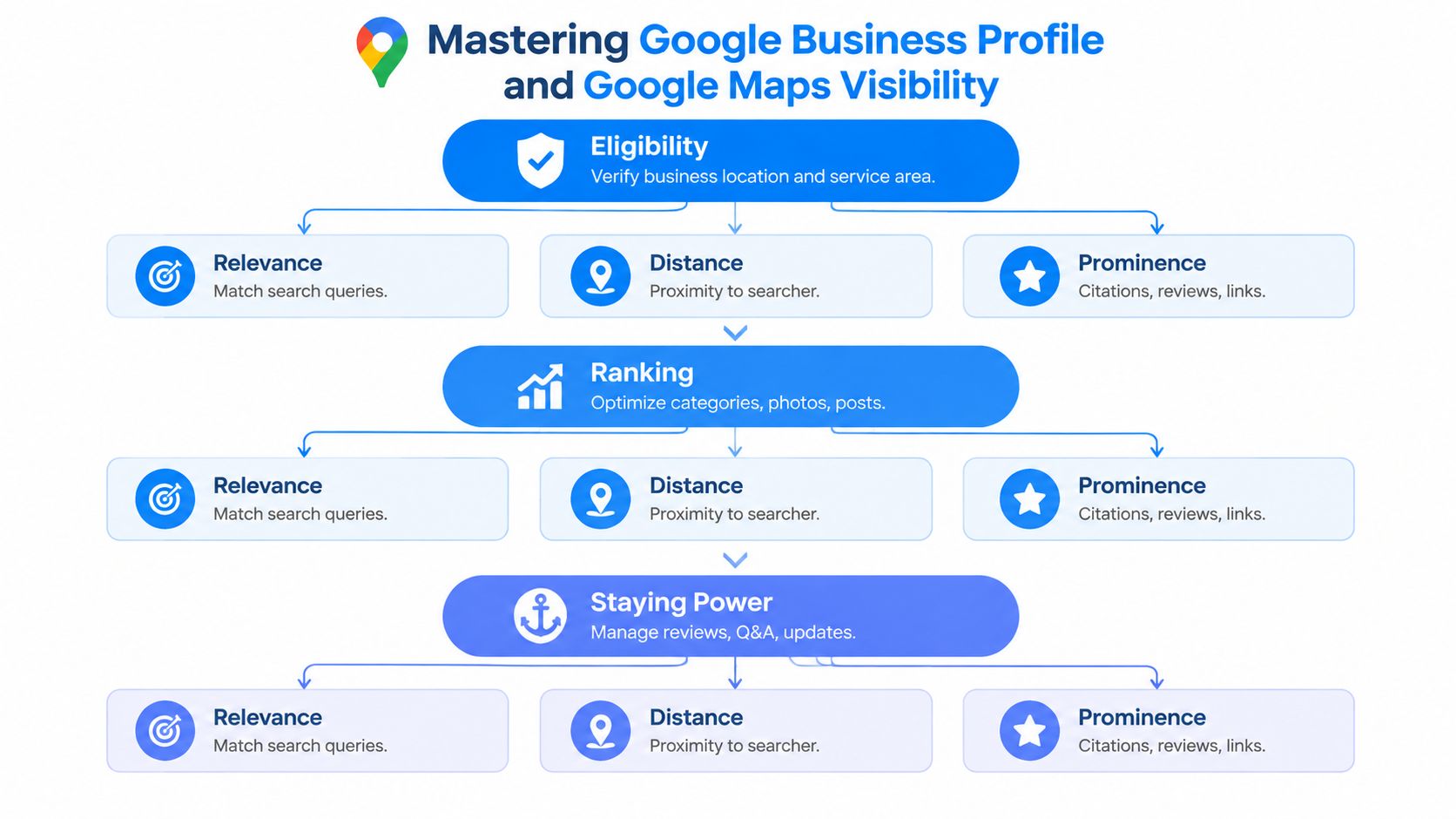
Google Maps is often the first place a homeowner sees a plumbing or HVAC company. A profile can be eligible for local visibility, rank competitively, and continue earning attention only when the business maintains all three layers.
Google's officially stated local ranking factors are relevance, distance, and prominence, as summarized in this Google Maps local pack guide. Relevance asks whether the profile fits the search. Distance considers how close the business is to the searcher. Prominence reflects how established and trusted the business appears online.
Start with eligibility
A profile that doesn't clearly communicate what the company does may struggle before distance or reviews can help. Check the fundamentals:
- Primary category: Choose the category that best represents the main business.
- Services: List actual plumbing or HVAC services in plain language.
- Hours: Keep regular, emergency, and holiday availability accurate.
- Service area: Configure the cities and areas the company serves.
- Business details: Keep the name, phone number, website, and address consistent.
- Photos: Add real teams, vehicles, equipment, completed work, and the service location where appropriate.
The profile should read like a clear storefront sign. “Plumbing contractor serving [city]” communicates more than a generic description with no service or location context.
Independent local SEO guidance places Google Business Profile signals at roughly 32% to 36% of local pack weighting, ahead of individual on-page, review, and citation signals, according to local SEO guidance for HVAC and plumbing companies. Another independent summary places GBP signals at about 32%, on-page website signals at about 33%, and review signals at about 16%, showing that Maps visibility depends on a combined system rather than a single setting, as outlined by local pack ranking research.
Then build ranking strength
A complete profile improves relevance and eligibility. Reviews, photos, updates, and consistent activity help support prominence. Distance can't be changed for every searcher, but a tightly matched profile can compete more effectively when Google evaluates nearby businesses.
Transactional Marketing offers Google Maps optimization and profile setup as part of its local SEO work. Any provider should explain what it will change, how it will measure visibility, and which service-city searches matter before promising results. A practical reference for service-area business fundamentals is the MD TECH TEAM local SEO playbook.
This Google Business Profile optimization guide provides another checklist for improving the profile itself. Use it alongside regular checks for category alignment, service descriptions, photos, questions and answers, and customer feedback.
"Building Service City Content Silos That Rank Without Duplication"
A plumbing or HVAC website can serve several cities without publishing dozens of pages that say the same thing. The difference is whether each page provides a real reason for a resident of that location to find it useful.
Search volume already supports focused local strategies. Industry sources cite nearly 180,000 monthly U.S. searches for “plumber near me,” while a home-services benchmark lists roughly 110,000 monthly “near me” HVAC searches and roughly 180,000 monthly plumbing searches, as reported in this local SEO guide for plumbers, electricians, and HVAC companies. Those broad terms matter, but a company still needs a structure that connects the service to the city and the customer's situation.
Use a hub and spokes
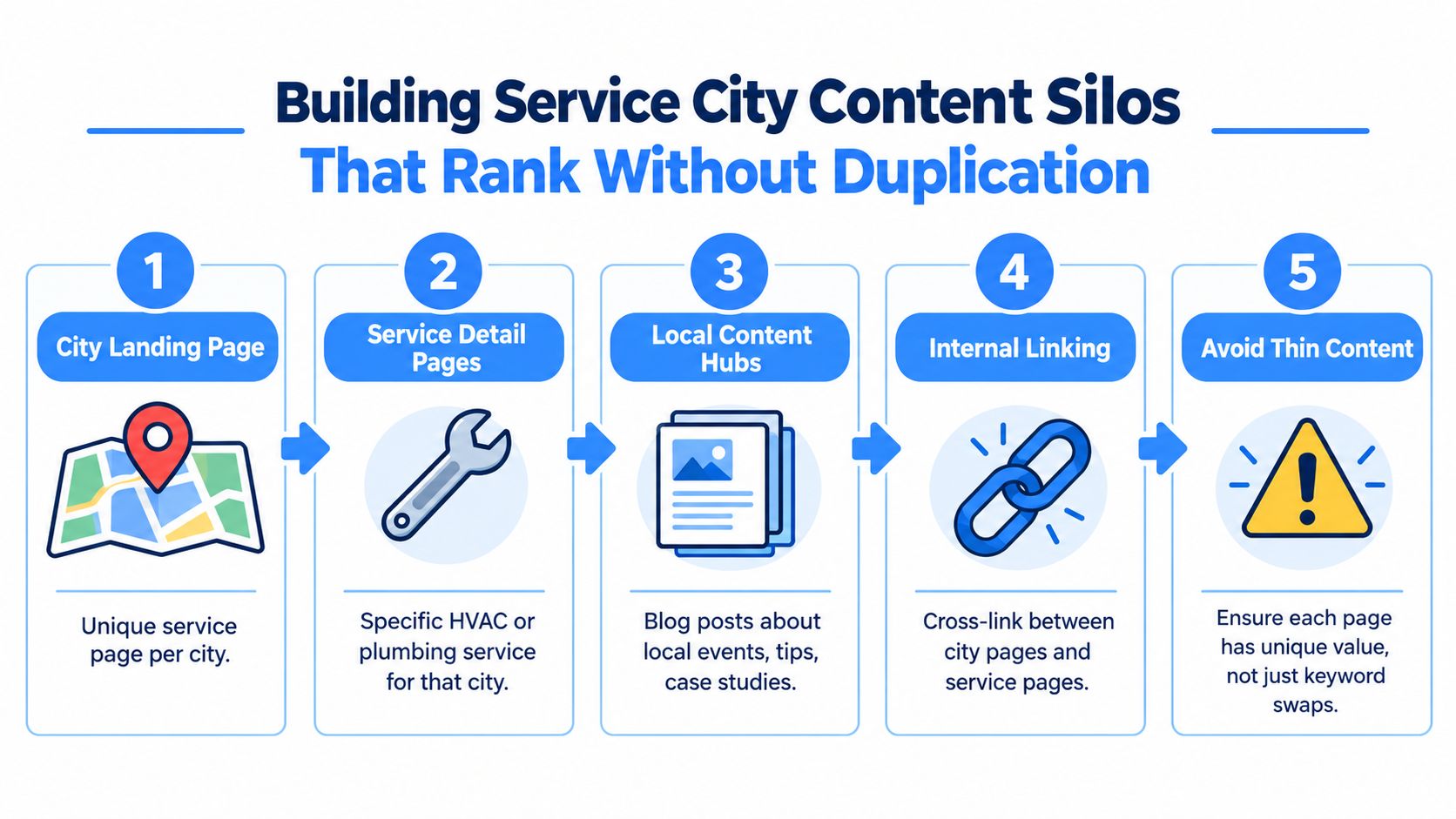
The hub is the main service page, such as “Air Conditioning Repair.” Spokes are focused pages such as “Air Conditioning Repair in [City]” or “Emergency Plumbing in [City].” Internal links connect the hub, city pages, and helpful local articles so visitors and search systems can understand the relationship.
A strong city page can include:
- The specific services offered in that area.
- Neighborhoods or ZIP areas the team regularly reaches.
- Common local property types or service conditions, when the company can describe them accurately.
- Photos from genuine work in the area.
- A clear call option and service request form.
- Answers to questions local customers ask.
Don't create a new page every time a keyword tool suggests a slightly different phrase. Create one when the service, location, customer need, or business coverage changes enough to justify unique information. If a city page has no local details, no relevant internal links, and no distinct conversion path, expand a stronger existing page instead.
Give every page a job
An HVAC city page should help a resident decide whether to call for repair, maintenance, or replacement. A plumbing city page might focus on emergency response, drain problems, water heaters, or sewer work. The page doesn't need artificial filler. It needs accurate information that supports a real decision.
Use consistent headings and business facts, but write original copy for each location. This structure helps humans use the site and gives AI systems clearer connections between service, geography, and intent. The service-area page guide offers additional direction for deciding how to organize those pages without creating thin location content.
"Citations Reviews and Local Links That Build Prominence"
Maps visibility depends partly on whether Google sees the business as established and trustworthy. Citations, reviews, and local links contribute to that picture, but they do different work.
Citations confirm business identity. The name, address, phone number, website, and service details should match across relevant directories and industry profiles. A citation isn't a substitute for a useful website or a strong Google Business Profile. It supports consistency.
Reviews show customer experience and ongoing activity. A star rating matters, but so do volume, recency, owner responses, and the language customers use to describe services and locations. A review that naturally mentions water heater repair in a served city can provide more context than a vague compliment.
Build reviews into the job workflow
The easiest review process happens immediately after service, while the customer remembers the technician and the outcome.
- Close the job and confirm the customer is satisfied.
- Send one direct review request through the company's normal follow-up process.
- Make the Google review link easy to use.
- Respond to the review in a personal, professional way.
- Record negative feedback privately and route it to the person responsible for resolution.
A 2026 home-services guide reports that contractors with 200 or more reviews rank about three times more often in the local pack than those with 50, and it emphasizes that review velocity can matter more than a larger but stale total, as explained in this local SEO ranking factors guide. Treat that as an operational benchmark, not a guarantee. The durable practice is steady, honest review acquisition rather than occasional bursts.
Earn local links naturally
A supplier, trade organization, neighborhood association, community event, or local business network may provide a relevant opportunity to earn a link. The relationship should exist for a reason beyond SEO. A plumbing company can contribute practical information to a local housing resource, while an HVAC company might participate in a community program that already maintains a legitimate online presence.
Avoid networks that exist only to exchange low-quality links. Prominence grows more reliably when business references, customer feedback, and local relationships reinforce the same real-world identity. Use this citation-building resource to audit consistency and identify missing business listings.
"Technical SEO and AI Optimization for Modern Local Search"
Technical SEO makes a website easier to use and easier for search systems to interpret. AI optimization applies the same principle to assistants and LLMs. A system should be able to identify the company, its services, its service areas, and the evidence supporting those claims without sorting through vague or contradictory pages.
Start with the visitor's phone. Plumbing and HVAC searches often happen during stressful situations, so a page should load efficiently, display the phone number clearly, and make the contact action obvious. Forms should work on mobile, headings should explain the page, and important service information shouldn't be hidden inside images.
Organize the information clearly
Use structured data where it accurately describes the business and its services. Local business and service schema can help systems interpret information, but markup can't compensate for inaccurate content. Keep the company's name, address, phone number, hours, and service areas consistent throughout the site and its profiles.
Internal links should reflect the content silo. A main HVAC service page can link to repair pages and relevant city pages. A city page can link back to the service hub and to useful questions for local homeowners. This structure gives Google and AI systems a readable map of the website.
Conversational queries deserve direct answers. A homeowner might ask, “Who repairs AC near me tonight?” or “Which plumber serves my neighborhood?” Pages should answer those questions with clear service, location, availability, and contact information. Avoid writing for an imaginary algorithm. Write facts that a person can verify and an assistant can summarize accurately.
Use AI without surrendering accuracy
An AI content engine can help plan article topics, group related services, and draft conversion-focused pages. It still needs verified company facts and human review. Never allow an LLM to invent licensing information, prices, response times, guarantees, service areas, or customer stories.
Transactional LLC combines local SEO, Google Maps work, website services, and an AI-driven content engine that organizes service and location silos. The important evaluation question is not whether a provider uses AI. It's whether the resulting pages remain specific, accurate, useful, and aligned with transactional searches.
"Tracking What Matters and Turning Rankings Into Booked Jobs"
A ranking report can look impressive while the phone stays quiet. Plumber HVAC SEO should connect visibility to actions, starting with the search terms that show commercial intent in each service city.
Track the journey from search to job:
- Search visibility: Monitor target service terms by city and review organic and Map Pack movement over time.
- Map performance: Use local ranking heat maps to see where the profile appears and where coverage is weak.
- Search behavior: Review Search Console queries to find the language people use.
- Lead quality: Separate calls, forms, booked appointments, and unqualified inquiries.
- Revenue context: Compare organic lead economics with paid search and Local Services Ads as paid conversion costs rise.
Recent industry reporting describes increasing home-service demand alongside higher cost per conversion, while a 2026 local SEO summary claims Map Pack visibility captures 44% of clicks and mature organic local SEO leads can cost $18 to $30 each, according to home-service search and local SEO reporting. Those figures make target selection an economic decision. A high-volume phrase isn't automatically the best target if it produces weak calls, poor margins, or jobs outside the company's profitable service area.
Use the first 30 to 60 days well
Begin with profile accuracy, tracking setup, priority service pages, and the cities that matter most. Then improve the pages and profile based on search data, customer questions, call recordings, and booking outcomes. A dashboard with keyword timelines, map heat maps, Search Console queries, traffic, and biweekly reporting keeps the work tied to decisions instead of vanity metrics.
Common blockers include duplicate city pages, inconsistent business details, unanswered reviews, unclear service areas, slow mobile pages, and calls that reach voicemail. Fixing those leaks can matter as much as publishing another article.
The goal isn't to collect rankings. It's to make the right business visible for a customer who needs a plumber or HVAC contractor now, then make calling and booking simple.
Transactional LLC offers plumber and HVAC SEO focused on transactional service-city searches, Google Maps optimization, website development, and AI-driven content planning for local businesses. Visit Transactional LLC to discuss how your company can build stronger visibility for searches such as “plumber near me” and “air conditioning repair near me.”