


Google Maps and organic search account for 23.2% of new-patient attribution for dental practices, while 51.5% spend under $500 per month or nothing at all on marketing. That gap is where focused dental marketing services can turn high-intent searches into booked appointments.
A practice can deliver excellent clinical care and still lose a patient before the first phone call. Someone searches for “dentist near me” from a mobile phone, scans the map results, compares reviews, and contacts the office that appears credible and convenient. If your practice is missing from that decision, a referral from last month won't recover the appointment today.
Transactional Marketing approaches dental growth through that specific moment. The priority isn't vague awareness or traffic that never produces a conversation. It's visibility for searches such as “emergency dentist near me,” “dental implants in [city],” and “dentist near me”, followed by a clear path to call, book, or request an appointment.
Why Dental Practices Miss Patients in the Search Results
A practice can have open appointment slots, satisfied patients, and years of clinical experience, yet lose a new inquiry before the first call. A nearby patient searches Google Maps, sees other dentists first, and contacts one of them before discovering your office.
The decision often happens quickly. Patients compare location, availability, reviews, accepted services, and a phone number they can tap. An incomplete Google Business Profile, a service page that does not match the search, or a booking form that fails on mobile can remove the practice from consideration within seconds.
That makes search visibility a booking issue, not a branding exercise. 77% of patients use search engines before booking, and 86% contact a dentist after searching, according to dental patient search research. A patient who has already searched is evaluating which practice can meet the need now. The marketing task is to make that choice easy.
Referrals remain valuable, but they aren't enough
Referrals carry trust, but they depend on an existing patient remembering the practice and making a recommendation at the right moment. Someone with a cracked tooth, a new insurance plan, or an urgent treatment need may search immediately instead of waiting for a personal introduction.
The 2026 dental practice survey found that 65.6% identified word of mouth and patient referrals as their top source of new patients, down from 77.5% in 2025. It also reported Google Business Profile organic visibility as the top channel for 15.6% of practices and Google Ads as the top channel for 7.6%. The findings appear in MouthWatch's dental practice marketing survey.
Practical rule: Referrals create demand, while local search captures patients who are actively looking.
Test the patient path from the areas your practice serves. Search priority treatments, inspect the map results and organic listings, open the relevant service page, and call the office from a phone. Check whether the information answers the immediate question and whether booking takes one obvious next step.
If the practice is missing from Maps, review why a business may not be showing up on Google Maps before increasing ad spend. Paying for more clicks will not fix an inaccurate profile, weak service relevance, or a broken contact process.
Dental marketing services should improve the full route from search to appointment. A ranking has value only when it supports a relevant page, credible proof, and a clear way to call, book, or request care. Visibility is the starting point. The commercial result is a patient who can find the practice and act without friction.
The Three Pillars of Modern Dental Marketing Services
Patients do not book from visibility alone. They book when a search result confirms the right service, location, credibility, and next action. Effective dental marketing services connect Google Business Profile optimization, dental SEO, and AI optimization so each channel helps move a suitable patient toward a call or appointment.
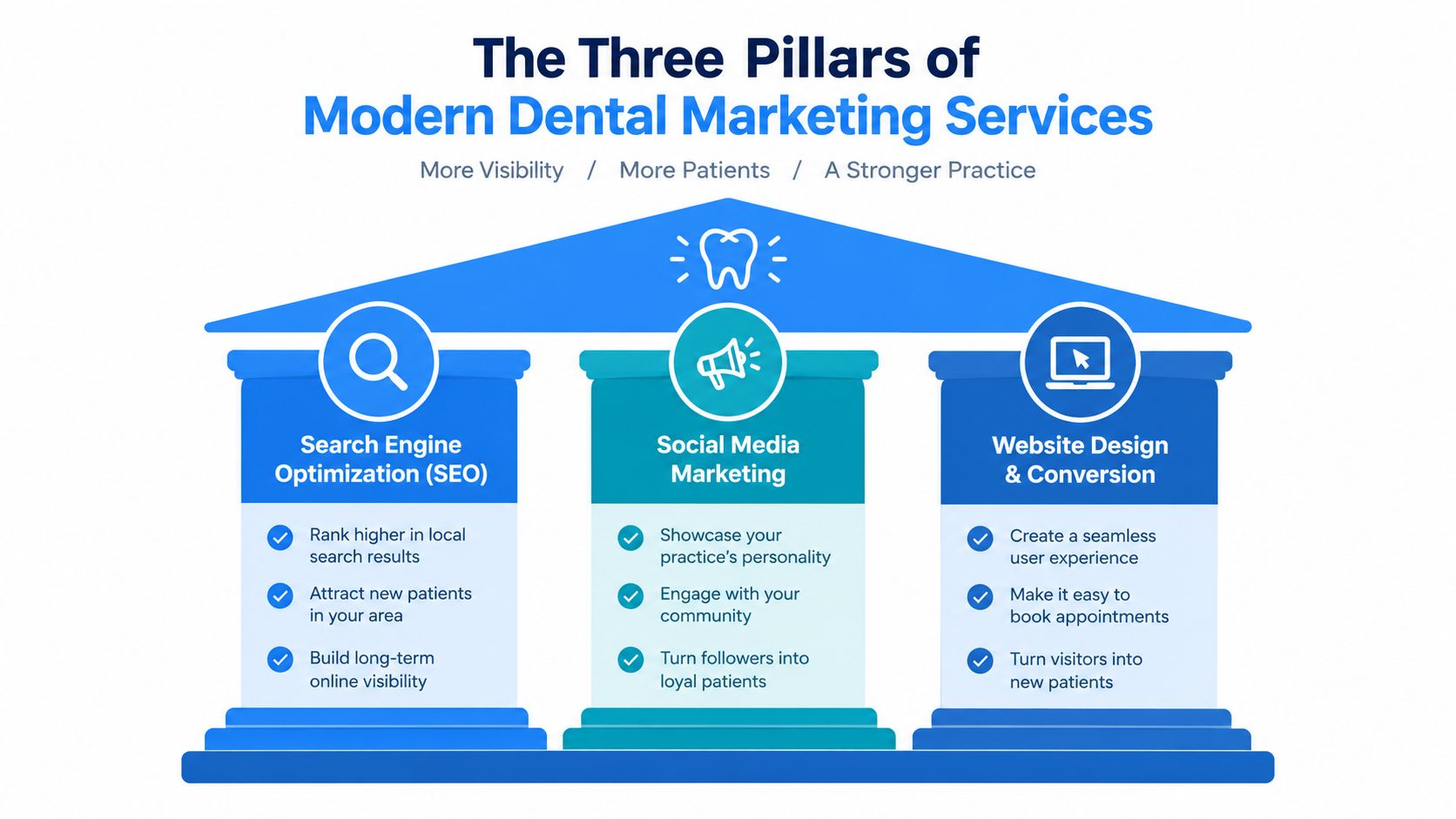
Google Business Profile optimization
A Google Business Profile often provides the first practical impression of a dental office. Its category, services, address, hours, photos, reviews, and appointment link should describe the practice accurately. If emergency care, implants, orthodontics, or cosmetic dentistry are missing, Google has less context and patients have less information for choosing the practice.
Local visibility depends on relevance, distance, and prominence, as outlined in Google Maps local ranking guidance. Accurate service details, consistent business information, useful updates, and an ethical review process can strengthen relevance and prominence. Distance cannot be changed through optimization, so service areas and location targeting must match where the practice can serve patients.
Dental SEO for service demand
Organic SEO gives high-intent patients more detail than a map listing can provide. A dental implants page should address treatment questions, suitability, proof, and booking options. An emergency dentistry page needs different information and a faster route to contact. Each page should match the patient's problem, the treatment offered, the service area, and the next action.
Search visibility can expose an underfunded opportunity for practices that rely mainly on referrals or occasional advertising. The practical lesson is not to chase every channel. Build focused pages and profiles that support appointment demand, then maintain them consistently rather than treating optimization as a one-time edit.
Social content can reinforce familiarity and reputation between visits, but engagement is not the same as booked care. These dentist social media growth tips can help teams plan useful visual content while keeping social activity tied to clear service and contact paths.
AI optimization and entity clarity
AI systems need dependable information about who the practice serves, where it operates, which treatments it provides, and why patients may trust it. Keep those details consistent across the website, Google Business Profile, professional directories, review platforms, and relevant third-party sources.
Transactional marketing applies the same discipline to AI discovery. A practice should be described clearly enough for an AI-generated recommendation to connect a patient's need with the correct provider, location, treatment, and booking route. Each pillar works toward that commercial outcome: a qualified patient reaches the office and can act.
Targeting Transactional Search Terms for Dental SEO
Not every dental search carries the same commercial value. “How often should I floss?” is informational. “Dentist near me accepting new patients” signals a much shorter path to contact. Both queries can matter, but they belong to different stages and should not receive the same budget or conversion treatment.
Transactional search intent describes queries where the user is ready to take action now, including searches containing “near me” or a service combined with a location, as explained in this guide to high-intent local search paths. In dental SEO, examples include:
- Immediate care: “emergency dentist near me”
- Service demand: “dental implants in [city]”
- Provider selection: “cosmetic dentist near me”
- Availability: “dentist accepting new patients [city]”
Informational traffic versus appointment intent
Informational content answers questions and can build trust before a patient is ready to schedule. It may explain the difference between a crown and an implant, describe what happens during a root canal, or address anxiety about treatment. Those pages should guide readers toward relevant services, but their primary purpose is education.
Transactional pages need a different structure. The service must be clear near the top, the location must be credible, and the next action should be obvious. A patient searching for an emergency dentist shouldn't have to sift through a general blog to find the phone number or discover whether urgent appointments are available.
| Search type | Patient need | Appropriate page response |
|---|---|---|
| Informational | Understand a treatment or symptom | Helpful explanation, FAQs, internal links |
| Commercial investigation | Compare providers or treatments | Credentials, reviews, process, service detail |
| Transactional | Call, book, or visit now | Local proof, availability, phone and booking options |
Build pages around the decision
A strong page isn't a list of repeated keywords. It answers the questions that prevent a patient from contacting the office. Include the treatment area, the communities served, what the first visit involves, who the service is suitable for, and how to request an appointment.
The page also needs a reliable internal linking structure. A general dental SEO campaign can connect emergency care, restorative dentistry, implants, cosmetic services, and location pages so search engines and patients can understand the practice's coverage. A focused dental SEO service approach should then measure whether those pages produce calls, forms, and booked patients, not merely impressions.
Transactional Marketing is named for this intent. The objective is to help a dental practice appear when a person is searching with a specific need and is prepared to spend money on care. Ranking for broad awareness terms can be useful, but a practice with limited resources should first protect the searches closest to an appointment.
Mastering Google Business Profile for Dental Practices
A Google Business Profile needs operational attention, not just an initial setup. Patients use it to decide whether the office is nearby, credible, open, and relevant to the treatment they need. Google uses profile and wider local signals to determine which practices deserve visibility for a query.

Start with accuracy and relevance
Google describes local visibility through relevance, distance, and prominence. Relevance means the profile and website match the patient's query. Distance reflects the relationship between the searcher and the practice. Prominence reflects the strength and recognition of the business across available signals.
Begin with the primary category. Choose the category that most accurately represents the practice, then add appropriate secondary categories without turning the profile into a keyword list. Complete the services section with plain descriptions of the treatments provided.
A practical profile workflow looks like this:
- Verify the core identity: Match the practice name, address, phone number, hours, website, and appointment URL across the profile and website.
- Clarify the treatment range: Add accurate services, treatment descriptions, accessibility details, and relevant attributes.
- Improve the visual proof: Use current photos of the exterior, reception area, treatment rooms, team, and patient-facing experience.
- Create a review process: Ask satisfied patients for honest feedback and respond professionally without revealing private health information.
- Monitor changes: Check suggested edits, duplicate listings, suspensions, unanswered questions, and shifts in map visibility.
Reviews need a compliant process
Reviews can influence a patient's confidence before the patient visits the website. The request should be simple and neutral, and the team shouldn't pressure patients to mention a particular treatment or provide misleading feedback. Responses should thank the reviewer without confirming private details.
The profile's primary category, services, reviews, NAP consistency, and completeness all contribute to how Google and patients interpret the listing. Guidance on how to optimize a Google Business Profile offers a useful reference for turning those fields into a repeatable workflow.
Map rankings also need to be evaluated from the places where patients search. A practice may appear prominently near its address and much less prominently in another part of the service area. Use local rank tracking and call data together, because a map position is only valuable when it supports real patient actions.
This overview shows how profile work fits into a broader local-search process.
Avoid promises that ignore the market
No ethical provider can guarantee a permanent top-three position for every query and every neighborhood. Google evaluates local results dynamically, and distance is one of the factors outside a marketer's direct control.
The right target is a measurable improvement in relevant coverage, supported by accurate listings, useful service pages, credible reviews, and a booking process that works. Track map visibility by service and area, then connect that information to calls and appointments.
Integrating AI Optimization into Dental Marketing Strategies
AI visibility starts with information that can be trusted and connected. A dental practice should make it easy for search engines and AI systems to identify its services, clinicians, locations, credentials, patient experience, and areas of expertise. The practice's website is the primary source, but it isn't the only source that shapes discoverability.
AI visibility is increasingly tied to first-party authority and discoverability across owned and third-party platforms, according to analysis of brand visibility in the AI age. In practical terms, a polished homepage won't compensate for inconsistent directory information, thin service pages, or a reputation that appears disconnected across platforms.
Make the practice easy to understand
AI optimization isn't about stuffing pages with phrases or writing content for a machine instead of a patient. It means organizing facts so both audiences can interpret them:
- Define services precisely: Separate emergency dentistry, preventive care, implants, orthodontics, and cosmetic procedures into appropriate pages.
- Strengthen first-party evidence: Explain clinician expertise, treatment processes, service areas, and patient logistics in plain language.
- Maintain external consistency: Keep practice details aligned across Google, professional directories, review platforms, and relevant community sources.
- Answer real questions: Build FAQs and treatment explanations around the concerns patients raise before calling.
An AI visibility strategy for growth teams can provide a broader framework for thinking about first-party content and external discoverability. For dental practices, the work should remain grounded in accurate healthcare information and a clear patient journey.
Reputation and content reinforce each other
A service page says what the practice offers. Reviews and third-party references help establish whether patients and other sources recognize that offering. Those signals should not contradict each other. If the website describes advanced implant care but the profile lacks the service, the information system has less confidence about the practice's relevance.
The same applies to local entities. Use consistent names, locations, provider details, and service language across the website and listings. Then review how AI-generated answers describe the practice, looking for omissions or inaccurate associations. A focused AI search engine optimization strategy should improve the underlying information architecture, not chase every new interface with isolated content.
Measuring ROI Beyond Vanity Metrics in Dental Marketing
Likes, impressions, and sessions can indicate activity without proving profitability. A dental practice needs to know which marketing source produced a new patient, what that patient cost to acquire, whether the appointment occurred, and whether the relationship generated lasting value.
Independent guidance on dental marketing ROI recommends tracking total spend, new patients acquired, cost per new patient by channel, inquiry volume, conversion rates, and patient lifetime value. Yet only 31% of dental practices reportedly track LTV, according to guidance on measuring dental marketing ROI.
Start with the booked-patient path
A report should connect marketing activity to the office's actual workflow:
- Source: Identify whether the inquiry came from Maps, organic search, paid search, referral, email, or another channel.
- Contact: Record calls, forms, chats, and missed calls, while protecting patient privacy.
- Outcome: Mark whether the inquiry became a booked appointment, a completed visit, or an unconverted lead.
- Economics: Compare channel spend with the value of the patients it produces over time.
Call tracking can help distinguish campaign phone numbers, but it shouldn't become the final metric. A call that reaches voicemail isn't equivalent to a booked new-patient appointment. Likewise, a form submission that receives no response is not a marketing success.
Measure the appointment, not just the attention.
The same source reports that average patient acquisition costs often range from $250 to $450, which makes channel-level measurement especially important. Those figures are not a universal price list. They are a reason to examine whether a campaign's acquisition cost fits the value and retention profile of the patients it attracts.
Referrals may outperform expensive channels
Paid search can capture urgent demand quickly, but it isn't automatically the most profitable channel. Referrals and email can cost less to acquire than paid search or SEO, particularly when a practice already has a strong patient relationship and a disciplined recall process.
That doesn't make paid search or SEO unnecessary. It means each channel should have a defined job. Paid search can support immediate transactional terms, SEO can build durable service visibility, Maps can capture nearby demand, and referrals can generate trusted introductions. Compare them using booked patients and lifetime value rather than assuming the channel with the most clicks deserves the largest budget.
A useful dashboard includes service, city, search visibility, calls, appointment requests, booked patients, spend, acquisition cost, and LTV when available. This turns dental marketing services from a monthly activity report into a decision system.
Choosing the Right Dental Marketing Partner for Growth
A suitable partner should name the transactional searches it will target, explain how it will improve Google Business Profile visibility, and show how service pages support booked appointments. Ask how calls, forms, and appointments are attributed. Reports focused only on impressions or rankings hide whether patients reached the practice.
Review contract terms, response times, account access, privacy practices, content ownership, and local reporting methods. The partner should prioritize high-intent services, connect Maps visibility with appointment outcomes, and recommend budget changes based on results. Local search can influence new-patient decisions, so focused investment in transactional visibility offers more value than activity reports alone, as noted in the 2026 dental marketing survey.
Transactional LLC provides industry-specific local SEO, Google Maps optimization, website support, paid campaigns, and an AI-driven content engine for service businesses. Its reporting covers search visibility and lead activity. Visit Transactional LLC to discuss a dental marketing plan built around calls, appointments, and measurable local growth.