


A garage door company can have a full schedule and still lose valuable opportunities before the first technician reaches the truck. The phone rings while the owner is measuring an opening, a web form lands while the dispatcher is coordinating an install, and a homeowner searching “garage door repair near me” calls the next business after waiting through voicemail.
That gap matters because garage door demand is both local and intent-driven. The U.S. overhead and garage door market is projected to exceed $19.6 billion in 2026, with more than 114 million garage and overhead doors currently in service, according to FMI's overhead and garage door services sector brief. The opportunity isn't to generate more garage door leads. It's to appear for transactional searches, answer quickly, and route each inquiry according to the job the customer wants.
Why Most Garage Door Companies Lose the Calls Already Coming In
At 9:10 on Monday morning, two technicians are on replacement installs, the owner is driving between estimates, and the office phone rings without an answer. A chat notification waits on the website. An emergency spring-replacement request sits in an inbox beside last week's quote follow-up. The Google Business Profile still displays old project photos and reviews from years ago.
By lunch, the company may have created demand without booking the work. Someone searching “garage door spring replacement near me” is usually deciding whether a provider can help, serves the right area, and can send a technician soon. Searches such as “garage door opener repair” and “emergency garage door service” carry the same buying intent.
Practical rule: Every transactional search needs a response path, not just a contact form.
The first leak is an unanswered phone. A technician may diagnose the issue best, but new inquiries should not depend on that technician being free to answer. The second leak is a web form left untouched until after lunch. The third is a callback made after another company has already confirmed the appointment.
Those failures have different economics. An emergency repair lead can become a booked dispatch quickly, so missed calls and slow callbacks directly threaten the day's revenue. A scheduled installation lead may require measurements, product choices, financing discussions, and several follow-ups. Treating both inquiries as identical creates either rushed estimates or slow emergency response.
Consumer Affairs' garage door industry overview describes a fragmented dealer network, strong residential demand, and the importance of local search in this category. That situation gives focused businesses room to generate high-intent traffic through search, then convert it with dependable response coverage.
A search such as “garage door repair near me” signals a customer looking for a provider, not a general maintenance article. The company needs a service page that matches the query, a clear next action, and someone responsible for the inquiry. A caller should reach a person or receive a prompt confirmation. A form should enter a monitored workflow rather than disappear into a shared inbox.
Set up separate paths for the two buying moments. Emergency repair needs live-answer coverage, quick qualification, service-area confirmation, and a direct dispatch call to action. Scheduled installation needs a useful quote process, project photography, and follow-up that keeps the company in consideration while the homeowner compares options. Visibility only produces garage door leads when the operation is ready to handle the job behind the search.
Winning the Google Maps Pack for Garage Door Searches
Google's local ranking model is commonly organized around relevance, distance, and prominence. For a garage door company, those factors become practical profile decisions rather than abstract SEO language. Relevance improves when the profile clearly represents services such as spring replacement, opener installation, commercial overhead doors, and emergency repair. Distance reflects the relationship between the searcher and the legitimate service location or service area. Prominence grows through reputation, citations, local links, and recognizable business activity.
Start with the Google Business Profile basics. Choose the primary category that best matches the company's main operation, then add accurate secondary services. Build out the service catalog with distinct entries for garage door repair, broken spring replacement, garage door installation, opener repair, and commercial work. Don't force every keyword into the business name. Keyword-stuffing the name can create trust and compliance problems, while a fake address can undermine the profile entirely.
Profile changes worth making this week
- Clarify the service mix: Use descriptions that explain what the company repairs, installs, and services.
- Add real job photography: Upload completed doors, opener installations, trucks, technicians, and before-and-after work from the actual service area.
- Strengthen service coverage: Make each service area clear on the website and profile without pretending to maintain an office where none exists.
- Request reviews at the right moment: A technician can ask after a successful repair, send a direct review link by text, and invite the customer to mention the completed service naturally.
- Reply to every review: Responses should sound human and reference the work performed and the community served, without stuffing repeated phrases.
| Factor | What Google Measures | Action to Take This Week |
|---|---|---|
| Relevance | How closely the profile matches the search and service | Expand accurate service categories and descriptions |
| Distance | Proximity between the searcher and the business or service area | Correct the address and define legitimate service coverage |
| Prominence | Reputation and visibility across local signals | Request reviews, publish real work photos, and earn local citations |
A profile isn't a set-it-and-forget-it asset. Review activity, new photos, accurate hours, and useful answers in the profile's Q&A area help customers decide whether to call. A local landing page for “garage door repair near me” should reinforce the same service details without copying the profile word for word.
For a practical profile implementation guide, use this guide to ranking higher on Google Maps. The central discipline is consistency. The service name, phone number, hours, location information, and promises on the profile should agree with the website and the way the answering team operates.
Building Service-Area Pages That Rank for Transactional Terms
A service-area page should answer one local buying question thoroughly. Consider a page targeting “garage door repair [city name]”. Its purpose is different from a page targeting “emergency garage door service [city name].” The first can cover repairs broadly, while the second should address urgency, live availability, common emergency problems, and the fastest way to contact the company.
A strong page structure makes that distinction clear:
- Unique H1 and opening: Use the city and service in a natural heading, followed by an answer that tells the reader what the company handles and where it works.
- Local relevance paragraph: Mention legitimate neighborhoods, landmarks, and service-area details that help a resident recognize the page as locally useful.
- Trust block: Explain licensing, insurance, warranties, technician experience, and the actual response process.
- Service block: Separate spring replacement, off-track doors, damaged panels, opener problems, and installation where appropriate.
- Quote or booking action: Put a click-to-call button and a clear request form above the fold.
- Proof section: Use real reviews and completed local work, with structured data only when the visible content supports it.
The page shouldn't become a thin doorway page with a city name swapped into identical copy. Add neighborhood-specific evidence, such as a completed repair in the area, a local supplier relationship, or a project type common to the homes being served. That detail gives the page a reason to exist beyond ranking for a modified phrase.
Group terms by customer intent
Keep closely related terms together rather than creating a page for every minor variation. “Garage door repair [city]” can cover general repairs, while “emergency garage door service [city]” deserves its own page when the company has distinct emergency coverage and messaging. A page for opener installation should focus on installation, compatibility, smart features, and booking an upgrade rather than competing with the repair page.
Link the homepage to a service hub, the service hub to core service pages, and those pages to relevant city pages. Use descriptive anchor text such as “emergency garage door service in [city]” when it accurately describes the destination. The service-area page strategy should support visitors first, then make the relationship between service, city, and business unmistakable to search engines.
The page also needs a conversion path that matches the query. Someone searching for an emergency repair shouldn't have to browse a gallery before finding the phone number. Someone researching a replacement needs project photos, material options, warranties, and a quote process that feels more considered.
Paid Ads and Retargeting for Garage Door Leads
Paid channels work best when each one has a defined job. Local Services Ads can capture urgent calls near the top of local results. Google Search campaigns can target specific transactional phrases and control the message more tightly. Meta retargeting can bring back visitors who looked at replacement work or requested a quote but didn't contact the company.
Available benchmarks show why the channels shouldn't be judged by one blended number. A 2026 garage door marketing analysis reports an average Local Services Ads lead cost of $30.49 and an average Google Ads click cost of $28.52, while a home-services search-ad conversion benchmark in the same analysis is 7.33%. The figures appear in this garage door marketing statistics analysis, but an operator should still evaluate the business's own booked-job economics.
| Channel | Best use | Main trade-off | Required assets |
|---|---|---|---|
| Local Services Ads | Urgent repair and local calls | Lead quality and coverage depend on profile strength and responsiveness | Verified profile, reviews, service area, live answering |
| Google Search Ads | Specific repair, replacement, and opener terms | You pay for clicks, including poor-fit searches | Focused campaigns, negative keywords, matching landing pages |
| Meta retargeting | Returning quote visitors and replacement consideration | It doesn't replace high-intent search capture | Pixel or audience setup, project photos, clear follow-up offer |
Build separate campaigns for “garage door repair near me,” “broken spring replacement,” “garage door opener repair,” and replacement terms. Keep the service radius tight enough that the dispatcher can meet the promise. Call-focused ads make sense for urgent repair, while installation campaigns should send visitors to a page with project photography, options, and a quote request.
Emergency and scheduled leads also deserve different budget logic. Industry coverage comparing emergency and scheduled garage door leads reports emergency conversion ranges of 40% to 60%, compared with 15% to 30% for installation leads, while installation tickets are described at approximately $2,500 to $8,000. Those are different sales motions. Emergency campaigns can justify aggressive bidding when the phone is covered, while installation campaigns need enough follow-up and visual proof to support a longer decision.
Retargeting should stay narrow. Reach people who viewed a replacement page, opened a quote form, or visited from a local listing but didn't call. Show finished installations, warranty information, and a low-friction estimate invitation rather than sending the same emergency repair ad to everyone. More examples of channel structure are available in these paid media examples.
Speed-to-Lead Workflows That Stop Wasted Calls
Response speed is an operational advantage that marketing teams can measure. One industry source reports that businesses responding within two minutes convert 62% of inbound leads, while response times above 30 minutes convert 4%, and it reports that 78% of customers buy from the first business to respond. Those figures are cited in this garage door digital marketing guide.
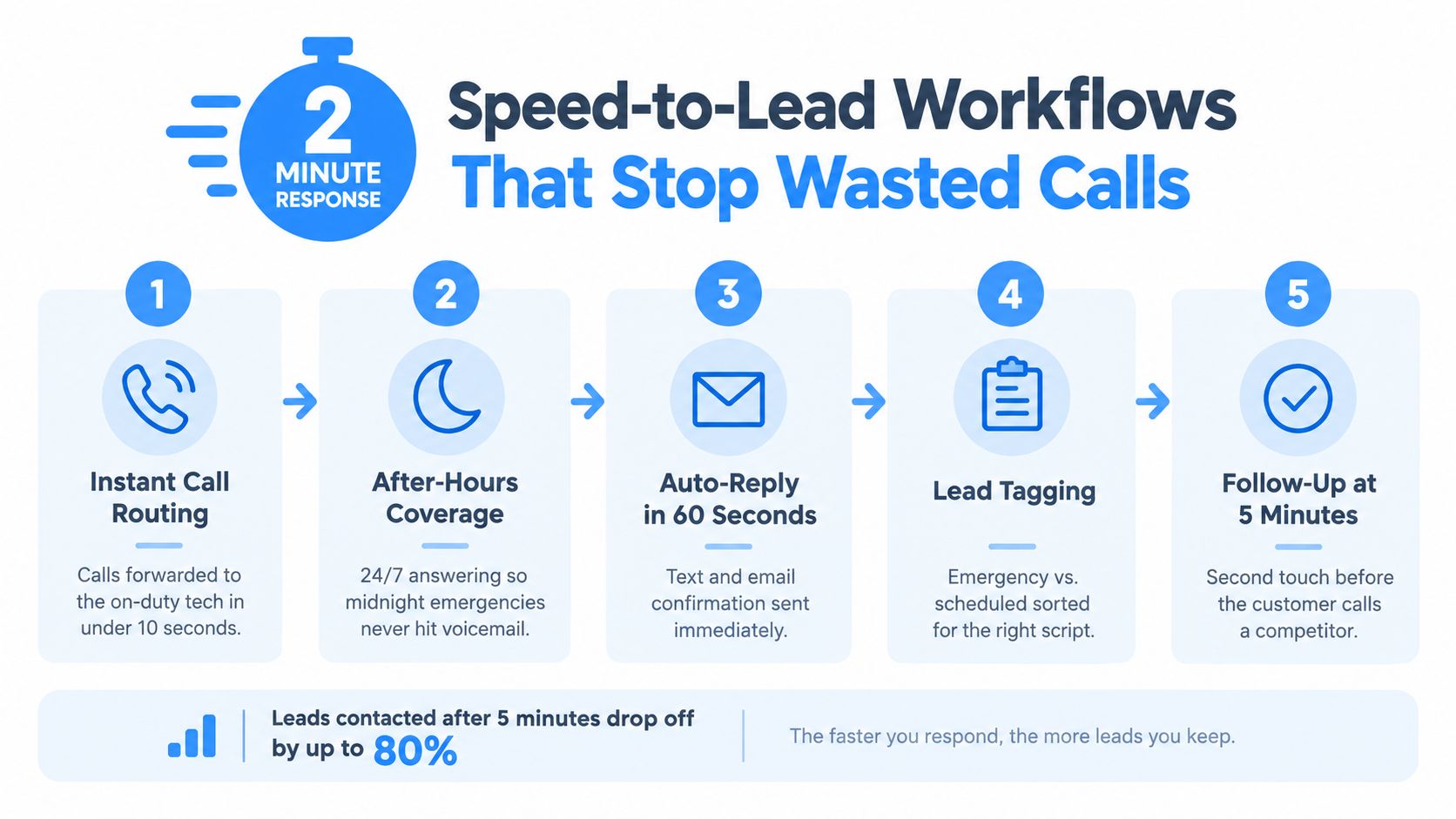
Use the two-minute mark as an operating baseline, then build the workflow around the way garage door leads arrive.
- Route the call immediately: Forward calls to the on-duty person instead of allowing every inquiry to depend on the owner being free.
- Cover closed hours: Use an answering service or trained after-hours responder for emergency repair. The goal is a useful first conversation, not a generic voicemail.
- Qualify quickly: Confirm the customer's name, address, door problem, access situation, and desired timing. Separate a trapped vehicle or unsafe door from a planned replacement estimate.
- Send an immediate text: If the call is missed, send a text acknowledging the inquiry and giving the customer a direct way to reply.
- Hand off and follow up: Tag the inquiry as emergency, repair, opener, or installation, then assign a person and next action in the CRM.
The first call shouldn't become a long diagnostic interview. A dispatcher needs enough information to reserve the right slot and set an honest expectation. Installation inquiries can receive a quote-preparation message, while emergency requests need dispatch confirmation and a clear arrival process.
Track calls, forms, booked jobs, job type, answer time, and lead source in one dashboard. The important comparison isn't just total leads. It's whether garage door repair near me calls are answered, whether installation forms receive a same-day response, and whether each source produces profitable booked work. A useful follow-up system can automate reminders without making the customer feel abandoned, as shown in this follow-up automation resource.
Local Partnerships, Reviews, and AI Visibility That Compound
Local promotion becomes stronger when referrals, reviews, and AI visibility support the same business facts. A property manager may refer a repair, the customer may leave a review after the job, and that review may reinforce the company's reputation when a future homeowner asks an AI search tool for a nearby garage door provider.
Start with partnerships that naturally encounter garage door problems. Realtors can refer repair and replacement work during a sale. Property managers can need recurring service. Nearby electricians, remodelers, and HVAC companies may encounter opener or access issues outside their own scope. Make the arrangement clear, lawful, and useful, with a simple referral process and transparent terms.
Reviews should come from the operating workflow, not from a vague request sent months later. The technician can ask after completing the work, the office can send a direct link, and the manager can review new feedback weekly. The request should invite an honest account of the service rather than dictate wording.

Make the business legible to AI search
AI visibility depends on consistent, complete information. Maintain accurate business details, service descriptions, location coverage, team information, and answers to common questions across the website and reputable local directories. Add relevant structured data and FAQ content where it reflects visible, useful page content.
Recent guidance defines LLM visibility as the measurable presence of a business, location, service, or source in AI-generated answers, and recommends complete business information, directory mentions, local resources, and tracking across AI systems. The recommendations are outlined in this guide to LLM visibility for local businesses.
The loop is practical. Partnerships create legitimate jobs, jobs create opportunities for reviews, reviews strengthen local trust, and consistent citations give search systems better material to use. Track referral inquiries, completed review requests, new reviews, profile actions, branded searches, and mentions in relevant AI answers. Use those signals to identify which local relationships and service pages deserve more attention.
A 30-60 Day Action Plan for More Garage Door Leads
Emergency and scheduled garage door leads shouldn't share the same response script or bidding logic. A broken spring search needs a fast answer and an available slot. A replacement search needs a credible portfolio, a clear estimate path, and follow-up that supports comparison without turning the conversation into a price race.
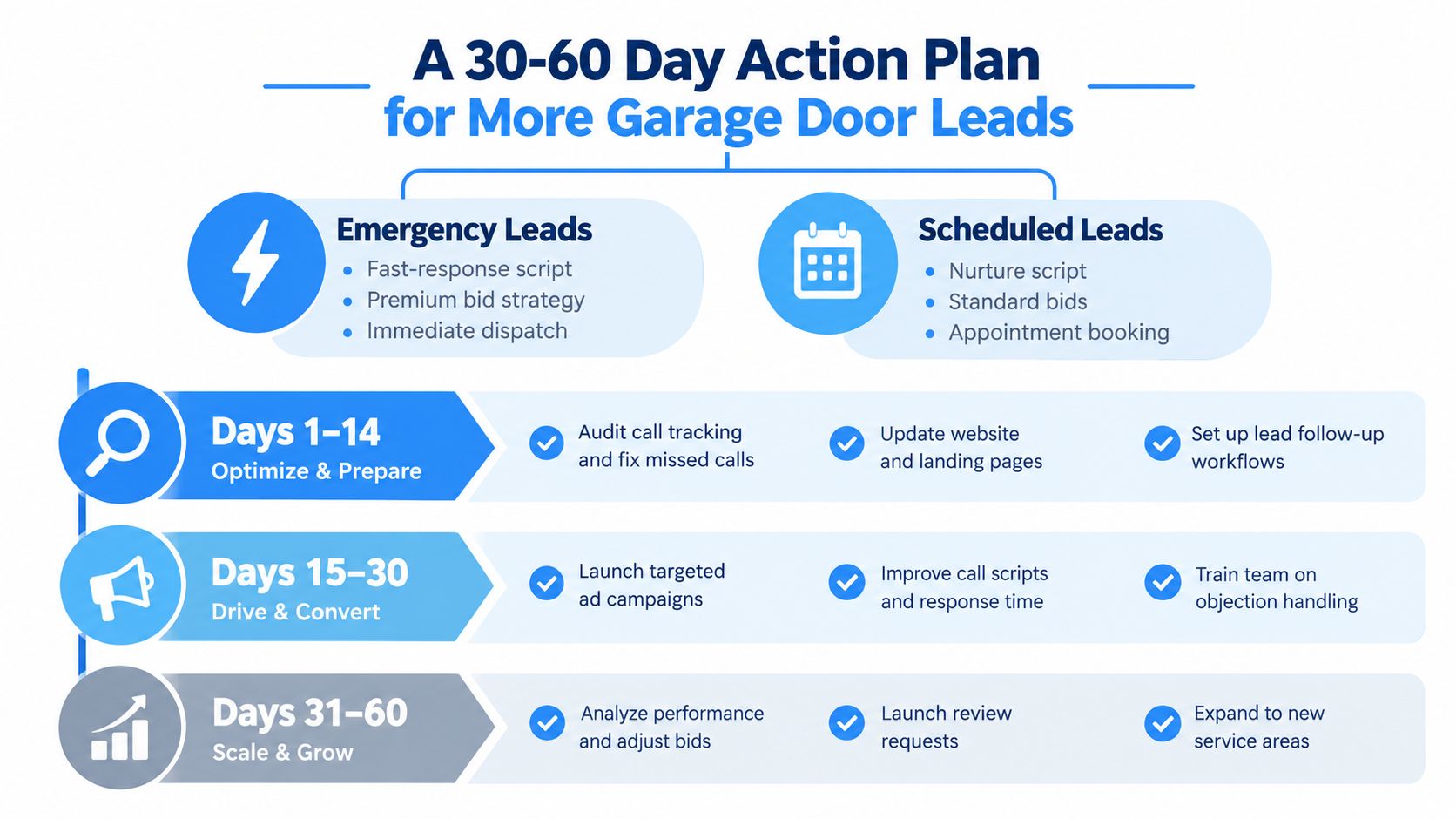
Days 1 through 7
Audit every call and form path. Confirm that the Google Business Profile has the correct category, phone number, hours, service area, and emergency language. Install call tracking and record the source, response time, job type, and booked outcome.
Choose one priority Maps correction for each legitimate location. At the same time, write two response scripts. The emergency version should qualify the problem and arrange dispatch quickly. The scheduled version should capture the project details and set a quote appointment.
Week 2
Publish a service-area page for each priority ZIP code or city segment, but only where the business can add real local value. Build a single retargeting audience for visitors who viewed a replacement or quote page without converting. Use finished project photos and a direct estimate invitation.
Send review requests after completed work. A practical internal target is three new reviews per technician per week, provided the requests are honest, permitted, and never tied to incentives for positive sentiment.
Weeks 3 and 4
Separate paid campaigns into emergency repair and scheduled installation groups. Give emergency terms a stronger response requirement and send them to a click-to-call experience. Give installation terms a quote page with photos, product choices, warranty details, and a follow-up sequence.
Review search terms and remove irrelevant traffic such as DIY research, parts-only searches, and employment queries. Compare cost per booked job by service type instead of celebrating a low blended cost per lead.
Days 30 through 60
Contact two local realtors and a property manager with a specific referral process. Ask what types of garage door work their clients or properties need, how they prefer to send referrals, and what information would help them trust the handoff.
Review the dashboard every week. Separate emergency repair, opener work, maintenance, and installation. A campaign that produces many low-value inquiries can still consume the attention required to close larger scheduled projects. Measure cost per booked job, answer rate, response time, close rate, and revenue by lead type so one budget doesn't siphon funds from another.
The most reliable garage door lead system joins transactional SEO, Google Maps visibility, paid search, AI-readable business information, and disciplined follow-up. If the phone is still being missed, more traffic only increases the amount of demand that leaks away.
Transactional LLC helps service businesses build industry-specific SEO, Google Maps optimization, AI-driven content systems, and paid campaigns around transactional searches such as “garage door repair near me.” Visit Transactional LLC to connect your local visibility, lead tracking, and follow-up into a system designed to turn high-intent searches into booked jobs.