


Google ranks local results using three main factors, relevance, distance and prominence, and each calls for a different fix. Local SEO helps your business match nearby searches by making your services clear, your location accurate and your reputation credible.
You might recognize the problem: your technicians cover a suburb every day, but your business barely appears when customers there search for help. Meanwhile, you can search from your office and see yourself near the top. That difference doesn't necessarily mean your profile needs another edit. It may mean you're measuring from the wrong place.
For a home-service owner, the useful question isn't just “How does local SEO work?” It's which part of the system is limiting the searches that could become booked jobs?
What Local SEO Is and Why It Pays Off
When a homeowner searches for air conditioning repair, Google can show nearby businesses in Maps or local search results. Local SEO helps your business qualify for those results by making clear what you do, where you serve customers, and why people can trust you. The payoff is practical: a searcher with a repair need can find your service, check your details, and contact you to book.
Google's explanation of local rankings describes three factors. Relevance is how well a result matches the search. Distance is how close the business is to the searcher or the location they name. Prominence reflects how established and recognized the business appears. Your Google Business Profile gives Google details such as your services, business category, hours and location, helping it assess whether your business fits a search. These factors work together, but they solve different problems. Editing a service description can improve clarity about what you offer; it cannot move your business closer to someone searching across town.

Focus on searches that signal a hiring decision
A transactional search term points toward hiring a provider, rather than just learning about a topic. Examples include air conditioning repair near me, emergency plumber near me, roofer near me and dentist near me.
The service and location shape what a useful result looks like. An HVAC business should explain its HVAC services and the places it serves. A dental practice needs information suited to dental patients, not a generic page copied from another type of business.
For the HVAC examples in this guide, compare these searches:
- Air conditioning repair near me: The searcher wants a nearby provider.
- Why is my air conditioner blowing warm air: The searcher is diagnosing a problem.
- Air conditioning repair in a named suburb: The searcher has specified both the service and location.
Transactional LLC focuses on the first and third types: service searches tied to a hiring decision in a specific city. They can indicate readiness to contact a provider, though a search phrase alone cannot tell you whether someone will book.
Local SEO doesn't create a broken air conditioner or a customer's need. It helps that customer find a credible business when the need already exists.
Accurate hours, phone numbers, service details and booking options make it easier for a searcher to take the next step. That connection between being found and being contactable is how local visibility can lead to booked work.
Local Ranking Signals at a Glance
Use this lookup to group each signal under the factor it supports: relevance, distance or prominence.
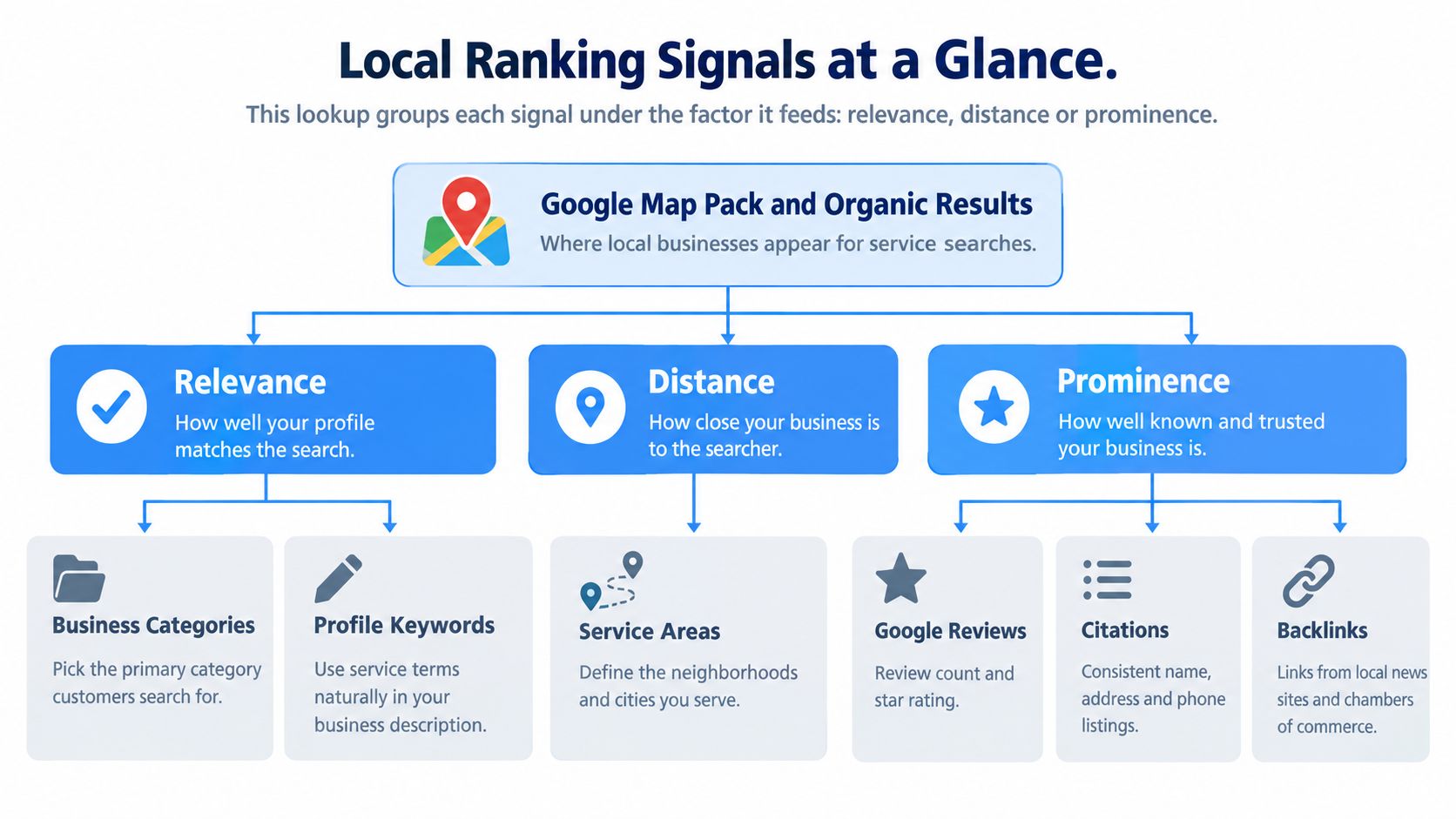
Local ranking signals, the factor each feeds, and what to verify
| Signal | Factor it feeds | What to verify |
|---|---|---|
| Business Profile completeness | Relevance, prominence | Primary and secondary categories, service list, hours, photos |
| Citation consistency | Prominence | Name, address and phone matched across directories |
| Review count and score | Prominence | Count, average rating, date of latest review, owner replies |
| Service and city landing pages | Relevance | A page per core service, each with unique local detail |
| Backlinks and local mentions | Prominence | Chambers, trade associations, sponsorships, local news |
| Technical site health | Relevance support | Indexing, mobile speed, accurate LocalBusiness schema |
| Verified location or service area | Distance context | Legitimate verified address and accurate cities or areas served |
Treat this as a working priority list, not a ranking formula. It combines ranking considerations with practical checks that help customers understand and contact your business. It doesn't establish that every item is a direct ranking factor.
Start with the profile, listings and customer feedback
First, compare your profile with the jobs you actually want. An HVAC company might describe installation clearly but barely mention repair. Check whether the available categories and service descriptions accurately cover the work, rather than adding unrelated categories for exposure.
Next, inspect your citations, meaning business listings and references across other websites. Look for old suite numbers, former business names and disconnected phone numbers. Call-tracking numbers deserve particular attention because an unmanaged change can leave customers with conflicting contact details.
Then inspect the review record. Review count and score belong in the prominence discussion, while the latest review date and owner replies help you evaluate your customer-feedback routine. Don't assume that replying to a review carries the same ranking significance as earning genuine feedback.
The map results and ordinary website results aren't interchangeable measurements. Track both rather than assuming a website's position predicts its Maps position.
For a more detailed working reference, use the local search ranking factors guide. Keep the profile's service information, contact consistency and review process near the top of your inspection list before spending time on cosmetic changes.
How Relevance, Distance and Prominence Interact
Think of local search like a job bid. Relevance determines whether your business fits the assignment, distance puts the job in geographic context, and prominence reflects how established your business appears.
These aren't points you can add together on a worksheet. A polished profile doesn't move your office closer to a customer, and being nearby doesn't automatically make your company the strongest match.
Google explains that distance relates to the searcher's location or the location named in the query. Its guidance on relevance, distance and prominence helps explain why a business can appear strongly near its office and weakly elsewhere in its territory.
Measure the territory, not just the office
Use a ranking grid to test the same service search from different geographic points. Arrange those points around your legitimate location and across the neighborhoods you actually want to serve.
Choose spacing that makes sense for your operating territory. An HVAC company serving nearby suburbs needs a different measurement footprint from a business focused on a compact neighborhood.
Keep the service phrase consistent across the grid. Also separate searches for your business name from searches such as air conditioning repair near me. Someone who already knows your name represents a different discovery path from someone comparing providers.
Diagnostic rule: If visibility weakens as measurement points move away from your location, investigate proximity before rewriting the profile again.
Use the following patterns as starting hypotheses, not automatic verdicts.
Diagnosing weak local visibility
| Symptom | Likely cause | First fix |
|---|---|---|
| Ranks well near the office, absent five or more miles away | Possible distance limit, not a universal mileage cutoff | Improve outer-city service pages for organic discovery or narrow the target area |
| Appears only for the business name | Weak relevance for non-branded terms | Check specific service categories and dedicated service pages |
| Relevant services set up, few map appearances | Possible low prominence | Assess genuine review flow and citation accuracy |
| Ranks for some services but not others | Missing or unclear service coverage | Create or improve the relevant service page |
| Profile edits do not change rankings | Possible prominence or proximity limit | Investigate reviews, local references and geography |
| Map ranking differs block to block | Single-point measurement is misleading | Track a grid rather than one location |
Match the remedy to the limitation
A dedicated city page can explain your service availability and support website discovery. It doesn't relocate your business for Maps. Likewise, adding a city to your service-area list isn't a substitute for being physically nearer.
If distance is the main constraint, consider whether a narrower target territory makes commercial sense. A nearer legitimate operating location may be another option, but only if it fits how the business actually operates.
This video provides another format for reviewing the local-search mechanics.
Building Prominence With Reviews, Citations and Links
Make a review request part of closing a completed job. A practical routine is to send a text or email after completion with a direct review-form link, then let the customer describe the experience in their own words.
You can invite them to mention the service performed without supplying a script. Reply factually, acknowledge the feedback and avoid publishing private job details.
Google specifically identifies review count and review score as prominence considerations. Its local-ranking guidance on reviews and web references also identifies links, articles and directories, and notes that ordinary web rankings can influence local results.
Make the business identity easy to verify
Keep a master record of the business name, public contact details, website and hours. Use it when reviewing listings rather than relying on memory.
Useful places to inspect include:
- Core business platforms: Google Business Profile, Apple Business Connect, Bing Places and Yelp.
- Business references: The Better Business Bureau and relevant industry directories.
- Professional records: Applicable licensing-board listings and trade-association directories.
The purpose isn't to collect every possible listing. It's to maintain accurate references that describe the same real business.
A citation-building workflow for local SEO can help organize corrections, ownership access and follow-up checks. Record which listings you control and which require a support request.
Earn references through real relationships
Look for opportunities connected to work you already do. A supplier may maintain a contractor directory. A trade association may offer a member page. A community project may provide a legitimate reason for local news coverage.
For an HVAC owner, these are more sensible starting points than unrelated websites selling links. Ask whether the reference would still make sense if search engines didn't exist.
Build a repeatable reputation process, not a burst of activity that nobody maintains.
Set a recurring review of requests, responses and business references. That's an operational recommendation, not a claim that a particular publishing rhythm guarantees rankings.
Keep the website involved, too. If a local article links to an outdated service page with a broken booking form, you've earned attention without giving the customer a reliable next step.
How to Audit Your Local SEO Step by Step
An audit should identify what's wrong, what it affects and who will fix it. A folder of screenshots isn't enough if nobody can turn the findings into work.
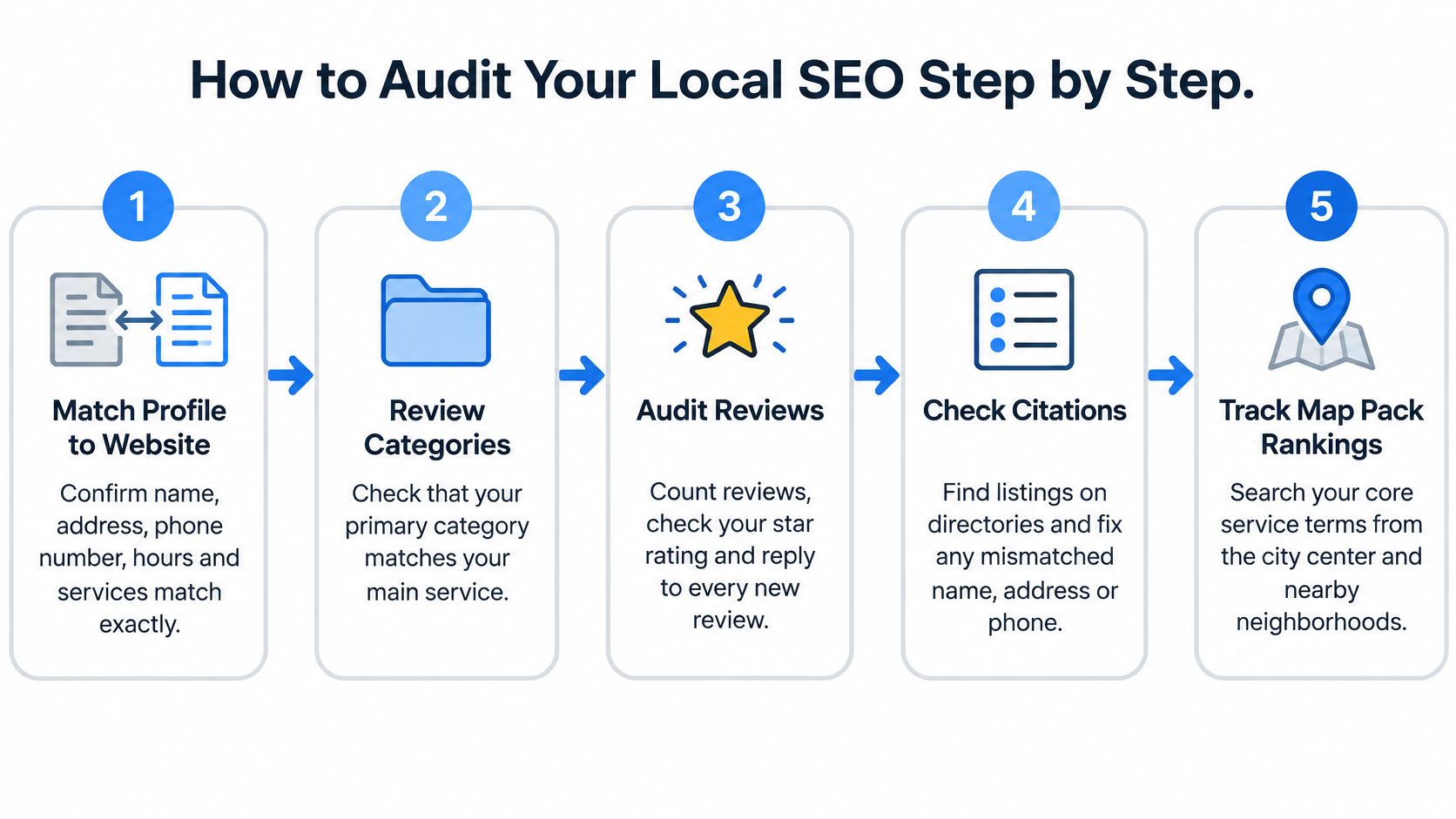
The visual below summarizes the core checks.
Verify the information customers encounter
Compare the profile with the website so customers don't receive conflicting instructions. Open both side by side and check the business name, public address where applicable, phone number, hours and service descriptions. Note whether holiday hours or booking instructions need attention.
Review categories and services so your core work is explicitly represented. Confirm that the primary category accurately describes the main business. Check available secondary categories against genuine services, then inspect the service list for omissions.
Inspect directory listings so outdated contact details don't misdirect customers. Search the business name, former phone numbers and previous addresses. Record duplicate entries and ownership problems separately from simple spelling corrections.
Audit the review record so you can identify gaps in the request process. Record count, average rating, latest review date and unanswered feedback. Ask who sends requests after a completed job and whether the process really happens.
Test the website and geographic reach
Read service and city pages as a prospective customer so missing details become obvious. Check whether each page explains the actual service, relevant local coverage and the next step. Call the displayed number and test the form rather than assuming they work.
Check technical access so your content can be discovered and used. Review indexing in Google Search Console, test mobile page performance and inspect LocalBusiness structured data for accuracy. Treat schema as a way to describe the business, not a ranking shortcut.
Run a geographic ranking scan so office-based searches don't distort your assessment. Choose priority services and record the results at consistent points across the territory. Keep Maps and ordinary website rankings in separate columns.
Connect inquiries to outcomes so visibility isn't mistaken for revenue. Record calls, direction requests where relevant, form submissions and booked jobs by location and service. Ask the person handling inquiries to distinguish qualified opportunities from wrong numbers and unrelated requests.
Use the Google Business Profile audit guide to organize profile-specific findings alongside the website and geographic checks.
Your final output should be a single scored sheet with a priority order. Give each issue a status such as correct, incomplete or blocking, then assign an owner and a next action.
Fix broken customer pathways before cosmetic details. An incorrect phone number deserves attention before a replacement cover photo, even if changing the photo feels easier.
Measuring Results and Where AI Answers Fit
Measure calls, form submissions, relevant direction requests and booked jobs by service and location. Rankings help diagnose visibility, but bookings tell you whether that visibility is producing useful opportunities.
Use Business Profile performance data for available profile interactions, call tracking for phone inquiries and your booking records for completed outcomes. In Search Console, filter query text for service terms and named cities, keeping branded and non-branded searches separate.
A city-name query filter isn't the same as measuring every searcher physically located in that city. Pair query reports with geographic rank tracking rather than treating either as a complete picture.
AI exposure depends on search intent
A 2025 analysis of 60,000 local-business queries reported the following AI Overview shares. These figures describe Google AI Overviews, not every AI assistant or every local market.
AI Overview exposure by search intent
| Query intent | AI Overview share | Local content priority |
|---|---|---|
| Reason queries, such as why is my AC blowing warm air | 59.9% | Explain causes and when to call, with clear next steps |
| Informational queries, such as how much does a new roof cost | 58.3% | Publish substantiated cost ranges, timelines and preparation detail |
| Commercial queries, such as HVAC repair near me | 17.2% | Keep profile, map and booking assets strong |
| Navigational queries, such as a brand or clinic name | 10.5% | Keep profile and website facts identical |
| All local-business queries combined | 40.2% | Balance informational pages with transactional conversion pages |
The percentages in the table come from the linked analysis; examples illustrate the intent categories.
The practical distinction is between answering a question and helping someone hire. An HVAC troubleshooting page should explain possible causes, safe preparation and when professional attention is appropriate. A repair-service page should make availability, coverage and booking straightforward.
Prepare content for people and AI-generated answers
For large language models, or LLMs, think in terms of clear, verifiable information rather than special wording. Build pages around decision questions: urgency, service differences, eligibility, preparation and common failure modes.
Include cost ranges only when your business can substantiate them. Explain what changes the quote instead of publishing unsupported prices.
Use local SEO reporting tools to keep search visibility and customer outcomes together. On a recurring monthly check, record whether each priority query shows your business in Maps, ordinary results or an AI Overview.
Test other AI assistants directly and record the query and observed answer separately. Don't assume the Google findings apply to them.
Fewer website clicks don't automatically mean fewer customers. Compare inquiry quality and booked jobs before deciding that traffic changes represent business losses.
Pitfalls That Stall Local Rankings
More activity isn't always the remedy. If you've already corrected the service information, repeating the same edits can distract you from a geographic limitation or a weak reputation record.
The ranking principles described earlier support a better question: what problem is this change supposed to solve?
Stuffing city names throughout the website: Replace repetition with useful details about neighborhoods served, actual job types and relevant local conditions. A customer needs evidence that you can help, not a footer packed with place names.
Creating duplicate or misleading listings: Maintain profiles that represent legitimate eligible business locations, and work through the appropriate process to resolve duplicates. Don't create extra identities merely to occupy more results.
Treating a virtual office or PO box as an operating location: Represent where the business actually operates and configure a service-area profile appropriately when customers aren't served at the address. Don't invent proximity.
Buying or incentivizing reviews: Request genuine feedback without rewards or dictated wording. Use the platform's reporting process when you encounter suspicious reviews.
Leaving conflicting phone numbers across directories: Maintain a documented main number and manage tracking numbers carefully. Test every public contact route after a change.
Swapping city names on otherwise identical pages: Write around the actual service and location, including meaningful coverage information and customer questions. Don't manufacture local projects or testimonials.
Editing constantly while checking from one point: Pause unnecessary changes and use a consistent geographic measurement routine. Record changes so you can distinguish your actions from unrelated ranking movement.
Ignoring negative feedback: Respond calmly with relevant facts and invite the customer to discuss the issue privately. Avoid arguments, speculation and disclosure of personal information.
Keep a change log
Record what changed, why you changed it and what outcome you expected. That simple discipline makes an agency discussion more useful: instead of asking whether someone “did SEO,” you can ask whether the action addressed the diagnosed problem.
Start With Your Profile and One Priority City
Choose one high-value transactional search in one priority suburb, such as air conditioning repair near me. Keep the initial work narrow enough that you can inspect the customer journey from search to booking.
Build a manageable first-month plan
Opening week: Verify profile ownership and business information, review the primary category and services, and correct important citation mismatches. Capture starting visibility and inquiry records before making changes.
Following week: Put the review-request routine into practice and address unanswered feedback. Assign responsibility so requests don't depend on someone remembering after a busy day.
Service-page week: Improve the page supporting that repair search with genuine local detail, verified pricing guidance where available and a clear booking action. Test the phone number and form on mobile.
Closing week: Repeat the geographic scan and compare inquiries and booked jobs with the starting record. Use the findings to choose the next priority, not to promise a ranking deadline.
Google's consumer research found that 50% of smartphone local searchers visited a store within a day, compared with 34% on computers or tablets, and 18% of smartphone local searches led to a purchase within a day versus 7% of non-local searches, according to its local-search research. The same research found that 4 in 5 consumers wanted ads customized to their city, ZIP code or surroundings.
Those are store-visit and purchase findings, not a forecast of HVAC bookings. Their practical lesson is to make local relevance and the next action clear.
Set expectations around diagnosed conditions and customer outcomes, not a guaranteed ranking date. Competition, geography and the work required should shape the plan.
Transactional LLC offers a contract-free partnership covering SEO, Google Maps and GMB setup and optimization, heat-map reporting and biweekly results, with timelines dependent on local competition rather than a guaranteed ranking date. Visit Transactional LLC to discuss your priority service and city, identify whether relevance, prominence or distance is limiting discovery, and connect the work to booked jobs.