


A lot of service businesses realize they need a Google Business Profile audit only after calls slow down. A plumber changes phone systems, a duplicate listing appears, hours drift out of date, and the profile still looks “fine” at a glance. Then someone searches for “emergency plumber near me,” taps a competitor instead, and the missed job never shows up in any report.
That's why a real audit has to go deeper than checking whether the profile exists. It needs to verify the basics, compare the listing against top competitors, test conversion paths, and look at how the business appears in both classic local search and AI-driven discovery. If you're working on creating your professional digital impression, your Google Business Profile sits near the center of that effort because it shapes what prospects see in Maps, search results, and increasingly in LLM-assisted answer experiences. For a practical foundation, it also helps to review what a Google Business Profile is before auditing it.
For service businesses, optimal performance on transactional search terms is crucial. Searches like “air conditioning repair near me,” “dentist near me,” and “roofer near me” come from people ready to book. A strong audit helps you show up where that buying intent lives. It also helps you avoid the quiet problems that keep businesses out of the top three map results in the neighborhoods they want to serve.
Introduction to Auditing Your Profile
A proper Google Business Profile audit starts with a simple question. If someone nearby searches for your core service right now, does your profile give Google and the customer every reason to trust it?
For home service companies, that answer often breaks in small places. The phone number on the profile differs from the website footer. A duplicate listing splits reviews. The primary category is too broad. The booking link works on desktop but fails on mobile. None of those issues feel dramatic on their own, but together they push a business away from transactional search terms like “plumber near me” or “HVAC repair near me,” which is exactly where the money is.
Practical rule: Audit for rankings, but prioritize for booked jobs. A profile that looks polished and still leaks calls is not optimized.
The strongest audits also account for how AI systems interpret local business data. LLM-driven search experiences lean on consistency, entity clarity, category relevance, and corroborating signals across the web. If your citations conflict, your categories are muddy, or your service areas are vague, AI visibility usually suffers alongside Maps visibility.
That's why the audit process needs sequence. Start with setup and completeness. Then move to categories and attributes, engagement signals, citation and schema validation, and finally performance diagnostics with a fix order based on impact. For businesses chasing transactional search terms, this structure matters because ranking for broad visibility isn't the goal. Getting found when someone is ready to call is.
Profile Setup and Completeness Checks
The first pass in a Google Business Profile audit is mechanical. That's a good thing. Mechanical checks catch expensive mistakes.
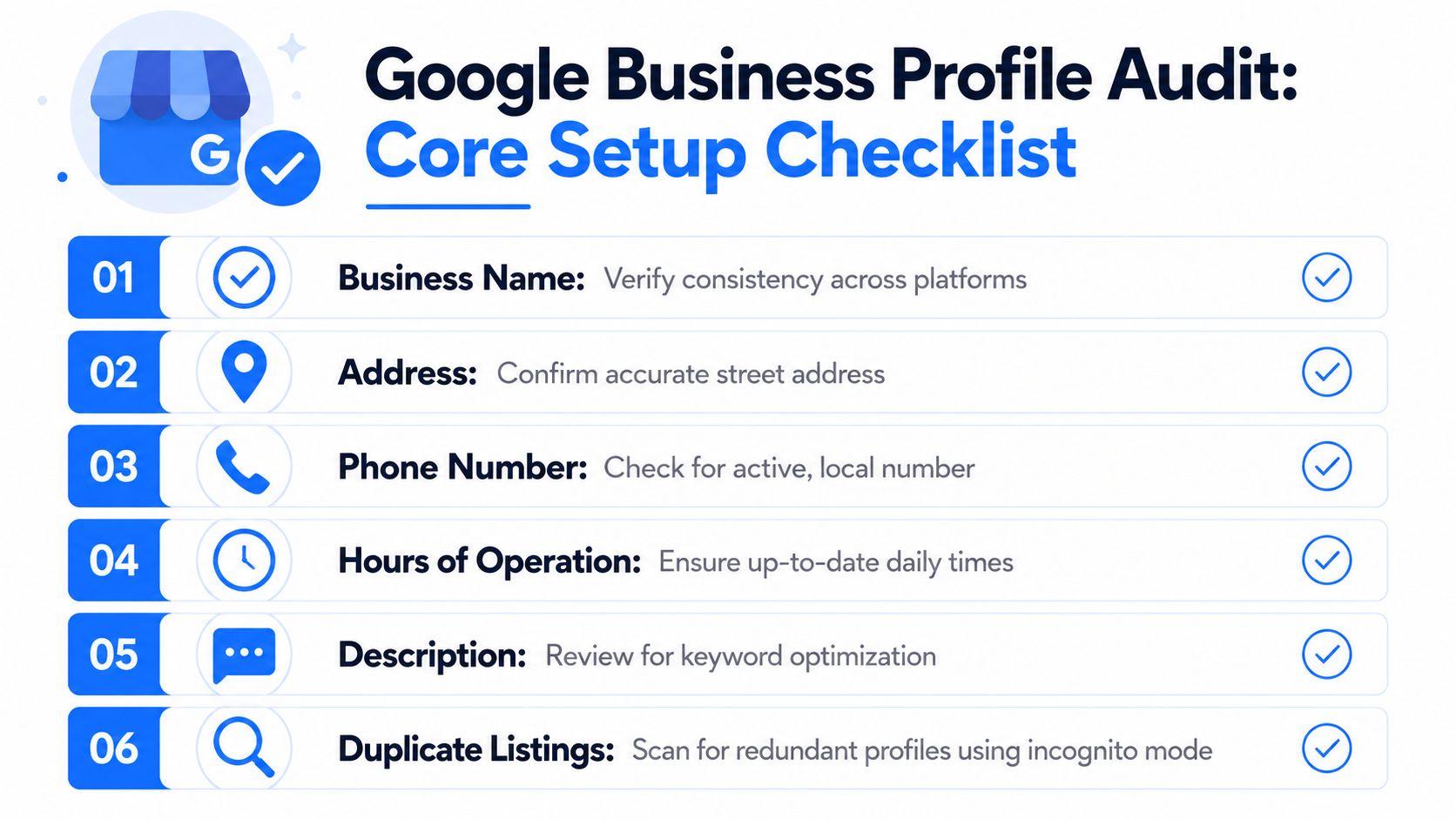
Verify the core fields first
Open the live profile, the website, and your main directory listings side by side. Then verify:
- Business name matches the official business name everywhere.
- Address is formatted consistently across the profile, website, Yelp, and Yellow Pages.
- Phone number is active, local when appropriate, and identical across listings.
- Hours reflect current operations and special schedules.
- Description clearly states core service and location in the opening lines.
- Services and attributes are filled out rather than left thin.
A complete profile performs better than a partial one. Profiles hitting a Profile Strength score of 85% or higher generate 2.3x more website clicks and 1.8x more phone calls than profiles below 60%, per the Birdeye State of Google Business Profiles 2025 report (Birdeye). If you need a practical setup walkthrough before auditing edge cases, review this guide to Google Business Profile setup.
Use tools, but confirm manually
BrightLocal and Moz Local are useful for surfacing NAP inconsistencies, but I wouldn't treat tool output as final. Profiles break in ways software won't fully interpret, especially when old practitioner edits, merged locations, or service-area changes are involved.
Use this quick check sequence:
- Run a citation scan in BrightLocal or Moz Local.
- Open Google Maps in incognito mode and search brand variations, old phone numbers, and partial addresses to spot duplicates.
- Compare the website schema against the live GBP details.
- Check desktop and mobile because URLs and action buttons can behave differently.
Duplicates are not a minor cleanup item
Duplicate listings cause real ranking drag. The 12-point methodology highlighted in Swydo's Google Business Profile audit guidance notes that 28% of service-area businesses have unmerged duplicates, and those duplicates can reduce average ranking by 2 to 4 positions in the local pack. For service businesses, that can be the difference between being visible for “electrician near me” and disappearing below the fold.
If you find a duplicate, don't leave it for later. Merge or remove it before you spend time polishing lower-impact details.
Category and Attribute Optimization
Categories decide whether Google sees your business as a fit for the exact query you want. For transactional searches, “close enough” category selection usually isn't enough.
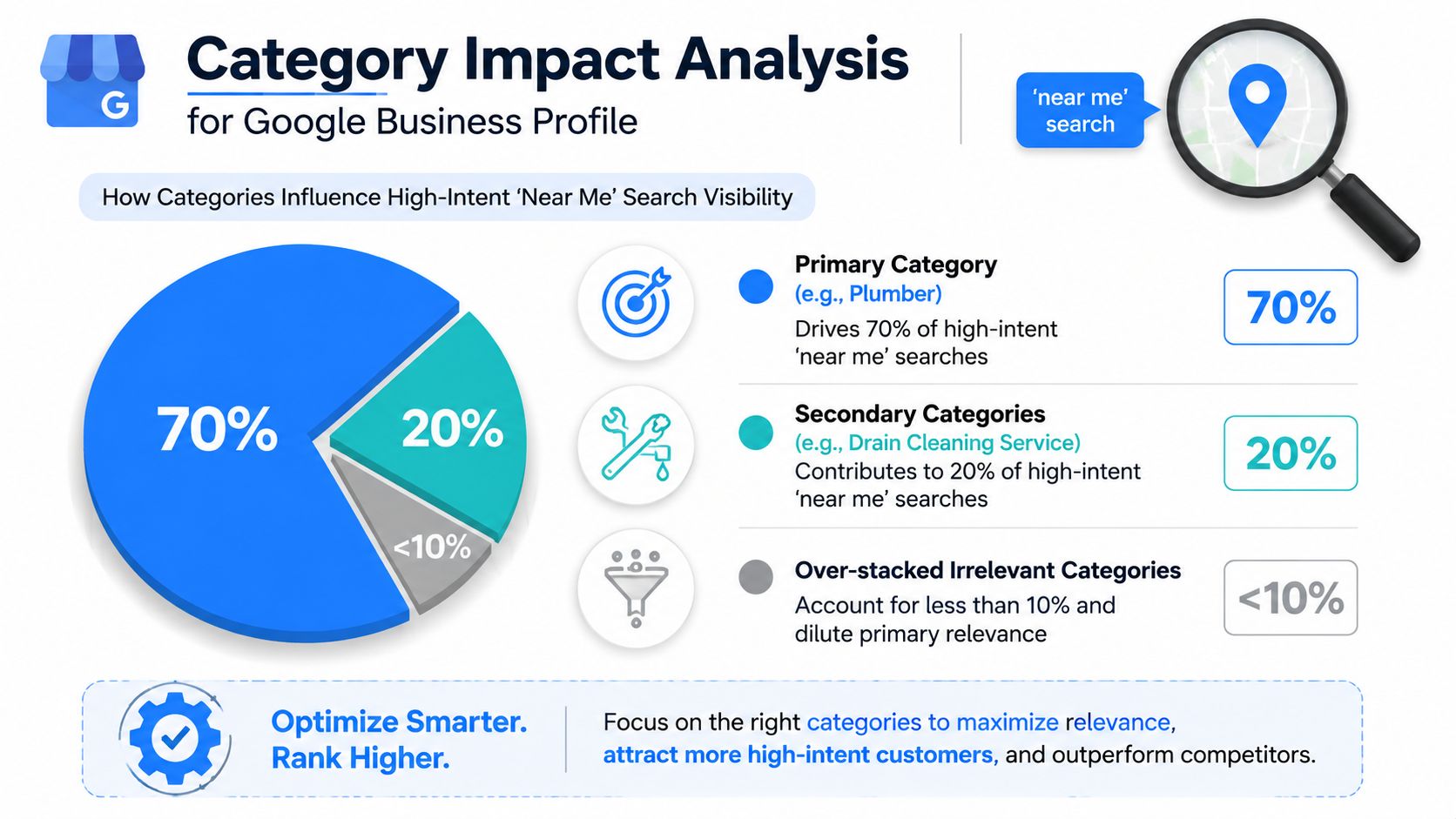
Match the primary category to the money term
If your best lead comes from drain emergencies, family dentistry, roof repair, or med spa injectables, the primary category should align with the service that drives the highest-value local intent. Generic categories weaken relevance.
A strong audit compares your primary and secondary categories against the top local competitors ranking for your target term. Pleper and GMB Everywhere are useful here because they expose category choices that aren't obvious in the front-end listing. That comparison matters because category misalignment is a common reason a business misses the top three map spots for transactional searches.
Secondary categories need testing, not guesswork
A lot of audit checklists stop at “add more categories.” That's too shallow. 68% of top-ranking home service businesses use all 10 secondary category slots, yet only 22% of audit guides cover testing which categories drive geo-grid visibility, avoiding category cannibalization (Search Engine Land).
That gap matters most for businesses serving multiple suburbs or ZIP clusters. You don't just need categories present. You need to know which category stack improves visibility in the specific parts of the service area where you want more calls.
A workable geo-grid process
Run category tests like this:
| Step | What to do | What you're looking for |
|---|---|---|
| Baseline | Capture current geo-grid rankings for your target keyword | Areas with weak penetration |
| Compare | Pull top competitors' primary and secondary categories | Relevance gaps |
| Adjust | Change only one or two secondary categories at a time | Cleaner causality |
| Recheck | Watch geo-grid movement in target suburbs | Which stack improves coverage |
The trade-off is real. Search Engine Land's reporting also notes category cannibalization in over-stacked profiles. In some verticals, loading irrelevant secondary categories can dilute primary relevance instead of expanding it.
The best category stack isn't the longest one. It's the one that helps you rank for the exact “near me” searches that turn into jobs.
Attributes matter too, especially when they reinforce service reality. But attributes should support category clarity, not compensate for category confusion. In AI-driven local discovery, that distinction matters because LLMs tend to favor profiles with a cleaner, more consistent entity definition.
Media Posts Reviews and Q&A Engagement
A profile with weak engagement signals rarely holds strong visibility for long. Photos, reviews, owner responses, posts, and Q&A tell Google the listing is active. They also tell customers whether the business feels current and credible.
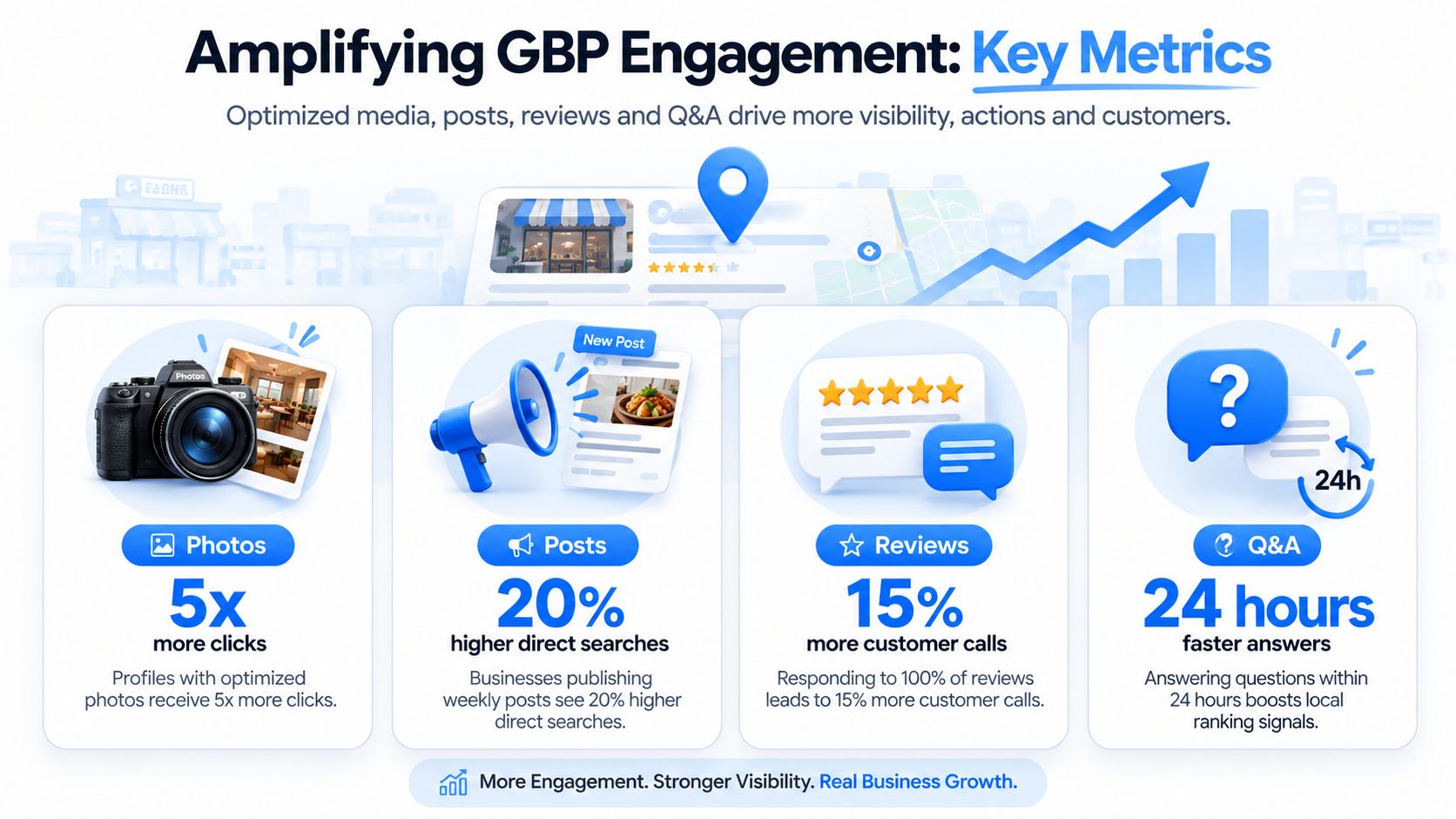
Audit media like proof, not decoration
For service businesses, photos should document real work, real teams, and real locations. During an audit, check whether the gallery supports the services you want to rank for. An HVAC company should show installs, repair visits, branded vehicles, technicians, and service-area context. A dental office should show operatories, team photos, exterior signage, and patient-facing spaces.
Businesses adding 4 to 6 verified reviews per month see a 22% increase in local search ranking stability, and profiles with 10+ geo-tagged photos rank 1.5x higher than those with untagged imagery. That benchmark was reported in the Birdeye State of Google Business Profiles 2025, as referenced earlier in this article. The practical takeaway is simple. Fresh proof wins.
Review velocity and response workflow
A review audit should answer four things:
- Are new reviews arriving consistently
- Is the owner responding quickly and professionally
- Do review themes reflect the target service lines
- Are requests built into the customer workflow
The businesses that do this best don't rely on occasional reminders. They build review requests into dispatch completion, front desk checkout, or follow-up text workflows. If you need ideas from another customer-retention context, this guide to loyalty coupons for restaurants is useful because it shows how structured post-transaction prompts can shape repeat engagement. The channel is different, but the operating principle is similar.
For review acquisition tactics specific to GBP, this guide on how to get more Google reviews is a useful companion.
Q&A and posts should remove friction
Q&A often gets ignored until a random user posts something inaccurate. Don't wait for that. Seed common questions and answer them directly. Think in terms of call-deflection and conversion support:
- Service area questions such as whether you serve a specific suburb
- Availability questions for emergency or same-day work
- Insurance or financing questions where relevant
- Appointment expectations for healthcare, dental, and wellness categories
Posts can reinforce this rhythm when they stay service-specific. A weekly post about “emergency AC repair in Mesa” helps more than a vague brand update because it aligns with the transactional phrasing people use.
Validate Citations NAP Website and Schema
This part of the audit is less glamorous, but it's where a lot of local rankings get damaged. Google needs to trust that your business details point to one entity, one location identity, and one consistent set of service signals.
Citation consistency is foundational
A proper audit checks the Name, Address, and Phone number across the profile, website, and major directories like Yelp and Yellow Pages. An audit must confirm NAP is identical across the profile, website, and major directories, and match top competitors' categories to dominate the top three Google Maps positions, per best practices (DreamWarrior).
That means matching punctuation, abbreviations, suite formatting, and phone usage with discipline. Small inconsistencies can create separate entity traces, especially when old listings still exist.
A good working list for citation review includes:
- Major directories such as Yelp and Yellow Pages
- Industry directories relevant to the business type
- Website contact points including header, footer, and contact page
- Location pages if the business serves multiple cities
- Third-party mentions that still rank for branded searches
Schema and duplicate cleanup
Once NAP is aligned, validate the website's LocalBusiness schema in Google's Rich Results Test. The schema should support, not contradict, the GBP. If the profile says one phone number and the markup says another, you've created unnecessary ambiguity.
Google Maps in incognito mode remains one of the fastest ways to catch duplicate listings that haven't surfaced in your dashboard. Search brand name variants, old addresses, and old local phone numbers. If you find a duplicate, use “Suggest an Edit” to merge or remove it.
Fixes in this area usually don't look dramatic from the outside. They matter because they stop the profile from sending mixed signals to Google, directories, and AI systems at the same time.
For operators who want to see how adjacent service companies think about local lead generation, this piece on boosting moving business bookings is worth reading. The industry is different, but the principle is the same. Consistent location signals support higher-intent discovery.
Analyze Metrics Local Diagnostics and Fix Prioritization
A Google Business Profile audit isn't finished when the checklist is complete. It's finished when you know which fixes matter first.
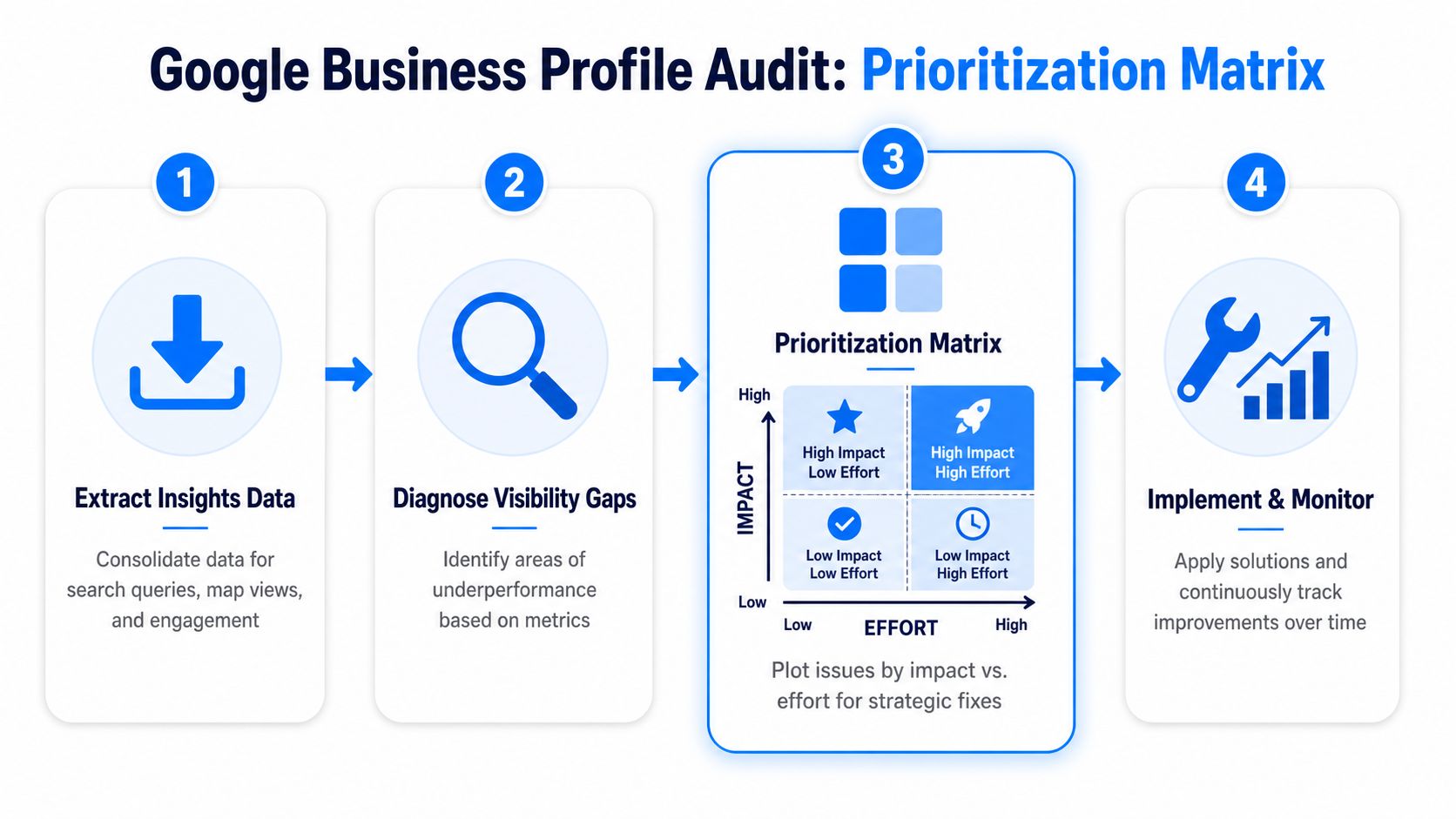
Read the profile like an operator
Start with business performance data and local visibility diagnostics together. Look at branded versus discovery queries, website clicks, calls, and direction requests. Then compare those signals with rank tracking, geo-grid coverage, and competitor positioning.
A full audit should also benchmark engagement against local norms. A complete 12-point audit measuring 90-day review velocity and competitor median performance identifies engagement gaps that directly correlate with lower visibility in transactional “near me” results (Prospect Audits).
That's important because not every weak metric needs the same response. Low calls can come from poor rankings, but they can also come from broken booking links, weak categories, duplicate listings, or thin proof on the profile itself.
Prioritize by impact and effort
This is the matrix I use most often:
| Priority | Typical issue | Why it moves first |
|---|---|---|
| High impact low effort | Broken links, wrong phone number, duplicate listing | Immediate conversion or visibility loss |
| High impact medium effort | Primary category revision, NAP cleanup, review workflow repair | Strong ranking effect |
| Medium impact low effort | Description rewrite, service updates, Q&A cleanup | Improves clarity and conversion |
| Medium impact ongoing effort | Review velocity, photo refresh cadence, post schedule | Supports stability |
Use local SEO reporting tools that track keyword timelines by city, map heat views, and Search Console query shifts. You need before-and-after visibility, not just a cleaned-up profile.
Don't separate AI visibility from local SEO
Businesses are now being summarized, recommended, and compared inside AI tools that synthesize local business information from multiple signals. That means your audit should ask:
- Is the entity consistent across the web
- Do categories clearly state what the business does
- Does the profile contain enough service-specific language to support retrieval
- Do reviews mention the exact services and locations that matter
A profile that is strong for transactional local SEO is usually better positioned for LLM visibility too. The overlap isn't perfect, but it's growing. If your business wants to show up for “roofer near me” in Maps and also be surfaced accurately in AI-assisted recommendations, consistency and clarity do most of the heavy lifting.
Conclusion and Next Steps
A strong Google Business Profile audit is not a vanity exercise. For service businesses, it's a revenue control process. The right audit catches the issues that suppress transactional visibility, especially on searches like “dentist near me,” “air conditioning repair near me,” or “roofer near me,” where the customer is ready to act.
The most useful sequence is straightforward. Tighten profile completeness. Fix categories with geo-grid testing in mind. Improve media, reviews, posts, and Q&A. Validate NAP, citations, website details, and schema. Then prioritize fixes based on what affects calls, bookings, and local pack visibility first.
This is also where old local SEO and new AI optimization meet. Google Maps rankings, citation consistency, category relevance, and review language all influence how a business is interpreted across search and LLM-driven discovery. If you want more visibility for transactional search terms, your profile has to be both technically clean and commercially clear.
A lot of businesses can improve quickly with one disciplined audit cycle. Others need a tighter operating system to keep rankings from slipping as competitors push harder in Maps. Either way, the work is worth doing now, before another month of high-intent searches goes to someone else.
If you want help turning a Google Business Profile audit into rankings for transactional search terms, Transactional LLC specializes in contract-free local SEO, Google Maps optimization, AI-driven content, and service-area targeting built to help local businesses show up when customers are ready to buy.