


Your ads are spending, the dashboard shows clicks and leads, and dispatch still has gaps nobody can explain. That's the usual leak in PPC for home services. A cheap lead that never books, sits outside your service area, or arrives when every truck is committed isn't growth. It's expense. I judge campaigns by cost per booked job and by whether your crew can run the work that the click creates.
What PPC Means for Home-Service Businesses
A homeowner wakes at 2 a.m. during a July heat wave, finds the house warming up, and types air conditioning repair near me on her phone. She isn't browsing for ideas. She's ready to hire the first credible company that answers. That transactional search term is the moment pay-per-click is built to capture, and it's the kind of term we target at Transactional Marketing because the searcher has money in hand and a problem to solve now.

What You're Actually Paying For
According to Tested Media's Google Ads history, Google introduced AdWords in October 2000 selling keyword ads by impression, then shifted toward a pay-per-click model in 2002, charging when users clicked rather than merely viewing an ad. That matters because your budget attaches to measurable actions. Clicks, calls, quote requests, and booked appointments can each be tracked back to the keyword that produced them.
The same logic applies across plumbing, HVAC, electrical, roofing, and pest control. It also applies to adjacent urgent work. If you want context on how another emergency trade scopes its jobs, read about what restoration companies do and notice how much of that demand is also time-sensitive and local.
Paid Clicks Are Not Map Rankings
Don't confuse buying a click with earning a Maps position. Google's local ranking guidance says local results rest on relevance, distance, and prominence, with prominence reflecting signals such as links, directories, review count, and review score. A farther business can rank above a closer one when Google decides it matches the query better. No review total guarantees a top-three Maps result, and no honest provider can promise one.
Ads rent the click. Your Business Profile, reviews, and website earn the map placement. Budget for both jobs separately.
So use ads for urgent transactional terms like roofer near me, keep your profile's services and service area accurate for those same searches, and let each channel do the work it's suited for.
Home-Service PPC Costs and Benchmarks by Trade
Start with the table. It's the reference you'll come back to when a campaign asks for more budget.
| Trade | Google Search CPL | LSA CPL | LSA booking rate | Cost per booked job (LSA) |
|---|---|---|---|---|
| HVAC | $127.74 | $51 | 44.0% | $116 |
| Plumbing | $129.02 | $57 | 44.5% | $128 |
| Electrical | $93.69 | $39 | 43.4% | $90 |
| Roofing | $228.15 | Not in benchmark sample | Not in benchmark sample | Divide your CPL by your booking rate |
| Cleaning | $46.99 | Not in benchmark sample | Not in benchmark sample | Divide your CPL by your booking rate |
| Pools and spas | $45.15 | Not in benchmark sample | Not in benchmark sample | Divide your CPL by your booking rate |
How to Read Each Row
Read across, not down. The LSA figures come from a February 2026 benchmark in RYN Digital's home-services statistics covering 888 contractors, $6.72 million in Google Local Services Ads spend, and 126,650 leads, with average home-services LSA cost per lead at $53. Cost per booked job is CPL divided by booking rate, which is why a $51 HVAC lead becomes roughly $116 before cancellations, close rate, and margin enter the math.
Two trades in the table are search-only references. Brand Rocket's summary of LocaliQ's 2025 benchmark put the median cost per lead for cleaning-service search campaigns at $46.99. Ambrose Marketing's summary of the same LocaliQ work recorded a median of $45.15 for pools and spas, based on 3,211 U.S. campaigns analyzed from April 2024 through March 2025.
Why Averages Mislead Budget Owners
For wider context, MDM PPC's home-services benchmarks for 2024 show a 7.26% search click-through rate, an 8.02% conversion rate, and an average cost per click of $11.54. Treat that as a different year and a different sample, not a target. Trade economics vary too much for a single average to set your bids, which is why our breakdown of Google paid search cost is worth reading before you lock a monthly number.
Use the benchmarks this way:
- Start with your own trade row: Ignore a cheaper trade's CPL when setting your ceiling. It isn't your market.
- Sanity-check the ticket: It helps to compare HVAC service call costs against your own pricing before deciding what a booked job can support.
- Replace benchmarks fast: After about 60 days, your own booked-job data outranks any published average.
- Treat every figure as a range: A benchmark describes a sample. It doesn't promise your result.
The one check that matters: If cost per booked job sits above gross profit per job, the campaign loses money however low the CPL looks.
Choosing Between Google Search Ads and Local Services Ads
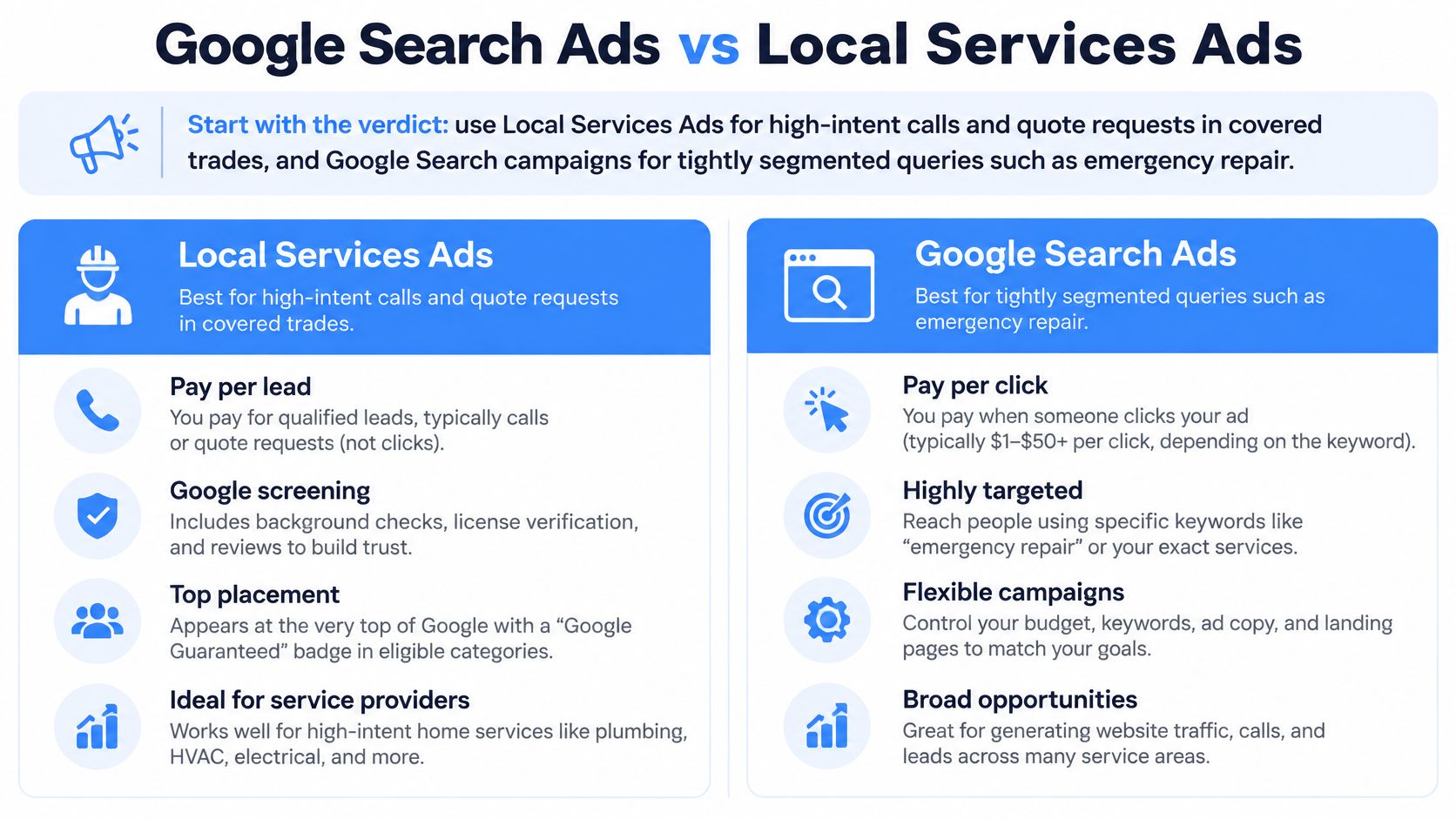
My verdict is simple. Use Local Services Ads for high-intent calls and quote requests in covered trades. Use Google Search campaigns for tightly segmented queries such as emergency repair, installation, branded searches, and specific services. Most operators shouldn't pick one and abandon the other.
| Criterion | Google Search Ads | Local Services Ads |
|---|---|---|
| How you pay | Per click, including research and accidental clicks | Per lead matched to the provider profile |
| Control over targeting | Keyword, query, geography, device and schedule | Service categories and service area |
| Best-fit searches | Emergency, installation, branded and service-specific queries | Calls and quote requests in covered trades |
| Landing page | Your own site, which needs conversion tracking | Lead arrives through Google's flow |
| Measurement | Clicks plus imported booked jobs | Lead fee, then your booking rate and job profit |
Why LSA Looks Cheaper, and the Trade-Off
LSA looks cheaper because of billing mechanics, not magic. Angarum Media's 2026 home-services marketing report found HVAC LSA leads averaged $51 versus $127.74 for air-conditioning search ads, while plumbing LSA leads averaged $57 versus $129.02 for plumbing search ads. Search pays for every eligible click, including research and comparison clicks. LSA bills for provider-matched leads. In exchange, Search gives you control over keyword, geography, schedule, landing page, and remarketing that LSA doesn't, which our guide to Google Local Services Ads for home services walks through in more depth.
Say a plumber has a $3,000 monthly budget. At roughly $58 per LSA lead, that's about 52 leads. At roughly $130 per search lead, it's about 23. Search only wins if its booking rate and average ticket cover the higher cost. Count jobs, not leads.
The walkthrough below shows how the two formats appear side by side in a live account.
Judge both channels on one funnel: valid lead, contacted lead, booked appointment, completed job, revenue, and gross profit. For owners who'd rather not run the search side themselves, our Paid Ads plan includes creating, maximizing, and running a Google PPC campaign.
Campaign Structure for Each Service and City
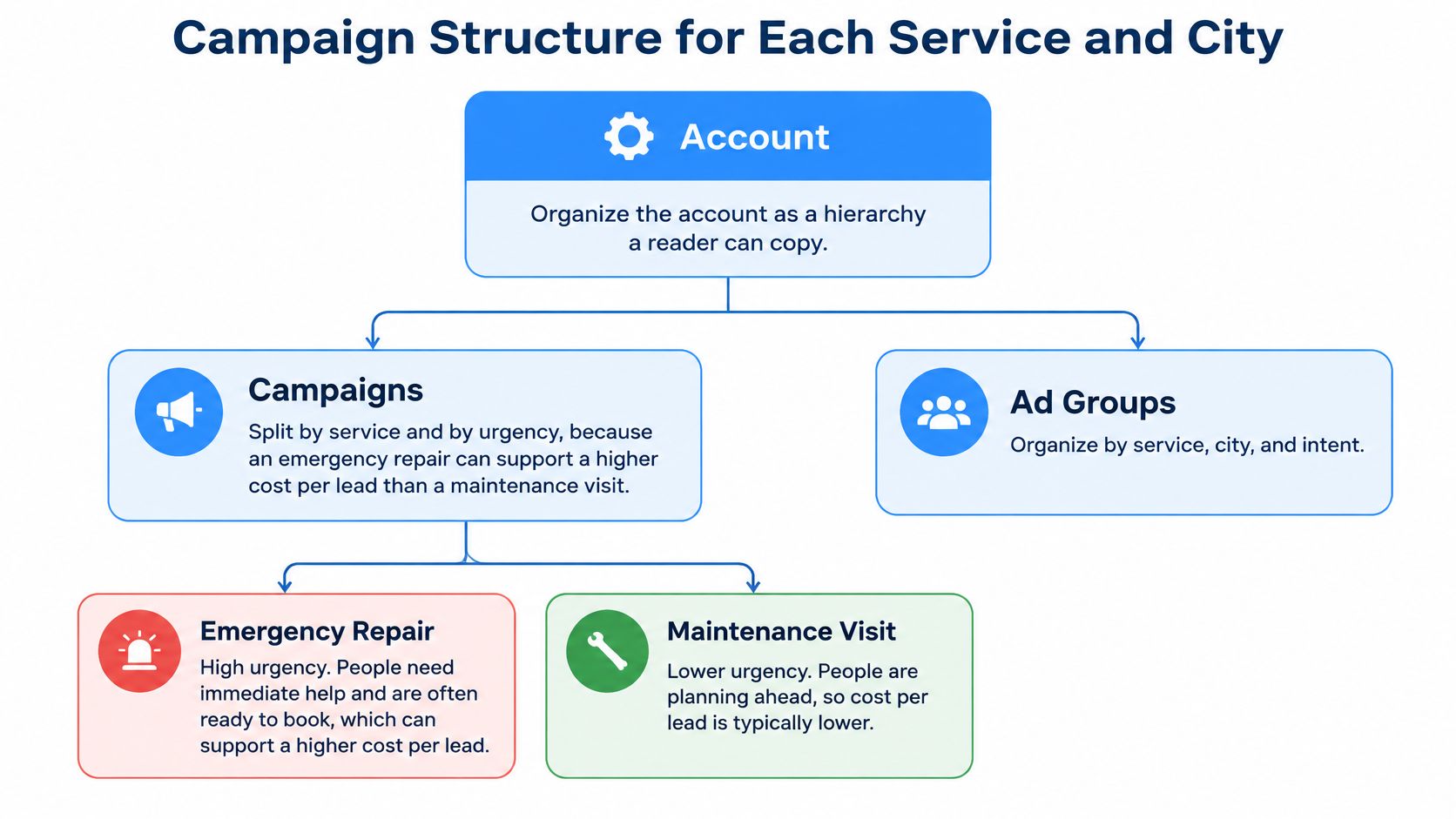
Build the account to mirror how your trucks run. Here's the hierarchy I'd copy into a new account before spending a dollar.
The Three-Level Build
- Campaigns split by service and urgency: Emergency repair can support a higher cost per lead than a maintenance visit, so never let them share a bid or a budget. Installations get their own campaign too, since the ticket and sales cycle differ completely.
- Ad groups split by city or ZIP cluster: This keeps ad copy, landing pages, and budgets honest at the local level where the work happens.
- Keywords built from transactional terms: Anchor on phrases like air conditioning repair near me and roofer near me, then load negatives for DIY, jobs, salary, and free before launch, not after the waste shows up.
Choose geography to match the trucks. A radius works for a small service area. Named cities suit a multi-location company. Either way, add ZIP exclusions for anywhere you won't drive, because Google won't protect your margin for you.
Throttle for Capacity, Not Just Cost
More leads don't equal growth when technician hours are finite. PipelineOn's home-services advertising overview notes Google Search home-services CPL averages about $90.92 while reported Meta lead CPL is roughly $41.26, but Meta leads generally close at lower rates than Google Search leads. It also flags that available 2025 survey coverage rests on only 61 contractors, which is too small a sample to set your operating rules.
So write your own rules. Cut bids or pause a campaign when crews are full. Shift budget to a trade with open schedule during a storm. Daypart to hours dispatch can answer. We currently work with businesses in HVAC, plumbing, electrical, pressure washing, carpet cleaning, pest control, window cleaning, and roofing, and the capacity question is the same in each trade.
A clean starter layout for a two-city HVAC company is three campaigns per city: emergency cooling, planned maintenance, and installation. Six campaigns, six budgets, no blended averages hiding the loser.
Ad Copy and Landing Pages That Book Jobs
Build the click in the order the homeowner experiences it. Each check below exists for one reason. It moves a searcher closer to a booked job.
Write Ads Dispatch Can Stand Behind
- Name the service and city in headlines: "AC Repair in Phoenix" beats a slogan. Add a response time only if the crew can meet it on your worst day, not your best.
- State proof you can document: License, insurance, warranty, and financing belong in descriptions when they're real. If you can't produce the paperwork, don't run the claim.
- Load the right extensions: Use a call asset on your tracked number, a location asset, sitelinks to individual service pages, and callouts for same-day or 24/7 service only when those hours are staffed.
- Use call-only ads for emergencies: When the phone is the conversion, remove the detour through a page the searcher never wanted.
Our notes on ad copy best practices cover headline testing in more detail if you want to go deeper on wording.
Match the Page to the Query
A search for air conditioning repair near me should open that city's repair page, not your homepage. Above the fold, put the service, the city, the phone number, a short form, and one trust item such as your review count. Nothing else earns that space.
Keep the page fast on a phone, because most of these searches happen on one, often in a hot house or next to a leaking water heater. Offer one action per page, call or form, and change one element per test so you know what moved the result.
If the ad promises speed and the page loads slowly, you've argued against yourself in the first three seconds.
Both the call and the form must feed call attribution so each click can be scored as a valid lead, not merely a visit. That's the same principle behind our Paid Ads plan, which includes customized funnel creation, optimization and management, and website optimization for lower ad spend and higher customer conversion. The page isn't decoration. It's where the click either becomes revenue or becomes a story about wasted spend.
How to Set Budgets and Bids From Booked-Job Costs
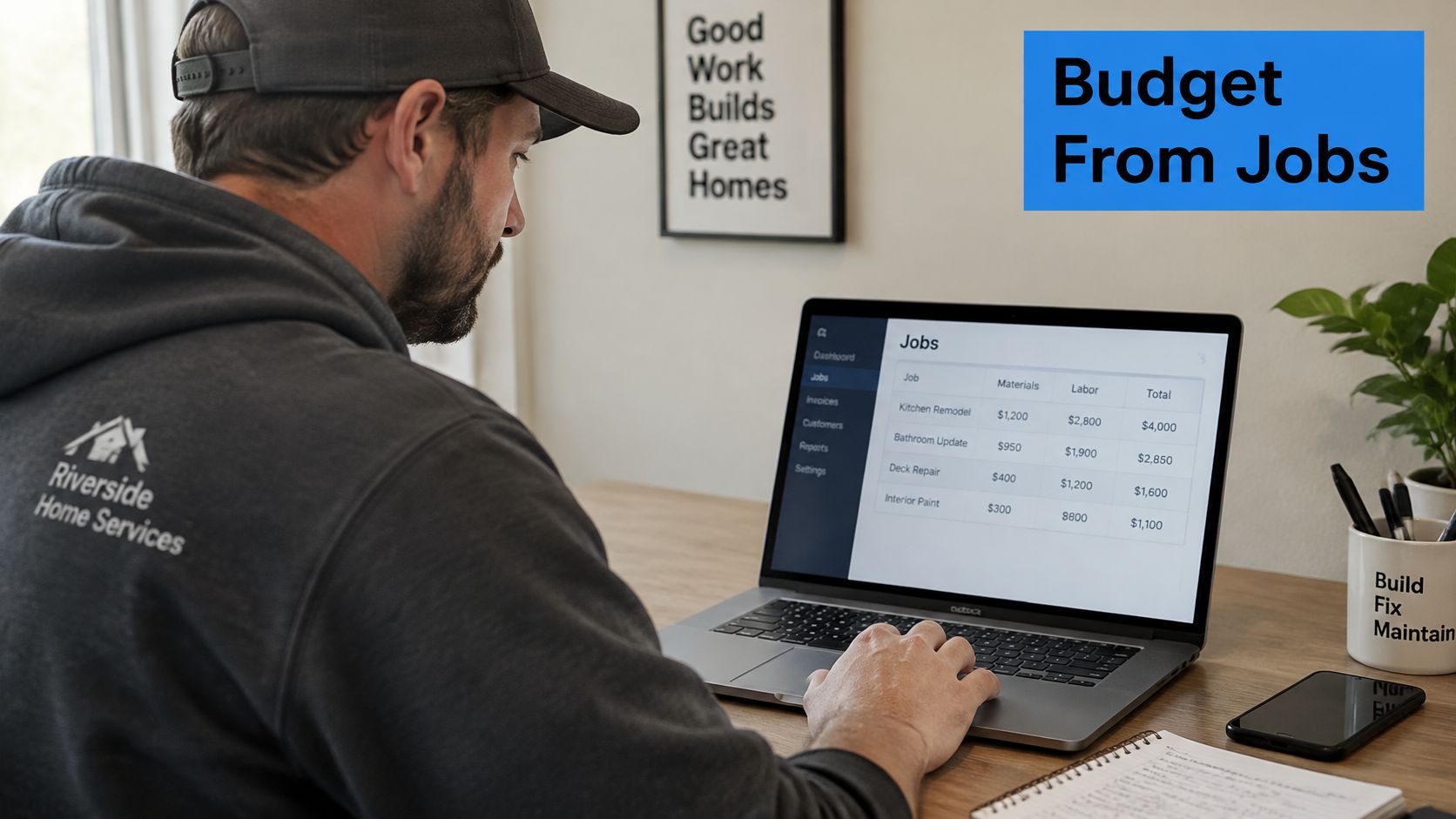
Build the budget backward from profit. Start by recording the full ladder for every campaign: impression, click, call or form, valid lead, booked appointment, completed job, revenue, and gross profit. If any rung is missing, you're guessing at every rung below it.
Set a Ceiling Before You Set a Bid
Cost per booked job equals spend divided by booked jobs. Cost per lead alone misleads because trades convert so differently. The Snow Media home-services ad benchmarks place average home-services Google Search CPC at $7.85, conversion rate at 7.33%, and CPL at $90.92, yet roofing CPL is reported at $228.15 with a 3.70% conversion rate, compared with $93.69 and 9.08% for electrical. Those two trades can't share a budget rule until close rate and margin are in.
Set your ceiling with one formula. Maximum cost per booked job equals average gross profit per completed job times the share of profit you'll allow for acquisition. Say a job produces $600 in gross profit and you'll spend 30% of that to win it. Your ceiling is $180. A campaign running above $180 gets a lower bid, fewer keywords, or a pause. Emergency work can sit nearer the ceiling than maintenance because it books faster and fills same-day holes in the schedule.
Feed Booked Jobs Back Into Bidding
Import qualified calls, estimates, and sold jobs into the ad platform so bidding can favor keywords that produce revenue, which is the core of value-based bidding done properly. Split spam and out-of-area calls from valid calls, and log call length, because a 20-second wrong-number call shouldn't train your bidding the same way a booked estimate does.
Adjust for season deliberately. Raise bids before summer cooling and winter heating demand peaks. Reduce them when off-season cost per booked job climbs past your ceiling. Check call quality weekly, since that's where junk shows up first. Then review booked-job cost against gross profit by campaign monthly, and move budget toward whatever survives that comparison.
Pitfalls That Waste Home-Service Ad Spend
Most wasted spend isn't dramatic. It's a set of small, reasonable-sounding decisions that compound until the month closes underwater.
Stopping at cost per lead is the first one. A lead price tells you nothing about cancellations, close rate, or margin, yet owners approve budget increases on it every month. Close behind is comparing lead-based billing with click-based billing as if the two bills measured the same thing. They don't, and treating them as equal scrambles every allocation decision downstream.
Structure failures come next. One campaign for every service and city forces emergency and planned work to share a single bid, so the urgent job subsidizes the tire-kicker. Sending clicks to the homepage does similar damage, as does promising same-day or 24/7 coverage your phones can't staff. On that last point, it's worth thinking through handling calls while HVAC technicians work, because an unanswered emergency call is ad spend converted directly into a competitor's booked job.
Buying demand your crew can't run is its own category of waste. Full schedules, missed calls, and ZIP codes outside your area all turn paid clicks into refunds of attention you'll never recover. So does chasing a cheaper social lead on CPL alone without checking whether it closes at a weaker rate and needs three follow-ups to book.
Finally, don't expect ads or a stack of reviews to purchase a Maps top three. In a study summarized by Yahoo Finance's small business coverage, explicit local queries still showed the Local Pack 93% of the time while AI Overviews appeared 15% of the time. Local intent still runs through Maps. Fix the matching failure first. Then consider more spend.
Decide Your 30-Day Transactional PPC Test
Run a test you can score. Pick two or three high gross-profit services and one transactional term in a single city, such as air conditioning repair near me or roofer near me. Don't add a second city until the first city's calls are being answered reliably.
Fund the test from your booked-job ceiling, not from a desire for more leads, and hold the budget steady until day 30. Launch with the setup already in place: one campaign per service, emergency work separated from planned work, a matching service page, a tracked number, and a working form. Record one trade row from the benchmark table as your outside reference on day one.
On day 30, import qualified calls and booked jobs, then apply the rule without negotiation. Keep a campaign only when cost per booked job is at or below your ceiling and the crew can still run the work. Otherwise tighten keywords, geography, or the offer, and replace the benchmark with your account's own number going forward. Treat organic page-one timing and any Maps position as separate from this paid result. Neither one is guaranteed by an ad test.
If you'd like the test managed for you, the Paid Ads plan costs $1,200 per month plus ad spend, with a $2,000 ad spend minimum. We also offer a free audit and a free consultation for home service businesses, so you can check your current terms, city coverage, and call tracking before another dollar spends.
Bring us your current campaigns and we'll audit them against cost per booked job, service-area coverage, and call tracking, then show you exactly which transactional terms are worth funding first. Start with a free audit at Transactional LLC and leave with a 30-day test plan built around booked jobs, not click reports.