


Most businesses see meaningful movement in local rankings within 3 to 6 months, while first Google Maps appearances can come within 6 to 12 weeks. That gap is why how long does local SEO take doesn't have one useful answer. You're really waiting on several clocks at once.
The stakes explain the patience required. In the 2026 BrightLocal survey of small and medium-sized businesses, 61% of consumers began their most recent local-business search on Google, while another 9% began on Google Maps. You're not entering an empty market. You're competing for transactional search terms like roofer near me and dentist near me, where the searcher has money in hand and is ready to spend it. At Transactional Marketing, that's exactly what we go after, because those searches turn into calls, not just clicks.
Typical Local SEO Timelines by Milestone
Local SEO pays out in stages, so a milestone forecast beats a single date. RG Marketing Group in 2026 puts the first meaningful ranking movement for most businesses at 3–6 months, and full return usually takes longer. I'd judge the work by the milestones below rather than by one finish line.
| Milestone | Typical window | What you should see |
|---|---|---|
| Profile and citation accuracy corrected | 2-4 weeks | Listing data matches across directories and the profile is complete |
| Service and location pages indexed | 2-6 weeks | Pages appear in Search Console and queries begin to register |
| Local Pack appearance for nearby searches | 6-12 weeks | First appearances in map results near the business location |
| Stable top-three positions in service area | 3-6 months | Consistent map-grid positions across several neighborhoods |
| Organic rankings for competitive citywide service terms | 6-9 months | Service-page rankings climb toward page one for terms such as emergency plumber |
| Calls and booked jobs from ranking gains | 3-6 months | Measurable rise in calls, direction requests and form leads |
| Meaningful return on investment | 6-12 months | Revenue from new leads exceeds ongoing cost |
Reading the Table in Order
The fastest rows are corrections, not rankings. Fixing your Google Business Profile, name, address, phone, categories and services takes weeks because you're editing data you control. Getting service and location pages indexed is the next checkpoint. If a page isn't indexed, it can't rank, no matter how well it's written.
Map movement follows once Google trusts that data. Stable top-three positions across a whole service area take longer than a single nearby appearance, because you need to hold positions at many grid points, not just next to your shop. Organic rankings for citywide terms are slower still. A plumber chasing a competitive city keyword may need the full 6 to 9 months in the table to reach page one.
The last two rows lag the ranking rows for a reason. Calls rise only after coverage widens enough to put the listing in front of searchers across the service area, and return on investment clears later still because monthly lead revenue has to overtake the ongoing cost of the work.
Say an HVAC company in a mid-sized city starts with a thin profile and one generic services page. By week four, its listings should match and its new city pages should be indexed. By month three, it may appear in the Local Pack near its office for air conditioning repair near me, while calls build more slowly as coverage widens.
Judge each month against the next milestone due, not against the final revenue goal.
That staged pacing matches what we see in delivery, where most businesses see ranking improvements within 3-6 months with ongoing SEO efforts. You can see how that pacing plays out in our local SEO case studies. If you're comparing approaches, the thinking behind ranking strategies for Instinct is a useful reminder that durable visibility comes from matching what a platform rewards, step by step, rather than forcing one big jump.
Why Google Maps and Organic Results Move at Different Speeds
Think of two clocks on the same wall. The Maps clock runs on your profile. The organic clock runs on your website's authority. They rarely strike at the same time.
This visual shows why the two result types need separate tracking.
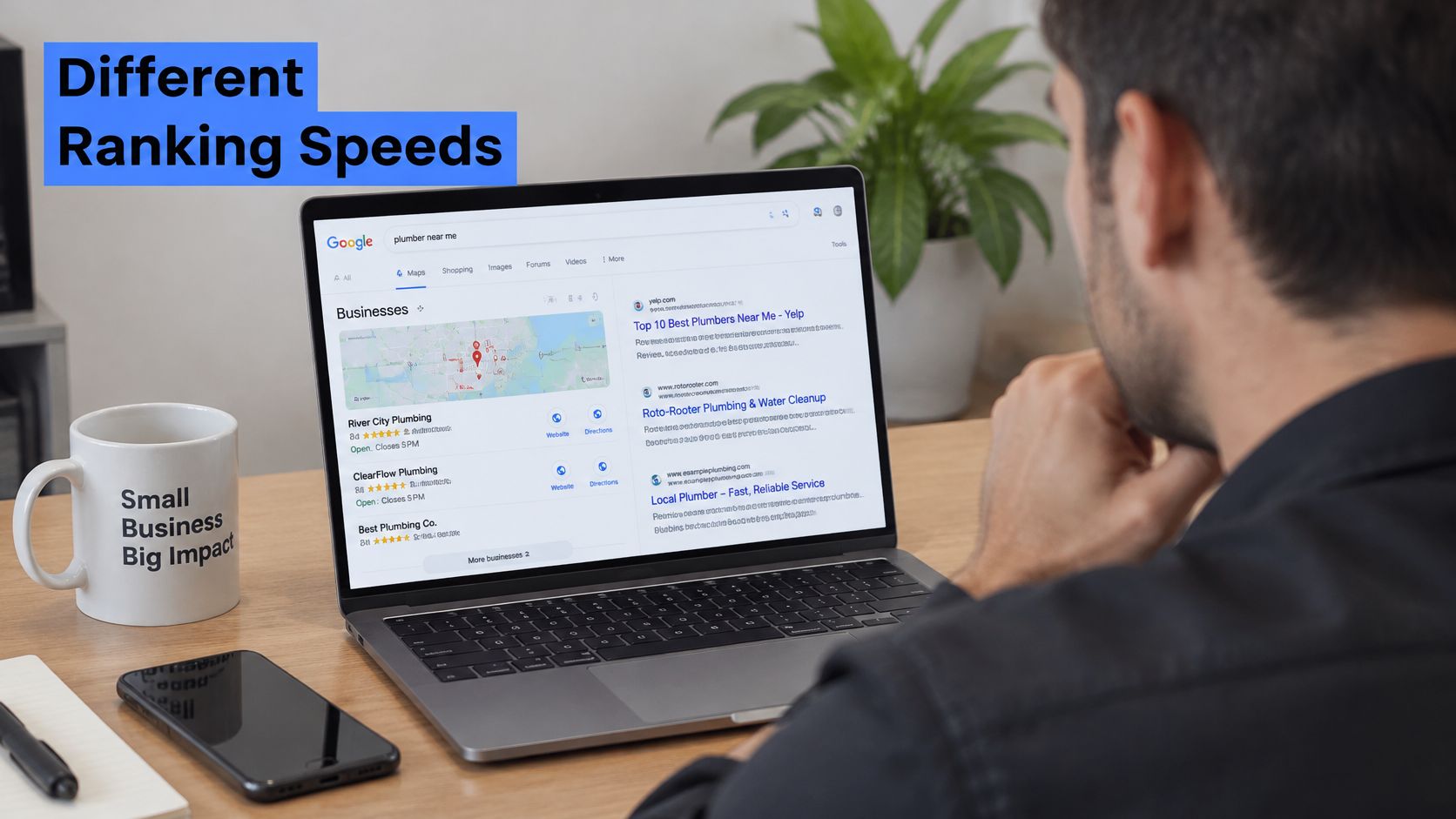
Google ranks local businesses on relevance, distance and prominence, and each changes at a different pace. Relevance moves fastest because categories, services and a complete profile are quick to fix. Distance barely moves at all, since it depends on where the searcher stands. Prominence, built from reviews, links and mentions across the web, accumulates slowest.
That split shows up in practice. According to StrategyC in 2026, local businesses can begin appearing in local-pack results within 6–12 weeks after optimizing their Google Business Profile, publishing location-specific service pages, and obtaining reviews. Our breakdown of Google Maps ranking factors explains which of those signals you can influence directly.
A Plumber Example
Say a plumber verifies his profile, picks the right primary category and publishes a page per service city. Branded and nearby searches improve first, often within the first couple of months. The non-branded term emergency plumber across the whole city may still sit on page two at month four, because it needs dedicated pages, geographic relevance and authoritative inbound links that take time to earn.
The practical lesson is simple. Check map results and organic results separately, because one can be strong while the other lags.
The walkthrough below shows how those separate checks look in practice.
Where AI Answers Fit
AI optimization doesn't replace this work, it rewards it. In Google's generative AI guidance for Search, Google recommends using Business Profiles, where appropriate, to make local business services visible in AI responses as well as other Google Search surfaces. Accurate details, clear service information and a maintained profile feed map results, AI Overviews and AI Mode alike. The same profile work speeds both, which is why we treat LLM visibility as an extension of local SEO, not a separate tactic.
Factors That Speed Up or Slow Down Your Timeline
Two businesses can start on the same day and finish months apart. Their starting conditions decide most of that gap.
| Factor | Faster when | Slower when |
|---|---|---|
| Local competition | Few established rivals in the service city | Dense market with entrenched competitors |
| Site health | Clean crawling, fast pages and clear titles | Indexing errors and thin or duplicate service pages |
| Citations | Name, address and phone match across directories | Conflicting listings and duplicate profiles |
| Google Business Profile | Accurate categories, services and photos | Unverified or incomplete profile |
| Distance from searcher | Business sits near the center of its service area | Customers are far from the business location |
| Service-page coverage | One page for each service and city | One generic homepage targeting every term |
| Links and web mentions | Local partners and directories link to the site | No third-party references |
The Factors You Control
Site health and service-page coverage are fully yours. A clean, crawlable site with one page per service and city gives Google something specific to rank for each search. A single homepage targeting every term gives it nothing specific, so it ranks for none of them well.
Citations are the most underrated fix. Say a dental practice has an old address on half its directory listings and a disconnected phone number on others. I'd correct those before building a single new link, because conflicting data undermines the trust every other signal depends on. That's usually the fastest change a business can make.
- Fastest lever: Profile and citation corrections, because you control the data
- Slowest lever: Links and mentions, because other sites must act
- Fixed constraint: Distance, because the searcher's location sets it
The Factors You Don't
Competition and distance set your ceiling. As Google's local ranking guidance explains, local rankings rest on relevance, distance and prominence together. Distance can't be fully overcome with content, so a business on the edge of its service area should expect slower progress in outer neighborhoods. A dense market with entrenched competitors can add months, since you're not just improving, you're displacing businesses that have accumulated signals for years.
Starting point: Fix the factor you can change this week, then plan around the ones you can't.
Start with your profile and citations. They're fast, they're cheap, and they make every slower factor work harder.
How Many Reviews Your Market Requires
"Get more reviews" is useless advice without a number. The right number depends on your category and your city, and the spread is wide.
The Local Falcon analysis of 50.4 million U.S. local search results across 1,993 categories in 2025 found that median competitive profiles often have roughly 50–300 reviews. Some categories compete with only a few reviews, while others commonly require dozens or hundreds. Major-city businesses may need about twice as many reviews as rural businesses.
Two Markets, Two Timelines
Say a dentist opens in a large metro area where the top three practices each hold several hundred reviews. Her profile can be technically perfect in month one and still sit outside the Local Pack, because she hasn't closed the review gap. Her realistic timeline to a stable top-three spot runs through steady review collection, not through any single optimization.
Contrast a roofing company in a smaller town. If local rivals hold modest review counts, a smaller base of genuine reviews can compete much sooner. Same tactics, very different clock.
- Check the threshold: Count reviews on the top-ranking competitors in each service city
- Set a monthly target: Base it on closing that gap at a pace your job volume supports
- Ask real customers only: Manufactured reviews risk penalties and removal
Our guide to getting more reviews covers compliant ways to build that pace. A complete profile earns early improvement, but holding a top-three position usually requires a steady review advantage, earned one completed job at a time. Budget your timeline around how fast you can earn them.
How to Accelerate Your Local SEO Results
You can't compress Google's timeline, but you can stop wasting it. These six steps remove the delays that are your fault.
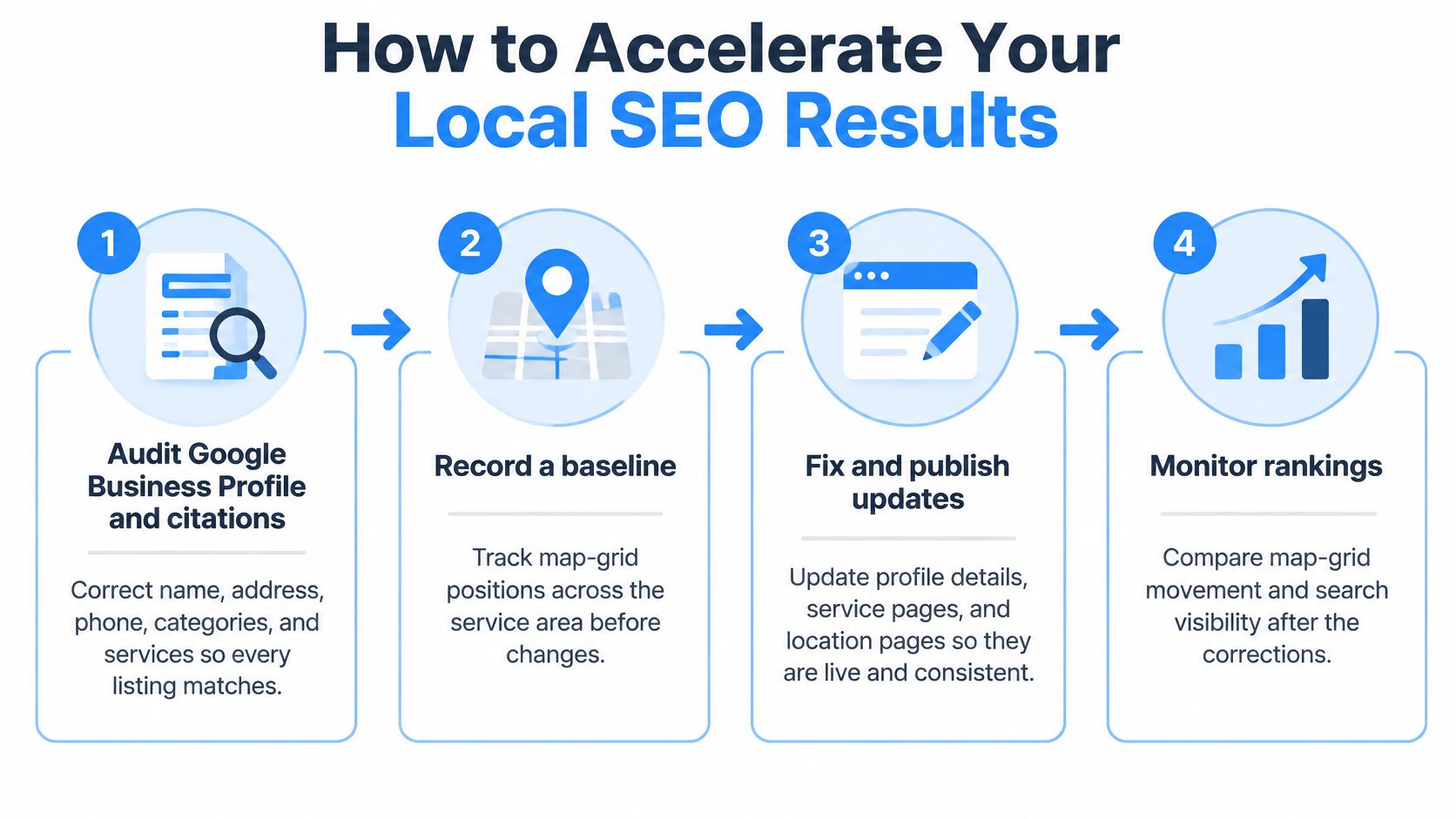
- Audit your profile and citations. Correct name, address, phone, categories and services so every listing matches. Conflicting data slows everything downstream, so this comes first.
- Record a baseline. Capture map-grid positions across your service area and your Search Console queries before you change anything. Without it, you can't prove later gains.
- Choose transactional terms with city names. Target phrases like air conditioning repair near me or roofer near me in the cities you serve. These match customers ready to book, which is the whole point of the exercise.
- Build one page per service and city. Give each page a clear title, local details and a call to action. Specific pages rank for specific searches, generic ones don't.
- Ask for reviews after every job. Request them from real customers and track the monthly count against your competitors. Consistency beats occasional bursts.
- Review monthly and adjust. Compare the grid, queries and calls each month, then fix the terms and pages that lag. Small corrections compound.
Where Businesses Slip
The most common slip is skipping step two. Owners rush to publish pages, then can't tell whether rankings moved. I'd rather delay launch by a day and keep the baseline.
Early progress you can't prove gets defunded, even when it's real.
Time matters on the operations side too, and the routines described in this guide to save time on hospitality marketing translate well to service businesses that need marketing to fit around booked jobs. Our own process follows this order. Transactional's SEO process starts with an initial SEO assessment, and each month, Transactional finds the best keywords for a client's business to rank for and then optimizes the client's Google Business Profile and other listings using them. That monthly cycle keeps the work aimed at terms that produce calls.
Measure Progress and Take the Next Step
A metric only means something at the right moment. Checking revenue at week three tells you nothing. Checking indexation at month six tells you too late. Match each check to the stage where it can change a decision.
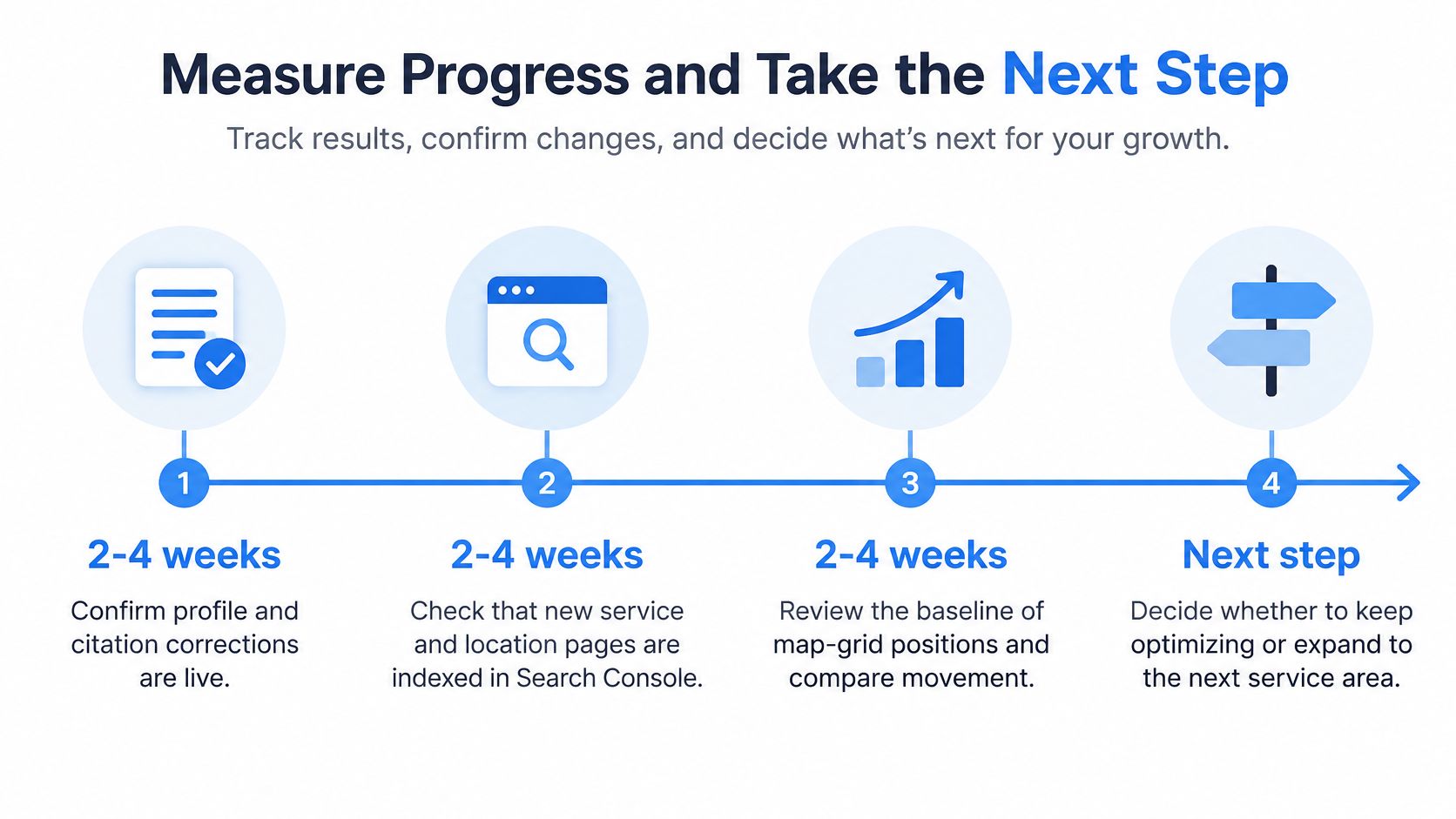
At 2 to 4 Weeks
Confirm the foundations are live. Your profile and citation corrections should be published, new service and location pages should be indexed in Search Console, and your baseline of map-grid positions and queries should be recorded. If pages aren't indexed, fix that before judging anything else. Nothing further down the timeline counts until this step is done.
At 8 to 12 Weeks
Look for first Local Pack appearances and early grid movement near your location. Positions will bounce, and that is normal. Short-term volatility is Google testing, not failure.
Early signals are proof the foundations took hold. They are not the finish line.
Transactional's case study shows steady ranking progress within 1.5 months, when keywords begin to rank higher and organic traffic starts to grow. Treat that movement as confirmation the strategy is pointed the right way, then keep the optimization running.
Every Quarter
Compare map-grid positions, non-branded queries, calls, direction requests and booked jobs against your baseline. Then decide whether to keep going, adjust the terms, or add pages for uncovered cities. Report fast technical wins separately from slower authority and conversion gains, or the slow numbers will make good work look stalled.
For the technical side of that tracking, this developer guide to track search rankings with Scrappey is a solid reference. Our overview of local SEO reporting tools covers the dashboards we use to tie rankings to calls.
Set your financial expectations against the right clock. According to Xpand Digital in 2026, the average time to see meaningful return on investment from SEO is 6–12 months, and competitive citywide terms sit at the far end of that range. On the ranking side, most businesses see improvements within 3 to 6 months with ongoing SEO efforts. The work does not stop at six months. Transactional's Ongoing SEO Maintenance provides continuous updates and strategy refinements to keep up with Google algorithm changes and competitors, because rankings you stop defending get taken.
Results do arrive when the work holds. Winn Smiles doubled its patient calls in 90 days with SEO after partnering with Transactional. The Dominate Local Search Results feature for home services targets appearing on Google's first page and Google Maps when customers search for services in the business's area, and the Google Maps optimization work aims to improve visibility in each client's service areas so more of those searches turn into calls.
Your next step is small. List three to five transactional terms tied to your cities, set your baseline this week, and book an initial assessment so the timeline you plan against is based on your market, not an average.
If you want your business on Google's first page and in Google Maps results for transactional terms like air conditioning repair near me, Transactional LLC can build that plan around your service area, your competitors and a realistic milestone timeline. Start with an initial SEO assessment and turn ready-to-buy searches into booked jobs.