


You're watching spend go out the door, leads stay flat, and a competitor keep owning the map pack for roofer near me or dentist near me. That's usually the point where generic ad testing advice stops helping, because the problem isn't just the ad, it's whether the test is tied to transactional intent in the first place.
For local service businesses, a d tests only matter if they teach you something you can reuse in Google Ads, Google Maps, SEO, and now AI-driven discovery. A good test doesn't just find a better headline. It reveals the exact language a money-in-hand searcher uses when they're ready to call, book, or request a quote.
Why Local Service Businesses Need a Real Ad Testing Playbook
A roofing owner doesn't lose sleep over abstract click-through rates. They notice that calls slowed down while a competitor keeps showing up in the map pack and the same tired ads keep soaking budget. The same thing happens in dental, HVAC, and pest control, where broad marketing advice often ignores high-intent local search.
The mistake is running tests that don't teach anything durable. If a Google Ads or Meta test isn't tracked cleanly, you can't tell whether the winner was the message, the audience, the bid strategy, or the landing page. That's how teams burn money on noise and walk away with no usable insight for the next campaign.
Practical rule: if a test can't be recycled into a landing page, a Google Business Profile post, or a service-page headline, it's not a local growth test. It's just spend.
Transactional intent changes the standard. A person searching air conditioning repair near me isn't browsing for entertainment, they're looking for someone who can solve a problem now. That means every test should answer one question, which angle gets more people to take the next step in a specific city or service area.
The local-service mindset also makes your ads and your organic work feed each other. A winning message from paid media can become an SEO page title, a map post, or an AI-optimized service page later. If you want the bigger picture on budget leakage and how to control it, the customer acquisition cost playbook is a useful companion read.
The Four Test Lanes Every Local Business Should Run
Creative tests
Creative tests are where most local service accounts start, and for good reason. Headline, hook, and format usually drive the first real change in response. A simple hypothesis sounds like this, “If we lead with emergency response and same-day availability, then booked calls will rise among homeowners searching for urgent service in our target area.”
That works because creative is the fastest way to match intent. A roofing ad aimed at storm damage shouldn't sound like a seasonal tune-up offer, and an emergency HVAC ad shouldn't borrow generic brand copy from a national ecommerce playbook. The creative should tell the searcher that you understand the urgency before they click.
Audience tests
Audience tests answer a different question, who is most likely to respond in this market. In local service work, that usually means geo-targeting, service-area radius, in-market behavior, and exclusion logic. The hypothesis can be plain, “If we narrow delivery to homes inside the core service area, then lead quality will improve even if volume dips.”
That trade-off matters. A broader audience often looks cheaper on paper, but the calls can drift into out-of-area noise, price shoppers, or people who aren't ready to book. For local businesses, that's wasted attention, and it usually shows up later as poor close rates.
Bid tests
Bid tests decide how aggressively the platform should pursue the conversion. On Google Ads, that might mean comparing automated bidding approaches against manual control. The hypothesis is, “If we change the bidding strategy to prioritize conversions instead of clicks, then booked-job efficiency will improve on high-intent search terms.”
Bid tests are easy to contaminate if creative and audience are changing at the same time. Keep the traffic stable, otherwise you won't know whether the lift came from the bid model or from the message. The point is to let the platform optimize around the same kind of lead you'd want in the office.
Landing page tests
Landing page tests translate the click into a booked job or patient. Here the hypothesis should focus on offer, form friction, and trust signals, such as call buttons, reviews, licenses, financing notes, or same-day response language. A clean version sounds like, “If we shorten the form and move the proof above the fold, then more visitors will convert from the same traffic source.”
For local service businesses, landing pages matter because they sit closest to the money. A strong ad can still fail if the page is vague, slow, or disconnected from the query. That's why the elements of advertisements and the page that follows it need to feel like one conversation.
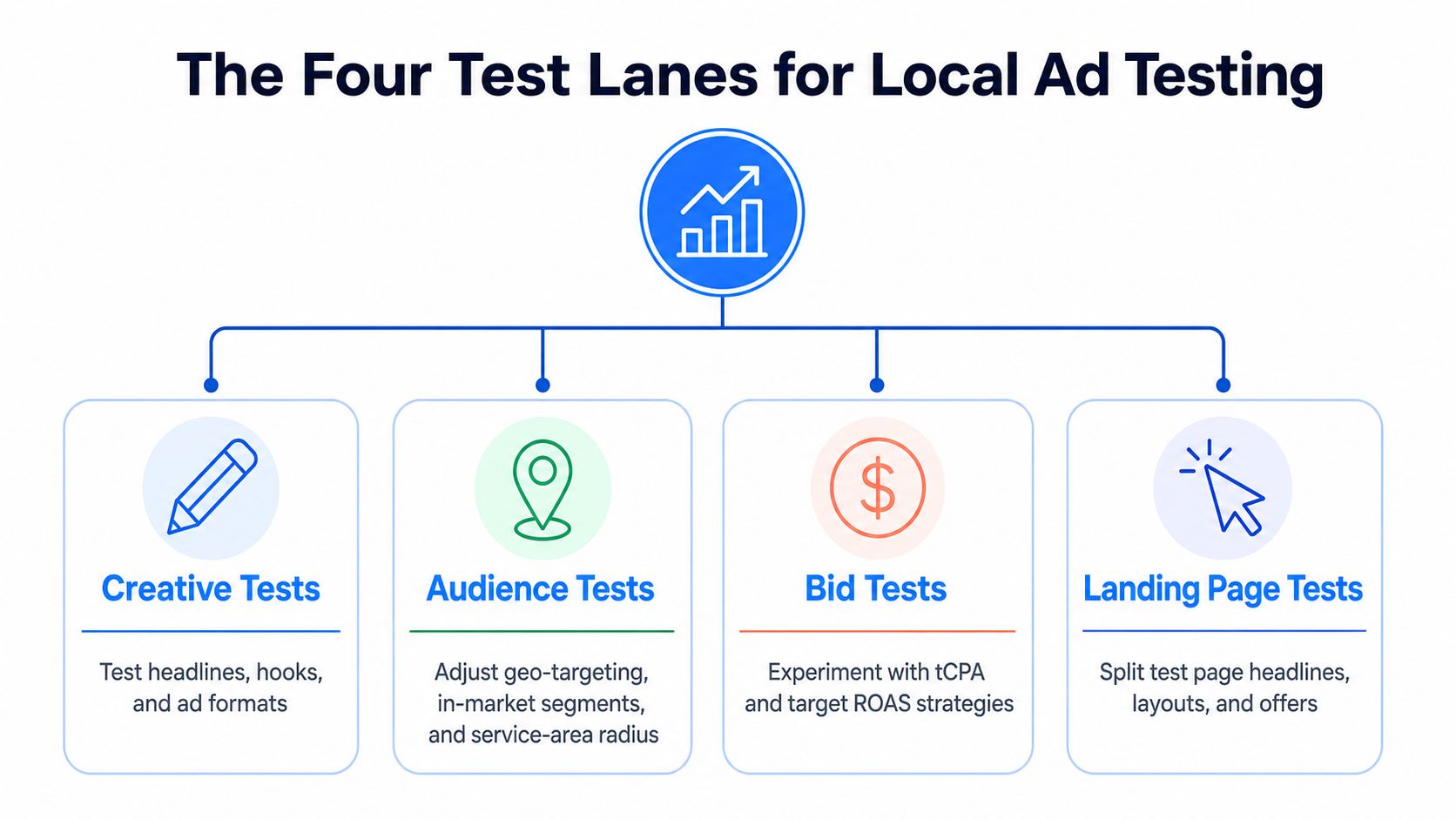
Separate one lane at a time. If the creative, audience, and landing page all change together, you don't have a test, you have a guess.
Pre-Launch Setup and Sample Size Math
A weak test often starts before launch because the setup was sloppy. The first checks are boring, but they keep false winners out of the report. Verified tracking, a firing conversion event, exclusions in place, and a budget that can survive the planned test window all need to be ready before spend goes live.
The math starts with the current baseline conversion rate, the minimum detectable effect, and the confidence and power you want. That is the only way to know whether the lift you are chasing is genuine or just traffic noise. The workflow from practitioner guidance is to define the hypothesis against a business outcome, calculate the sample need from baseline rate, MDE, and desired confidence or power, then let the test run until statistical significance is reached instead of stopping on a fixed calendar date. The full A/B ad testing guide also recommends even traffic splits, usually 50/50 for two variants, and warns against premature stopping.
For local service tests, the practical benchmark is straightforward. Credible guidance points to at least 7 full days to capture weekday and weekend behavior, with 3 to 4 weeks sometimes needed for low-impression campaigns. It also notes that roughly 50 to 100 conversions per variant can support confident conclusions, while stronger directional reads often use about 1,000 conversions or 10,000 impressions per variant, depending on channel and volume. The same practitioner benchmark supports those rule-of-thumb ranges.
Sample Size and Duration Cheat Sheet for Local Ad Tests
| Volume Tier | Conversions per Variant | Impressions per Variant | Suggested Duration | Confidence Read |
|---|---|---|---|---|
| Low volume | 50 to 100 | Not reliable for early reads | At least 7 full days, often longer | Directional only |
| Medium volume | Around 1,000 | Around 10,000 | 2 to 4 weeks, depending on pace | Stronger directional read |
| Low-impression campaigns | 50 to 100 if possible | Can take substantial time to accumulate | 3 to 4 weeks sometimes needed | More conservative read |
Practical rule: never stop because the calendar says the test is “done.” Stop when the data can support the decision you need to make.
The mistake local teams make is pacing budget to a deadline instead of to a sample requirement. If the sample will not arrive in time, the right fix is to reduce the number of variants, widen the window, or choose a higher-volume query set. If you need a cleaner way to estimate acquisition economics before launch, the cost per acquisition guide gives a useful framework. For teams testing short-form social creative at the same time, Boost TikTok ad performance can help keep creative reviews tied to actual delivery results.
Google Ads Versus Meta Creative Testing Mechanics
Google Ads and Meta both support testing, but they reward different behavior. Google is more intent-driven, so query alignment and landing page relevance matter more. Meta is more creative-driven, so the hook, visual structure, and angle usually decide whether a concept gets attention.
Google Ads testing tends to center on campaign drafts, experiments, copy variations, and landing page comparisons. That makes it a strong fit for service-area intent, because someone already searching for roofer near me or dentist near me is signaling demand directly. If the ad matches the query closely, the platform has a better chance of surfacing the right business at the right moment. The Google Ads campaign setup guide is the natural place to build that foundation.
Meta behaves differently. The platform is much better for creative iteration, short-cycle testing, and angle discovery. Practitioner guidance now also emphasizes isolating one variable at a time, running 3 to 5 variants simultaneously, and keeping static and video in separate groups so one format doesn't drown out the others. The same guidance also points to dedicated testing campaigns, short kill rules, and careful handling of learning-phase effects, which is why a local business can't treat Meta like a simple copy swap machine. The Meta creative-testing discussion makes that separation clear.
For teams that also work in short-form social, RenderIO's Boost TikTok ad performance resource is useful because it reinforces the same principle, creative structure is a variable on its own, not a side note.
Google Ads and Meta behave differently in practice
- Lead with Google when the searcher already has local intent and is closer to a call or form fill.
- Lead with Meta when you want to shape demand, test hooks, or learn which promise earns attention.
- Keep the variable clean so you can compare results across platforms without blending message, audience, and format into one unreadable mix.
- Use the same business outcome for both platforms, booked job, booked patient, or qualified lead, so the learnings stay comparable.
The biggest mistake is assuming a winner on one platform will translate perfectly to the other. Sometimes it does, but only after the angle is adapted to the user's mindset. Google wants precision. Meta wants a reason to stop scrolling.
Turning Winning Angles Into Landing Pages and Organic Content
A strong angle shouldn't die in the ad account. It should move downstream and keep working.
Take a local HVAC example. A Meta test might show that same-day AC repair with upfront pricing gets better response than a softer brand promise. That winning angle can become the landing page headline, the first line in the supporting copy, the click-to-call prompt, and the trust block above the fold. The page should feel like the ad continued, not like a different company took over after the click.
That same angle can then become SEO and map content. The headline can inform the service page targeting air conditioning repair near me, the Google Business Profile post can echo the same promise, and the content silo can answer the questions a homeowner asks before they call. In an AI search environment where Google is testing Gemini-based ad experiences and conversational discovery formats, that alignment matters even more because the search result itself is becoming more explanatory and context-aware, not just a static list of blue links. Google's own Search ad updates around Gemini and AI-driven formats point in that direction, especially for helpful, personalized responses inside Search.
The guide to effective landing page tests is helpful here because it reinforces a simple point, the page has to preserve the promise that won the test. If the ad said same-day service and upfront pricing, the landing page shouldn't bury that under generic company language.
Winning local ads are assets, not throwaways. One good angle can carry paid media, a service page, a map post, and an AI-optimized article if you keep the wording tight.
The cleaner the reuse, the stronger the equity. A business that owns the same transactional angle across paid, organic, map, and AI discovery doesn't just win one campaign. It builds a repeatable search position around the exact terms that matter in its city.
Reading the Results and Feeding Them Into SEO and Maps
The post-test decision is where a lot of teams get lazy. A variant can win on cost per lead and still lose on booked jobs if the leads are low intent. In that case, the page or ad may look efficient in-platform while producing weaker sales outcomes, so the winner shouldn't automatically graduate.
The decision rule is straightforward. Promote the variant that improves the business outcome you care about, not just the cheapest click or lowest lead cost. Retire the loser if it clearly underperforms after a fair sample, and keep the winner only if the call quality, booking rate, or close rate holds up when the sales team touches it.
Troubleshooting the most common test failures
- Tests under 7 days: extend the window, because weekday and weekend behavior can distort the read.
- Tests split unevenly: reset the traffic allocation, because one side never had a fair shot.
- Tests killed by learning phase effects: keep the configuration stable longer and avoid unnecessary edits while the platform is still optimizing.
Once a winner is real, map it to the next layer. The angle should point to a target keyword, a Google Maps post, and a service-city content silo. That's how transactional search terms get owned over time, because the same phrase keeps showing up in the ad, the map profile, the page, and the supporting article. The searcher sees one message in multiple places, and that consistency is what local discovery rewards.
The 30-Day Ad Testing Sprint for a Local Service Business
Week 1 sets the baseline, verifies tracking, and launches the first creative test against a real transactional query. Week 2 layers in an audience test so you can see whether the lead quality changes by geo or service area. Week 3 puts the leading angle onto a landing page and checks whether the same promise still converts once the click lands. Week 4 takes the winner into organic content, map posts, and AI-search assets so the result compounds outside the ad account.
That sprint produces more than a prettier dashboard. It gives the business a tighter cost per booked job, better local visibility, and a growing footprint around the exact search terms people use when they're ready to spend. The point of a d tests for local service companies isn't just to make ads look smarter. It's to keep showing up where money-in-hand searchers are already asking for help.
Transactional LLC helps local service businesses turn test results into search visibility that compounds. If you want a team that builds transactional intent campaigns, Google Maps optimization, and AI-ready content around the exact terms your customers use, visit Transactional LLC and see how the strategy can fit your service area.