
You're probably dealing with a familiar problem. The phone rings, but too many calls are for cheap mowing, one-off cleanup, or people who want a quote from five companies and hire nobody. Meanwhile, the services that move your revenue, retaining walls, irrigation, lighting, drainage correction, premium installs, don't show up often enough.
That's usually not a lead problem. It's an intent problem.
Most ads for landscaping fail because they chase activity instead of buyers. More clicks. More impressions. More “reach.” None of that matters if the wrong homeowner fills out the form. If you want booked jobs, your ads need to target transactional searches, meaning searches made by people who are ready to hire now. That's the standard. It's also the standard AI-driven search will keep rewarding, because AI systems surface businesses that clearly match direct, commercial queries instead of vague informational content.
Adopt a Transactional Mindset for Your Ad Strategy
A homeowner searching “landscaping ideas” is browsing. A homeowner searching “retaining wall installation near me” is shopping. If your campaign treats those two searches the same, you'll waste money.
That's why the right approach to ads for landscaping starts with a hard rule. Bid on buying intent, not curiosity. Generic “landscaping” campaigns pull in mixed traffic. Some of it is useful. A lot of it isn't. The better play is tighter segmentation by service and by job value.
Stop buying generic landscaping clicks
One source aimed at grounds care professionals makes the point clearly: many companies miss the opportunity to focus on high-profit services, and a better approach is to create separate campaigns and landing pages for each service because that improves conversion rates and significantly lowers cost per lead by matching ads to transactional search intent, as noted in Scorpion's landscaping advertising guidance.
That's the difference between advertising and guessing.
Run separate campaigns for services like:
- Hardscaping: paver patio installation, retaining wall contractors, walkway pavers
- Water and drainage work: sprinkler repair, irrigation installation, French drain installation
- Outdoor upgrades: outdoor lighting installation, sod installation, grading
- Seasonal profit centers: spring cleanup, fall cleanup, mulch installation
Don't dump all of that into one ad group and hope Google sorts it out.
Practical rule: If the keyword doesn't describe a service someone can hire you for right now, it usually doesn't belong in your paid campaign.
Structure your business around transactional search
A lot of exterior property care providers still think in terms of “we do exterior property care.” Homeowners don't search that way when they're serious. They search by problem, project, urgency, and location.
That means your ads, landing pages, Google Business Profile, and service pages should all align around exact buyer language. If you need a clean definition of how search intent works, review what search queries actually signal. It will sharpen how you build campaigns.
This also helps beyond standard SEO. AI search tools and large language models don't reward vague service descriptions well. They favor businesses with clear service pages, local relevance, and direct answers to commercial questions. “We offer beautiful outdoor solutions” is fluff. “Patio paver installation in Plano” is useful.
Focus on lead quality before lead volume
More leads can hurt you if they fill your schedule with low-margin work. A healthier pipeline starts with deciding what you want more of, then building campaigns around those terms. If you want an outside perspective on how contractors clean up that process, this guide on how to improve your contractor marketing pipeline is worth reading because it reinforces the same operational truth: better inputs produce better jobs.
Here's the blunt version:
| Search type | What it usually means | Should you bid aggressively |
|---|---|---|
| “landscaping ideas” | Research mode | No |
| “best plants for shade” | Informational | No |
| “landscape lighting installer near me” | Transactional | Yes |
| “sprinkler repair [city]” | Immediate problem solving | Yes |
| “retaining wall contractors near me” | High-value project intent | Yes |
The grounds care professionals who win paid search don't try to show up for everything. They show up for the searches tied directly to revenue.
Select Ad Platforms to Capture Ready-to-Buy Customers
A homeowner searches "sprinkler repair near me" at 8:10 a.m. and wants someone out this week. Another scrolls Instagram after dinner and pauses on a patio makeover photo. Those two clicks do not carry the same buying intent, so they should never get the same budget priority.
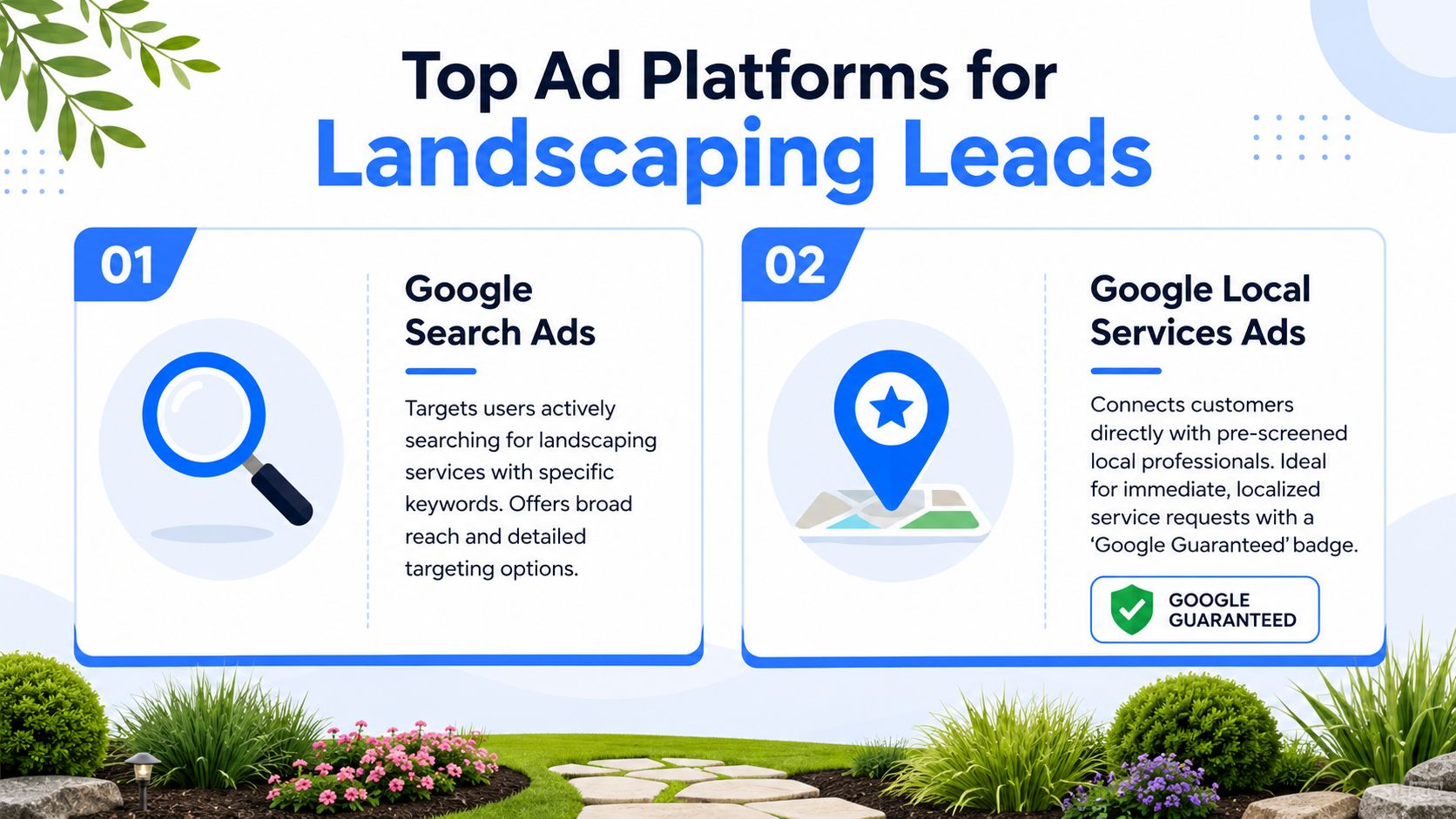
If your goal is high-value jobs now, choose platforms by transactional intent. Ignore vanity reach. Ignore impressions. Put money where buyers ask for service, pricing, and availability.
Google Search Ads for direct demand
Google Search Ads should get first priority because they capture active demand. A search like "drainage contractor near me," "sod installation quote," or "sprinkler valve repair" signals a homeowner who is close to hiring.
That makes search your best channel for immediate lead flow and the cleanest path to measuring real ROI. It also lines up with how AI-driven search is headed. Clear service intent, clear geography, clear next step.
Use search for your highest-value service lines first. Retaining walls, drainage correction, irrigation repair, patio installation, lighting. Jobs with urgency or strong commercial intent belong here.
LSAs for trust-heavy local clicks
Google Local Services Ads deserve the next budget slot if your category is eligible. They show up at the top of local results, put reviews and the Google badge in front of the prospect, and reduce friction before someone ever reaches your site.
If you need a clearer breakdown of setup and eligibility, review Google Guarantee Ads for local service businesses. LSAs work best when the buyer wants proof fast and plans to contact a provider right away.
They are not a replacement for search campaigns. They are a trust layer on top of them.
Facebook and Instagram as support channels
Facebook and Instagram belong in a support role. Use them for remarketing, audience warming, and staying visible during longer decision cycles.
That matters for outdoor kitchens, full yard redesigns, premium hardscaping, and other bigger-ticket projects where homeowners compare options over time. A source focused on the industry notes stronger results from Facebook when campaigns are judged by estimate quality and booked work, not cheap lead form volume, according to Savant Marketing Agency's Facebook ads benchmarks for landscapers.
Keep the hierarchy straight. Social can assist the sale. Search captures the hand-raiser.
The same logic shows up in other home service categories. If you want a parallel example, study how service businesses master Google Ads for your cleaning company by putting buyer intent ahead of broad exposure.
Budget priority for ready-to-buy traffic
Start with the platforms that produce phone calls, quote requests, and booked estimates.
- Google Search Ads for service-plus-city searches with clear hiring intent
- Google LSAs for trust, reviews, and fast local contact
- Facebook or Instagram for remarketing and longer sales cycles
Small budget? Put it into Search first.
Once Search is producing qualified leads and LSAs are set up properly, add paid social to re-engage visitors who did not book on the first visit. That order protects your budget and keeps your ad strategy tied to transactions, not attention.
Build Ad Campaigns That Attract Transactional Searches
Bad campaign structure burns money fast. A homeowner searches "patio paver installer near me," clicks your ad, lands on a generic services page, and leaves. You paid for that mistake.

If you want high-value jobs, build campaigns around hiring intent. Every keyword, ad, and page should point to one service and one next step.
Build around service-specific keyword groups
Stop stuffing everything into one campaign. That setup attracts mixed intent, weak clicks, and low-quality leads.
Build one campaign per service line, then split ad groups by closely matched search terms. A clean structure looks like this:
- Campaign 1: Retaining walls
- Campaign 2: Patio pavers
- Campaign 3: Irrigation repair
- Campaign 4: Outdoor lighting
- Campaign 5: Seasonal cleanup
Inside each campaign, keep the terms tight. "Retaining wall contractor," "retaining wall installation," and "retaining wall builder near me" belong together because the searcher is looking for the same job. "Lawn mowing" does not.
That level of control matters for transactional intent. It lets you write sharper ads, send traffic to the right page, and filter out searches from people who are browsing instead of buying.
Write ads that match the next action
A ready-to-buy homeowner wants confirmation, not clever copy. Your ad should answer four questions in seconds:
- What do you do? Patio paver installation, drainage correction, sprinkler repair
- Where do you do it? City, county, neighborhood, or service area
- Why trust you? Licensed, experienced, locally based, real project photos
- What should I do now? Request a quote, book an estimate, call today
Write headlines that mirror the search. If the query is "irrigation repair near me," your ad should say irrigation repair, not "complete outdoor solutions." Broad wording kills relevance and lowers lead quality.
If you want a broader look at ad construction across local service industries, this article on how to master Google Ads for your cleaning company is useful because the account logic is similar even though the service category is different.
A useful internal checklist for messaging is this set of core elements of advertisements that drive action. If your ad does not make the service, location, and next step obvious, rewrite it.
Ad writing rule: Put the exact service in the headline and make the conversion step impossible to miss.
Use geo-targeting and negative keywords with discipline
Loose targeting is a tax on your budget.
Set your ads to the service area you will cover profitably. Exclude towns you do not want, border areas that waste drive time, and any region where crews cannot respond fast. If a zip code never turns into profitable work, cut it.
Negative keywords matter just as much. Add terms that signal low intent or bad fit, including:
- Research terms: ideas, pictures, inspiration, examples
- DIY terms: how to, tutorial, do it yourself
- Employment terms: jobs, salary, hiring, apprenticeship
- Wrong-service terms: mowing, tree removal, maintenance, if you only want install work
As noted earlier, benchmarks for outdoor services show paid search is not cheap. That is why account hygiene matters. Junk traffic drives up cost per lead and fills your pipeline with people who were never going to hire you.
A quick visual can help if you're mapping campaign intent to creative and placement:
Send every click to the right place
One ad group should point to one service page. Keep it that strict.
If the ad sells irrigation repair, send the click to an irrigation repair page with proof, local relevance, and a quote form. If the ad sells outdoor lighting, send the click to an outdoor lighting page. This is how you turn transactional searches into booked estimates instead of bounced visits.
AI-driven search will reward this precision too. Clear service intent, local specificity, and strong message match give both search engines and homeowners fewer reasons to hesitate.
Optimize Landing Pages and Local Trust Signals
A paid click is expensive. Sending it to a weak page is stupid.
Most outdoor living websites weren't built for conversion. They were built to exist. Big difference. A homeowner who clicks an ad for outdoor lighting should land on a page about outdoor lighting, not a vague homepage with six menu options and a stock photo of grass.

Match the page to the job
Every landing page should answer five questions fast:
| What the visitor needs to know | What your page should show |
|---|---|
| Do you do this service? | One service-specific headline |
| Do you work in my area? | Service area copy and local references |
| Can I trust you? | Reviews, photos, badges, proof of work |
| What happens next? | Clear form or click-to-call CTA |
| Why choose you? | Sharp value proposition, not generic fluff |
Keep the page focused. Remove top-nav clutter if the page is built for ads. Show actual project photos. Add a short form. Put the phone number high on the page. If the service has common objections, address them directly.
For example, a drainage page should talk about standing water, erosion, runoff, grading, and correction options. A lighting page should emphasize design, safety, curb appeal, and system installation.
Your paid ads convert better when your local presence is strong
A lot of outdoor service providers separate paid ads from local SEO and Maps. That's a mistake. Homeowners click an ad, then check your reviews, Google Business Profile, and service details before they contact you. Paid traffic and local trust signals work together.
One source notes that Google Local Services Ads appear above traditional ads and organic listings, and that the Google Guaranteed badge, along with reviews and service details, increases the likelihood of a homeowner making contact, according to Improve & Grow's landscaping advertising analysis.
That same logic applies beyond LSAs. When your Google Business Profile is complete, active, and review-rich, your standard paid traffic gets stronger too. Homeowners validate before they convert.
Your ad earns the click. Your reviews, service details, and local proof often earn the call.
Don't send premium traffic to a generic experience
If you advertise hardscaping, build a hardscaping page. If you advertise irrigation, build an irrigation page. If you advertise in multiple cities, localize the page copy and proof where appropriate.
That kind of structure also helps AI search systems understand your business. Service-specific pages, clear local relevance, and consistent business details make it easier for search engines and AI tools to connect your company to transactional questions from real buyers.
Master Budgeting Bidding and Measuring True ROI
Flat budgets are lazy. Landscaping demand doesn't stay flat, so your ad spend shouldn't either.
This category is seasonal. If you spend the same amount every month, you're ignoring how buyers search, when they convert, and which services are worth pushing at different times of year.

Budget around demand curves, not habit
A benchmark across 61 outdoor service providers showed average monthly spend of $567.69 in 2024, with spending ranging from about $300 in January to just over $1,000 in April. The same data showed search demand peaking in April, while conversion rates varied by month, including 7.82% in February versus 4.59% in April, according to these landscaping seasonality benchmarks.
That matters because higher demand doesn't automatically mean higher efficiency.
If April is crowded and expensive, you may need to raise budget for volume while tightening targeting to protect quality. If February converts better for a service line, you should lean in earlier instead of waiting for the obvious spring rush.
Track the numbers that decide profit
Most yard care and grounds maintenance businesses watch clicks and leads. That's not enough. You need to track the path from lead to estimate to booked job.
Use this stack:
- Cost per lead: what you paid to generate the inquiry
- Lead-to-estimate rate: how many inquiries turn into real opportunities
- Close rate: how many estimates become jobs
- Average job value: whether the campaign attracts profitable work
If you want the financial framework in plain language, review how to calculate cost per acquisition for local campaigns. That's the metric discipline most small operators skip.
Operational takeaway: A cheap lead that never turns into an estimate is not a good lead.
Bidding should follow service value
Don't bid the same way across every service.
A campaign for sprinkler repair may need fast-response, high-intent bidding because urgency drives action. A campaign for outdoor space design may need a slower sales process with tighter qualification and better remarketing support. Budget should follow both intent and margin.
A practical decision model looks like this:
| Service type | Intent level | Budget approach | Main KPI |
|---|---|---|---|
| Emergency or repair work | High | Protect visibility in core areas | Booked jobs |
| Premium installs | High but selective | Focus on exact terms and better landing pages | Qualified estimates |
| Seasonal cleanup | Time-sensitive | Increase before demand spikes | Cost per booked route/job |
The benchmark authors also warn that higher budgets don't necessarily improve lead volume or lead quality. That warning is right. More spend only helps when targeting, service mix, and close process are already under control.
Your Blueprint for Dominating Local Landscaping Searches
Those who win in this industry don't market like generalists. They build around intent.
They target transactional searches first. They split campaigns by service instead of hiding everything under “landscaping.” They use Google Search for active demand, LSAs for trust-heavy local visibility, and paid social for remarketing instead of pretending Facebook traffic is the same as a buyer searching for a contractor. They send clicks to focused pages, not homepages. Then they measure booked jobs, not vanity metrics.
The system that actually works
Here's the short version:
Choose the services worth advertising
Focus on the work that supports margin and schedule quality.Build campaigns around exact buyer language
“Retaining wall contractor near me” beats “landscaping services” every time.Align every ad with a matching landing page
Search intent should carry straight through to the page and CTA.Strengthen Maps, reviews, and local trust
Homeowners check your local presence before they commit.Adjust budget by season and service line
Spend where demand and profitability overlap.
That framework also sets you up for AI-driven discovery. AI search systems don't want broad marketing language. They need clear service entities, strong local context, structured pages, and obvious commercial relevance. Businesses that organize their sites and campaigns around transactional intent are easier for both Google and AI tools to surface.
Don't isolate ads from the rest of local marketing
The smartest garden and yard care specialists connect paid ads to local SEO, Maps visibility, reviews, remarketing, and even offline follow-up. If you're thinking about how digital and offline channels can reinforce each other, this article on integrating local SEO and direct mail is a useful example of how local service businesses can create repeated exposure instead of relying on one touchpoint.
One more blunt truth. If you want to dominate ads for landscaping, your real competitor isn't the biggest company in town. It's the company that responds first, looks the most trustworthy, and appears exactly when a homeowner searches with money in hand.
That's the whole game.
If you want help building a landscaping marketing system around transactional search terms, Google Maps visibility, service-area SEO, and paid campaigns that target buyers instead of browsers, talk to Transactional LLC. They focus on getting local service businesses found for the searches that lead directly to calls, estimates, and booked jobs.