


Let’s cut to the chase. Content marketing for plumbers isn’t about writing generic blog posts or posting on social media a few times a week. It's a calculated strategy for creating specific online content—service pages, blog articles, and location-specific guides—that puts your business in front of homeowners at the exact moment they need you. This is how Transactional Marketing gets our clients to show up for the exact search terms their customers are using.
This isn’t about just having a website; it’s about turning that website into your best salesperson, one that works 24/7 to bring in paying customers. When someone’s basement is flooding, they aren’t looking for plumbing trivia. They’re searching for a hero with a transactional search term like "emergency plumber near me," and your content is what makes you the first one they call.
Why Your Plumbing Business Needs Transactional Content
Tired of throwing money at ads that don't bring in actual jobs? The most efficient path from a frantic Google search to a booked appointment is through transactional content marketing. Forget the fluffy "5 Tips to Save Water" articles. We're talking about a focused approach that targets customers with a credit card in hand, ready to hire someone now.
Our entire system here at Transactional Marketing is built on this foundation. It's why we're called Transactional Marketing. We work to get your plumbing business ranking for the exact search terms that signal an immediate need. These are what we call transactional search terms.
A transactional search term is what a customer types when they have an urgent problem and are ready to spend money to fix it. Think "emergency plumber near me" or "clogged drain repair in Dallas." This person has money in their hand, ready to spend. Capturing this traffic is the secret to a constantly ringing phone.
This approach fundamentally changes the game. You stop interrupting potential customers and instead become the solution they’re actively seeking. That's how we get our customers to show up for these transactional search terms and make their company the obvious choice.
To win, you have to understand the mindset of the searcher. Are they just curious, or do they have a real problem that costs them money every minute it's not fixed? Focusing on the latter is how you build a profitable business, not just a website with traffic.
Transactional Vs Informational Searches for Plumbers
| Search Type | Example Search Query | Customer Intent | Value To Your Business |
|---|---|---|---|
| Transactional | "24 hour plumber in Phoenix" | Urgent Need: Find and hire a plumber immediately. They have a problem that needs solving right now. | High: These searches directly lead to booked jobs and revenue. This is your primary target. |
| Informational | "why is my faucet dripping" | Research: Understand a problem or learn how to do something. They are not ready to hire yet. | Low (Immediate): Can be valuable for long-term brand awareness but doesn't lead to immediate work. |
As you can see, there's a world of difference. While informational content has its place, your bread and butter comes from capturing those high-intent, transactional searches.
Connecting Content Directly to Calls
The plumbing industry is crowded, with over 113,000 companies fighting for the same customers. A powerful online presence isn't just an advantage anymore; it's a requirement for survival. Studies show that 97% of people now look online for local services.
Here's the most important number: an overwhelming 93% of those searching for plumbers actually call a business after finding what they need online.
This is where our strategy really shines. By creating content that precisely matches what a paying customer is searching for, we make sure you're the one they find and call. A huge piece of this puzzle is integrating your website content with your Google Business Profile to dominate the Google Maps 3-Pack. Transactional Marketing has the technology to get your business into those top three spots, which translates into hundreds of more phone calls every month and literally thousands of more phone calls every year.
It's not just about getting found; it's about getting chosen. A smart content strategy does three things perfectly:
- Answers Urgent Needs: Your content speaks directly to a homeowner's pain, whether it’s a burst pipe on a holiday weekend or a water heater that's gone cold.
- Builds Instant Trust: Providing clear, no-nonsense answers establishes you as the expert before you even pick up the phone.
- Targets Ready-to-Buy Customers: You laser-focus your efforts on homeowners who are past the "just looking" phase and are ready to hire a professional.
At Transactional Marketing, we use a battle-tested process to pinpoint these money-making keywords and build a powerful content machine around them. It’s our proven system that literally gets our clients' websites showing up on page one of Google, typically within 30 to 60 days. Our only mission is to make your phone ring with qualified, local customers ready to book a job. If you're curious about how this applies to other local industries, you can explore our overview of content marketing for local businesses.
Building Content Silos Around Your Most Profitable Services
Let's be honest: a random blog post about "5 plumbing tips" isn't going to make your phone ring. If you want content that actually books jobs, you need a smart, structured game plan. This is where content siloing comes in.
Instead of just throwing content at your website and hoping something sticks, you organize everything around your most profitable services. This strategy does two critical things: it signals deep expertise to search engines and AI, and it turns your website into an authority on the specific problems people in your town are facing.
This laser-focused approach is how we get our plumbing clients ranking on page one, often in as little as 30 to 60 days. We don't just build websites; we build ranking machines. By creating these carefully planned content silos, you make it crystal clear to search engines that you are the local expert for a particular service, like "air conditioning repair near me" or in this case, "water heater repair near me."
A content silo is simply a way of grouping related content together on your site. For example, everything you write about 'drain cleaning' lives in one group and links back and forth, creating a powerful, organized hierarchy that Google and AI LLMs love.
This method gets you away from a flat, disorganized website where every page is basically competing with every other page. Instead, you create focused "hubs" of expertise that build on each other.
How to Architect Your First Plumbing Silo
First, think about your biggest money-maker. Is it drain cleaning? Water heater installation? Let's run with drain cleaning as our example.
Your main "Drain Cleaning" service page is the anchor, the central pillar of this entire silo. This is the page you want to rank for the big-money transactional term, like "drain cleaning services in [Your City]."
From there, you build out the rest of the silo with supporting content that all links back to that main pillar page. This will look something like this:
- Specific Service Pages: Get granular. Create dedicated pages for things like "hydro jetting services" or "clogged sewer line repair." These target niche keywords that are still incredibly valuable.
- Informational Blog Posts: Answer the real questions your customers have. Write articles like, "What Are the Signs of a Main Sewer Line Clog?" or "How to Prevent Kitchen Sink Blockages."
Every single one of these supporting pages needs to link up to your main "Drain Cleaning" pillar page. This structure is key—it funnels all that authority upwards, telling Google that your main service page is the most important resource you have on that topic.
This diagram shows how a simple silo gives your site a clean structure, creating clear pathways for both your customers and search engine crawlers.
As you can see, the main topic page sits at the top, supported by more specific sub-pages. This is what strengthens your main page's ability to rank.
Finding the Right Keywords for Your Silos
A silo is only as good as the keywords it’s built on. You have to go after the transactional search terms that your local customers are actually typing into their phones when a pipe bursts.
We don't guess. At Transactional Marketing, our process is not like every other boring marketing company. We know how to laser focus and target specific search terms and get businesses to show up for them right in their local cities.
We use professional tools and deep analysis to find the terms that signal urgency and a wallet that's ready to open—phrases like "sump pump repair near me" or "emergency water heater replacement." These are the exact phrases that drive immediate business. Each silo you build should be centered around a group of these high-value, transactional keywords.
Here’s what a 'Water Heater' silo could look like:
- Pillar Page: "Water Heater Repair and Installation in [Your City]"
- Supporting Service Page: "Tankless Water Heater Services"
- Supporting Blog Post: "How Much Does a New Water Heater Cost?"
- Supporting Blog Post: "Signs Your Water Heater Is About to Fail"
By meticulously organizing your site this way, you're not just creating random content; you're building a strategic framework designed to dominate the search results for your most valuable services. This is the foundation of a content marketing plan that works.
To see how this silo strategy fits into the bigger picture, check out our guide on local SEO for plumbers. This organized approach ensures that when a potential customer searches for a service you offer, your website is the most relevant, authoritative answer they find.
How Your Website Content Gets You to the Top of Google Maps
For any plumber, the Google Maps 3-Pack is everything. It's the digital main street where customers with a burst pipe or a backed-up sewer line are making a split-second decision on who to call. Your website's content is the engine that drives your visibility on that map. Get this connection right, and your phone will ring off the hook.
Let's be clear: winning in local search is the whole ballgame. A staggering 42% of local searches lead to a click on the map pack results. On a phone, where most of your emergency calls come from, that number jumps to a massive 70%.
Those top three spots aren't just for show—they get a whopping 44% click-through rate (CTR). Even better, nearly 28% of those local searches turn into a sale. This is where your best, highest-intent customers are found.
The Direct Line Between Your Website and the Map
At Transactional Marketing, our entire system is built to push our clients into those top map spots. It is very, very important for businesses to show up in the Google business maps. It all hinges on having the right content foundation on your website. Google Maps isn’t some isolated island; it actively pulls information from your Google Business Profile (GBP) and, just as importantly, your website to figure out if you're the right plumber for the job.
The connection is really that direct. When you build out detailed, locally-focused service pages, you're sending powerful ranking signals to Google. A page on your site for "Emergency Sump Pump Repair in South Austin" tells Google you're the go-to expert for anyone searching that exact transactional term in that part of town. That’s how you climb the map rankings.
Your website content and your Google Maps listing are a team. Strong, hyper-local service pages feed Google the proof it needs to rank you higher in the 3-Pack for money-making searches.
Think of it this way: every service you offer in a specific neighborhood is a new chance to rank. Generic "plumbing services" content gets you buried. Specific, geo-targeted content gets you found by the customers right around the corner who are ready to hire you.
This is what we mean when we talk about building service silos. You start broad and funnel your website's authority down into highly specific, profitable services.
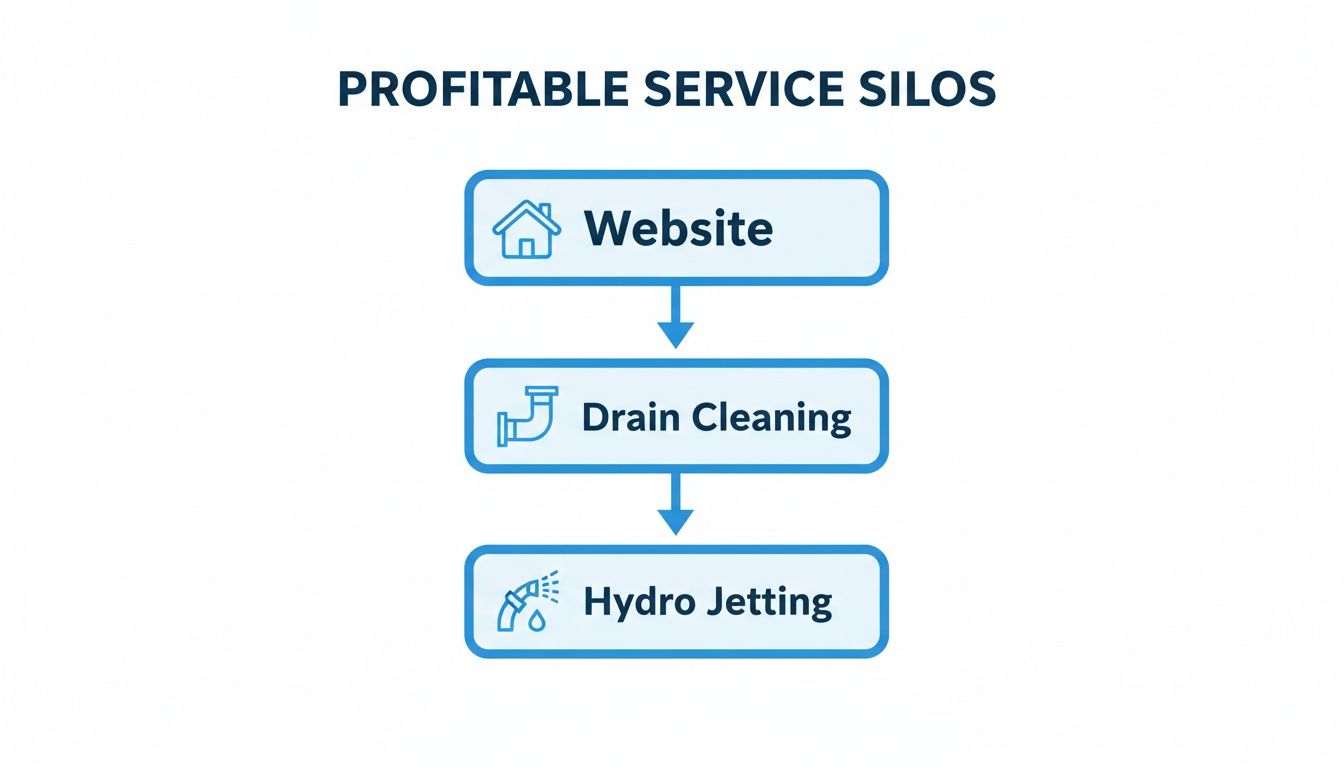
As you can see, you’re creating a clear path of relevance from your main website to a specific service like "Hydro Jetting," making it easy for Google to see you as an authority.
Make Your Google Business Profile a Lead-Generating Machine
Your GBP isn't just a static listing with your address and phone number. It's a dynamic marketing channel you can—and should—power with fresh content. One of the most overlooked tools here is Google Business Profile Posts. Think of them as mini-ads or blog updates that show up right on your Maps listing.
Use these posts to push timely offers and spotlight high-intent services. Here are a few real-world examples:
- Weekend Availability: "Weekend Water Heater Repair in [Your City] – No Extra Charge!"
- Highlighting a Service: "Tough clog? We specialize in hydro jetting. Call for a fast quote."
- Emergency Response: "24/7 Emergency Plumber on call for burst pipes. We can be there in an hour."
Each post reinforces your expertise and gives a customer with cash in hand a great reason to call you before anyone else. To truly lock down your area, you need to combine this with solid local SEO strategies. A fully optimized GBP paired with a content-rich website is an unbeatable combination for attracting nearby customers.
Transactional Marketing has the technology to optimize these map locations and make sure they show up in the top three in their service areas. This translates into hundreds of more phone calls every month and literally thousands of more phone calls every year. If you want to dig into the nitty-gritty, check out our guide on how to rank higher on Google Maps. This is how you take control of your local market.
Getting Your Content Ready for AI and Voice Search
The way customers find you isn't what it was a few years ago. AI optimization is the new way businesses are going to be found. More and more, people are just asking their phone or smart speaker a direct question. They're not typing "plumber Dallas"; they're saying, "Hey Google, find a plumber who can fix a burst pipe right now."
This shift is driven by things like Google’s AI Overviews and voice assistants, and it's a huge opportunity. We're talking about a new way to get found online, which we call AI Optimization. A lot of AI optimization has to do with how Large Language Models (LLMs) find businesses in the search results.
For your plumbing business, this isn't some far-off technical concept. It's about making sure that when an AI has to recommend a plumber, it picks you. The goal is simple: when a customer has a problem they need solved immediately, the AI should see your business as the most direct and trustworthy solution.
AI Optimization is the process of structuring your website's content so it’s easy for Large Language Models (LLMs)—the brains behind Google's AI—to understand and recommend. You're giving them clear, structured facts so they can confidently feature your business in their answers.
When a homeowner asks their phone, "Find a plumber near me who installs tankless water heaters," your website needs to be the clearest source of that information. That's how you capture these high-intent, ready-to-buy customers through the next wave of search technology.
How to Structure Your Content for AI and Voice Commands
An AI doesn't "read" your website like a person. It scans it for data, looking for clear signals and facts to piece together an answer. To show up in these AI-generated results, you have to format your content for a machine's brain, not just a human's eyes.
This means you need to be incredibly direct. Think of your service pages less like a brochure and more like a spec sheet for the AI. Every detail should be clean, concise, and easy for an algorithm to grab.
Here’s how we do it:
Use a Question-and-Answer Format: Don't make the AI guess. On your "Emergency Plumbing" page, have a heading like, "Do You Offer 24/7 Service?" followed by a direct answer: "Yes, we provide 24/7 emergency plumbing services across the entire [Your City] area."
Make Factual, Scannable Lists: Bullet points are your best friend. An AI can easily pull from a list titled "Our Drain Cleaning Services Include:" when it sees items like Hydro Jetting, Sewer Line Camera Inspection, and Kitchen Sink Unclogging.
Get Hyper-Specific with Your Wording: Vague marketing-speak is invisible to an AI. Instead of "We offer water heater services," be precise: "We specialize in the repair, replacement, and installation of gas, electric, and tankless water heaters." That specific data is exactly what an AI needs.
This is a core part of the system we implement for our clients at Transactional Marketing. We build your content to become a "source of truth" for the AI models that are increasingly the gatekeepers to new customers.
Winning the Clicks from Transactional Voice Searches
Voice searches are almost always local and urgent. People aren't asking Alexa for a history of indoor plumbing; they're in their kitchen saying, "Find a plumber who can fix a running toilet." They need help, now.
To win these transactional searches, your content has to provide an immediate solution in a conversational way. AI looks for pages that sound like a natural answer to a spoken question. This is why a strong FAQ section or a headline that solves a problem is so effective.
We build our content strategies around these exact moments. By creating pages that directly answer the urgent, spoken questions of homeowners in your town, we make sure both traditional search and AI assistants view your business as the best local answer. It’s how a simple voice command becomes a booked job and a paying customer.
Turning Website Visitors into Booked Jobs

You did it. Your company is on the first page of Google, and the traffic is rolling in. But if the phone isn't ringing, all that hard work—and marketing spend—is going right down the drain.
Getting found is just the first step. The real money is made when you convert those website visitors into actual, paying jobs. Every single element on your site needs to work together to convince a stressed-out homeowner that you are the right person to call.
Here at Transactional Marketing, this is our obsession. We don't just build pages that rank; we engineer them to turn clicks into customers by focusing on transactional search terms.
Write Headlines That Solve a Problem Now
When a pipe bursts under the sink at 10 PM, nobody is browsing for "clever plumbing taglines." They're in panic mode, searching for a quick fix. Your headline has to cut through that panic and scream, "I can solve your problem right now."
A vague headline like "Expert Plumbing Solutions" is a complete waste of digital real estate. It gets scrolled past in a heartbeat. You need to get specific.
- Weak: "Your Trusted Local Plumber"
- Strong: "24/7 Emergency Plumber for Burst Pipes & Leaks in [Your City]"
See the difference? The strong example mirrors the customer's frantic transactional search. It confirms you handle their exact issue, in their location, and you’re available immediately. They've found their solution, and they're less likely to hit the back button.
When a potential customer is stressed, clarity is king. Your headlines and opening sentences must instantly answer two questions: "Can you fix my immediate problem?" and "Can you fix it right now?"
This one tweak—aligning your headline with their urgent need—is often the single biggest lever you can pull to keep people on your page and move them toward a phone call.
Put Your Call to Action Front and Center
Your call-to-action (CTA) is the most important button on your page. It's what turns a looker into a booker. This is no time for subtlety. Your CTAs need to be obvious and impossible to miss.
We make sure a CTA is always within arm's reach, no matter where someone is on the page.
- Above the Fold: The very first thing they see should be a bold, can't-miss button like "Call Now: [Your Number]" or "Get an Emergency Quote." This is for the person who’s in a full-blown crisis and just needs a number.
- After Key Information: Once you've explained a service or shown off some five-star reviews, give them another chance to act. You’ve earned some trust; now make it easy for them to take the next step.
- At the Bottom: For the detail-oriented folks who read everything, a final, clear CTA at the end of the page gives them a logical finish line.
You can also supercharge this process with tools like a chatbot for lead generation. These bots can qualify visitors, answer basic questions, and capture leads 24/7, even while you're out on a job.
Build Unshakable Trust on the Page
Before someone trusts you with their home (and their credit card), they need to feel confident you're the real deal. Your service pages should be packed with trust signals that instantly quiet any doubts about your credibility.
We build these elements right into the page design and copy:
- Badges and Certifications: Make sure "Licensed & Insured," "Certified Technicians," and any local awards or affiliations are easy to spot. These are visual shortcuts that scream professionalism.
- Real Job Photos: Ditch the stock photos of smiling actors with pristine wrenches. Use genuine photos of your team, your trucks, and your work in the neighborhoods you actually serve. It proves you're a legitimate local business.
- Customer Testimonials: Weave in short, impactful quotes from happy customers. Nothing you can say about yourself is as powerful as a customer saying, "They were here in 30 minutes and fixed our leak fast!"
This combination of urgent headlines, unmissable CTAs, and powerful trust signals is what separates a website that gets traffic from a business that gets booked. For a deeper look at the mechanics, you can learn more about how to improve your website's conversion rate in our detailed guide. This is how you make sure your marketing efforts translate directly into a busier schedule and a healthier bottom line.
Your Questions Answered
I get it. You're busy running a business, not trying to become a marketing guru. When it comes to content marketing, most plumbers I talk to have the same handful of questions. Let's cut through the noise and get straight to the answers that actually matter for your bottom line.
What Is Transactional Content and Why Should I Care?
Think of transactional content as any page on your website that targets a customer who needs you right now. These aren't people researching how a toilet works; they're the ones typing transactional search terms like "emergency plumber in my area" or "cost to replace a water heater in Dallas" into their phone.
This is where the money is, plain and simple. It's why our company is named Transactional Marketing.
Informational content has its place, but it's a long game. Transactional content is about intercepting customers with a wallet in their hand, ready to book a job. That’s how you turn a simple Google search into a ringing phone and a scheduled appointment.
How Fast Can This Actually Make My Phone Ring?
This is the big one, right? The honest answer is: it depends on your starting point and how tough your local competition is. But with a smart, focused plan, you can see movement much faster than you’d think.
By honing in on specific, high-intent transactional keywords from day one, we've seen plumbers hit the first page of Google in as little as 30 to 60 days. Transactional Marketing has a proven system that literally gets our customers' websites showing up on page one of Google for the exact search terms their customers are using.
The goal isn't just website traffic; it's qualified phone calls. A strategic content plan focused on what paying customers are searching for can start generating real leads in a matter of weeks. This is the difference between just having a website and having a lead-generating machine.
Your First Month Content Action Plan
To give you a running start, here’s a simple, actionable plan for your first four weeks. The goal is to build out a service silo with both a transactional service page and a supporting informational blog post.
| Week | Service Silo Focus | Blog Post Topic (Informational) | Service Page Tweak (Transactional) |
|---|---|---|---|
| 1 | Water Heaters | "Tank vs. Tankless: Which Water Heater is Right for My Home?" | Add a "Water Heater Installation Costs in [Your City]" section. |
| 2 | Drain Cleaning | "5 Signs You Have a Main Line Clog (And When to Call a Pro)" | Create a detailed "Hydro Jetting Services" section with benefits. |
| 3 | Emergency Plumbing | "What Counts as a Plumbing Emergency? A Quick Guide." | Add a "24/7 Emergency Plumber Near Me" banner with your phone number. |
| 4 | Leak Detection | "How to Find a Hidden Water Leak in Your Walls" | Expand your "Slab Leak Repair" section with your process and equipment. |
This simple rhythm of creating one informational piece and one transactional piece per week builds authority and relevance quickly, signaling to Google that you are the local expert for that service.
How Does My Website Content Help Me Rank on Google Maps?
Think of your website as the foundation that holds up your Google Maps listing. Google's job is to provide the most relevant local answer, and it crawls your website to confirm that you’re a legitimate expert in the services and areas you claim.
When you have a detailed service page for "hydro jetting in Austin," you send a powerful signal to Google that you are an authority on that specific service in that specific city.
This is absolutely crucial for getting into the coveted Google Maps 3-Pack. Transactional Marketing has the technology to make sure your map locations show up in the top three in your service areas. That’s where the majority of ready-to-buy customers click, which can mean hundreds of extra calls a month.
What’s the Deal With AI Optimization? Is It a Big Deal for a Plumber?
Yes, it's quickly becoming a very big deal. AI Optimization is the new way businesses are going to be found. It's simply about making sure your website content is easily understood by AI search tools like Google's AI Overviews, Siri, and Alexa.
When someone asks their phone, "Hey Google, find a plumber who offers 24/7 emergency service," the AI scans websites for clear, direct answers. A lot of AI optimization has to do with how LLMs (Large Language Models) find businesses in search results. If your site isn't structured for that, you're invisible.
This means your content needs to be written for a machine to read. It's not complicated, it just requires being direct.
- Use clear Q&A formats: "Do you service tankless water heaters?" followed by a direct "Yes, we install and repair all major brands…"
- List out your services and service areas factually.
- Use simple, unambiguous language. No marketing fluff.
This is the future of how people find local services. We make sure every piece of content we build is ready for it, ensuring you’re the go-to answer for both traditional search and AI assistants.
Ready to stop guessing and start getting calls from customers who actually need you now? The team at Transactional Marketing has a proven system to get your plumbing business showing up for the keywords that drive revenue. Let us help you turn your website into your most valuable employee. See how our no-contract process works at Transactional.net.