


66% of legal consumers begin their search for an attorney online, and 75% keep researching even after a personal referral according to Scorpion’s criminal defense digital marketing data. That changes the entire job of criminal lawyer marketing.
A criminal defense firm no longer wins because it has a decent website and a few referrals. It wins because it shows up when someone searches with urgency, trust signals, and intent to hire. Terms like “DUI lawyer near me,” “criminal defense attorney [city],” and “drug charge lawyer near me” are transactional searches. The person behind that search usually isn’t browsing casually. They need help now.
That’s the lane that matters most. Good criminal lawyer marketing doesn’t chase vanity traffic. It targets high-intent search behavior, captures calls from Google Maps and organic search, and turns those calls into signed cases.
The New Digital Battlefield for Client Acquisition
Search behavior now decides who gets the first call.
In criminal defense, the buying window is short and emotionally charged. A prospect is not building a vendor shortlist over three weeks. They are trying to solve a legal problem fast, and they use Google to reduce risk before they speak to anyone. Referral relationships still matter, but referrals now get verified through search, reviews, maps, attorney bios, and page-level relevance tied to the charge and city.
That changes how criminal lawyer marketing should be built. The firms that win signed cases are not the firms publishing the most general legal content. They are the firms that own transactional search terms, control local visibility, and make it easy for a stressed prospect to call from the search results, the map pack, or a charge-specific landing page.
What urgent legal buyers do
The pattern is consistent:
- They search with high intent. Queries include charges, court dates, arrests, bail issues, and location modifiers.
- They check trust signals fast. Google Business Profile, reviews, practice area pages, attorney credibility, and local relevance all get scanned within minutes.
- They choose the firm that reduces uncertainty. Clear positioning, visible experience, and a direct path to contact matter more than broad brand messaging.
Many firms lose ground here. They invest in content that reads well to colleagues, covers broad legal education topics, or chases informational traffic that rarely turns into retained cases. That work has a place, especially for authority building and AI retrieval, but it should not sit at the center of client acquisition.
The center is transactional demand.
A serious system targets the searches that signal intent to hire now. It also structures content so Google, Google Maps, and large language models can connect the firm to specific case types, locations, and outcomes. That means tight service pages, local entity signals, review velocity, and supporting content that strengthens topical authority around the money terms.
For firms that want a practical model, our guide on how to optimize your Google Business Profile for local client acquisition shows how to tighten the local piece of that system. Outside perspectives can help too. Resources on marketing for criminal defense lawyers are useful because criminal defense operates under a different search pattern than estate planning, family law, or personal injury.
The trade-off is simple. Vanity traffic can make reporting look busy. Transactional visibility drives calls. If your firm is not showing up for high-value local searches at the moment urgency peaks, another firm is taking that case.
Your Foundation for Local Search Dominance
The single most important local asset for criminal lawyer marketing is your Google Business Profile. When someone searches “criminal lawyer near me” or “DUI attorney [city],” Google often shows the map pack before the traditional organic listings. That is where immediate calls happen.

The performance gap here is significant. GBP and review automation drives 40-50% of leads for criminal defense firms, 95% of hiring decisions are swayed by reviews, and the top 3 results in the map pack capture over 70% of clicks for local searches according to Webris on criminal defense marketing.
If your profile is weak, incomplete, or unmanaged, you’re losing high-intent searches before your website even has a chance.
Set up the profile for buyer intent
A profile should be built for conversion, not just verification. The basics matter, but the details decide whether Google understands your relevance.
Use this checklist:
Choose precise service alignment
Your primary category should reflect criminal defense. Supporting services should match the actual case types you want, such as DUI defense, drug offenses, domestic violence defense, or federal criminal defense.Write service descriptions around transactional terms
Don’t fill the profile with vague firm language. Use service naming that matches the way prospects search. “DUI defense attorney” beats “general legal representation.”Complete every trust field
Hours, phone number, website, appointment options, business description, and service areas all need to be accurate and current.Add real photos
Office exterior, lobby, attorney headshots, conference rooms, and team photos help reduce friction. Stock imagery weakens trust.
For firms managing this process in-house, this guide to Google Business Profile optimization is a practical starting point.
Reviews are not a side task
Many firms treat review collection like an occasional admin task. That’s a mistake. In criminal defense, reviews influence trust before a call and often before a click.
The strongest review systems do three things well:
- Ask consistently after a meaningful client interaction
- Use SMS and email workflows so requests don’t depend on memory
- Route feedback cleanly so the team can address issues before they damage public perception
What doesn’t work is random outreach, one-off requests from staff, or waiting until the end of the case with no process behind it.
Reviews shape the buying decision long before intake gets a chance to sell the consultation.
Optimize for Maps and AI discovery
Google Maps visibility still matters most for local conversion, but search is widening. Prospects now ask AI tools direct questions such as “best DUI lawyer near me” or “who handles felony charges in [city].” That makes profile consistency, service clarity, and local authority even more important.
For a broader view of how local visibility intersects with AI-driven discovery, AI Search Engine Optimization: GEO & AEO Mastery 2026 is a useful reference. The practical implication is simple. Your firm needs structured, consistent information that both Google and AI systems can interpret.
A quick explainer helps here:
What firms get wrong with GBP
The most common mistakes are operational, not technical.
| Problem | What it causes | Better move |
|---|---|---|
| Generic service descriptions | Weak relevance for transactional searches | Use specific charge and case-type language |
| Inconsistent review requests | Low review velocity | Build a repeatable post-consult or post-milestone process |
| Sparse photo galleries | Lower trust from first-time visitors | Upload real office and team images regularly |
| Ignoring Q&A | Missed opportunity to address objections | Add useful questions about consultations, charges, and next steps |
The firms that win local search treat GBP like a revenue asset. They update it, measure it, and optimize it with the same seriousness they apply to intake.
Build Unshakeable Authority with Content Silos
Google Maps captures urgent local intent, but your website does the heavier strategic work. It tells Google what you’re relevant for, tells AI systems what you’re authoritative on, and tells prospects whether you understand their problem.

The biggest mistake here is publishing scattered content. A random blog post about court etiquette, followed by a generic article on expungement, followed by a city page with thin copy, doesn’t build authority. It creates noise.
A stronger structure is the content silo. That means grouping pages around one high-value case category and supporting that category with tightly related subtopics.
Build silos around profitable case types
A criminal defense website should usually organize around real commercial intent, not broad legal commentary. Start with your revenue-driving practice areas.
A practical structure looks like this:
DUI silo
Main DUI defense page, refusal cases, first offense pages, local courthouse pages, penalties, administrative suspension content, and FAQ content tied to consultation intent.Drug charge silo
Possession, trafficking, distribution, intent, search and seizure issues, local process pages, and “what happens next” pages.Domestic violence silo
Protective orders, first appearance questions, evidence issues, no-contact order content, and defense process pages.White-collar or federal silo
Investigation-stage content, subpoena response topics, federal procedure concerns, and industry-specific defense topics.
This structure helps in two ways. Search engines understand topical depth. Prospects also move through the site in a way that builds confidence instead of creating confusion.
For firms building a serious publishing system, this resource on law firm content marketing gives a useful framework for organizing service pages, supporting articles, and location content.
Write for transactional intent, not empty traffic
Not every keyword is worth pursuing. “What is criminal law” may attract traffic, but it usually doesn’t bring retained clients. Transactional criminal lawyer marketing focuses on queries tied to action.
Examples of better targets include search patterns like:
- criminal defense lawyer for felony charge
- dui attorney near me
- assault charge lawyer [city]
- need lawyer after arrest
- attorney for first court appearance
- drug possession defense lawyer [city]
The copy on those pages needs to do three jobs at once:
- Match the search intent
- Reduce uncertainty
- Create a clear next step
That means fewer academic explanations and more practical answers. What happens next. What deadlines matter. Whether the charge is defensible. What the firm handles. How to call now.
Field note: The best-performing service pages usually feel closer to intake conversations than blog essays.
AI optimization changes how authority gets surfaced
AI-driven discovery is changing content strategy. Large language models and AI summaries don’t reward fluff. They surface pages that are structured clearly, answer direct questions, and show strong topical consistency.
That means your content should include:
- Clear headings that mirror client questions
- Direct answers near the top of the page
- Supporting detail below, not buried behind generic intros
- Case-type specificity by charge, geography, and situation
- Consistent entity signals such as attorney names, firm details, locations, and services
A lot of firms still publish content written for old-school ranking tactics only. Keyword stuffing, generic city swaps, and thin location pages are weak in both traditional SEO and AI search environments.
Find the sub-niches your competitors ignore
One of the smartest moves in criminal lawyer marketing is targeting underserved local demand. Data shows 30-50% of metro areas remain underserved for specific charges, and firms can verify these opportunities through heatmaps, attorney directory comparisons, and crime-stat cross-referencing according to Zahavian Legal Marketing.
That matters because broad head terms are crowded. Sub-niches often aren’t.
A firm might find stronger opportunities in:
| Sub-niche angle | Why it matters |
|---|---|
| First-time DUI in suburban service areas | Search intent is urgent and local |
| Domestic violence defense in specific courthouse regions | Queries often include city modifiers |
| Felony defense tied to particular neighborhoods or counties | Competitors may not have localized depth |
| White-collar investigations in business districts | Higher-value searches often need specialized pages |
The point isn’t to publish more pages for the sake of volume. The point is to build the exact pages your market needs, then connect them into a structure search engines and AI systems can understand.
Activate High-Intent Leads with Targeted PPC
SEO compounds over time. Paid search captures demand today.
That’s why PPC belongs in criminal lawyer marketing, but only when it’s run with discipline. Many firms waste budget by bidding on broad legal terms, sending traffic to the homepage, and hoping urgency alone will produce calls. It rarely does.
The better use of PPC is as a precision layer on top of your local SEO and website structure. An integrated strategy using SEO, local SEO, and paid ads can lead to a 183% increase in signed cases, and the Google Screened badge from Local Service Ads can boost conversion rates by 20-30% on a pay-per-lead model according to OnTopList’s criminal defense marketing analysis.
Where paid search works best
PPC is strongest when the search indicates immediate legal action. That usually means:
- arrest-related urgency
- hearing-related urgency
- charge-specific urgency
- location-specific legal help
- branded competitor comparison searches
- mobile searches with clear call intent
What doesn’t work well is broad awareness targeting with vague language like “experienced legal help” or “trusted law firm services.” Criminal defense prospects aren’t looking for abstract reassurance. They’re trying to solve a live problem.
Example PPC Transactional Keyword Targeting
| Case Type | High-Intent Transactional Keyword | Ad Group Focus | Recommended Ad Type |
|---|---|---|---|
| DUI | dui lawyer near me | Immediate consultation and local defense | Google Ads search |
| Drug charges | drug possession lawyer [city] | Charge-specific defense messaging | Google Ads search |
| Domestic violence | domestic violence attorney near me | Urgent case evaluation | Google Ads search |
| Felony defense | felony defense lawyer [city] | Serious charge representation | Google Ads search |
| General criminal defense | criminal lawyer near me | Fast intake and broad emergency coverage | Local Service Ads |
Don’t send paid clicks to generic pages
Ad traffic needs dedicated landing pages. The page should match the keyword, reinforce the exact case type, and make the phone number or consultation action impossible to miss.
A strong landing page usually includes:
- A headline tied to the search
- Brief explanation of the legal issue
- Immediate trust markers
- Fast contact options
- Service-area relevance
- Clear intake expectations
If you’re budgeting campaigns, this breakdown of Google paid search cost considerations is a useful reference for planning channel mix and lead economics.
Paid ads work best when they compress the distance between search, trust, and contact.
LSAs deserve special attention
Local Service Ads are especially valuable for criminal defense because they sit in a high-visibility position and can reduce resistance for prospects who don’t know which firm to trust. The Google Screened badge matters because it signals legitimacy before the click or lead submission.
Still, LSAs don’t rescue weak operations. If intake is slow, if the profile language is generic, or if reviews are thin, paid visibility turns into expensive leakage.
The trade-off is straightforward. PPC gives speed. SEO gives durability. Firms that rely on only one usually leave money on the table.
Implement a Scalable Client Conversion Workflow
Lead generation is only half the system. A criminal defense firm can rank well, show up in Maps, run solid ads, and still lose cases because intake is loose, slow, or inconsistent.
That failure usually doesn’t show up in vanity metrics. Traffic may look fine. Call volume may look fine. Signed-case volume tells the truth.
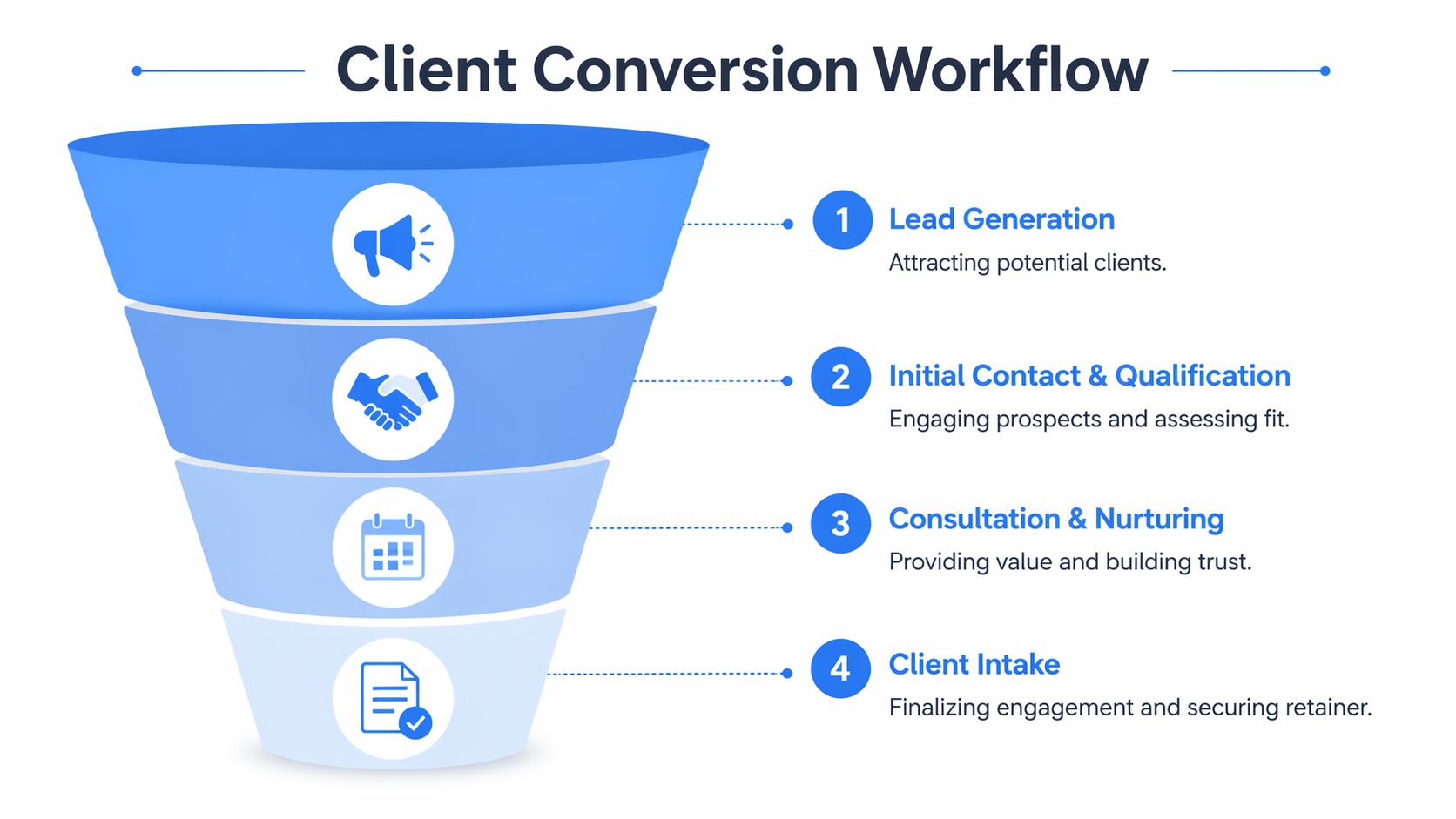
A better approach is to treat conversion like a workflow, not an event. The workflow should be visible, repeatable, and owned by named people on the team.
Stage one through stage four
The cleanest version looks like this:
Lead capture
Every contact point should make the next step obvious. That includes click-to-call buttons, short web forms, mobile-friendly pages, and tracked phone numbers for channel visibility.
Avoid long consultation forms unless the lead source is highly qualified. In criminal defense, urgency usually beats detail.
Initial contact and qualification
The first response should be fast, human, and direct. A prospect who submits a form during a stressful legal event doesn’t want a slow email chain. They want to know whether you handle the charge, whether someone can talk soon, and what happens next.
A good intake script covers:
- Charge type or legal issue
- Location and court jurisdiction
- Timeline urgency
- Decision-maker status
- Best callback path
Consultation and nurturing
Not every prospect hires on the first interaction. Some need family input, fee clarity, or a better understanding of the value of private counsel. In these situations, follow-up discipline matters.
The firms that convert more leads usually don't “close harder.” They remove uncertainty faster.
Client intake
Once the prospect is ready, the process should move cleanly into agreement, payment, document collection, and onboarding. Friction at this stage costs real revenue.
Handle price sensitivity before it stalls the sale
Many criminal defense firms underperform by waiting for pricing objections to appear during intake, then improvising answers.
That’s backwards. 85% of potential clients research via Google, yet conversion often drops due to price sensitivity. Firms can boost conversions by 20-30% by creating content and FAQ sections that address financial concerns and transparently explain the value and potential ROI of hiring a private attorney according to MyCase’s criminal defense marketing discussion.
That doesn’t mean publishing fee sheets or racing to the bottom. It means answering the questions prospects already have:
- What does a private criminal defense lawyer do?
- What risks come with handling the case poorly?
- What factors affect legal fees?
- What’s the difference between limited help and full representation?
- When is speed especially important?
Firms that ignore these questions force intake staff to solve trust issues that content should have handled earlier.
Build a review loop into the workflow
Review generation should be part of operations, not a marketing afterthought. The best time to request a review is after a meaningful client milestone, not randomly months later.
A practical review loop includes:
Trigger point selection
Choose clear moments when satisfied clients are most likely to respond.Automated request delivery
Use SMS or email workflows so the process happens every time.Internal follow-up
If a client has concerns, route that feedback to the team quickly.Reputation visibility
Monitor public responses and patterns so intake can spot recurring objections.
A good workflow turns marketing into a closed loop. Search generates the lead. Intake converts it. Delivery creates satisfaction. Reviews strengthen search visibility again.
Track Measure and Scale Your Marketing ROI
Most firms track the wrong things. They watch rankings, website sessions, or impression counts and assume growth is happening. Those metrics can be useful, but they don’t tell you whether marketing is producing profitable cases.
Criminal lawyer marketing should be measured like an acquisition system. You need to know where the lead came from, whether it was qualified, whether it booked, whether it retained, and what that path cost.
The numbers that matter most
Start with operational KPIs, not vanity metrics.
| KPI | Why it matters |
|---|---|
| Leads by source | Shows whether Maps, organic search, LSAs, or PPC are producing opportunities |
| Qualified leads | Separates raw inquiries from actual case fits |
| Consultations booked | Reveals intake effectiveness |
| Signed cases | Tells you which channels create revenue, not just activity |
| Cost per signed case | Exposes whether a channel is economically sustainable |
These numbers should be tied together. A channel that produces a lot of low-quality leads may look busy while underperforming financially. A smaller channel may produce fewer calls but better retained-case quality.
What a real dashboard should include
A modern reporting setup should show operational and search visibility data in one place. That usually means:
- Keyword timelines for transactional search terms by city
- Google Maps heatmaps to see where local visibility is strong or weak
- Search Console query trends to identify rising case-type demand
- Call tracking by channel
- Form submissions by page and source
- Lead status updates from intake through signed case
Criminal defense marketing is rarely linear. A prospect may first see a map listing, then visit a service page, then return through a branded search, then call from mobile. If reporting is fragmented, your team misreads what’s driving growth.
Use measurement to make decisions, not just reports
Good reporting changes behavior.
If map visibility is strong but signed cases are weak, review intake. If PPC drives consultations but not retained clients, review keyword targeting and landing page alignment. If a practice area page ranks but doesn’t convert, rewrite the page for decision-stage concerns.
For teams trying to tighten attribution and reporting discipline, this guide on how to measure marketing effectiveness is useful alongside a firm-specific setup. A more applied view for local operators is this resource on measuring marketing effectiveness.
Operating principle: If a metric doesn't help you change budget, messaging, or process, it isn't a core KPI.
How scaling actually works
Scaling doesn’t mean adding more tactics at once. It means identifying the search terms, pages, map positions, and campaigns that produce retained clients, then expanding from that base.
A disciplined scale path usually looks like this:
- Strengthen top-performing transactional terms first
- Expand into adjacent case-type silos
- Push map visibility deeper into priority service areas
- Increase paid support only where intake can absorb demand
- Use review and content feedback to sharpen conversion language
That’s how firms grow without losing efficiency. They don’t chase every keyword. They build around the searches that lead to signed cases.
Transactional LLC helps service businesses build that kind of acquisition system with local SEO, Google Maps optimization, AI-driven content silos, transparent reporting, and paid search support focused on high-intent search terms. If you want a clearer path to stronger local visibility and more inbound calls from ready-to-hire prospects, visit Transactional LLC.