


Most law firm content marketing advice is backwards.
It tells firms to publish broad educational content, chase “authority,” and hope that trust turns into cases later. That sounds smart in a conference room. It performs badly when a partner wants signed clients, booked consultations, and phones ringing from people searching right now.
A law firm doesn’t need more vanity traffic. It needs to show up when someone types “divorce lawyer near me,” “car accident attorney in [city],” or “DUI lawyer open now.” Those are transactional searches. They come from people with urgency, money, and a problem they want solved.
That’s the standard every piece of law firm content marketing should meet. If content doesn’t support a transactional keyword, a local map result, or a consultation request, it’s probably wasting budget.
The Transactional Mindset Your Law Firm Needs Now
Most firms publish content as if they’re running a legal magazine.
They write broad posts about legal news, abstract rights, or generic “what is” topics with no local angle and no conversion path. That creates activity, not revenue. The problem isn’t content itself. The problem is content without purchase intent behind it.
A smarter approach starts with the query, not the article idea. You identify what a prospective client searches when they’re close to hiring, then you build the page, supporting content, and map signals around that phrase.

Why thought leadership alone falls short
Thought leadership has a place. It just shouldn’t be the center of your acquisition strategy.
If your firm handles family law in Phoenix, your best content asset usually isn’t a broad essay on the evolution of custody law. It’s a page tightly aligned to terms like “child custody lawyer Phoenix,” supported by content that answers the exact objections and questions a ready-to-hire client has. That page can rank, convert, and feed your map visibility.
The legal industry has a measurement problem. Scorpion notes that an underserved angle in law firm content marketing is measuring ROI, and that only 25% of legal marketers can confidently measure content ROI. That tells you a lot. Firms are producing content without tying it to booked consultations, retained clients, or transactional search visibility.
Practical rule: If a content topic can’t be connected to a service page, a city page, a Google Business Profile category, or a consultation CTA, it belongs lower on your priority list.
What transactional intent looks like in legal search
Transactional searches aren’t mysterious. They usually include one or more of these signals:
- Service intent: “personal injury lawyer,” “probate attorney,” “immigration lawyer”
- Local intent: “near me,” city names, neighborhood names, “downtown,” ZIP-based phrases
- Urgency language: “now,” “today,” “free consultation,” “open”
- Case-specific need: “after car accident lawyer,” “contested divorce attorney,” “felony defense lawyer”
Those searches behave differently from broad informational queries. The user isn’t browsing. The user is comparing firms, checking credibility, and deciding who to call.
That’s why law firm content marketing should act like a conversion system, not a publishing hobby.
What to build instead
A transactional strategy usually includes a compact set of assets working together:
| Asset | Job | Example |
|---|---|---|
| Practice area page | Rank for the core service term | “DUI Lawyer in Tampa” |
| Localized support page | Capture city or submarket relevance | “Breath Test DUI Defense in Tampa” |
| FAQ article | Remove friction before contact | “Will a first DUI lead to jail time in Florida?” |
| Google Business Profile content | Reinforce local intent and trust | Posts, Q&A, service descriptions |
| Conversion layer | Turn searchers into consultations | Click-to-call, form, trust signals |
A disciplined local SEO process matters. A law firm that wants to win transactional search has to treat local relevance, service relevance, and conversion relevance as one system. Broad marketing advice won’t do that. A local-first framework like these local business marketing strategies is far closer to what legal firms need.
Your website shouldn’t just answer legal questions. It should answer them in a way that gets the right person to call your office before they call the next firm.
When firms adopt this mindset, content decisions get easier. You stop asking, “What should we blog about this month?” and start asking, “Which search terms signal the strongest intent to hire, and what content assets do we need to own them?”
That shift changes everything.
Build Your AI-Powered Content and Keyword Silos
Random content doesn’t rank consistently. Structured content does.
If your firm handles personal injury, you don’t need twelve disconnected articles floating around your site. You need a content silo that tells Google, AI search systems, and potential clients that your firm owns that subject in your market.
The simplest way to think about a silo is this. One strong pillar page targets the main transactional term. Supporting pages cover subtopics, objections, location modifiers, and intent-driven questions. Every supporting page links back to the pillar and to related pages inside the same topic family.
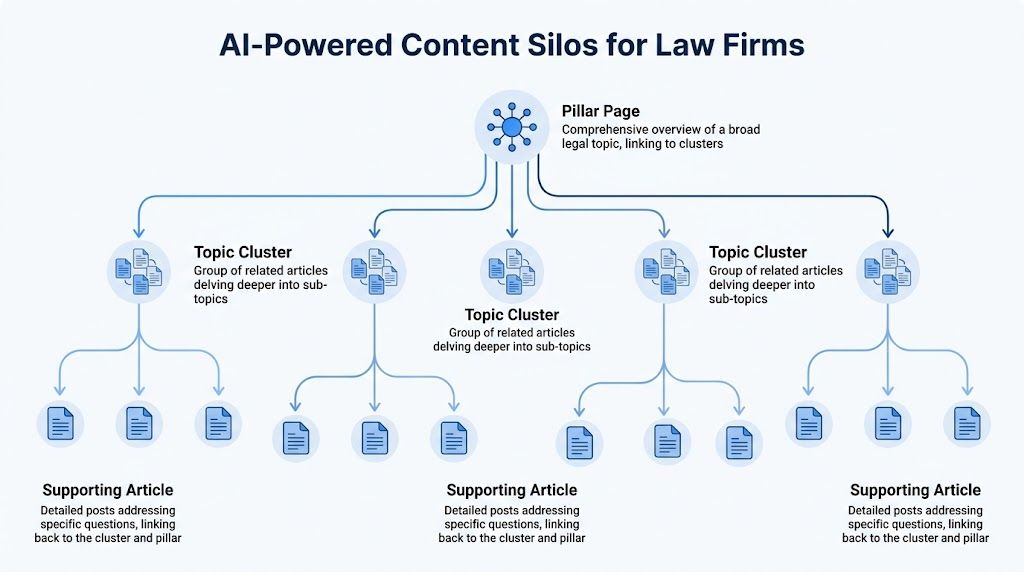
A personal injury silo that actually makes sense
Start with the pillar page:
Personal Injury Lawyer in [City]
That page should target the primary transactional phrase for the practice area and geography. It isn’t a history lesson. It’s a conversion page built to rank and convert.
Then add cluster pages such as:
- Car accident lawyer in [City]
- Truck accident lawyer in [City]
- Slip and fall attorney in [City]
- Wrongful death lawyer in [City]
- What to do after a car accident in [State]
- How long does a personal injury claim take
- When should I hire a personal injury lawyer
Notice the structure. Some pages are pure service pages. Others address the exact questions people ask before hiring. Together, they cover the money terms and the decision-stage content that supports them.
Why this works better than scattered blogging
Law firms see strong returns from organic search when they take SEO seriously. Amra & Elma reports that law firms achieve an average 526% ROI from SEO within three years, with organic search driving 66% of all call conversions and 52.6% of total website traffic. That isn’t an argument for more random content. It’s an argument for content architecture built around intent.
A silo helps in three ways:
Topical clarity
Search engines can see exactly what your firm covers and how the pages relate.Internal link strength
Authority flows through the silo instead of leaking into unrelated pages.Better user progression
A visitor can move from a question page to a service page to a consultation CTA without friction.
Where AI belongs in the process
AI is useful when it speeds up research, clustering, and drafting. It becomes dangerous when firms let it publish bland generic copy at scale.
Use AI to do the heavy lifting first:
- Group keywords by practice area and intent
- Identify transactional modifiers like city names and “near me” behavior
- Build article briefs
- Surface missing FAQ patterns
- Outline internal links between pillar, cluster, and support pages
Then bring in attorney review, local context, and conversion writing.
If your team is evaluating workflow tools, this overview of best AI legal assistants is a useful reference point for understanding where legal-specific AI support can fit into research and content operations.
A clean silo framework for family law
Here’s a practical model for a family law firm.
| Layer | Page type | Primary purpose |
|---|---|---|
| Pillar | Family Law Attorney in [City] | Core ranking and conversion page |
| Cluster | Divorce Lawyer in [City] | Service-specific transactional term |
| Cluster | Child Custody Lawyer in [City] | Practice-area depth |
| Support | How custody is decided in [State] | Decision-stage education |
| Support | Uncontested divorce timeline | Objection handling |
| Support | What to bring to a divorce consultation | Conversion support |
This kind of structure works well for AI search optimization too. Large language model-driven search experiences tend to favor sites with organized topical depth, clear entity signals, and consistent internal relationships between pages. That’s one reason silo planning should be part of your AI search engine optimization process, not an afterthought.
A law firm site should read like a system. One main service page, clear supporting pages, obvious local relevance, and no wasted articles.
The execution standard
Don’t build silos around curiosity clicks. Build them around retained-case potential.
A strong law firm content marketing plan asks:
- Which practice areas generate the most valuable matters?
- Which cities or suburbs matter most?
- Which search phrases signal hiring intent?
- Which supporting articles remove doubt and push the prospect to contact the firm?
Once you answer those questions, your publishing calendar stops being random. It becomes an expansion map for rankings, Maps visibility, and intake.
That’s the right use of AI in legal marketing. Not replacing strategy. Accelerating it.
Dominate Local Maps for High-Intent Clients
Most law firms obsess over organic rankings and underplay Google Maps.
That’s a mistake. For local legal searches, the map pack often gets the first real attention. A searcher looking for “injury lawyer near me” or “divorce attorney in [city]” wants speed, proximity, trust, and a fast way to call. Your Google Business Profile has to satisfy all four.
What a strong profile actually includes
A complete profile is the minimum. It’s not the strategy.
For law firms, the profile should reinforce the same transactional targets your website supports. That means your categories, service descriptions, business description, photos, Q&A, and posting cadence should all align with the practice areas and cities you want to rank for.
Use this checklist:
- Primary category selection: Choose the category that matches the main revenue-driving practice area.
- Service mapping: Add services that mirror your core transactional pages.
- Geographic reinforcement: Reference actual service cities naturally in profile content where appropriate.
- Review quality: Encourage reviews that mention service type and client experience in plain language.
- Photo activity: Add office, team, exterior, and branded images regularly.
- Q&A coverage: Preload common hiring-stage questions and answer them clearly.
- Posting discipline: Publish updates tied to legal services, FAQs, and consultation prompts.
Small and solo firms can compete here. Walker Advertising highlights that smaller firms can scale content marketing by focusing on hyper-local transactional searches and using AI content engines for silo creation. The same logic applies to Maps. You don’t need a giant marketing department. You need local focus and consistency.
How content supports map rankings
Google Maps optimization doesn’t live in a silo from content. The website and the profile feed each other.
If your profile emphasizes “estate planning attorney” but your site barely supports that service, your local signals stay weak. If your site has a well-built cluster around “criminal defense lawyer in [city]” and your profile reinforces that service with reviews, posts, and relevant landing pages, your local relevance gets much stronger.
The map listing is often the first conversion page a prospect sees. Treat it like a sales asset, not a directory entry.
A deeper walkthrough on local pack strategy is worth reviewing if your visibility breaks down in this area. This guide on how to rank higher on Google Maps covers the mechanics firms often miss.
The local content moves that matter
Don’t overcomplicate this. Focus on the elements that influence action:
Service-linked posts
Publish short profile posts tied to real hiring intent. Examples include consultation-focused updates, brief answers to common intake questions, or reminders about specific services your firm handles.
Q&A that removes hesitation
Use the Q&A section to answer practical questions such as whether consultations are available, what documents a person should bring, or whether your office handles a certain case type.
Photos that validate the business
Prospects want evidence that your office is real, active, and professional. Add current office and team photos instead of relying on stock visuals.
A useful primer on local ranking factors and profile optimization can help your staff avoid weak profile management habits. This video is a good starting point:
What firms get wrong
They create one profile, fill it out once, and assume that’s enough.
It isn’t. A map profile needs maintenance, review acquisition, service alignment, and ongoing content signals. It also needs a website behind it that targets the same local transactional phrases. When those elements line up, your firm becomes much harder to displace in the local 3-pack.
That’s where high-intent clients click first.
Create Legal Content That Converts into Cases
Traffic is not the finish line. A retained client is.
A lot of law firm content marketing fails at the point of conversion. The page ranks. The user lands. Then the page rambles, buries the phone number, dodges the core question, and gives the visitor no reason to trust the firm or act now.
Conversion content is tighter than that. It answers the legal question, shows authority fast, and moves the reader toward a consultation.
The anatomy of a page that brings in cases
A high-converting service page or article usually includes these elements near the top:
- A headline built around the transactional phrase
- A sharp opening that confirms the firm handles the issue
- A clear CTA above the fold
- Trust signals such as attorney credentials, reviews, or case-related proof
- A short explanation of what happens next if the prospect contacts the firm
That’s the difference between content that informs and content that converts.
For example, compare these two openings.
Weak version:
“Personal injury law can be complicated and stressful for many individuals and families.”
Better version:
“If you were injured in a car crash in Atlanta, you may have a short window to protect your claim. Our personal injury lawyers handle accident cases across Atlanta and can review your situation in a consultation.”
The second version is stronger because it addresses location, urgency, service, and action in a few lines.
Write for the decision stage, not the classroom
Your reader doesn’t need a law school lecture. Your reader needs clarity.
That means your content should answer practical questions such as:
| Client question | What your content should do |
|---|---|
| Do I need a lawyer? | Explain when legal representation matters |
| How much will this cost? | Address fee structure or consultation path clearly |
| What happens next? | Describe the intake and case review process |
| Can I trust this firm? | Show proof, experience, and relevance |
| How do I contact you now? | Offer immediate call and form options |
A good resource on writing stronger digital assets is this guide to content marketing best practices, especially if your team tends to produce generic educational copy without a conversion goal.
Good legal content reduces uncertainty. Great legal content reduces uncertainty and gets the consultation.
Use ROI logic when choosing content topics
Not all leads are equal. That’s why content selection should follow revenue quality, not just search volume.
LawBrokr recommends calculating ROI with the formula (Leads × Conversion Rate × Client Lifetime Value – Costs) / Costs, and warns that ignoring Client Lifetime Value leads firms to overvalue low-quality leads. That matters in legal marketing because a page attracting low-intent form fills can look successful while producing weak matters.
A criminal defense page that brings fewer but stronger consultations can outperform a broad informational post that produces noise.
A simple conversion framework for every article
Use this sequence:
Match the search term exactly enough
The headline and intro should confirm relevance immediately.Answer the urgent question fast
Don’t bury the main answer under generic background.Insert proof before the reader drifts
Add attorney bios, testimonial snippets, or process clarity early.Offer the next step repeatedly
Include consultation CTAs in the intro, middle, and end.Link into the service page
Every support article should push qualified prospects toward the main conversion page.
That’s how law firm content marketing starts producing cases instead of just pageviews.
Measure and Amplify Your Content Marketing ROI
Most firms measure the wrong things.
They look at impressions, raw traffic, and social engagement because those numbers are easy to pull. None of that tells a partner whether content is producing qualified consultations from the cities and case types the firm wants.
A serious legal content program needs an operating system for measurement. Otherwise, content becomes opinion-driven, and opinion is expensive.
Use OKRs instead of vague marketing goals
The right structure is OKRs, not “we want more visibility.”
Good2bSocial recommends an OKR methodology where firm-wide goals cascade into marketing key results, such as a 25% sales increase at the firm level and 20% growth in content-generated leads at the marketing level, tracked through an integrated measurement pyramid. That approach is better because it forces the firm to connect content to business outcomes.
Here’s what that looks like in practice:
Objective
Increase retained matters in the firm’s highest-value practice area.
Key results
- Improve rankings for core transactional terms in target cities
- Increase consultations that originate from organic search
- Expand local map visibility where the firm wants more cases
- Reduce spend wasted on weak non-converting content
Build a measurement pyramid that reflects reality
A law firm should track content at three levels.
| Level | What to track | Why it matters |
|---|---|---|
| Strategic | Retained clients, qualified consultations, practice-area growth | This is the business outcome |
| Mid-level | Organic landing pages, conversion paths, map visibility by city | This shows channel performance |
| Operational | Search Console queries, on-page engagement, internal link flow | This shows what needs fixing |
A page can rank without converting, and a page can convert without supporting map performance in the right city. Therefore, you need both views.
A practical reporting stack often includes Google Analytics, Google Search Console, your CRM or intake software, and local rank or heat map tools. Together, they show which queries bring in prospects, which cities respond, and which pages assist signed matters.
Promotion matters after publication
Publishing isn’t enough. Strong firms amplify winning content.
That doesn’t mean buying junk links or stuffing legal directories. It means distributing useful assets through your email list, social channels, referral partners, practice-area pages, and selective outreach where relevant. It also means repurposing strong articles into FAQs, short video scripts, and Google Business Profile posts.
Publish once, then keep pushing the same asset through every channel that can generate a consultation.
This is also where transparent reporting changes behavior. If a dashboard shows a cluster is gaining visibility in one city but not another, you can adjust internal links, local references, GBP support, and supporting content. If Search Console shows a page is appearing for the wrong type of query, you tighten the copy and CTA.
A clear framework for how to measure marketing effectiveness helps firms stop guessing and start making those decisions from real data.
What to review every reporting cycle
Don’t dump data into a spreadsheet and call it strategy. Review decisions.
Use each reporting cycle to ask:
- Which transactional keywords moved in the target cities?
- Which pages generated actual consultations?
- Which map areas remain weak?
- Which content attracted low-quality leads?
- Which pages need stronger CTAs, revised headlines, or better internal links?
That’s how law firm content marketing compounds. You publish with intent, track with discipline, and expand what produces real matters.
Your Questions on Transactional Legal Marketing Answered
Does this work in hyper-competitive practice areas?
Yes, if you narrow the target. Don’t chase one giant phrase and hope. Build around city-level intent, sub-practice terms, map visibility, and question-stage content that supports the main service page. Competitive markets punish generic firms. They don’t punish focused firms.
Can AI write all of our content?
It can draft. It shouldn’t run the whole operation alone.
Use AI for clustering, outlines, FAQs, title options, and first drafts. Then have a human tighten the local angle, legal accuracy, conversion path, and tone. Firms that publish raw AI copy usually end up sounding the same as everyone else.
What budget makes sense for a smaller firm?
Start with one practice area and one city cluster if budget is tight. Build the core service page, the supporting silo, and the map assets around that target first. Expand only after the first cluster starts generating consultations.
How is this different from a typical SEO agency?
Most agencies chase broad traffic, send vague reports, and talk about “brand presence.” A transactional approach focuses on terms that signal buying intent, local map visibility, and lead quality. That’s a different standard.
Should every law firm blog post target a transactional keyword?
Not directly, but every post should support one. Some pages convert immediately. Others remove doubt, answer objections, or strengthen internal relevance for the money page. If a post doesn’t help that system, it’s probably filler.
If your firm wants more than blog traffic and vague SEO reports, talk to Transactional LLC. They focus on the searches that bring in paying clients, build AI-driven content silos around those terms, and push law firms toward stronger Google Maps visibility where high-intent prospects click and call.