


You're probably already collecting reviews, sending the occasional follow-up text, and checking your Google Business Profile when calls slow down. The problem is that most owners stop at “good feedback” instead of asking the more useful question, what does that feedback do for transactional search terms like dentist near me, roofer near me, or air conditioning repair near me?
That's where customer satisfaction metrics become more than a reporting exercise. When they're measured correctly, they tell you what customers experienced, which touchpoint caused friction, and what kind of proof you can turn into stronger local visibility. In local search, that matters because Google Business Profile actions, review signals, and AI-driven answers all favor businesses that look trusted, active, and easy to choose.
For service businesses, satisfaction data is not just about retention. It's also the raw material that drives reviews, strengthens Maps performance, and supports the kind of trust signals AI systems use when they decide which businesses deserve attention.
Why Your Customer Reviews Are Your Most Powerful SEO Weapon
A roofing owner sees five-star reviews roll in after a storm repair, but still wonders why calls aren't steady. A dental practice gets kind words from patients, yet the front desk still has slow days. The gap is usually not service quality, it's that the business hasn't turned those moments of satisfaction into search visibility.
Customer feedback matters because it gives you proof that real people had a good experience, and that proof is exactly what local search can work with. A strong review stream helps a business look relevant for transactional search terms, the searches where the customer is ready to hire now, not browse later.
The best way to think about this is simple. Satisfaction creates language, language becomes reviews, reviews become local trust, and local trust helps a business compete for the phone call. If you want to push deeper into the mechanics of getting that review flow right, this guide to getting more Google reviews is a useful companion.
Practical rule: don't treat reviews as a reputation trophy. Treat them as the public version of your customer satisfaction data.
That shift matters because local search is crowded with businesses that all claim they do good work. The businesses that win are usually the ones that make it easiest for a search engine, and a human, to believe they're the safer choice. When a homeowner searches with urgency, the business with stronger satisfaction signals has a better chance of being seen as the obvious next call.
In practice, reviews do more than decorate a profile. They shape how confidently a prospect can move from search result to contact form to booked job.
The Core Three Metrics Translated for Service Businesses
The three most useful customer satisfaction metrics are CSAT, NPS, and CES, but they only become useful when you translate them into the language of jobs, appointments, and service calls. The definitions are straightforward, the operational value is where most businesses miss.
CSAT captures how satisfied someone was with a specific interaction. In a dental office, that might mean a patient's experience after a cleaning or crown consult. In an HVAC company, it might reflect the technician visit that solved the no-cool problem. The common format is a post-interaction question such as “How satisfied were you with your service today?” on a 1–5 scale, which makes CSAT a short-term, interaction-level metric rather than a broad loyalty score how to improve customer satisfaction.
NPS is different. It asks whether the customer would recommend your business, which makes it useful for understanding advocacy, not just immediate happiness. For a dentist, that's the question behind, “Would you send a family member here?” For a plumber, it's the difference between a one-time fix and a business people talk about at the neighborhood barbecue.
CES measures effort. If a patient had to call three times to schedule, or a homeowner had to repeat the same issue to multiple staff members, that friction shows up here. A lower-effort experience usually points to a cleaner journey, which is exactly what busy service customers want.
| Metric | What It Measures | Example Question for a Dental Practice |
|---|---|---|
| CSAT | Satisfaction with a specific visit or interaction | How satisfied were you with your appointment today? |
| NPS | Likelihood to recommend | How likely are you to recommend our practice to a friend or family member? |
| CES | Effort required to get help or resolution | How easy was it to schedule and complete your visit? |
A useful companion here is improve site performance with UX data, because survey signals and on-site friction often tell the same story from different angles. If patients complain about booking difficulty, the issue isn't just service, it's also experience design.
Turning Positive Feedback into Google Maps Dominance
Google Business Profile is where satisfaction turns into local demand. A business can have a decent website and still lose the call if its Maps profile looks thinner, quieter, or less trusted than a competitor's.
The review signals that matter most are the ones tied to real behavior. One local SEO source recommends watching the total number of reviews, the average star rating, how many new reviews arrive each month, and how quickly the business responds to feedback, because those mechanics affect visibility, trust, and local ranking performance review signals and local ranking performance. That's why customer satisfaction is so valuable, it feeds the exact proof Google and searchers can see.
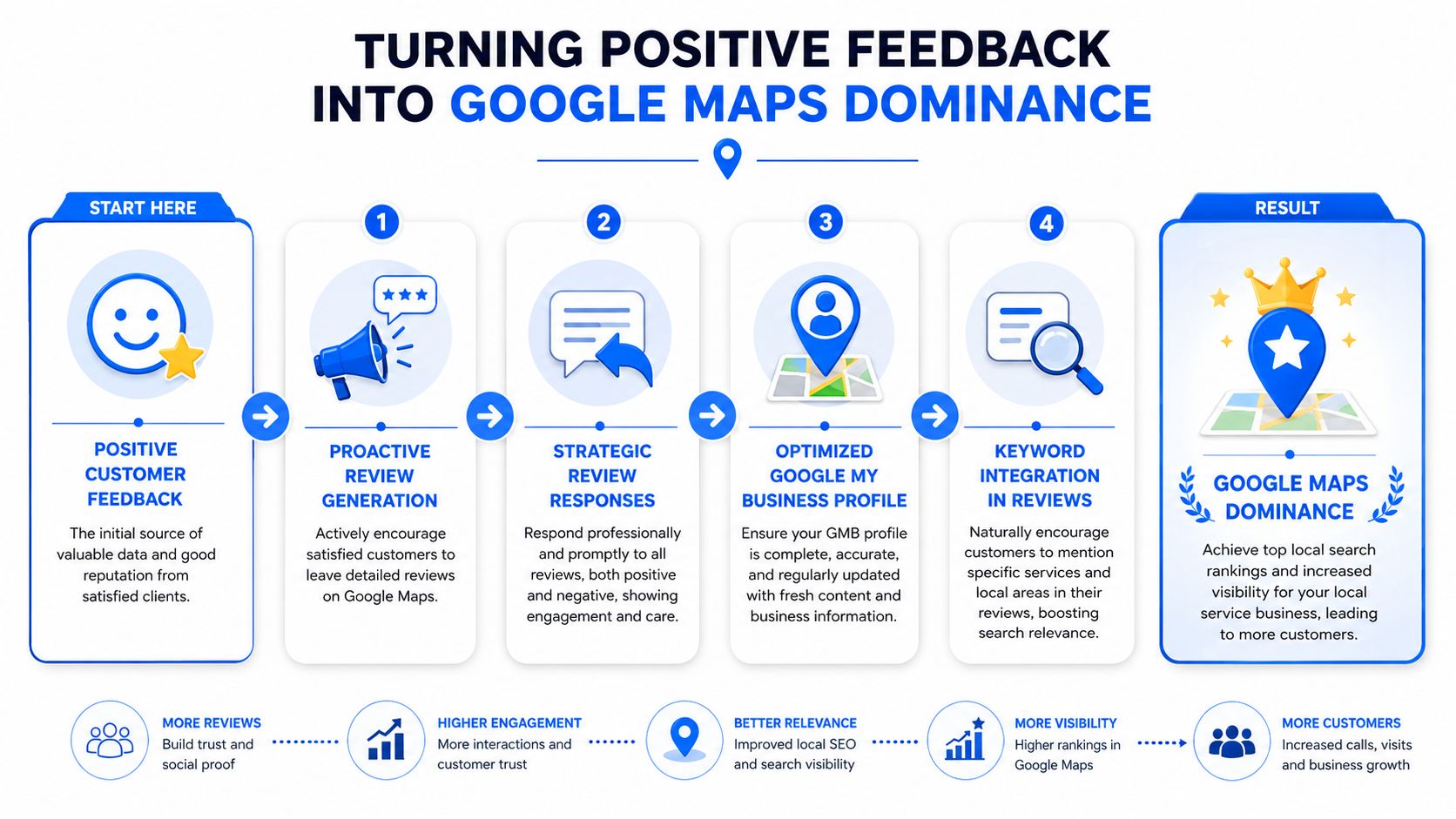
A strong Maps presence doesn't come from one big review push. It comes from a repeatable system, starting with great service, then encouraging feedback, then converting that feedback into public proof. Businesses that respond professionally also show they're active, which helps a profile feel maintained instead of abandoned.
Practical rule: if your feedback process stops at the survey, you're leaving local ranking signals on the table.
The local pack matters because it's a separate performance layer from organic rankings, and reports commonly track the top 3 local pack, average position, search visibility, profile views, and phone calls together local pack and visibility metrics. This is the key to success. A profile that earns trust through reviews and responses can move from being seen to being chosen, and that's where the calls come from.
Google Maps ranking factors is worth reading if you're trying to connect the dots between reputation signals and map visibility without guessing.
How AI Uses Your Customer Data to Rank You
AI search systems don't just scan for keywords, they look for patterns that make a business seem reliable. That's why customer feedback matters so much now, because reviews and satisfaction signals create a trail of trust that AI can use when deciding which local business belongs in an answer.
A business with consistent, descriptive reviews gives AI more context than a profile with generic praise. “Great service” is weak evidence. A steady stream of comments about responsiveness, clean work, easy scheduling, or fast resolution tells a much better story about what the business does well.
The broader shift here is that search is moving from pages to answers. If a homeowner asks for the best dentist in town, or the most dependable roofer nearby, AI systems need confidence that the business is real, relevant, and preferred by actual customers. That's where satisfaction data becomes an asset instead of a vanity number.

A stronger customer feedback pattern also helps you interpret what's happening across channels. A business might look fine on one listing while repeated contacts, poor form submissions, or weak response handling expose friction underneath. That's why pairing reviews with service data is smarter than chasing one score in isolation.
If you're thinking about how AI-facing support fits into this, Expressify AI's automated support is a good example of how modern businesses can reduce response friction and keep the customer journey moving.
AI search engine optimization is now part of the same conversation as local visibility, because the businesses that surface in AI answers will usually be the ones with the cleanest trust signals, not just the loudest ad spend.
Designing Simple Surveys That Get Actionable Answers
The best survey is the one customers will answer. That means short, timely, and sent when the service is still fresh enough to remember clearly.
For home service and dental businesses, timing matters more than polish. CSAT is most reliable when it's collected immediately after a touchpoint, because timing affects accuracy and broad averages can hide serious problems by segment or product area timing and accuracy in customer satisfaction. A text message after the visit or resolution usually works better than a clunky web form buried in an email footer.
Keep the question narrow
Ask about one interaction, not the whole brand. “How satisfied were you with today's visit?” gets you cleaner data than “How do you feel about our company overall?” The first question can reveal a broken technician handoff, a billing issue, or a scheduling win. The second one blurs everything together.
Use the channel your customers already check
SMS and email are practical because they're low-friction. A homeowner leaving work or a patient heading back to the office can answer a single question without opening a portal or logging in. If the survey takes too much effort, the response rate falls and the signal gets noisy.
A few strong rules help here:
- Send fast: ask while the job, appointment, or call is still fresh.
- Keep it short: one rating question and one optional comment is enough.
- Write in plain language: avoid internal jargon that makes the customer think.
- Separate service issues from review asks: use the survey to learn first, then route happy customers into review generation.
The point isn't to build a research lab. It's to create a repeatable stream of usable feedback that tells you what happened, where it happened, and what to fix next.
Building Your Local Growth Metrics Dashboard
A local business dashboard should show more than a single score. If you only watch satisfaction in isolation, you can miss the fact that the profile is generating attention but not conversions, or that the phone is ringing but the customer experience is collapsing after booking.
The core Google Business Profile metrics to include are phone calls, direction requests, and website clicks. One local SEO guide recommends tracking those foundation metrics for at least 3 months before adding more complexity, because that gives enough time to compare changes after profile edits or review campaigns Google Business Profile baseline metrics. That baseline matters because short-term noise can make you think a fix worked when it didn't.

A useful dashboard connects the front-end and the back-end. Satisfaction data tells you what people felt. Maps metrics show whether that feeling turned into action. Website clicks and call volume show whether visibility is translating into demand.
A practical dashboard for a service business can be built around three questions:
- Are customers happy after the interaction?
- Is that satisfaction producing stronger public signals?
- Are those signals creating more calls, directions, and clicks?
If the answer is yes across all three, the business is building compounding momentum. If one part breaks, you usually see the failure in the metric that sits closest to it. That's why local SEO reporting tools are useful, they help connect satisfaction, Maps visibility, and lead behavior in one place instead of forcing owners to guess.
From Metrics to More Booked Jobs and Patients
Customer satisfaction metrics only matter when they change behavior. A survey score that sits in a spreadsheet doesn't help a plumber, dentist, or HVAC owner win more transactional searches. A metric that shapes reviews, responses, and service fixes absolutely can.
The businesses that grow are the ones that treat satisfaction as a lead-generation asset. They use feedback to improve the customer journey, turn the best experiences into public proof, and strengthen the signals that local search and AI systems trust. That creates a direct line from service quality to calls, bookings, and new patients.
If you're trying to build that system without making it messy, the 2026 setup guide for agencies is a practical resource for tightening follow-up and reducing lost opportunities. Missed calls and slow responses are exactly the kind of friction that turns a strong satisfaction score into a weak revenue result.
The bottom line is simple. Customer satisfaction metrics are not passive reporting numbers. They're the operating system behind better service, stronger Maps visibility, and more transactional demand.
If you want help turning customer feedback into more calls, booked jobs, and new patients, contact Transactional LLC and build a local search system around the metrics that move revenue.