


If you're paying for clicks and the schedule still has holes, the problem usually isn't Google Ads itself. It's the way the campaign was built. Most dental practices don't need more traffic. They need more transactional searches from people ready to call, book, or show up for treatment.
That's the core of profitable dental PPC advertising. You don't win by appearing for every dental query in your city. You win by showing up when someone searches with intent. "Emergency dentist near me." "Dental implants consultation." "Tooth extraction today." Those are different from casual research searches. The patient behind them usually isn't browsing. They're trying to solve a problem now.
That distinction matters even more as search behavior changes across Google, Maps, and AI-influenced results. A strong local paid search strategy still has to align with the same reality that drives SEO and AI visibility. Practices that organize their marketing around high-intent service terms tend to attract better leads than practices chasing broad awareness.
Why Most Dental PPC Fails and How to Fix It
Most failed dental campaigns share the same flaw. They treat all keywords as equal.
A practice launches one generic search campaign, loads it with broad dental terms, sends every click to the homepage, and hopes the phone rings. The account collects impressions. It may even collect clicks. But clicks from "what is a root canal" and clicks from "emergency dentist near me" are not worth the same amount to the practice.
The real problem is mixed intent
A lot of agencies build campaigns for activity, not for transactions. They want more impressions, more keywords, more ad groups, more reporting. That seems advanced. It usually creates waste.
Dental PPC advertising works best when it targets people close to a decision. If someone needs urgent care, wants an implant consult, or is actively comparing whitening providers, that search has commercial value. If someone is doing early-stage research, the click may still matter, but it belongs in a different strategy with different expectations.
Practical rule: If the keyword doesn't suggest a likely appointment, quote request, or phone call, it shouldn't get the same budget as a transactional search term.
This is why broad campaign builds underperform. They blend emergency, cosmetic, insurance, educational, and branded searches into one bucket. Then the practice can't tell what's driving patients.
Fix the campaign around patient action
The correction is simple, but most accounts never implement it well:
- Target service-specific intent instead of generic dental traffic
- Separate urgent and high-value treatments from lower-intent terms
- Write ads for the exact problem searched, not for the practice in general
- Send traffic to the matching page with a clear booking path
- Measure calls and booked leads, not just clicks
Paid search already plays a major role in patient acquisition. One dental marketing dataset reports that about 35% of dental office traffic comes from paid search ads, which is why wasted traffic gets expensive fast. If you want a deeper breakdown of the economics behind spend and lead quality, this guide on Google paid search cost is useful.
The fix isn't more complexity. It's more focus. Transactional terms are where dental PPC advertising earns its keep.
Keyword Research for Transactional Dental Services
Good keyword research for dentists starts with one question. Is this search likely to produce a patient, or just a visitor?
That filter removes a lot of noise. It also keeps budgets pointed at terms that can turn into calls, form fills, and booked appointments.
Recent dental marketing research reports that 69% of patients research online before choosing a dental provider, 71% look up dentists before booking, and 98% read online reviews before booking. The same research notes that over 50% of all Google searches are local, which is why capturing high-intent local searches matters so much for dental practices, according to Design for Dentists' dental marketing research.
Separate research terms from buying terms
Informational searches have value in SEO, content, and remarketing. They're just not where most dental ad budgets should start.
A search like "how long does Invisalign take" signals interest. A search like "Invisalign dentist near me" signals movement. A search like "emergency dentist open now" signals urgency.
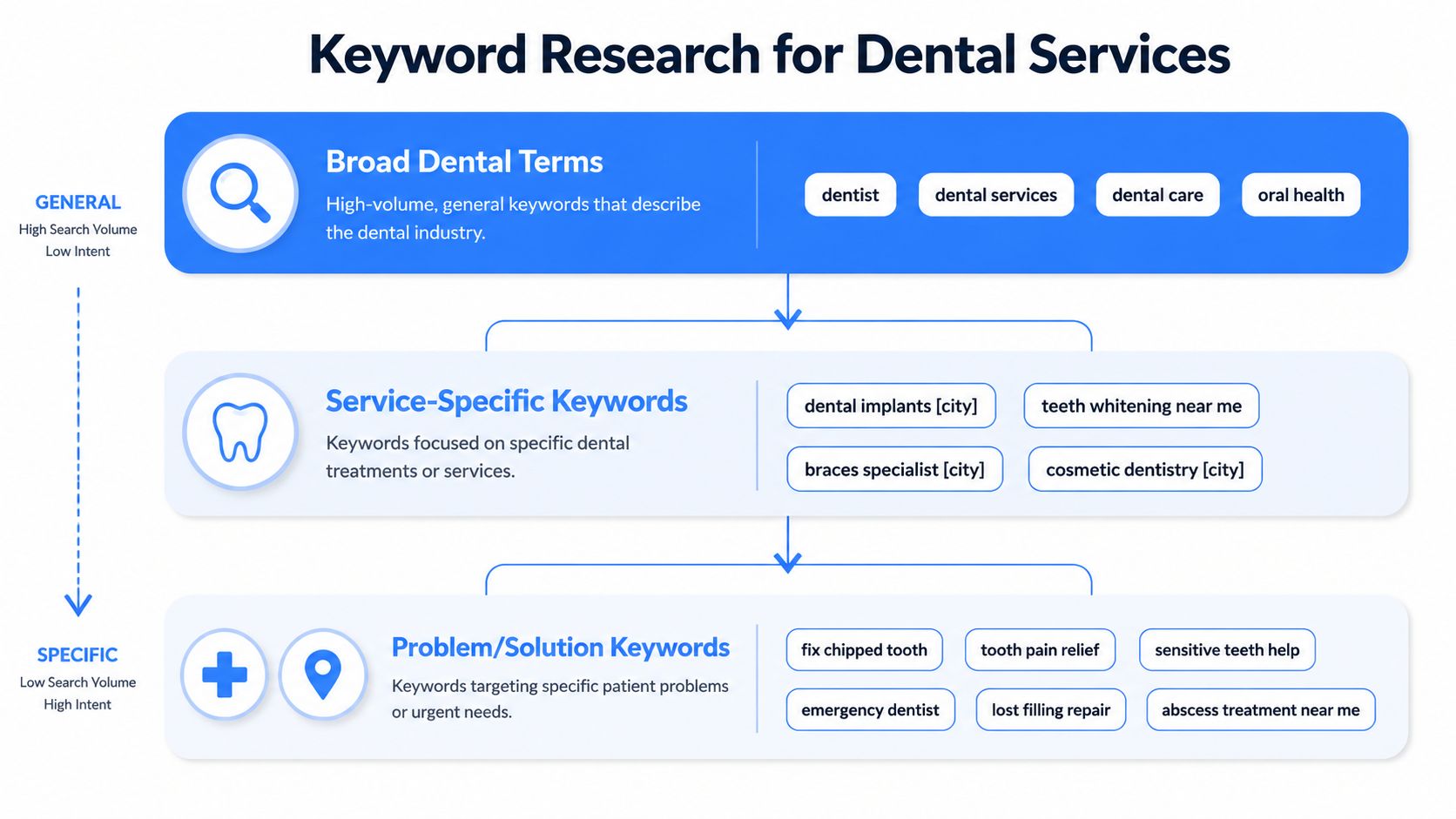
A practical keyword stack usually looks like this:
- Core local terms such as dentist near me, dentist in city, family dentist city
- Service terms such as dental implants city, teeth whitening near me, same-day crowns city
- Problem terms like broken tooth repair, tooth pain dentist, cracked tooth dentist
- Urgent care terms including emergency dentist, tooth extraction today, weekend dentist
- Consultation terms such as implant consultation, cosmetic dentist consultation, second opinion dentist
Start with the procedures that justify ad spend
Not every service deserves equal investment. PPC is often most defensible for urgent, high-intent, or high-value treatments such as emergency care and implants, as discussed in Active Marketing's guidance on profitable dental PPC campaigns.
That doesn't mean you ignore general dentistry. It means you don't let low-intent searches absorb budget that should go to service lines with clearer commercial intent.
Use a shortlist like this when building campaigns:
| Search theme | Typical intent | PPC priority |
|---|---|---|
| Emergency care | Immediate need | High |
| Implants | High value, strong intent | High |
| Extractions | Problem-solving | High |
| Whitening | Commercial, but comparison-heavy | Medium |
| General dentist terms | Broader intent mix | Medium |
| Educational queries | Early research | Low |
Use AI tools to expand, then filter hard
AI-assisted research tools are useful because they surface the phrases patients type, including messy, problem-based wording. That's especially helpful for searches that don't sound like textbook dental terminology.
Still, the tool doesn't make the decision. You do. Keep terms that imply action. Cut terms that imply curiosity.
For a practical process, this guide to keyword research best practices is worth reviewing. The best keyword list isn't the biggest one. It's the one that protects budget and attracts patients with money-in-hand intent.
Good dental keyword research doesn't start with volume. It starts with urgency, treatment value, and distance from the appointment.
Building Your High-Performance Campaign Structure
A dental Google Ads account should look like a well-run practice. Clear departments. Clear responsibilities. No confusion about where a patient goes next.
When the account is messy, optimization gets messy too. Budget leaks into the wrong searches, ad copy stays generic, and reporting doesn't tell you which treatments are producing leads.

Build around services, not one giant campaign
A high-performing dental PPC build should use a single shared account for multiple locations, separate branded vs. non-branded campaigns, segment keywords by funnel stage, and apply negative keywords aggressively. It should also schedule ads during business hours if the goal is phone leads so calls are answered live, based on Cardinal Digital's dental PPC best practices.
That guidance is solid because it gives you control where it matters most.
A clean structure often includes separate campaigns for:
- Emergency dentistry for urgent searches and call-first behavior
- Implants and restorative for higher-value consults
- Cosmetic services like whitening or veneers
- General dentistry for broad local intent
- Brand campaigns for practice-name searches and reputation defense
Branded and non-branded terms should never be lumped together. Brand traffic behaves differently, converts differently, and can hide the weakness of your prospecting campaigns if you combine the data.
Match ad groups to real search themes
Inside each campaign, keep ad groups narrow. Don't dump implants, dentures, and extractions into one ad group just because they're all restorative. Each search theme should have its own message and destination.
A simple comparison shows the difference:
| Weak structure | Better structure |
|---|---|
| One campaign for all dental services | Separate campaigns by treatment category |
| Mixed branded and non-branded keywords | Distinct campaign types for clean reporting |
| Homepage as default landing page | Service-specific landing pages |
| Small negative list | Aggressive filtering of irrelevant intent |
If you want a model for account setup mechanics, this walkthrough on how to set up a Google Ads campaign gives a useful framework.
Use negatives like a budget shield
Most accounts don't lose money because bidding is wrong. They lose money because junk queries keep getting through.
Negative keywords should block low-value traffic around jobs, education, free searches, DIY intent, and mismatched services. They should also keep one service line from cannibalizing another. If someone searches for emergency extraction, that click shouldn't drift into a cosmetic ad group.
A quick visual breakdown helps if you're rebuilding an account from scratch:
The goal of campaign structure isn't neatness for its own sake. It's control over budget, message, and lead quality.
Crafting Ads and Extensions That Convert Patients
Most dental ads are forgettable because they sound interchangeable. "Trusted local dentist." "Quality care for the whole family." "Book today." None of that speaks to the actual reason the patient searched.
People click when the ad reflects the problem in their head. If they searched for a painful tooth, they want relief. If they searched for implants, they want clarity, confidence, and a next step. Generic ad copy misses both.
Generic ads get ignored
Compare these two approaches.
Weak ad
- Local Dental Office
- Gentle Family Dentistry
- Experienced Team
- Contact Us Today
Stronger ad
- Same-Day Emergency Dentist
- Tooth Pain Appointments Available
- Call Now to Speak With the Front Desk
- Convenient Local Office
The second version isn't clever. It doesn't need to be. It matches the searcher's intent.
Write to the treatment and the urgency
The ad should answer three questions fast:
- What service is this for?
- Why should I click this practice?
- What do I do next?
That means your headlines and descriptions should include the procedure, the location signal, and the action path. If the campaign is built around transactional keywords, the ad copy should feel transactional too.
A few examples:
- Emergency campaign should mention same-day care, urgent pain relief, or immediate appointments
- Implant campaign should mention consultations, missing teeth solutions, or implant expertise
- Whitening campaign should mention cosmetic improvement, fast booking, or local availability
If the search was specific and the ad is broad, relevance breaks. When relevance breaks, conversion rate usually follows.
Extensions do more than decorate the ad
Ad extensions are where dental PPC advertising starts behaving like a local patient acquisition system instead of a basic text ad campaign.
Use extensions that remove friction:
- Call extensions for patients who want to book now
- Location extensions to reinforce proximity and connect the ad to local presence
- Sitelinks for services such as implants, emergency care, and new patient forms
- Callouts to highlight practical details like same-day appointments or financing options
- Structured snippets to list key treatment categories
Location extensions matter for another reason. They support visibility where local intent is strongest, especially when your Google Business Profile is already well managed.
If you're drafting ad variations and need a fast starting point, CodeDesign.ai's ad generator can help produce first-pass headlines and descriptions. It won't replace strategy, but it can speed up testing when you're building multiple service-specific ads.
The winning ad usually isn't the most polished one. It's the one that sounds closest to the patient's reason for searching.
Optimizing for Local Dominance and Profitability
A practice can get clicks all day and still lose money if those clicks come from the wrong neighborhoods, the wrong services, or the wrong stage of intent.
That is the local PPC problem most dental accounts never solve. They target too wide, spread budget across every procedure, and send traffic to pages that do not help a patient book. The result is activity without appointments.
Profit comes from control. Control over geography. Control over service mix. Control over what happens after the click.
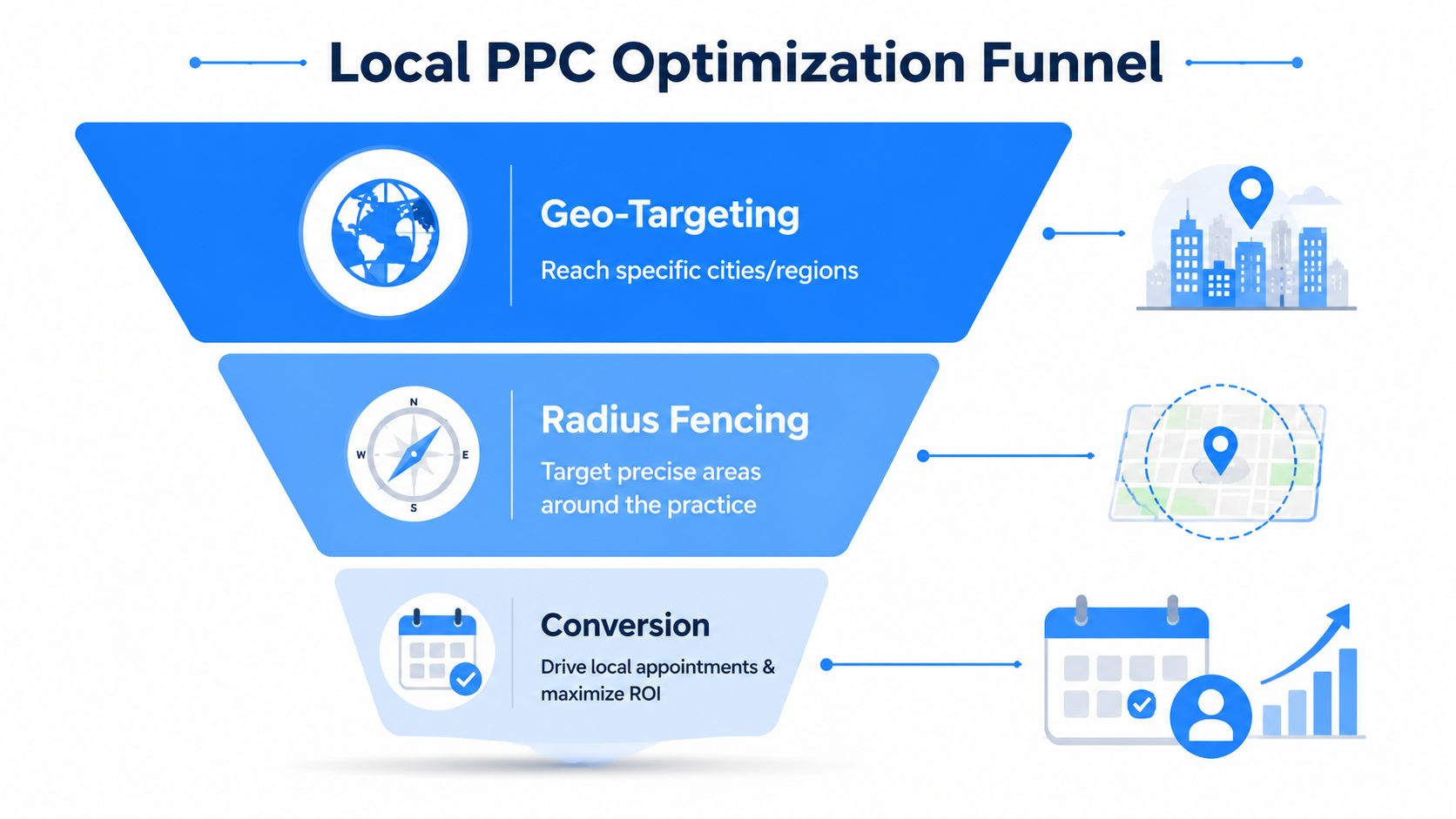
Tight geography protects budget
For dental PPC advertising, local dominance usually starts by getting smaller, not bigger. A wide radius sounds safe, but it often pulls in low-probability clicks from people who are too far away, too price-sensitive, or too unlikely to show up.
Transactional searches have a short decision window. Someone searching "emergency dentist near me" or "dental implants consultation" usually wants a practical next step close to home or work. The account should reflect that reality.
For most practices, that means:
- Prioritize close-in zip codes or radius targeting where patients are more likely to book
- Adjust bids by location when nearby areas produce stronger call and appointment rates
- Exclude weak zones that drive clicks but rarely turn into scheduled visits
- Split campaigns by location cluster if multiple offices serve different trade areas
Map visibility matters here too. Location extensions help, but they do not carry local presence on their own. The Google Business Profile has to be accurate, active, and tied closely to the service areas that produce patients. If the practice wants stronger map pack coverage, paid search and local profile management need to support each other.
Budget the treatments that can carry the account
Even budget splits look organized in reports. They usually perform poorly in dental accounts.
A transactional campaign should protect spend for procedures that create immediate action or support a stronger acquisition cost. Emergency dentistry fits because urgency shortens the path to a call. Implants fit because patient value leaves more room to bid aggressively and still stay profitable. General dentistry terms can work, but they need tighter controls because they attract more comparison shoppers and softer intent.
I usually set budget priority by revenue potential and booking intent, then review it against actual close rates from the front desk. That trade-off matters. A cosmetic keyword may produce cheap leads, but if those callers mostly ask about price and never schedule, it should not steal budget from implant consults or emergency cases.
A practical model looks like this:
| Priority level | Best fit |
|---|---|
| Highest | Emergency, implants, urgent restorative searches |
| Selective | Cosmetic services with clear offer and intent |
| Controlled | Broad general dentistry terms |
| Limited | Informational traffic and weak-intent themes |
If the practice is serious about margin, cost per lead is only part of the picture. Use a cost per acquisition calculation for dental PPC profitability to judge whether a campaign is producing booked patients at a number the practice can support.
Landing pages finish the sale
The click is not the win. The appointment is.
A good landing page keeps the patient in transactional mode. It answers the immediate concern, confirms the service, shows the office is local, and makes the next action obvious. Phone number at the top. Short form. Insurance or financing details if they help reduce hesitation. Proof points that support the procedure being advertised, not generic branding copy.
Emergency pages should focus on speed, symptoms, availability, and calling now. Implant pages should focus on candidacy, missing-tooth solutions, consultation booking, and trust signals. If one page tries to cover every service, conversion rates usually slide because the message gets diluted.
This is also where call handling affects profitability. If the campaign drives high-intent calls and no one answers, media efficiency collapses fast. Teams comparing top call tracking solutions can get clearer attribution on which locations, campaigns, and keywords are producing real phone opportunities, not just raw call volume.
Local dominance comes from relevance and restraint. Show up in the right areas, for the right procedures, with a booking path built for action. That is how dental ad spend turns into more calls, more appointments, and better margins.
Tracking Results and Proving Your PPC ROI
A dentist sees 42 leads in the monthly report, but the schedule is still thin. That gap usually comes from weak tracking, loose attribution, or agencies counting every call the same whether it was a price shopper, an existing patient, or someone ready to book implants this week.
Dental PPC should be measured like a patient acquisition system. Track the path from keyword to call, from call to booked appointment, and from booked appointment to completed visit. If that chain breaks, budget decisions turn into guesswork.
Track the actions that turn into patients
For a transactional campaign, not every conversion deserves equal weight. A 90-second emergency call is more valuable than a casual page view. A completed implant consult form matters more than a generic contact submission.
Focus reporting on actions the front desk can verify:
- Phone calls from ads and landing pages
- Appointment form submissions tied to specific services
- Online booking starts when the site supports scheduling
- Direction and location intent signals when local search drives patient demand
- Booked appointments by service line, not just raw lead volume
That last point matters. Agencies often stop at lead count because it makes reports look stronger. Practices need booked patients by procedure category. Emergency, implants, Invisalign, and general dentistry do not carry the same revenue, close rate, or scheduling urgency.
Separate diagnostic metrics from business metrics
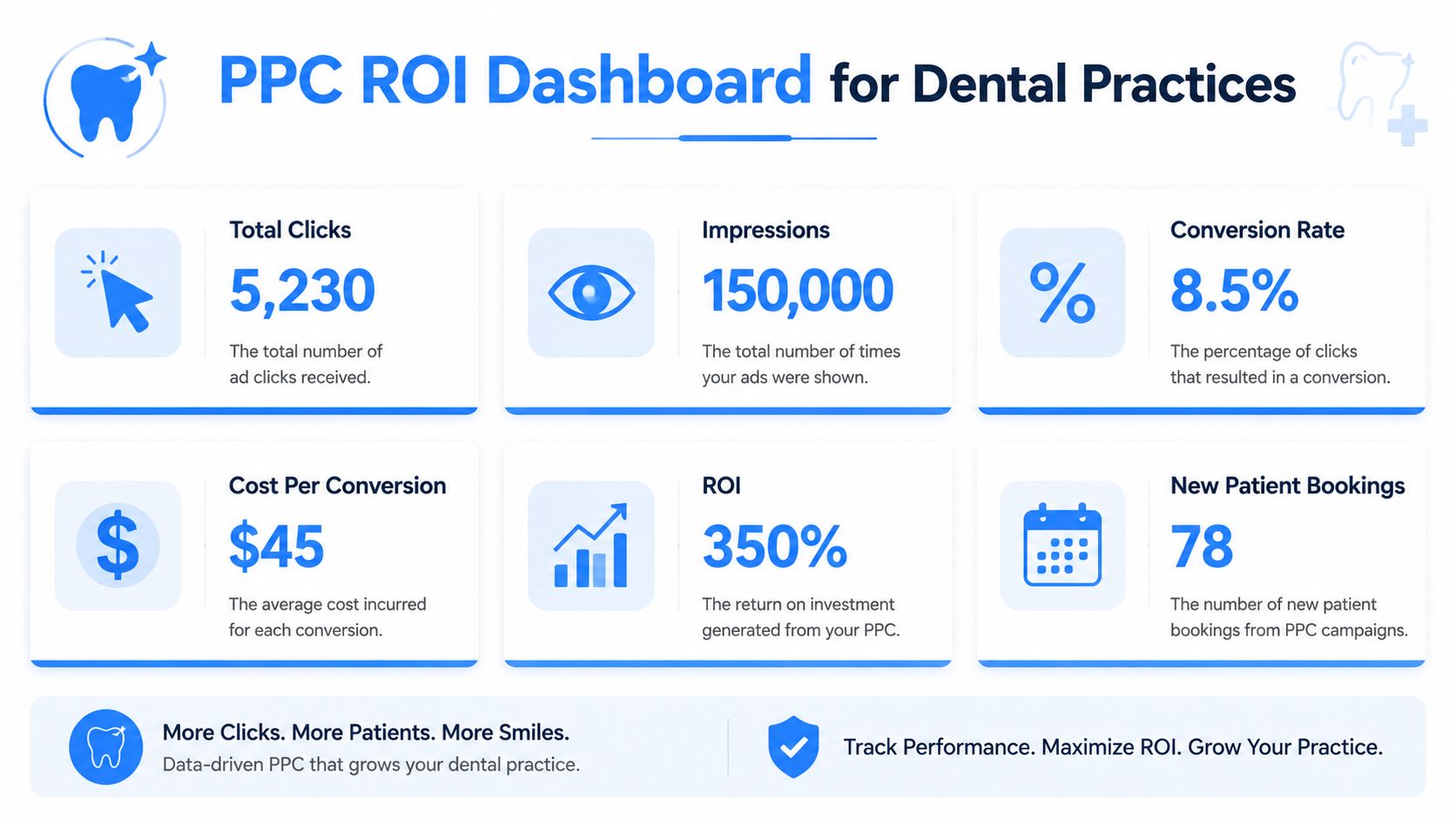
Clicks, CTR, and impression share help diagnose campaign behavior. They do not prove profitability.
Use this split instead:
| Metric | Why it matters |
|---|---|
| Clicks | Shows search demand and ad engagement |
| Conversion rate | Shows whether traffic turns into leads |
| Cost per lead | Helps compare campaigns and service categories |
| Cost per acquired patient | Connects spend to actual growth |
| Call quality | Shows whether leads are bookable and relevant |
Many dental accounts waste money. They optimize for cheaper leads, then discover those leads rarely book. A strong campaign can produce a higher cost per lead and still win if the calls are better, the show rate is higher, and the procedure value supports the spend.
For phone-heavy practices, attribution has to go deeper than call volume. The reporting should show which campaign, keyword, location, and landing page drove the call. If you're comparing vendors, these top call tracking solutions are a practical starting point.
Build reporting around decisions
A useful PPC report should answer a short list of business questions fast:
- Which service campaigns are producing booked appointments?
- Which keywords drive high-intent calls versus low-value inquiries?
- Which locations are profitable after no-shows and close rates are considered?
- Which ads and landing pages bring in the best patients, not just the most form fills?
Cost per acquisition is the number that usually settles the argument. If you need a clean way to calculate it, use this guide on how to calculate cost per acquisition.
Good reporting changes budget allocation. It shifts spend toward procedures with strong margins and reliable close rates. It cuts search terms that look active in Google Ads but produce weak calls at the front desk. That is how transactional dental PPC proves its value. Not by generating activity, but by producing more booked appointments from the searches most likely to turn into revenue.