


You've just finished a roofing, HVAC, plumbing, or electrical job, and the next morning your schedule has an uncomfortable gap. You know homeowners need your service, but a competitor appears in Google Maps when they search for “roofer near me” or “HVAC repair near me.” The buyer calls that competitor before visiting your website, reading your story, or comparing your credentials.
That's the central problem digital marketing for contractors must solve. Contractor marketing isn't a popularity contest and it isn't about collecting empty website traffic. It's about placing your business in front of people using transactional search terms, the searches that signal a buyer is ready to hire, then converting that visibility into calls, estimates, and booked jobs.
Transactional Marketing is built around that exact idea. The work focuses on local SEO, Google Maps optimization, service-city content, AI and LLM discovery, paid search, and tracking, all connected as one system. A contractor shouldn't manage these channels as isolated projects. The website, Google Business Profile, Map Pack presence, reviews, ads, and follow-up must reinforce one another.
Why Contractor Marketing Is a Transactional Intent Game
A homeowner searching for “burst pipe repair near me” isn't browsing for entertainment. They're trying to solve a problem now. The same applies to an electrical outage, an active roof leak, failed air conditioning, or a pest issue that can't wait.
Local intent makes this behavior unusually valuable. Forty-six percent of all Google searches have local intent, and 76% of people who search for something nearby visit a business within a day, according to local SEO statistics for home services. The same source reports that 78% of mobile local searches result in an offline purchase. For contractors, those searches lead directly to calls, site visits, dispatches, and estimates.
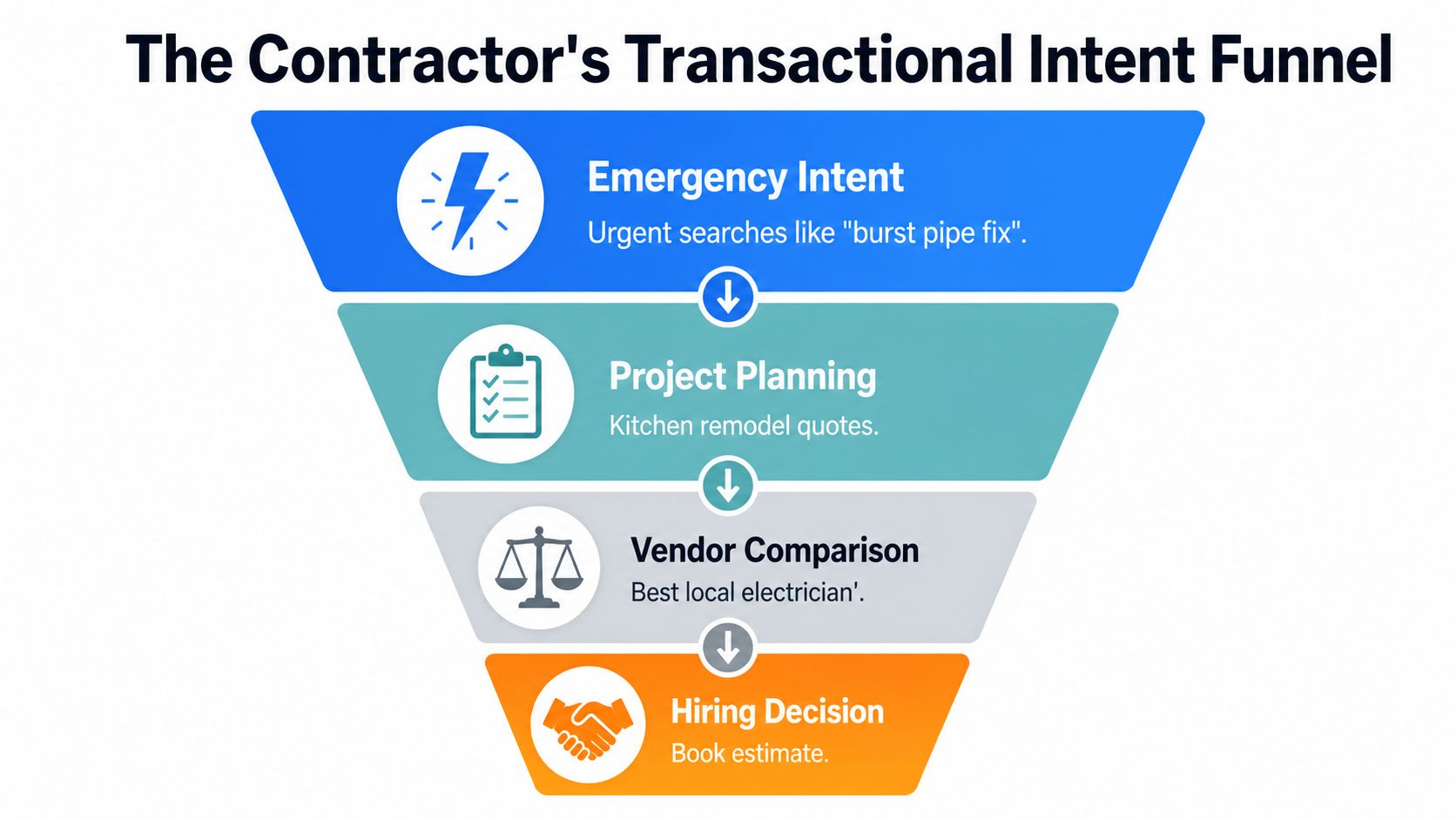
Four searches, four buying situations
Contractors compete for more than one kind of commercial query:
- Emergency intent: “burst pipe repair near me” or “24-hour electrician.”
- Scheduled intent: “roof replacement estimate” or “water heater installation.”
- Comparison intent: “best HVAC company” or “top-rated local roofer.”
- Branded local intent: a search for your company name, often after a referral or previous visit.
The content and conversion path should match the situation. Emergency searchers need a visible phone number, availability, and a fast response. Scheduled buyers need scope details, pricing guidance, project photos, and an estimate form. Comparison shoppers look for reviews, licensing, proof of workmanship, and clear service areas.
Google Maps and Local Services Ads matter because these formats put the call action directly beside the information a buyer needs. A Maps listing can show the phone number, hours, reviews, service category, and directions without requiring a website visit. Local Services Ads similarly place screened contractor visibility near the top of the results, where urgency and proximity shape the decision.
The operating principle: Optimize for the search that carries a hiring decision, not the keyword that produces the most impressions.
A roofer, for example, needs visibility in the Map Pack for searches tied to roof repair, replacement, inspections, and estimates across each service city. The website must validate the listing, the reviews must reduce risk, and call tracking must show which placement generated the conversation. The practical framework in 2026 local SEO for contractors is useful because it treats local visibility as an operating system rather than a one-time profile update.
The rest of the strategy follows that logic. Build a website that converts, optimize the Google Business Profile, create service-city silos, generate legitimate reviews, use paid ads for immediate demand, prepare content for AI discovery, and measure qualified calls instead of vanity traffic.
Building a Contractor Website That Converts Local Search Traffic
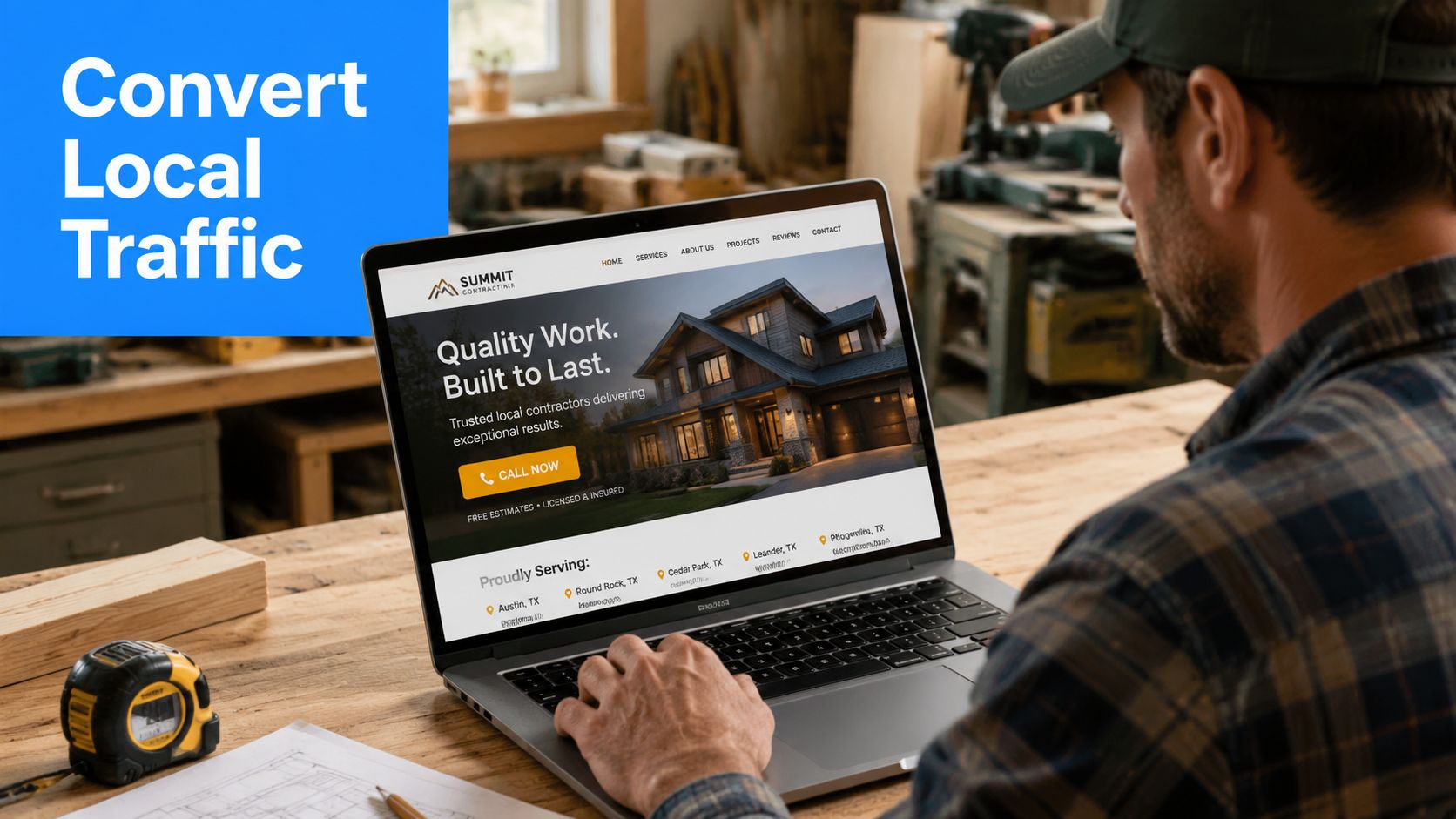
A contractor website has one job before it has any other job: make the next action obvious. Someone arriving from Google Maps on a phone shouldn't have to search through a navigation menu to find your number or determine whether you serve their city.
Put a click-to-call button above the fold, alongside a headline that states the trade and location plainly. “Licensed HVAC repair in Phoenix” is stronger than “Reliable comfort solutions.” Add the cities and service areas you cover in the header or footer, but don't create a long block of stuffed locations that helps neither users nor search engines.
Build pages around services, not vague promises
Each profitable service needs its own page. A roofing company might separate roof repair, roof replacement, storm damage, and roof inspections. A plumber might separate drain cleaning, sewer line repair, water heater replacement, and leak detection.
Every page should include:
- A direct service headline: Match the wording used in the transactional search.
- Proof of competence: Show licenses, insurance, BBB status, manufacturer certifications, and relevant trade credentials.
- Local evidence: Use authentic project photos, neighborhoods served, and an embedded Google Map where appropriate.
- A short form: Ask only for the information needed to start the conversation, ideally fewer than five fields.
- A clear phone path: Repeat the phone action where a buyer naturally decides to contact you.
Transparent pricing ranges can qualify leads, even when the final quote requires an inspection. Project galleries should explain the work, not just display polished images. Use real photos, label the service and city, and add descriptive alt text that identifies what the image shows without forcing keywords into every sentence.
Remove mobile conversion friction
Slow pages, stock photography, buried phone numbers, and homepage sliders create friction precisely when a buyer is ready to act. A Map Pack visitor may never reach the second section of the page. Compress images, keep the first screen focused, and let the visitor call without zooming or hunting.
Structured data can help search engines interpret the business. Use appropriate LocalBusiness, Service, and Review schema when the visible page content supports it. Schema doesn't replace useful copy, local proof, or reviews. It clarifies the information already present.
For a practical explanation of how click to call drives conversions, focus on the connection between immediate intent and a low-friction phone action. Contractors needing a dedicated build can also review the home services web design service approach, especially when the current website was built as a brochure rather than a lead system.
Winning the Google Maps Top Three for Your Service Area
Google Business Profile optimization starts with accuracy. Use the business name, address, phone number, website, hours, and service information everywhere. Don't add “best roofer” or a city name to the business name unless it's part of the actual registered name. Keyword stuffing can create compliance problems and doesn't substitute for relevance, distance, or prominence.
Google identifies those three factors directly in its explanation of local ranking. Relevance measures how well the profile matches the search. Distance reflects the relationship between the business and the searcher. Prominence reflects how well-known the business is, with signals such as links and review volume contributing to that picture.
Set the profile up for one trade
Choose the most accurate primary category for the main business. A plumbing company should use the most specific plumbing category available rather than defaulting to a broad “contractor” label. Add secondary categories only when they accurately describe genuine services.
Review the service-area settings carefully. A contractor that travels should list the cities it serves and publish matching service-area pages on the website. A storefront business needs consistent address information. A service-area business should avoid presenting a virtual location as a customer-facing office.
Hours must reflect reality. Emergency plumbing and HVAC companies should make after-hours availability clear when they provide it. Incorrect hours damage trust when a customer calls and receives no answer.
Make activity useful, not decorative
Seed the Q&A area with genuine questions homeowners ask, such as whether estimates are available, which neighborhoods are served, and what emergency response includes. Publish Google Posts with real job photos, seasonal services, and useful updates. Upload clear project images that show equipment, workmanship, crews, and completed results.
Review velocity matters because fresh customer feedback supports both prominence and conversion. Ask customers soon after completion, respond specifically, and mention the service naturally in replies. Don't write identical responses or force city names into every sentence.
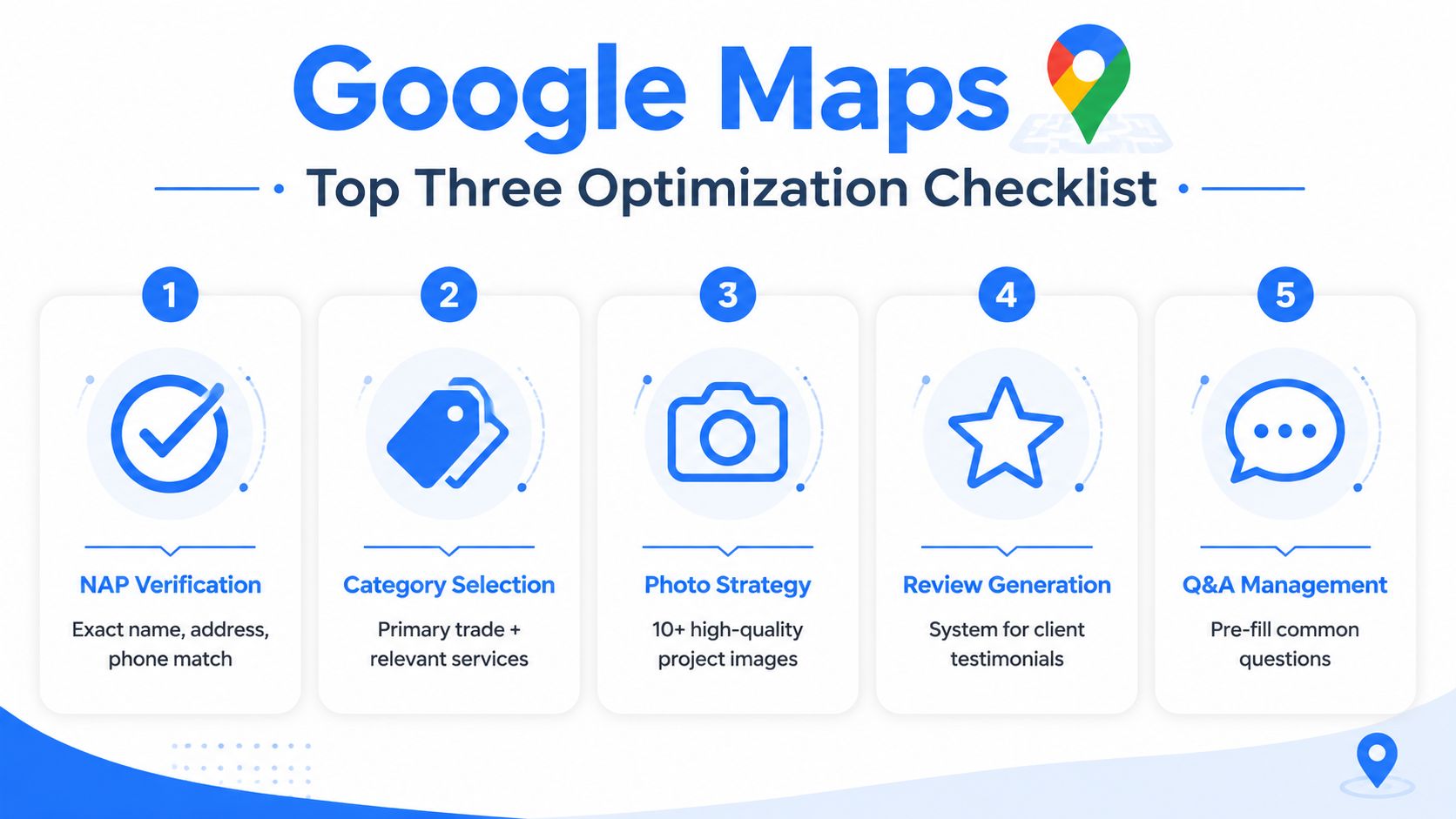
A useful afternoon checklist is simple:
- Confirm the profile is verified and the NAP details match the website.
- Select the most accurate primary trade category.
- Review secondary categories, services, hours, and service areas.
- Add recent, authentic project photos.
- Answer common questions and publish a useful update.
- Create a repeatable review request process.
- Check the listing from target neighborhoods, not only from the office.
Contractors who want a more detailed implementation sequence can use how to rank higher on Google Maps as a working reference. The aim is not to make the profile look busy. It's to make the listing unmistakably relevant to the transactional searches that produce calls.
Service City Content Silos and Transactional Keyword Targeting
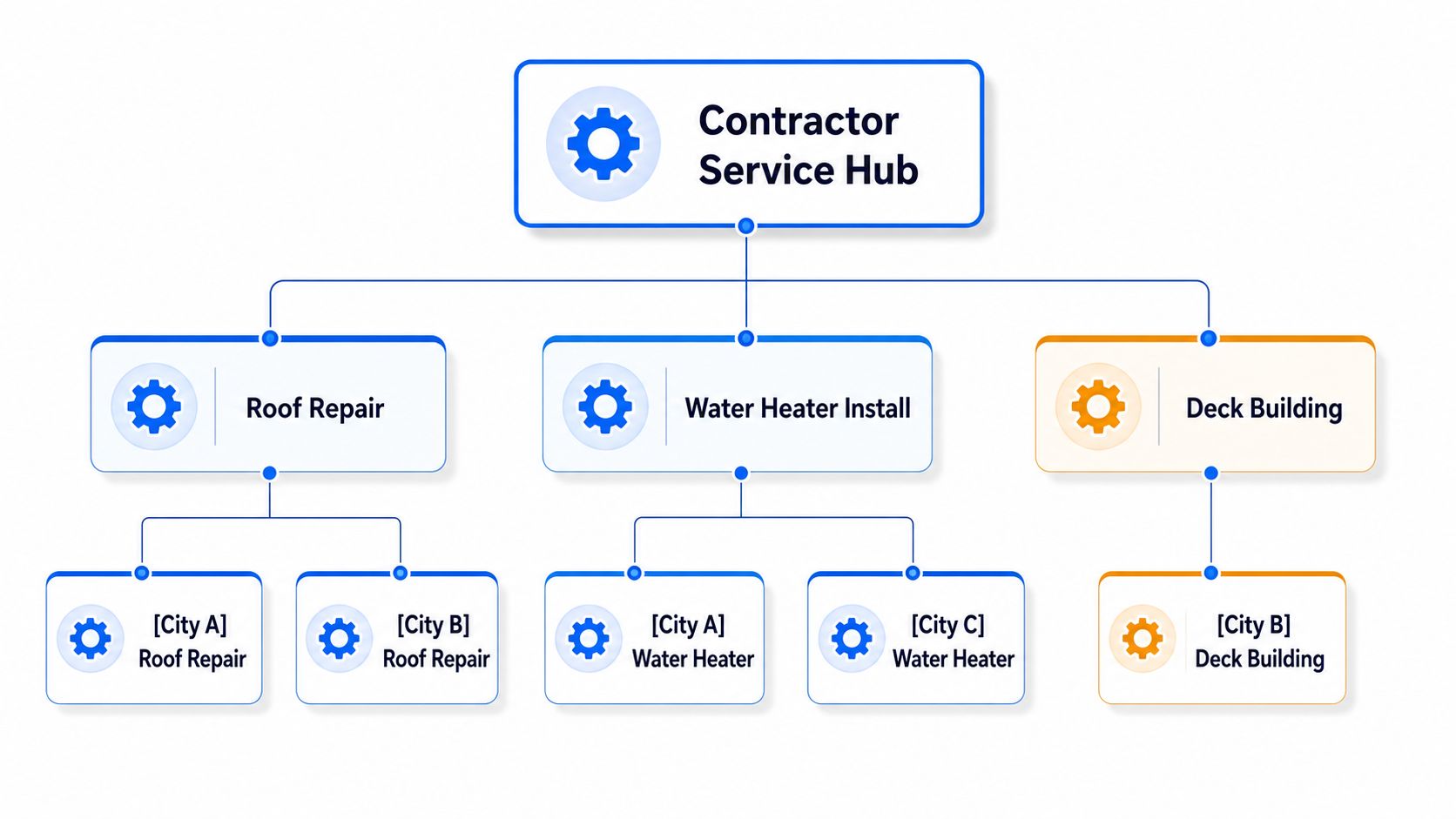
A contractor serving multiple cities shouldn't place every service and location on one generic page. That structure forces Google and AI systems to guess which page answers which search. Build a clean hierarchy instead.
Start with a keyword map grouped by trade, service, and city. For a plumbing company, that might include roof repair for one business and water heater replacement, sewer line repair, and drain cleaning for another. Each service should have a central page, with supporting city pages built only for locations the company serves.
Give every page a local reason to exist
A city page needs more than a swapped city name. Add local proof, nearby neighborhoods, relevant building or weather considerations, authentic project photos, and service details that reflect how the company works in that location. Embed a map when it helps the visitor understand coverage.
Link the central service page to each valid city page, and link city pages back to the relevant service hub. Keep the architecture obvious. A roofing visitor should move from roof repair to roof repair in the selected city, not into an unrelated general contractor blog post.
A page earns its place in a service-city silo by answering a distinct local need. If the copy could be published in another city without changing anything meaningful, it isn't localized enough.
Write for conventional search and AI discovery
AI Overviews and tools such as ChatGPT and Perplexity introduce another discovery layer. The content must make the business, services, locations, and evidence easy to interpret. Use concise definitions, direct answers, descriptive headings, comparison tables where helpful, and FAQ blocks based on real homeowner questions.
The shift is not a reason to abandon SEO. It's a reason to make the SEO clearer. An AI system can only associate a contractor with “HVAC repair near me” when the site consistently explains the trade, service, location, proof, and availability.
An empirical study of LLM local-business citations found that semantic relevance had a stronger effect on local LLM ranking behavior than traditional authority signals, while schema markup showed only a weak relationship with ranking across platforms, with correlations close to zero. The study of how LLMs rank local businesses supports a practical conclusion: write pages that answer the exact local question first, then use structured data to clarify rather than decorate the page.
The strongest silos connect transactional pages to operational proof. Include who answers the phone, what happens after a request, which services require an inspection, and what areas the crew covers. That information helps a homeowner choose and gives search systems a coherent entity to cite.
Reviews, Citations, and Reputation as a Ranking Layer
Reviews do two jobs at once. They help Google understand prominence, and they help a homeowner decide whether the risk of hiring a contractor feels acceptable. Ninety-eight percent of consumers read online reviews for local businesses at least occasionally, while 76% say they always or regularly read them when evaluating a local service provider, according to online review statistics for local businesses.
That makes review generation an operating process, not an occasional request from the owner. Send a direct review link when the job is complete and the customer is most familiar with the quality of the work. Ask for an honest review, never a scripted endorsement. Reply with specific references to the service, workmanship, or customer concern, and mention the city only when it sounds natural.
Compare the signals that shape trust
| Signal | Maps Ranking Impact | Conversion Impact | Owner Action |
|---|---|---|---|
| Google reviews | Supports prominence and profile activity | Reduces perceived hiring risk | Request feedback after completed work |
| Review recency | Keeps the profile current | Shows that customers still use the business | Maintain a consistent request process |
| Service-specific language | Reinforces relevance when authentic | Helps prospects identify a matching job type | Invite customers to describe the work in their own words |
| NAP consistency | Supports entity clarity across listings | Prevents confusion about contact details | Audit the website, directories, and social profiles |
| Local citations | Reinforces business identity and coverage | Adds discovery paths and third-party confirmation | Correct duplicates and outdated listings |
| Photo evidence | Adds visible proof of actual work | Lets buyers judge quality before calling | Upload real project and team photos |
For a broader explanation of understanding local SEO through reviews, the important distinction is between reputation as branding and reputation as a search input. Treat every review, citation, photo, and response as part of the same trust graph.
Keep the business identity consistent
Use the same business name, address, phone number, and website details across major directories, the website footer, Google Business Profile, and social bios. Audit for duplicates, old URLs, inconsistent suite information, and listings tied to former locations. A contractor that changes offices or phone systems should update the entire citation ecosystem, not just Google.
Contractors can use citation building for local SEO to organize that cleanup. The principle is straightforward: accurate identity signals support visibility, while specific customer proof supports the call decision.
Paid Ads for Contractors That Capture Ready to Book Calls
Paid advertising works best when the campaign matches the lead type. Local Services Ads, Google Search Ads, and remarketing aren't interchangeable, even though all three appear under the paid marketing label.
Local Services Ads are built around screened lead calls and pay-per-lead pricing. They're useful for trades where a homeowner wants a verified local provider immediately, especially plumbing, HVAC, electrical, and roofing. Their limitation is control. You need to monitor lead quality, service categories, coverage, and disputed leads closely.
Google Search Ads give you tighter control over the query, message, landing page, and geography. Create separate campaigns by trade, service, and city. “Emergency drain cleaning in Denver” should not share the same ad and page as “sewer line replacement estimate.”
Remarketing reaches people who visited your website but didn't call or submit a form. Display and YouTube campaigns can keep a contractor visible while a homeowner compares estimates, but they should support high-intent search rather than replace it.
Choose the channel by economics
A high-ticket roof replacement can justify stronger bids and longer follow-up because the job value supports the acquisition cost. A drain-cleaning company may need tighter radius targeting, call-focused ads, and strict negative keywords to avoid paying for unrelated searches.
Benchmark data shows the difference between broad home-services performance and construction-specific performance. Home services search ads average a 7.33% conversion rate overall, while construction and general contractors average 2.61%, with an average cost per lead of $165.67 in that category, according to Google Ads statistics for contractors. The same source reports that high-intent phone leads in home services can convert at 46% on the call, while plumbing lead-to-customer performance can reach 12% to 16%, demonstrating why booked jobs matter more than blended click metrics.
A practical starting allocation is 40% to Local Services Ads, 40% to Search, and 20% to remarketing, but treat that as a test model, not a law. Shift based on qualified bookings. Use negative keyword lists, service-area limits, ad scheduling, call assets, and landing pages whose headline matches the ad promise.
The Google Ads for contractors approach should be judged by lead source, qualified conversation, booked estimate, and booked job. Cheap clicks are not a win if the phone goes unanswered or the landing page attracts the wrong project.
Tracking KPIs and a 90 Day Rollout for Contractor Marketing
Marketing reports often celebrate impressions, clicks, and traffic while the owner still doesn't know which channel produced the last profitable job. Fix the measurement layer before increasing spend.
Use call tracking with dynamic number insertion so visitors from Google Business Profile, organic search, and paid ads can be assigned to the right source. Track forms through Google Tag Manager, connect lead records to the CRM, and record whether each inquiry became a qualified booking. A contractor needs source-level visibility from search impression to phone conversation to revenue.
Use three KPI tiers
Tier 1 metrics measure money and movement:
- Phone calls
- Form submissions
- Qualified bookings
- Cost per booked job
Tier 2 metrics measure channel health:
- Maps Pack impression share
- Organic landing-page conversions
- Review velocity
- Paid impression share and lead quality
Tier 3 metrics provide context:
- Assisted touches
- Returning visitors
- Branded search activity
- Engagement with project and service content
Build a weekly Looker Studio dashboard that pulls from GA4, Google Ads, Local Services Ads, Google Business Profile Insights, and the CRM. Review booked-job data, not just cost per lead. A campaign that generates fewer inquiries but more profitable work deserves more budget than a campaign producing a large volume of unqualified requests.
A practical 90-day sequence
Days 1 to 30: Fix the website foundation, add click-to-call paths, configure the Google Business Profile, install call tracking, connect form attribution, and clean priority citations. Confirm that every important service has a relevant landing page.
Days 31 to 60: Publish the highest-value service-city silos, launch Local Services Ads and Search campaigns for the strongest-margin trade, and request reviews immediately after completed work. Use early paid-search query data to improve organic page language.
Days 61 to 90: Add remarketing, refine keywords using qualified and booked-job data, improve call handling, and move budget away from weak cost-per-lead sources toward cost per booked job. Test AI-ready FAQ and answer content against the questions appearing in Search Console and sales conversations.
Budget must match the market, trade, and service area. Don't copy a universal spend chart or promise a fixed cost-per-lead range without verified local data. Set an initial budget your company can sustain, then scale only after tracking proves which searches produce profitable jobs.
Owner's rule: If your report cannot show which source generated a booked job, it isn't a marketing dashboard. It's a traffic summary.
Transactional LLC offers contractor-focused local SEO, Google Maps optimization, AI-driven content silos, conversion-focused websites, and paid campaigns built around searches such as “roofer near me” and “HVAC repair near me.” Visit Transactional LLC to build a measurable system that targets transactional search terms and turns local visibility into qualified calls and booked work.