


Your website probably looks better than it performs.
That's the problem. A home service business doesn't need a digital brochure with slick animations, oversized hero images, and vague copy about “quality craftsmanship.” It needs a machine that turns high-intent searches into phone calls, booked estimates, and jobs on the calendar.
If someone searches “plumber near me,” “air conditioning repair near me,” or “roofer near me,” they aren't browsing for inspiration. They're trying to hire someone now. That's the entire game. Transactional search terms signal immediate buying intent, and your home services web design should be built around capturing that demand fast.
This matters even more as search changes. Traditional local SEO still drives visibility, but AI optimization now matters too. Large language models, AI search summaries, and answer engines increasingly shape which businesses get surfaced first. If your site is vague, poorly structured, or disconnected from your Google Business Profile, you're harder to find in both classic search and AI-assisted discovery. That's why every serious local business needs content, structure, and entity signals aligned for search engines and LLMs.
The market is moving in that direction. The global online on-demand home services market is projected to grow from US$4.7 billion in 2026 to US$7.1 billion by 2033, at a 6.1% CAGR, driven by digital platforms for booking and managing home service transactions, according to Persistence Market Research's online on-demand home services market analysis. More homeowners are hiring through digital interfaces. Better websites will win more of that demand.
Why Your Pretty Website Is Not Getting Calls
A lot of home service owners get burned the same way. They pay for a redesign, approve a polished homepage, get excited about the new look, then wait for the phone to ring. It doesn't.
That happens because most websites are built to impress the owner, not convert the searcher. The homeowner landing on your site after a transactional search doesn't care about your brand story first. They care about three things. Do you do the job, do you serve their area, and can they reach you immediately?
A recent guide on home service websites points out the exact problem: most advice ignores the gap between “looking good” and “producing calls,” and the gap keeps widening because clarity and structure drive conversions more than aesthetics alone. It also notes that trust signals such as real photos, reviews near decision points, and clear service area information need to appear where doubt shows up, not on isolated pages buried in the site architecture, as explained in Hook Agency's piece on home service websites that convert.
What a buyer actually sees
When someone searches for emergency service, they scan fast. They don't read your site in order.
They look for:
- Service match. Does this page clearly say plumbing, HVAC, roofing, electrical, or pest control?
- Location match. Does it confirm you work in their city or neighborhood?
- Contact path. Is the phone number obvious, tappable, and repeated where action happens?
- Trust proof. Are there real reviews, real photos, and signs that you're a legitimate local company?
If your site hides those answers behind sliders, generic headlines, or menu clutter, you lose the lead.
Practical rule: Every important page should answer “what you do,” “where you do it,” and “how to contact you” before the visitor has to think.
Stop building brochures
A home services website should act like a dispatcher, not a portfolio. The job is to route urgent local demand into a call, form, or booking request.
That means your design choices should support transactional intent:
- Put services first, not abstract branding copy.
- Lead with local relevance, not a giant stock image.
- Show trust near the CTA, not on a separate testimonials page.
- Write for buying searches, not vanity phrases.
If your site gets traffic but not calls, fix conversion before chasing more visits. A lot of businesses need stronger page structure, cleaner CTA placement, and fewer distractions. This guide on improving website conversion rate is the right place to start if that's your situation.
The Blueprint for Transactional SEO Architecture
Most home service sites are organized around the company's internal structure. That's backwards. Your website should be organized around how people search.
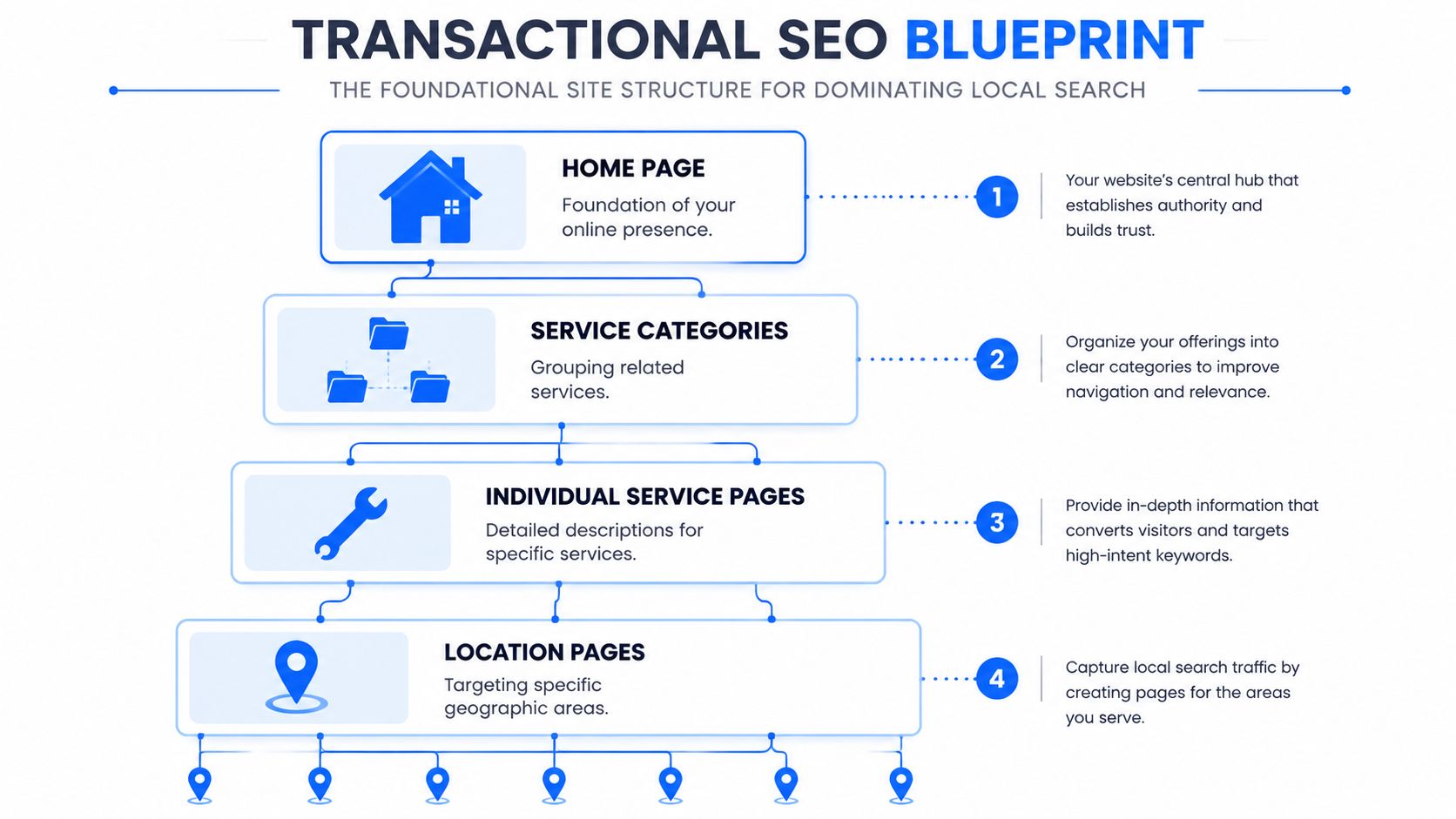
Someone doesn't search for your menu labels. They search for a specific service in a specific place. That's why the correct architecture is simple and aggressive. Homepage to service category to individual service page to location page. That structure gives Google, AI systems, and actual buyers a clean path to the exact answer they need.
Transactional keywords matter because the searcher is already close to hiring. Searches like “roofer near me” signal immediate purchase intent and are 2–3x more likely to convert than informational searchers, with transactional keyword conversion rates ranging from 1–4% compared with near-zero rates for top-of-funnel blog traffic, based on the cited analysis in this transactional keyword discussion on LinkedIn.
The structure that works
Use this hierarchy:
Homepage
Your broad authority page. It should confirm the core service categories, primary service area, and strongest conversion paths.Service category pages
These group related work. HVAC, plumbing, roofing, electrical, pest control.Individual service pages
These target job-specific searches such as AC repair, drain cleaning, roof leak repair, panel upgrades, or termite treatment.Location pages
These pair a service with a city, neighborhood, or service area phrase.
Here's what that looks like in practice:
| Page type | Example |
|---|---|
| Homepage | / |
| Service category | /hvac/ |
| Individual service | /ac-repair/ |
| Location page | /ac-repair-dallas/ |
Why this beats generic websites
A generic “Services” page forces one page to rank for everything. That rarely works well in local search. Google wants relevance. So do LLMs summarizing local providers.
A strong architecture creates focused landing pages for exact searches:
- “AC repair near me”
- “roof repair in Dallas”
- “emergency plumber Fort Worth”
- “electrician near me”
Each page becomes a direct match for intent.
The strongest local sites don't chase broad traffic first. They build pages for the searches that come with money attached.
Internal linking has to support intent
Don't leave these pages disconnected. Your homepage should link to service categories. Service categories should link to individual services. Individual services should link to location pages. Location pages should link back up the chain.
That internal structure helps search engines understand topical relationships and helps users move from broad interest to a local conversion page without friction. If you want a clean way to group these targets, this explainer on keyword clustering shows how to organize services and city terms into usable page sets.
Designing Service and Local Pages That Convert
The page structure gets you in the game. The page itself wins the lead.
Most service pages fail because they try to sound polished instead of useful. They talk in generic terms, delay the call to action, and bury the keyword target. A transactional page should feel obvious. The visitor should know within seconds that they found the right company for the exact job in the exact place they searched.
For transactional keywords, on-page SEO needs discipline. The primary keyword should appear in the first 100 words, show up in header tags, the title tag should stay under 60 characters, and the meta description should be about 155 characters, based on the recommendations in DinoRANK's guide to transactional keyword optimization.
What to put on a service page
Take a page targeting roof repair.
The page should open with a direct headline, a short service promise, a visible local phone number, and a CTA button. Then it should move into proof, process, and common problems solved.
A strong page layout looks like this:
- Headline with service intent. “Roof Repair in Dallas”
- Opening paragraph with keyword early. Mention roof repair in Dallas naturally in the first lines.
- Immediate CTA. Call now, request an inspection, or book service.
- Problem-based sections. Leaks, storm damage, missing shingles, flashing issues.
- Trust block near the fold. Reviews, license info, insurance, real crew photos.
- Service area confirmation. Name neighborhoods or nearby cities you serve.
- FAQ section. Short, direct answers about repair timelines, common issues, and next steps.
What makes a location page different
A city page isn't a copy-paste service page with the city swapped in. That's lazy, and search engines are good at spotting it.
A local page should include:
| Element | Service page | Location page |
|---|---|---|
| Core keyword | Roof repair | Roof repair Dallas |
| Primary purpose | Explain service | Match local intent |
| Proof needed | Expertise and process | Local presence and service area fit |
| CTA style | Book repair | Call for service in that city |
Copy rules that actually help conversions
Write short blocks. Use blunt headlines. Keep the page focused on action.
Do this:
- Use the keyword where it matters. Title tag, H1, opening copy, subheads.
- Keep headlines concrete. “Emergency AC Repair in Plano” beats “Reliable Comfort Solutions.”
- Place CTAs after moments of reassurance. Right after reviews, service guarantees, and location confirmation.
- Use original images when possible. Team trucks, technicians, job photos, office shots.
Avoid this:
- Stock-heavy hero sections
- Long intro paragraphs about company history
- One page trying to rank for every service
- Walls of text with no visual guidance
A transactional page should read like a fast answer, not a brochure. If the visitor has to interpret what you do, the page is already underperforming.
Building Unbreakable Trust and Capturing Leads
High-intent traffic is unforgiving. The visitor showed up ready to spend. If your page feels sketchy, slow, or confusing, they leave and call the next company.
Trust is not a design accessory. It is the conversion engine. That's especially obvious in home services, where the customer is inviting someone into their house. They want proof that you're real, local, competent, and easy to contact.
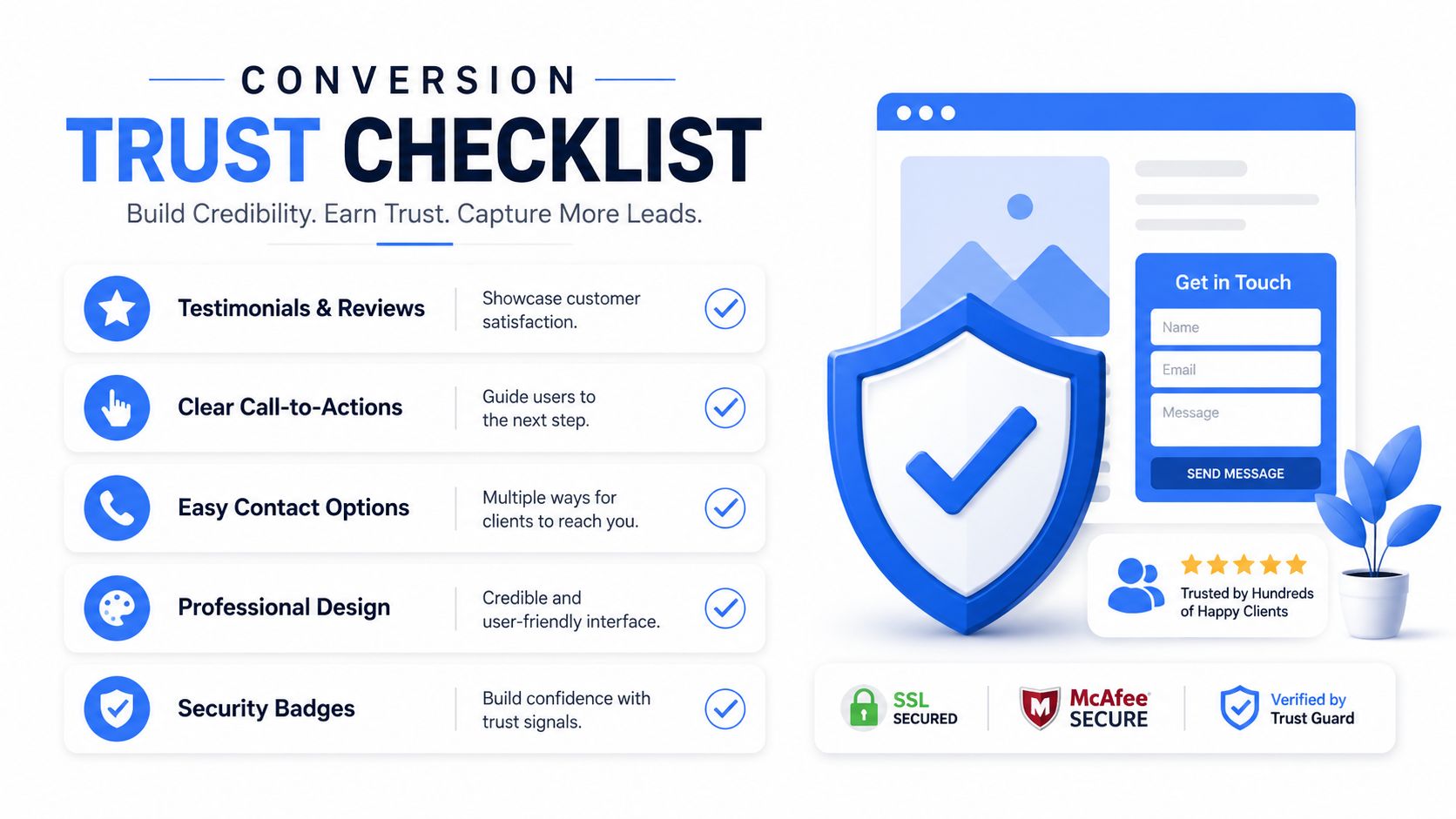
The numbers back this up. Plumbing websites average a 15.61% conversion rate, far above the 2–5% baseline for service businesses, according to Cube Creative's roundup of home service marketing stats. That gap doesn't happen by accident. It comes from pages that remove doubt and make contact easy.
Trust elements that belong on the page
Don't isolate these on an “About” page and hope people find them. Put them near the decision point.
- Real photos. Use actual staff, vehicles, uniforms, and completed work.
- Reviews beside the CTA. Not in a hidden carousel halfway down the footer.
- License and insurance signals. If relevant to your trade, show them clearly.
- Service area clarity. Say where you work in plain language.
- Local phone number. Make it visible in the header and sticky on mobile.
Lead capture should feel effortless
A lot of websites ask too much before earning the lead. Long forms kill urgency.
Use a simple conversion setup:
Click-to-call button
Best for emergency or same-day jobs.Short form
Name, phone, service need, city. That's enough to start.Booking or request flow
Good for estimates, tune-ups, inspections, and repeat service.
Here's the standard I use: if a customer can't call you or submit a request in seconds, your page has friction you need to remove.
Reviews don't build trust when they're hidden on a testimonials page. They build trust when they appear right where the customer hesitates.
A steady review system also improves what the visitor sees before they ever land on your site. If your reputation pipeline is weak, this resource on getting more reviews is worth fixing before you spend another dollar on traffic.
Dominating Google Maps with GMB and Schema
Your website doesn't operate alone. In local search, it feeds your Google Business Profile, supports map rankings, and helps validate your relevance for the searches that drive calls.
That's why home services web design should be connected to Maps from day one. Not later. Not after launch. Right away.
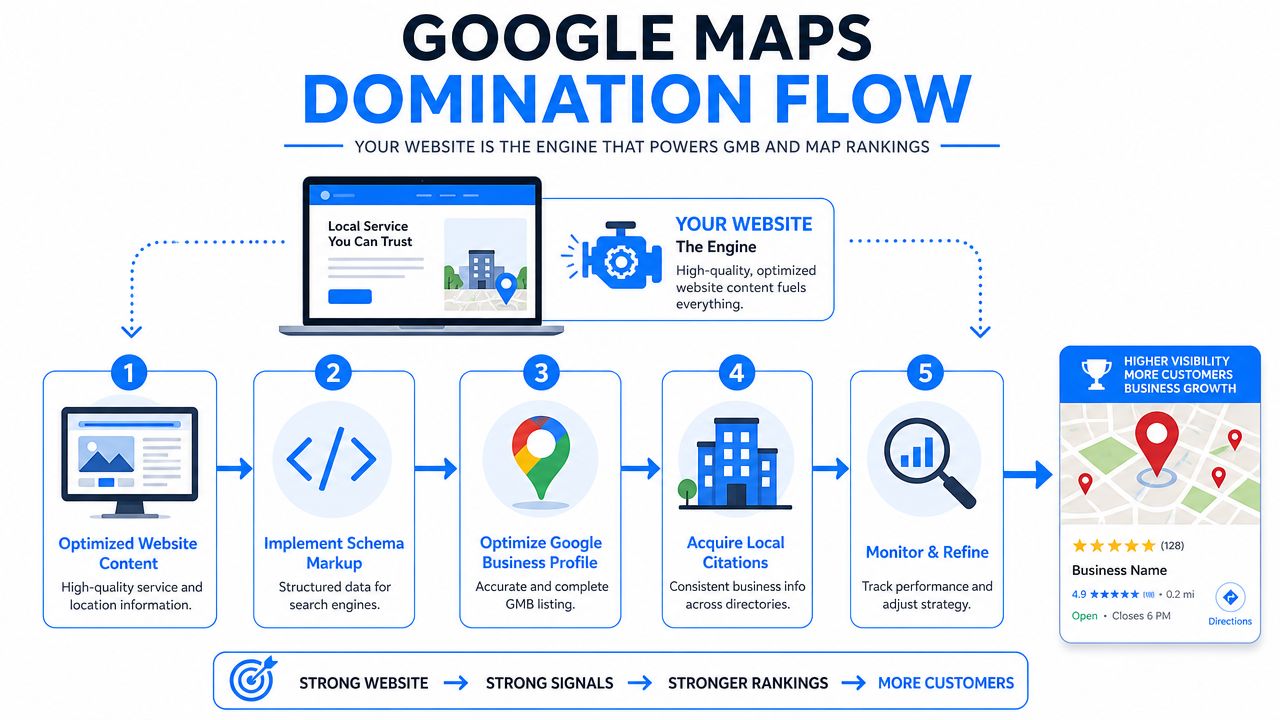
Location-based transactional keywords such as “near me” and “in [city]” are critical for local SEO because they directly signal buying readiness and sit among the top buyer-intent keyword categories, according to SEOptimer's overview of transactional keywords for local SEO.
Your website validates your profile
Google Business Profile can't do the whole job by itself. Your GBP needs a website that confirms:
- Matching services
- Matching service areas
- Consistent business details
- Relevant local landing pages
- Clear topical authority
If your profile says AC repair in a city, but your website has no focused page for that service and area, your local signals are weaker than they should be.
Schema is the bridge
LocalBusiness and service-related schema help search engines interpret your business details more cleanly. It won't rescue weak content, but it does help connect the dots between your company, your services, and your service area.
Use schema to reinforce:
| Signal | What Google needs to understand |
|---|---|
| Business identity | Who you are |
| Service scope | What you offer |
| Location relevance | Where you operate |
| Contact details | How customers reach you |
That structure also helps with AI optimization. LLM-driven discovery tools pull from structured, consistent sources when summarizing local providers. If you're trying to evaluate how visible your business is in AI-assisted search, a Generative Engine Optimization Audit can help you spot where your entity signals and local content need work.
Maps visibility needs a system
Ranking in Maps takes more than page design. You need aligned website content, a complete profile, clean citations, ongoing review activity, and performance monitoring.
If you want the website and Maps strategy working together instead of fighting each other, this guide to local maps SEO lays out the operational side.
The Need for Speed and Mobile-First Design
Homeowners don't search for urgent services from a desktop at leisure. They search while the AC is out, the pipe is leaking, or the breaker keeps tripping. In that moment, your site has one job. Load fast and make contact easy.
That's why mobile-first design isn't optional in home services. It's the operating environment.
A rigorous mobile-first methodology means designing navigation and primary CTAs for the smallest screen first, then testing every critical user flow on mobile before desktop deployment, according to Farmboy's breakdown of mobile-first web design practices. That's the right approach for local service businesses because the user's urgency doesn't wait for your desktop layout to look pretty.
What mobile-first actually means
It does not mean shrinking a desktop site.
It means prioritizing these items first:
- Tap-to-call in the header
- Short menus
- Visible service categories
- Forms that don't require too much typing
- Buttons large enough to hit without precision
- Fast page rendering on weak mobile connections
Technical fixes that protect leads
If you want practical implementation help, these practical mobile design strategies give useful design patterns for structuring smaller-screen experiences.
For home service websites, the technical checklist is straightforward:
Compress images
Huge image files slow down urgent pages for no good reason.Use lazy loading where it makes sense
Prioritize above-the-fold content and defer what isn't needed immediately.Avoid heavy JavaScript bundles
Fancy effects often damage usability.Use aggressive caching
Returning visitors and repeat sessions should load fast.Deploy a CDN
Faster delivery helps stabilize the experience across service areas.
Test user flows, not just pages
A page can look fine in a preview and still fail the actual test.
Check these flows on actual phones:
- Call from the header
- Submit the quote form
- Open the menu and find a service page
- Tap to the city page from a service page
- Return to the homepage without confusion
If the phone number is hard to tap, the menu is clumsy, or the form fights the user, the design failed. It doesn't matter how polished it looks on a large monitor.
Launch Track and Maintain Your Lead Machine
A website launch is not a finish line. It's the point where measurement starts.
The businesses that win local search treat their websites like operating assets. They track rankings, calls, forms, and map visibility. They keep refining pages based on what drives booked jobs, not what wins design awards.
What to watch after launch
Ignore vanity metrics first. Traffic alone doesn't pay for trucks, payroll, or ad spend.
Track the metrics tied to revenue:
- Phone calls from service and location pages
- Form submissions by page type
- Google Business Profile lead activity
- Keyword rankings for transactional searches
- Map visibility across target service areas
A useful dashboard should make it obvious which pages generate action and which pages need work. If a city page ranks but doesn't convert, fix trust and CTA placement. If a service page converts but doesn't rank, improve internal linking and local relevance.
Maintenance is where compounding happens
Good home services web design gets stronger over time when you maintain it properly.
That means:
- Updating service pages with better proof
- Expanding into new city pages carefully
- Monitoring form issues and mobile usability
- Refreshing copy for AI readability and entity clarity
- Keeping Maps and website signals aligned
Video walkthroughs can also help teams understand how to evaluate local SEO visibility and page performance in practice.
The smartest operators don't ask, “Is the website done?” They ask, “Is the website producing more transactional leads this month than last month?” That's the right question. Especially now, when businesses need to show up not only in Google's traditional results but also in AI-assisted discovery environments that summarize, recommend, and compare local providers on the fly.
If you want a website built for transactional search terms, stronger Google Maps visibility, and AI-driven local SEO that targets searches like “air conditioning repair near me,” “roofer near me,” and “dentist near me,” talk to Transactional LLC. They focus on getting local businesses found where buyers are ready to spend, with website strategy, Maps optimization, and search campaigns designed to turn searches into calls.