

Before you can dispute a Google review, you need a clear reason. This means identifying a specific policy violation, whether it’s spam, a blatant conflict of interest, or hate speech. Once you have your violation, you can flag the review directly from your Google Business Profile. Just be sure to select the violation that fits best.
You really only get one shot to make a strong first impression with Google's system. Your initial report is what their automated tools and, eventually, human reviewers will see, so it has to be convincing right out of the gate.
Why Mastering Google Review Disputes Is Critical in 2026

If you run a service business—think roofers, dentists, or HVAC contractors—you know that online reviews aren't just feedback. They're a direct line to your revenue. Your Google review profile is often the single biggest factor determining if you show up for high-value transactional search terms like "roofer near me" or "emergency dentist open now."
When a potential customer searches for those phrases, they have a problem they need solved immediately and money ready to spend. These are the exact terms we get our customers to show up for. Your reviews are what make them decide to call you instead of the next company on the list. That's why we're called Transactional Marketing—we get you in front of customers with money in hand, ready to transact.
That's why managing your reviews isn't just a side task; it's a core business function. It’s a huge part of Google Maps optimization and the key to landing in the coveted top three map results. Here at Transactional Marketing, our entire system is built on this reality—we have the technology to make your map locations show up in the top three, which can translate into hundreds of more phone calls every month.
The New Threat of AI-Driven Review Removals
The landscape got a lot more complicated when Google rolled out aggressive AI moderation to fight spam. The intent was good, but the AI has been chaotic, often removing legitimate, hard-earned positive reviews right along with the fake ones. A sudden dip in your review count or rating can absolutely tank your visibility overnight, knocking you right off the first page and out of the Google Maps 3-Pack.
This isn't a small problem. It's a direct threat to your bottom line. We've seen this happen firsthand with clients in multiple industries. One roofing company we work with relied on a steady flow of five-star reviews for "roofing company near me" searches. Their lead flow was cut nearly in half after the AI zapped a dozen perfectly valid customer testimonials.
This new reality was thrown into sharp relief in early 2026 when a massive wave of AI-driven review removals hit over 60,000 businesses globally. The event triggered widespread disputes as legitimate reviews vanished, threatening the online visibility of countless service companies.
Proactive Management Is Non-Negotiable
This is where adapting to an AI-driven world and AI optimization becomes so important. You have to understand how large language models (LLMs) are interpreting your business's reputation online. Every review, every response you write, and every dispute you file sends signals that shape how search engines and new AI search results find and rank you.
The problem got even worse recently. In early 2026, Google’s systems purged hundreds of millions of reviews from Google Business Profiles across the globe, creating total confusion. In a bizarre twist, many businesses saw reviews disappear from their public profile, but their total review count stayed the same because the backend data failed to sync.
Learning how to effectively dispute Google review issues—whether that means removing a fake negative review or fighting to get a legitimate positive one reinstated—is no longer just a good idea. It's a fundamental skill for survival and growth. Our expertise at Transactional Marketing goes beyond standard SEO; we have the technology and a proven system to help you navigate this complex environment, protect your rankings for the terms that drive revenue, and keep your business thriving. If you want to brush up on the basics, you might find our guide on what is a Google Business Profile helpful.
Identifying Reviews That Violate Google's Policies
Before you even think about hitting that "dispute" button, you need to have your ducks in a row. Google simply won't remove a review just because it’s negative or you disagree with the customer’s take. To win a dispute, you have to nail the review for a specific policy violation. Knowing these rules isn't just helpful—it's your entire game plan.
Your job is to act like a detective, matching the review's content to a concrete violation in Google's rulebook. For the service businesses we work with, this is a critical skill. Imagine a rival HVAC company leaves a phony one-star review to sabotage your ranking for the transactional search term "AC repair near me." That's a textbook conflict of interest, and it gives you a solid foundation to get it taken down.
An Actionable Guide to Google Review Policy Violations
Google’s prohibited content policies are pretty long, but for a local service business, you'll see the same handful of violations pop up again and again. Getting familiar with these will help you spot removable reviews in seconds.
The table below breaks down the most common violations we see. We focus our marketing on one industry per topic, so these examples are specific to help you identify issues within your own field.
| Violation Type | What It Means | Example for a Service Business (e.g., Dental, HVAC) |
|---|---|---|
| Spam & Fake Content | The review is from a fake account, a bot, someone who was never a customer, or contains commercial links. | A "customer" leaves a one-star review for your dental practice but your records show they never had an appointment. |
| Conflict of Interest | The review is from a current/former employee, a competitor, or someone with a clear financial incentive. | After letting an employee go, a negative review appears the next day detailing "internal issues" at your HVAC company. |
| Harassment & Hate Speech | The content includes personal attacks, obscene language, or targets someone based on their identity. | A review for your plumbing service personally insults a specific technician by name using offensive slurs. |
| Impersonation | The reviewer is pretending to be someone else (a public figure, another customer, or even you). | Someone leaves a review pretending to be your business manager, "apologizing" for poor service you never provided. |
| Private Information | The review reveals personal details like a home address, phone number, or private email. | A customer posts a five-star review for your roofing job but includes the technician's personal cell phone number. |
By referencing this guide, you can move past the frustration of a bad review and into a clear, strategic response. It turns a subjective complaint into an objective, actionable case.
Expert Tip: Don't just focus on the negative stuff. Google's AI is also on the lookout for suspicious positive reviews. If you see a cluster of five-star reviews all using generic phrases like "great service," it can trigger a spam filter. The goal is a trustworthy profile, not a perfect one.
How These Violations Play Out in the Real World
Let's put this into practice. How do these policies actually show up on your Google Business Profile?
Say a dental practice has to terminate an employee for poor performance. The very next day, a scathing one-star review appears, filled with false claims about the office's "internal operations." That's a textbook Conflict of Interest. The reviewer isn't a genuine customer—they're a disgruntled ex-employee with a clear axe to grind.
Here's another one: a roofing company finishes a big job. The client is thrilled and leaves a glowing review, but they include the full name and personal cell number of the lead roofer. Even though the sentiment is positive, this is a clear-cut Private Information violation. You should flag it immediately to protect your employee's privacy.
This is exactly why a deep understanding of the rules is so critical. As we help our clients get to the top of Google for their most profitable transactional search terms, we also teach them how to defend that position. Knowing how to spot and handle these reviews is a core business skill. If you're wondering what happens on Google's end, we've covered the process for when a Google review is removed. Mastering this protects the very asset that brings you customers who are ready to buy.
Your Playbook for Flagging and Disputing Reviews
Now that you know how to spot a review that breaks Google's rules, it’s time to take action. Think of this as your tactical guide for the official dispute Google review process. Following the right steps is absolutely crucial for protecting your reputation and keeping your business visible for the high-value transactional search terms that actually make the phone ring.
Let me be direct: blindly flagging a review over and over or picking the wrong violation type will get you nowhere. It’s just a waste of your time. The real goal is to file a clean, accurate report that Google's automated systems and human moderators can understand and act on quickly. A precise first attempt is your best shot at getting a fake or malicious review taken down.
The Flagging Process Inside Your Google Business Profile
When you're ready to report a review, you'll do it right from your Google Business Profile (GBP) dashboard. While the process itself seems simple, every single click matters.
First, head over to your GBP dashboard and open up the “Reviews” section. Find the exact review you need to dispute. Next to it, you'll see three small dots—click them and choose "Report review."
This next screen is where most people go wrong. You'll see a list of violation types. You absolutely have to select the one that most accurately describes the problem. For instance, if a competitor leaves a bogus one-star review pretending to be a customer, that's a clear Conflict of interest. If the review is full of racist slurs, you’d report it for Hate speech. Getting this right is everything.
Once you hit submit, you have to wait. Google usually takes between three to seven business days to review the flag and send you an email with their decision. Whatever you do, don't flag the same review multiple times. It doesn't speed things up and can actually work against you.
Understanding Google's AI and Its Impact
In recent years, the review dispute process has gotten trickier. Google's AI has become incredibly aggressive in scanning for manipulation, but this has created a lot of collateral damage for honest businesses.
A recent analysis of 60,000 Business Profiles revealed that perfectly legitimate 5-star reviews are getting caught in the crossfire. We've seen Google's 2026 policy updates lead to shocking deletion rates, especially for businesses in healthcare and professional services like dental offices or roofing contractors. You can read the full analysis of why Google is deleting genuine reviews to grasp just how big this problem has become.
Even generic but positive comments like "great dentist" or "quick service" can trigger the AI if they appear in high volume, causing your hard-earned reviews to simply disappear. This is exactly why a solid review management strategy is no longer optional. It’s a core part of local SEO and essential for keeping that top-three spot on Google Maps that we help our clients secure with our specialized technology.
To help you categorize violations quickly, use this visual guide. It breaks down some of the most common and clear-cut violations you'll encounter.
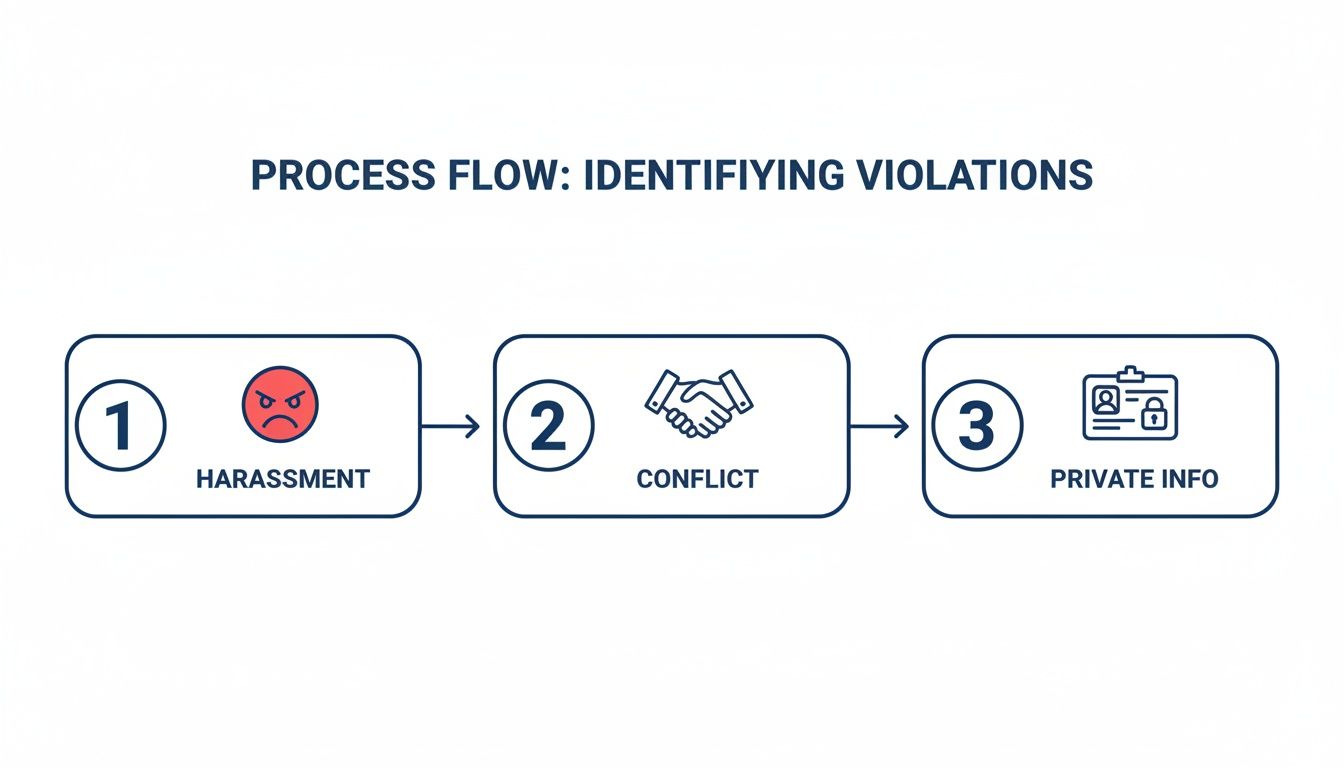
Having this handy makes the flagging process much faster and, more importantly, more accurate.
Setting Realistic Expectations for Outcomes
You need to go into this process with a level head. Not every dispute will end with the review being removed. Google tends to give the benefit of the doubt to the user’s personal experience unless a policy has been clearly and explicitly violated.
- Successful Removal: If the violation is blatant—like spam, hate speech, or a clear conflict of interest—your chances of removal are high.
- Denied Removal: If the review is just negative and describes a poor experience (even if you disagree with the facts), Google will almost certainly leave it up.
Remember, the dispute process is just one tool in your arsenal. A professional public response to a negative review is often your most powerful move, as it shows all future customers that you are attentive and committed to service.
This entire playbook is one piece of a much larger strategy. Our proven system focuses on getting your business on page one of Google for those critical searches—like "air conditioning repair near me" or "dentist near me"—within 30 to 60 days. A clean, well-defended review profile is a pillar of that success. To make sure your entire profile is firing on all cylinders, check out our Google My Business optimization checklist. It’s designed to help you maximize your visibility and attract customers who are ready to buy.
Escalating Your Case When a Dispute Is Denied
It’s a gut-punch to get that email from Google saying your dispute was denied. When a review is obviously fake or malicious, seeing that automated rejection can feel like hitting a brick wall.
But here’s what I’ve learned from handling hundreds of these cases: Google's first "no" is rarely the final answer. It’s often just an automated response. Your real work starts now, and it involves escalating your case to get a human to take a second, harder look.
Think of the initial denial not as an endpoint, but as your ticket to the next level. Google has a one-time appeal process, and this is your chance to build a much more compelling argument that an automated system might have missed.
For the service businesses we work with, a clean review profile is non-negotiable. It's the difference between showing up for high-value transactional search terms like "emergency plumber near me" and losing out to a competitor. We don't let a bad-faith review derail the hard-won visibility we secure for our clients.
Building a More Robust Argument for Your Appeal
When you file that appeal, you can't just send the same complaint again. You need to come prepared with undeniable proof. Your first flag was an alert; this appeal is your case file. The goal is to gather so much compelling evidence that it leaves no room for interpretation.
You have to think like you're building a legal brief. Vague claims like "this is a fake review" won't get you anywhere. You need to prove, with documentation, that the review specifically violates one of Google's policies.
Types of Evidence to Gather:
- Customer Records: Pull up your CRM, booking software, or payment system. A simple screenshot showing a search for the reviewer's name with "no results found" is incredibly powerful proof.
- Disproving Timelines: If a reviewer claims they had a terrible "roofing installation" last Tuesday, but your records show your crew was on a completely different job across town, document it. A redacted work schedule or a time-stamped photo from the actual job site works wonders.
- Screenshots of Harassment: Did the conflict originate on social media, email, or text? Screenshot the entire conversation. If a user was sending you threatening DMs before posting a one-star review, that provides crucial context about their intent.
- Identifying Ex-Employees: If you suspect the review is from a disgruntled former employee, provide their full name and employment dates. This directly points to a conflict of interest, which is a clear policy violation.
Compile all of this into a single, easy-to-read document (like a PDF). When you submit your appeal, you can attach this file, giving the support agent everything they need in one place.
Contacting Google Business Profile Support Directly
If the appeal process also hits a dead end, it's time to escalate further by contacting Google Business Profile support directly. This is your best shot at getting out of the automated queue and in front of a real person.
How you frame your request is everything.
When you open a support ticket, be professional, concise, and straight to the point. The very first thing you should provide is the case ID from your initial denied dispute. This immediately shows the support agent that you’ve already gone through the standard process.
Pro Tip: Don't lead with an emotional complaint like "This review is fake and it's hurting my business!" Instead, frame it as a policy violation backed by your evidence. Try something like this:
"I am requesting a second look at Case ID [your case number]. This review violates Google's policy on conflict of interest. The reviewer, [Name], is a former employee terminated on [Date]. We have attached documentation confirming their employment dates and a link to the review. Can you please escalate for manual review?"
This approach changes the dynamic. You’re no longer just a complaining business owner; you're a partner helping Google enforce its own rules and maintain the integrity of its platform. It’s a small shift in tone that can make all the difference.
Building a Bulletproof Reputation with Proactive AI Optimization
Knowing how to dispute a Google review is a necessary skill, but it’s fundamentally a defensive move. The real secret to long-term success isn’t just playing defense—it’s going on offense. Your primary goal should be to build such a strong online reputation that the occasional negative review barely makes a dent.
Think of it this way: the best defense against a one-star review is a mountain of five-star ones. When you consistently earn authentic, positive feedback, a single negative comment loses its power. It becomes a statistical blip, its ability to damage your rating or scare off customers all but gone.
This is exactly the system we've perfected at Transactional Marketing. We focus on getting our clients ranked on page one for their most valuable transactional search terms—think "dentist near me" or "air conditioning repair near me"—often in just 30 to 60 days. Our process isn't like other boring marketing companies; we laser-focus on the specific terms that get you found by customers in your city who are ready to spend money.
Feeding the AI with Positive Signals
Everything you do online today is a form of AI optimization. Google’s large language models (LLMs) are constantly learning about your business from every piece of digital content they can find. How you show up in new AI-powered search results depends heavily on these signals, especially your reviews and your responses.
One of the most impactful things you can do is respond to every single review—good, bad, or indifferent. Each thoughtful reply is another piece of positive context you're feeding the AI. You're actively demonstrating that your business is engaged, professional, and genuinely cares about customer feedback.
This process builds a powerful digital footprint that strengthens your authority and resilience in local search. The more positive signals you send, the more authoritative your Google Business Profile becomes, which is key to landing in that coveted top-three spot in Google Maps that drives so many calls. You can dig deeper into this strategy in our complete guide to AI Search Engine Optimization.
The need for this proactive approach is more urgent than ever. With 90% of consumers relying on reviews for local businesses, your reputation is your most valuable asset. But in the unpredictable environment of 2026—marked by mass AI-driven removals and constant suspicion of fake reviews—that trust is on shaky ground.
A Holistic Approach to Reputation Management
Building a reputation that can withstand anything comes down to three core activities: generating new reviews, monitoring your profile constantly, and responding to feedback quickly. Successfully navigating Google's murky review landscape in 2026 is a real test for local businesses, as the lack of clear rules puts the pressure on you to maintain your own credibility.
For any service-based business like a roofer or dentist, this means making it a habit to ask satisfied customers for a review. It also means having a system in place to know the second a new review pops up so you can act on it.
To manage all this effectively, it’s worth looking into dedicated platforms. You can learn more about the best Reputation Management Software Platforms available to help you streamline the entire process. These tools can automate review requests and put all your monitoring in one place, saving you time while making your online presence stronger. It’s this kind of proactive work that separates the businesses that just get by from the ones that truly own their local market.
Common Questions (and Real Answers) About Disputing Google Reviews
When you're in the trenches trying to manage your company's reputation, you run into some very specific and often frustrating scenarios. Let's tackle some of the most common questions I get from business owners trying to make sense of the Google review dispute process.
Getting this right is about more than just a star rating. It's about showing up for the high-value transactional search terms that actually make your phone ring. When a customer searches for "roofer near me," your reviews are the first thing they see—and often what decides whether you get the job.
How Long Does It Take for Google to Remove a Flagged Review?
Once you've flagged a review, you're pretty much on Google's clock. In most cases, you'll hear back within three to seven business days.
But that's not a guarantee. The review pipeline is a mix of automated systems and human moderators, and things can get backed up. One thing I can tell you from experience: flagging the same review over and over won't speed it up. It can actually look like spam and work against you. The best play is to submit one solid, well-documented flag and wait for their email. If that first attempt is denied, you can then try a one-time appeal.
Will Responding to a Negative Review Hurt My Removal Chances?
This question comes up all the time, and the answer is a firm "no." Responding to a negative review has absolutely no bearing on whether Google will remove it. In fact, a public response is a critical part of good reputation management and can even be seen as a form of AI optimization.
Think of the public response and the private dispute as two separate tracks. Your public reply shows every potential customer who sees that review that you're engaged, professional, and care about your customers. If the review gets removed, fantastic. If it stays, your professional response remains, turning a negative into a powerful signal of your company's integrity. It often wins over new customers all on its own.
Can I Dispute a Review That Is Just Factually Incorrect?
This is easily one of the most maddening situations for a business owner. A customer leaves a review with the wrong dates, an incorrect price, or a complete mischaracterization of events. Unfortunately, if the review doesn't break a clear policy—like hate speech or a conflict of interest—Google almost never gets involved.
Google's official stance is to avoid acting as the referee in factual disputes between a business and a customer. They have no way of knowing who is telling the truth.
Your public response is your best and only tool here. Use it to correct the record calmly and professionally. Avoid getting into an argument. Just state the facts as you know them, provide helpful context, and offer to take the conversation offline to resolve it. This lets you control the narrative for anyone else reading it.
What Should I Do If a Legitimate Positive Review Disappeared?
It’s incredibly disheartening to earn a glowing 5-star review only to see it vanish. This is happening more and more as Google’s spam-detection algorithms and new AI optimization filters become more aggressive, often filtering out legitimate reviews by mistake.
If a good review goes missing, your only real option is to contact Google Business Profile support. There's no formal "dispute" process for this like with negative reviews, but you can open a support ticket and ask why it was removed. You’ll need to provide any details you have, like the customer's name or when it was posted.
Honestly, success here isn't guaranteed. It's a perfect example of why the best defense is a great offense. This is the core of our philosophy at Transactional Marketing. Our proven system is built to get your website ranked on page one of Google for the searches that generate jobs, usually within 30 to 60 days. This drives a consistent flow of new customers and, in turn, a steady stream of new positive reviews, creating a powerful and resilient online reputation that dominates your local market.
Ready to stop worrying about reviews and start dominating your local market? The team at Transactional Marketing uses a proven system to get our clients to the top of Google for the transactional search terms that drive real revenue. Visit us at Transactional.net to see how we can make your phone ring.