


You're good at your trade. You solve real problems. You show up, do the work, and take care of customers.
But when someone in your city searches for the service you sell, your business doesn't show up where it matters. The phone stays quiet. A weaker competitor gets the call. That's the problem this engine optimization starter guide fixes.
If you own a local service business, SEO isn't about vanity traffic. It's about transactional search terms. That means searches like “roofer near me,” “emergency plumber,” “AC repair near me,” or “dentist near me.” Those aren't casual searches. Those are buyers looking for help right now. Your job is to get in front of them at the exact moment they're ready to book.
Stop Waiting for Referrals and Start Capturing Customers
A lot of local businesses still run on referrals, repeat customers, and hope. That works until it doesn't.
One week is busy. The next week is thin. You ask yourself why the phone slowed down, even though your team does better work than the companies outranking you. The answer is usually simple. You're not visible when buyers are searching with intent.
More than 50% of all website traffic originates from organic search results, which means search isn't a side channel. It's one of the main ways customers find businesses online, as noted in this beginner SEO guide from Scorpion.
Transactional intent is the only traffic that matters
A homeowner searching “how does my furnace work” is researching.
A homeowner searching “furnace repair near me” is trying to hire someone.
That second search is where the money is. If your marketing doesn't prioritize those searches, you're spending time on traffic that may never turn into a booked job. A proper Engine Optimization Starter Guide for local services has to start there. Not with theory. Not with branding fluff. With buyer intent.
Practical rule: Build every SEO decision around searches that lead to calls, form fills, appointments, and booked jobs.
What this looks like in the real world
An HVAC owner in a competitive suburb usually has the same complaint. “We have a website, but it doesn't do much.”
That website often has one “Services” page, a generic home page, and no real local targeting. Meanwhile, a potential customer searches “air conditioning repair near me” on a hot afternoon and hires whoever appears in Maps and the first page results.
That's the game. Visibility at the moment of need.
Here's what matters most:
- Search terms with urgency: “emergency electrician,” “same day pest control,” “tooth extraction near me”
- Location-specific searches: “water heater repair in Phoenix,” “chiropractor near me”
- Map visibility: buyers often call directly from Google Business Profile without ever visiting a website
Referrals are great. They just aren't scalable. Search is.
The Foundations of Local Search Engine Optimization
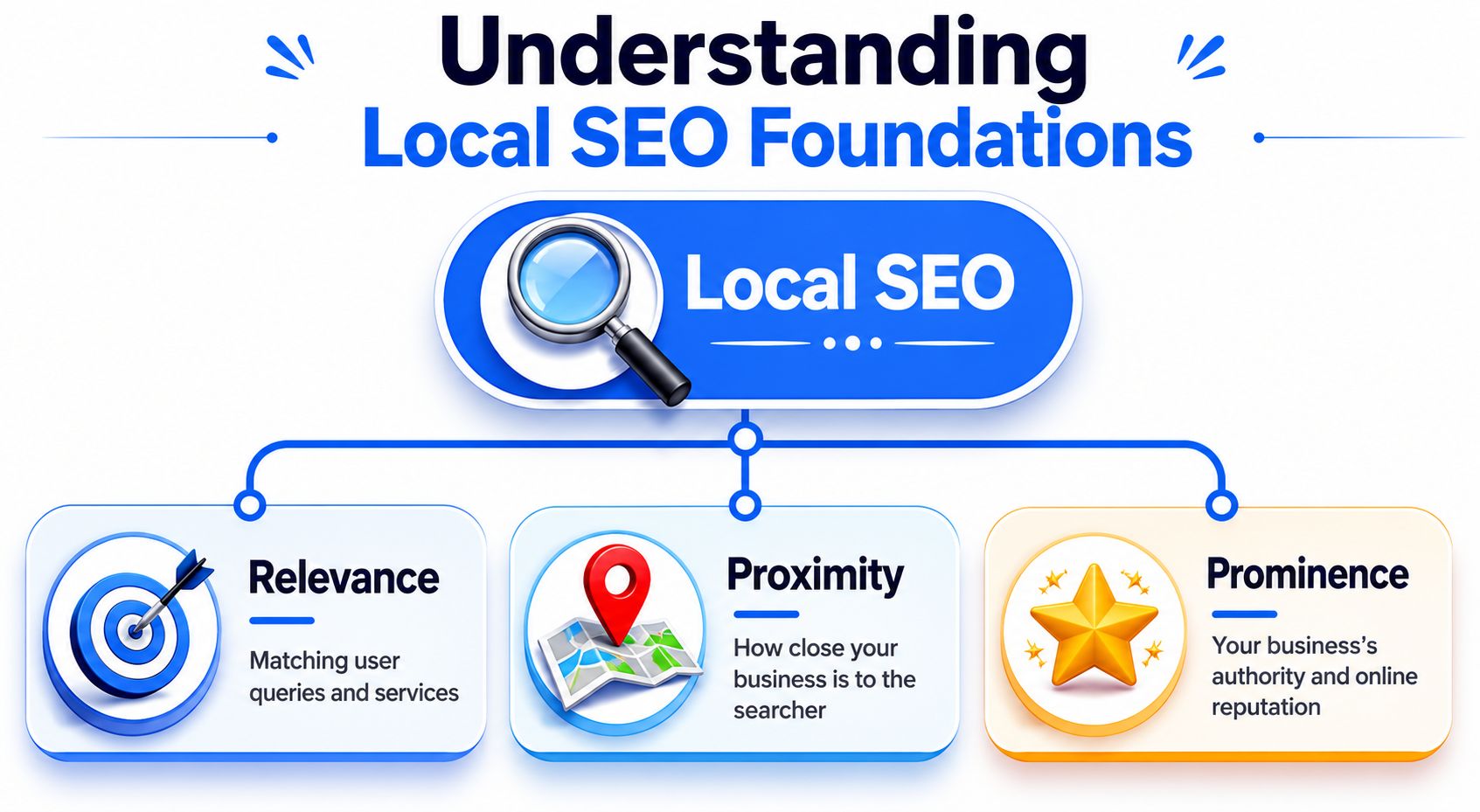
Local SEO is easier to understand when you stop treating it like a mystery. Picture it as a storefront.
If your sign is clear, your shop is easy to find, and people trust your business, you get customers. Online, the same rules apply. You need visibility, relevance, and authority across search results, Google Maps, and now AI-driven answer engines.
Visibility means being findable
If Google can't easily crawl your site, understand your pages, and connect your business to a local area, you won't rank consistently.
Google's own starter guidance has been clear for years. Its publicly shared starter guide, originally created for internal use, emphasized unique page titles, helpful meta descriptions, and better site structure as foundational SEO work that still matters today, according to the Google SEO Starter Guide archive.
That's why a serious local SEO setup starts with the basics done right. If you want a strong outside perspective on that process, this overview of website SEO optimization services is a useful benchmark for what competent execution should include.
Relevance means matching what buyers want
Your pages need to match the exact service and location combinations people search for. If you do roofing in Dallas, a vague page about “quality exterior solutions” won't cut it.
Use plain service language. Say what you do. Say where you do it. Put the right terms in titles, headings, and body copy. Keep pages tightly focused.
For a practical framework, review these local SEO best practices and compare them to your current setup.
Authority means earning trust signals
Authority comes from reviews, strong service pages, local mentions, internal links, and a site structure that proves you know the topic. AI search systems also lean on that same clarity. If your site is disorganized, thin, or vague, both search engines and AI tools are less likely to surface it.
A quick lens on the three foundations:
| Foundation | What it means | What to fix first |
|---|---|---|
| Visibility | Google can find and understand your pages | Titles, meta descriptions, internal links, navigation |
| Relevance | Your page matches the searcher's intent | Service-specific and city-specific page targeting |
| Authority | Your business looks credible and established | Reviews, supporting content, citations, strong site structure |
The fundamentals haven't changed much because buyer behavior hasn't changed. People still search for a service, compare options fast, and call the business that looks most relevant and trustworthy.
Your Digital Storefront Mastering Google Business Profile
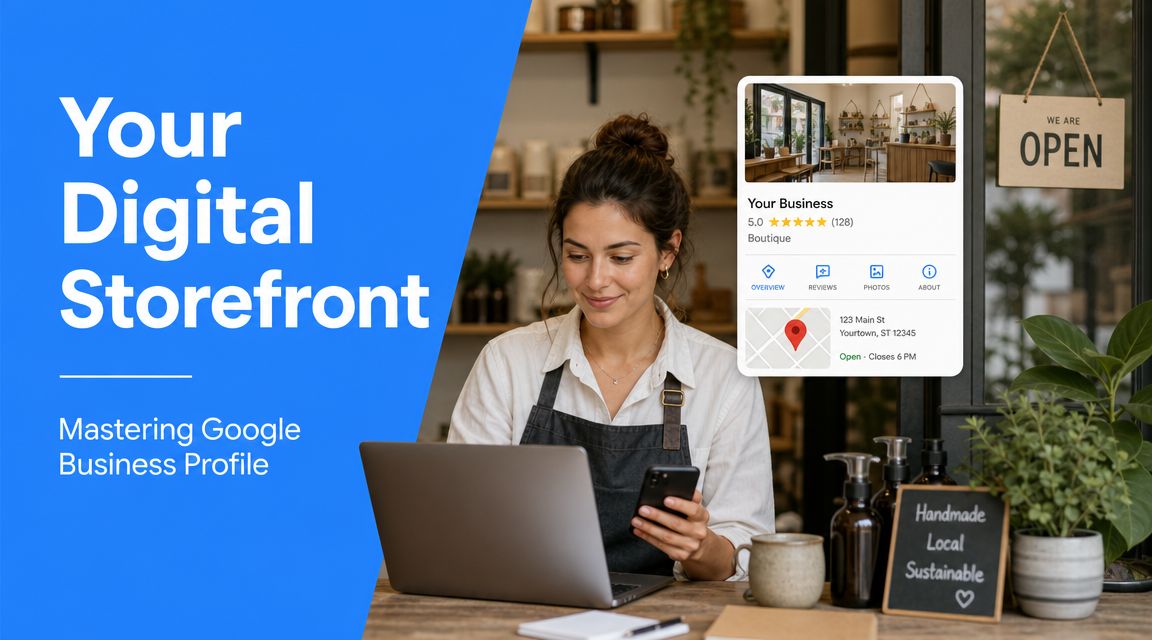
Your Google Business Profile is not a side asset. For many local searches, it's the first thing a buyer sees and the last thing they need before calling.
If you ignore it, your competitors win by default.
Treat your profile like a conversion page
A strong profile does four jobs fast. It confirms you're real, explains what you do, shows where you work, and gives buyers enough confidence to contact you.
Start with the essentials:
- Claim and verify the profile: If you haven't done this, stop reading and handle it.
- Choose the right primary category: This tells Google what your business should rank for first.
- Add useful secondary categories: Only add categories that reflect real services.
- Write a direct business description: Mention your actual services and service area in plain English.
- Upload real photos regularly: Use team photos, trucks, jobs, office shots, before-and-after images
- Keep hours accurate: Wrong hours cost calls and create bad reviews
If you need a plain-English breakdown of the platform itself, this guide on what Google Business Profile is covers the basics well.
Reviews are not optional
Reviews do more than boost trust. They also reinforce relevance and prominence.
Ask every happy customer. Make the ask simple. Send the link right after the job when satisfaction is high. Then respond to every review, including the bad ones. A stale profile with old reviews tells buyers your business is either inactive or inattentive.
Here's the standard I recommend:
- Ask consistently after completed work.
- Mention the service naturally when replying.
- Thank the customer like a human, not a script.
- Don't stuff keywords into every response.
A local buyer doesn't need a polished brand manifesto. They need to know you solve the problem, serve their area, and can be trusted.
Use posts, services, and Q&A properly
Most businesses leave these fields empty. That's lazy.
Fill out your services section with real offerings. Publish Google Posts when you have an offer, seasonal service, or timely update. Add and answer common questions before customers ask them.
This walkthrough is worth watching if you want to tighten up the details on your profile and local presence:
Your checklist for a profile that earns calls
| Area | What good looks like |
|---|---|
| Categories | Primary category matches your main revenue service |
| Description | Clear service and city language, written for buyers |
| Photos | Fresh, local, real-world images |
| Reviews | Ongoing review flow and active responses |
| Services and posts | Filled out, current, specific |
A neglected Google Business Profile is a missed revenue channel. Fix it first.
Dominating the Map A Guide to Google Maps Optimization
For local services, the map pack is often the entire battlefield.
When someone searches “AC repair near me” on a phone, they aren't studying ten blue links. They're scanning the map results, checking reviews, and calling one of the top options. If you're not in that pack, you're invisible during the most valuable searches.
The three map signals that matter
Google Maps rankings come down to three ideas: proximity, relevance, and prominence.
You can't control where the searcher is standing. That's proximity.
You can control the other two.
Relevance comes from how accurately your Google Business Profile and website describe your services, service areas, and business category. Prominence comes from the strength of your reputation across the web. That includes reviews, mentions in trusted directories, and overall consistency in your business information.
Citations are boring and important
A citation is a listing of your business name, address, phone number, and related business details on directories and local platforms.
They aren't glamorous. They work anyway.
If your information is inconsistent across the web, Google gets mixed signals. If your listings are clean, complete, and aligned, Google gets confidence that your business is legitimate and established in the market you serve.
Focus on these actions:
- Audit your listings: fix wrong phone numbers, old addresses, duplicate listings
- Match your business details everywhere: keep naming consistent
- Complete strong directory profiles: don't leave half the fields blank
- Support maps with local pages on your website: Maps and website SEO strengthen each other
For businesses trying to push higher in map visibility, this guide on how to rank higher on Google Maps is a solid next step.
Why reviews do double duty
Reviews influence both click behavior and map strength. Buyers trust recent, specific, believable reviews. Google also uses review content to understand what services customers associate with your business.
That means a review mentioning “same-day drain cleaning” or “emergency roof repair” is more useful than a generic “great company.”
Don't chase map rankings with gimmicks. Build relevance with accurate data and build prominence with proof from real customers.
What strong map optimization looks like
Weak map presence usually has the same symptoms. Sparse reviews. Incomplete profile. Inconsistent listings. No location signals on the website.
Strong map presence usually includes:
- A fully built out Google Business Profile
- Steady review generation
- Consistent directory listings
- Service pages tied to the cities you target
- A local brand footprint people can verify
Google Maps optimization isn't a side task. For local service companies, it's one of the shortest paths between a search and a phone call.
On-Page and Technical SEO Essentials for Local Sites
A local website should do one thing well. It should turn search demand into booked work.
Most local sites fail because they're too broad, too thin, or too confusing. They lump every service onto one page, use generic copy, and make Google guess what they offer. That's a bad plan.
Build pages around service plus location
If you offer multiple services in multiple cities, create pages that reflect that reality.
A plumbing company shouldn't rely on one generic services page. It needs focused pages like water heater repair in one city, drain cleaning in another, and sewer line replacement in the areas relevant to the business. Keep each page unique and useful. Don't clone the same text and swap city names.
A simple page structure works well:
- Title tag: service plus city
- H1 heading: clear match to the title
- Opening paragraph: direct statement of service and location
- Body sections: process, common problems, service details, FAQs
- Call prompts: phone number, form, appointment action
Technical SEO decides whether Google can use your site
Good copy won't save a site Google can't crawl properly.
Google's starter documentation stresses that crawlability and indexability are prerequisites. It recommends using sitemaps and internal links to help discovery, keeping resources accessible, and using canonical tags to consolidate duplicate signals, as explained in the Google Search SEO starter guide.
That matters a lot for local businesses because service-area websites often generate duplicate or thin city pages. If those pages compete with each other, you dilute your own rankings.
Fix these technical issues first
| Problem | Why it hurts | What to do |
|---|---|---|
| Orphan pages | Google has trouble discovering them | Add internal links from core service and city pages |
| Duplicate city pages | Signals get split across similar URLs | Consolidate or use canonicals where appropriate |
| Blocked assets | Google can't render pages correctly | Keep important resources accessible |
| Weak mobile experience | Buyers leave before converting | Simplify layout, forms, buttons, and speed |
Keep content readable and organized
Google's older starter guidance still gets this right. Make text easy to read. Break up long content. Use headings and sections. Don't publish giant walls of copy that nobody wants to scroll through.
That ties directly to conversions. A buyer landing on “emergency electrician in Mesa” doesn't want a company history lesson. They want confirmation that you handle the problem, serve the city, and can respond.
Clean structure helps two audiences at once. Google can understand the page, and the customer can act on it.
Your website is the hub. If it's thin, messy, or duplicated, your rankings will stall no matter how good your map profile looks.
AI Optimization and Content for Transactional Keywords
AI optimization is just SEO with stricter standards for clarity.
If an AI system scans your site to understand what you do, where you do it, and when to recommend you, vague marketing copy won't survive. The businesses that win in AI search are the ones with direct language, strong structure, and clear topical coverage.
Build content silos around buying intent
Start with a main service page. Then build supporting pages under it that answer specific transactional searches.
For a roofing company, that could mean one main roofing services page connected to pages about roof repair, leak detection, storm damage repair, and shingle replacement. Each page should target a distinct intent and link logically to related pages.
That structure helps in two ways:
- Search engines understand topical depth
- AI systems can extract cleaner answers from well-organized content
If you want a focused look at this direction, read more about AI search engine optimization.
Write like a real expert, not a brochure
AI systems favor content that's easy to interpret. Buyers do too. That means clear answers, plain wording, and pages that sound like a competent professional instead of a marketing committee.
Use this standard:
- Lead with the answer: say what the service is and who it's for
- Use simple language: drop the fluff
- Break content into chunks: headings, lists, FAQs, and concise sections
- Keep the intent transactional: guide readers toward action
For teams trying to balance AI-assisted writing with quality control, these strategies for authentic content in SEO are worth reviewing.
What content should you publish first
Don't start with random blog topics. Start with content tied to revenue.
A stronger order looks like this:
- Core service pages
- City-specific service pages
- Supporting FAQ content tied to objections and urgency
- Comparison pages if buyers often weigh options
- Educational content only after the transactional layer is built
A page about “how long does AC repair take” can support a conversion path. A vague blog post about “the history of air conditioning” usually won't.
AI optimization rewards clean websites
AI systems don't need clever branding. They need usable source material.
That means a well-structured local site, strong internal linking, direct service language, and pages built around what buyers ask. If your site already does that for SEO, you're closer than most businesses think.
Your First 90 Days A Transactional SEO Action Plan
Most businesses fail at SEO because they try to do everything at once or they do the wrong things first. A sharp 90-day sprint works better.
The priority is simple. Build the assets that capture transactional search terms first, then tighten the signals that help those assets rank.
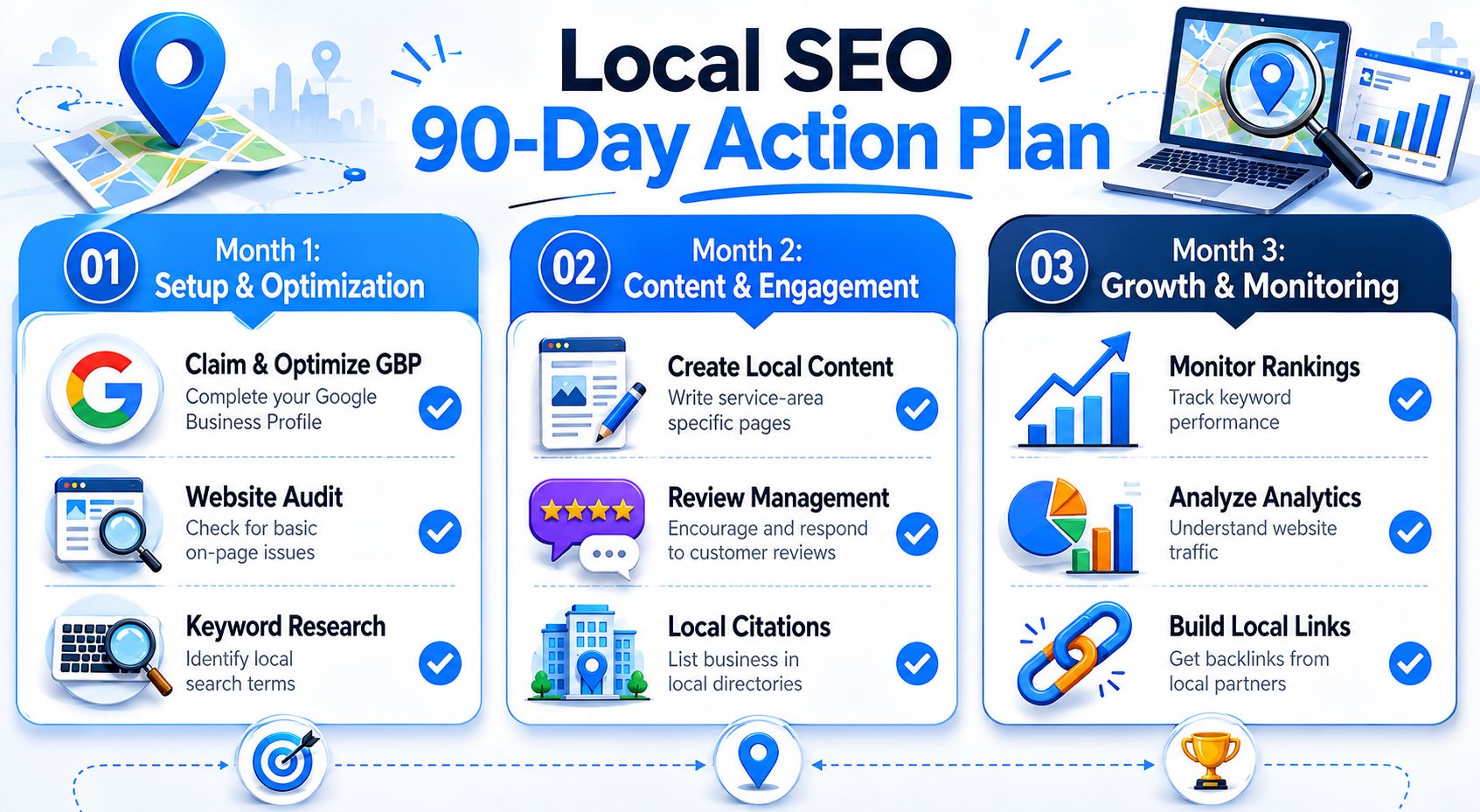
Days 1 through 30
Handle the foundation.
- Google Business Profile: claim it, verify it, complete every field that matters
- Core business data: clean up inconsistent directory listings
- Website audit: fix broken titles, weak navigation, thin service pages, mobile friction
- Keyword targeting: identify the actual “near me,” city, and service phrases buyers use
Days 31 through 60
Build the pages that can rank and convert.
- Create service pages: one page per primary service
- Create location pages: only for real target markets
- Start review generation: make it a process, not a random ask
- Strengthen internal links: connect related services and city pages
Rank what people hire for first. Save broad awareness content for later.
Days 61 through 90
Expand and monitor.
| Focus | Action |
|---|---|
| Support content | Publish FAQ or intent-supporting articles tied to your main services |
| Performance review | Check Google Search Console for queries, indexing, and page visibility |
| GBP activity | Add photos, respond to reviews, refine services and posts |
| Page improvements | Update weak pages based on real search behavior |
This is enough to build momentum. Not magic. Not busywork. Just the right sequence.
If you want a partner to execute this system without locking you into a long contract, Transactional LLC helps local service businesses rank for transactional terms, improve Google Maps visibility, and build AI-ready content that turns searches into calls, jobs, and patients.