

A Google Business Profile can be the shortest path between a contractor's expertise and a customer ready to hire. Google's local search research found that 18% of local smartphone searches lead to a purchase within one day, compared with 7% for non-local searches. For a plumber, HVAC technician, roofer, electrician, or pest control company, searches such as “roofer near me” and “air conditioning repair near me” carry immediate commercial intent.
That's why Transactional Marketing focuses on transactional search terms. These are searches made by people who already have a problem, a budget, and a reason to contact a business now. A properly managed Google Business Profile turns that intent into calls, website visits, messages, direction requests, and booked estimates, while accurate business information helps Google and emerging AI systems understand when your company is the right local answer.
Why Your Google Business Profile Is Your Most Profitable Marketing Asset
A contractor's profile isn't merely a directory entry. It's a local conversion asset displayed when a searcher is comparing businesses, often on a mobile device and often under time pressure. Google reports that local searches influence offline behavior, helping people decide where to go, whom to call, and where to buy. That connection is especially valuable when someone searches for an emergency plumber, HVAC repair company, roofing contractor, or electrical service.
Consumer behavior reinforces the point. 45% of consumers default to Google for local searches, while 52% began their most recent local search on Google and 71% used Google Search during the process, according to BrightLocal's local SEO statistics. The same source surfaces Google guidance stating that businesses with complete profiles are 70% more likely to attract visits and 50% more likely to be considered for purchase.
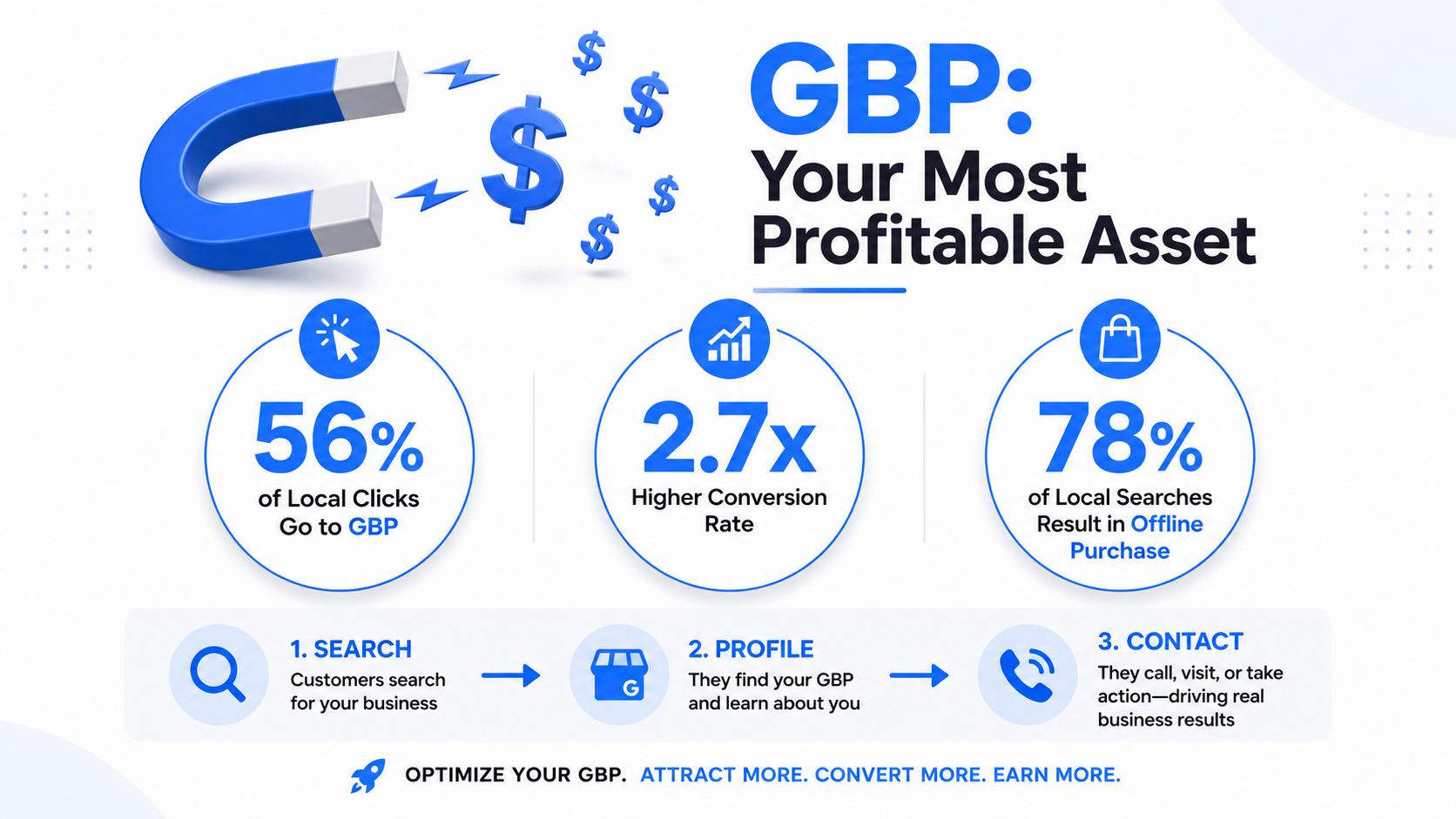
The profile is where intent becomes action
A customer searching “HVAC repair near me” usually doesn't want a general educational article first. They want to know whether you serve the area, whether you're open, whether other customers trust you, and how quickly they can reach you. Your category, services, photos, reviews, hours, phone number, and website destination answer those questions before the customer ever visits your site.
Google's local ranking guidance centers on relevance, distance, and prominence. A complete profile supports relevance, while accurate location information helps Google assess distance and a strong reputation contributes to prominence. You can learn how those factors connect with a practical Google Business Profile guide for local businesses.
Practical rule: Optimize the profile for the exact job a customer wants to buy, not for the broadest description of everything your company could theoretically do.
That principle also shapes the website. A profile for a roofing company should support roofing-related transactional searches and send users to a relevant roofing page, not a generic homepage that forces them to search again. Contractors that want to align map visibility with broader service-area SEO can review local SEO for contractors.
The objective isn't visibility for its own sake. Transactional Marketing targets searches such as “roofer near me,” “dentist near me,” and “air conditioning repair near me,” because those searches place the business in front of people actively evaluating providers. Google Maps optimization then supports the same commercial journey, from local discovery to phone call and booked estimate.
Choosing Between Service Area and Storefront Setup
The address decision affects eligibility, trust, and how accurately Google represents your business. Contractors should choose the setup that reflects how customers interact with the company, rather than selecting a storefront because a visible address seems more authoritative.
A service-area business fits a home-based HVAC company, mobile plumber, electrician, roofer, or contractor whose team travels to customers. A storefront profile fits a business with a genuine location where customers can visit during stated hours, such as a plumbing company operating from a customer-facing showroom or a contractor with a public office and walk-in service.
Match the profile to the real-world business
Google's guidance emphasizes representing a business consistently and accurately. If customers don't visit your home, don't present a residential address as a public storefront. If you operate from a warehouse that isn't open to customers, don't imply that it's a walk-in location. The profile should tell searchers what they can expect when they contact you.
For a service-area setup:
- Use a truthful business name: Keep the name consistent with how the company is identified in the world. Adding city names or keywords to the business name can create compliance problems.
- Hide a non-public address: If customers don't visit the location, configure the profile so the address isn't displayed publicly.
- Define practical coverage: List the cities and areas where crews accept work. A broad list doesn't guarantee visibility in every location.
- Keep location signals aligned: Use matching business details across the website, citations, and profile so Google can reconcile the company's identity.
A contractor serving several cities may need location-specific website pages and a carefully managed local SEO structure, but shouldn't list every nearby town. Proximity still constrains local visibility, and a distant business may not outrank a closer, more relevant competitor just because its service-area list is longer. For companies with several legitimate hubs, the multi-location local SEO guide provides a useful framework for separating locations without creating confusing duplicate signals.
The same discipline supports AI discovery. Systems that summarize local businesses need clear, consistent facts about services, locations, hours, and contact methods. Guidance on how to optimize local businesses for AI search is useful here because AI visibility depends on understandable, corroborated business information, not inflated geographic claims.
Selecting Categories and Services That Win Transactional Searches
Your primary category tells Google what your business is. It's one of the strongest mechanics behind local relevance, so choosing “Contractor” when the company is a plumber, roofing contractor, or electrical contractor wastes an important opportunity.
Google Business Profile category research repeatedly identifies the primary category as a major local ranking signal, with secondary categories also helping Google connect a profile to relevant searches, as explained by MBA Digital's category and ranking analysis.
Start with the narrowest truthful category
Choose the category that best describes the service customers hire you to perform. A roofing specialist should prioritize “Roofing contractor” over a generic contractor category. An electrical business should select “Electrical contractor” when that accurately represents the company. An HVAC company needs to distinguish its core business from adjacent services such as general home improvement.
The category must be truthful. A category that attracts an irrelevant search may create impressions, but it won't necessarily produce qualified calls. Transactional Marketing's approach is to target the service intent that matches the company's actual capability, availability, and service area.
Secondary categories should add legitimate lines of business, not every category that appears remotely related. A plumbing business might add a category for drain cleaning if that's a substantial service, while a roofing company shouldn't add plumbing categories to expand reach.
Build the Services field around buying intent
Google allows businesses to edit the services shown in their profile, and its official Services guidance supports treating this field as a structured service inventory. Don't paste a keyword list. Use clear customer-facing names and descriptions that explain the work.
A useful prioritization looks like this:
- Lead with urgent services: Emergency plumbing, air conditioning repair, electrical troubleshooting, leak repair, and storm-damage roofing deserve prominent placement when they're core offerings.
- Separate distinct jobs: “Water heater replacement” and “drain cleaning” should not be buried under a vague “plumbing services” label.
- Match website pages: Link the profile to a page that discusses the same service and location intent. The profile and website should reinforce one another.
- Reflect actual capacity: Don't advertise a service your team rarely performs or can't support in the listed area.
Granular service names may improve clarity and matching, but they aren't a substitute for proximity, prominence, or a strong website. They also shouldn't replace useful project photos and review generation. For a contractor with residential and commercial divisions, separate the service language carefully so an AI answer engine or local searcher can identify which jobs the company accepts.
Building a Review and Photo System That Drives Booked Jobs
Reviews and photos influence the decision a customer makes after finding your profile. They're not decorative additions. A searcher comparing two emergency plumbers may use recent feedback, rating quality, project evidence, and the owner's responses to decide who deserves the call.
One 2026 industry benchmark reports an average Google Business Profile to paying-customer conversion rate of 3.2%, compared with 0.7% for social media and 1.4% for email for local businesses, as summarized by Searchlab's Google Business Profile statistics. The same benchmark cites SOCi and BrightLocal data indicating that a one-star increase in average rating can improve conversions by 44%. These figures don't guarantee a result for every contractor, but they show why review acquisition belongs inside the sales process.
Ask consistently, not randomly
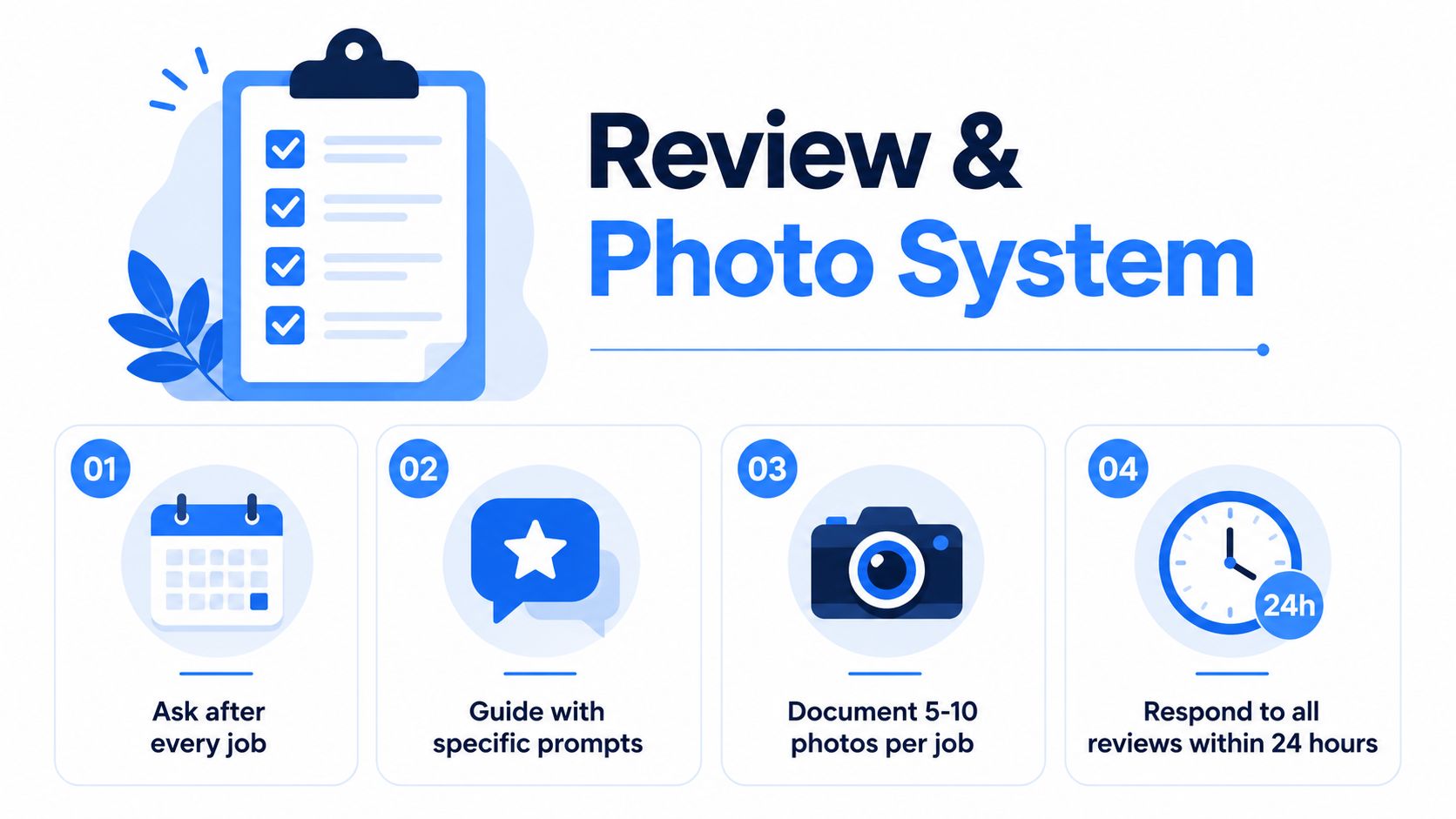
The strongest review systems connect the request to job completion. After the customer confirms the work is finished, send a direct review link by text or email. Keep the request simple, and never offer incentives, pressure customers, or create reviews from employees and friends.
A prompt can invite useful detail without scripting the customer's opinion. Ask what service was completed, what problem was solved, and whether the customer would recommend the company. Honest reviews that mention real services help future customers understand your capabilities.
Competitive contractor guidance identifies practical targets among top local-pack performers: 200 or more reviews, a 4.5 or higher average rating, and 10 or more new reviews per month, alongside substantial and recently updated photo galleries and regular profile posts, according to Domaniai's contractor optimization guidance. Those are benchmarks, not promises. A smaller contractor should build a sustainable cadence rather than manufacture volume.
Use job evidence instead of stock imagery
Upload before-and-after work, equipment, branded vehicles, technicians at work, completed installations, and clean project details. Refresh the gallery monthly, a practical contractor workflow supported by the same Domaniai guidance. Recent images communicate that the company is active and give customers tangible proof of the service they're considering.
Respond to every review professionally. Thank customers for positive feedback, and address negative comments without revealing private details or arguing. A thoughtful response can reassure prospects who are reading the profile for signs of accountability.
A repeatable system matters more than occasional bursts of activity. Contractors can use this guide to getting more Google reviews to formalize the request process and connect reputation work to booked jobs.
A short visual walkthrough can help teams implement the process consistently:
Ongoing Optimization Through Posts and AI Discovery Signals
A completed profile can still lose attention if the information becomes stale. Ongoing optimization keeps services, hours, photos, offers, and customer questions aligned with current demand.
Google Posts work best when they support a real commercial reason to contact the business. Publish completed-project updates, seasonal maintenance reminders, emergency-service availability, financing information when applicable, and clear next steps. Contractor guidance recommends two to four posts per week as a competitive activity target, but a sustainable schedule is more valuable than publishing low-quality filler.
Use Q&A to remove buying friction
Questions on the profile often reveal the objections that prevent calls. Address topics such as:
- Coverage: Which cities and neighborhoods does the crew serve?
- Availability: Does the company handle emergency work?
- Process: How does a customer request an estimate?
- Credentials: What licensing, insurance, or qualifications apply?
- Service fit: Does the company handle the specific repair or installation?
Write answers in plain language. Don't stuff city names or repeat the same phrase unnaturally. The best answers help a customer decide whether to call and give search systems clear information to interpret.
Prepare for AI-mediated local discovery
AI and LLM-based search tools increasingly summarize businesses instead of showing only a list of links. A contractor's visibility therefore depends on more than a map position. Consistent business facts across the profile, website, directories, reviews, and service pages give AI systems more reliable material to identify the company's services and locations.
Measure discovery signals beyond rankings. Google recommends monitoring profile interactions such as calls, direction requests, and messages, while Search Console can reveal impressions for non-brand local queries, as described in Google's Business Profile performance guidance. Branded search growth can also show whether repeated visibility is making the company more memorable.
Transactional Marketing uses this broader view of optimization. The goal is to make a contractor discoverable for high-intent searches in Google Maps, traditional results, and AI-assisted answers, then make the profile clear enough to convert that discovery into contact.
Common Profile Mistakes That Silently Kill Your Visibility
Many contractors assume that claiming the profile is the hard part. It isn't. The damaging errors usually appear later, when inaccurate details, weak relevance, and neglected customer signals make the profile less useful to both Google and searchers.
The most expensive errors are often small
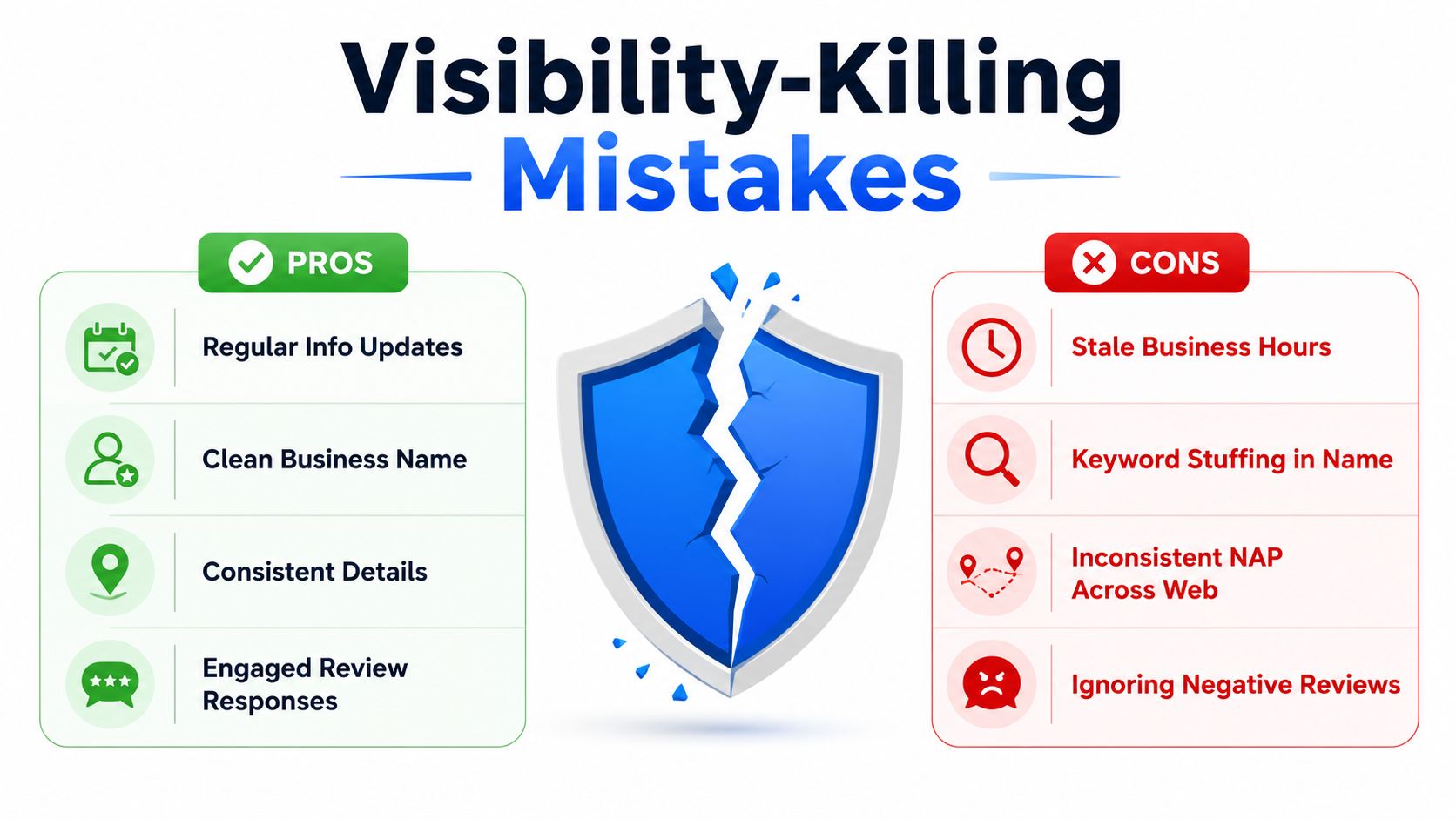
- Generic categories: Selecting “Contractor” instead of a truthful trade-specific category weakens relevance for searches such as “emergency plumber” or “electrical contractor.”
- Overextended service areas: Listing every nearby city doesn't overcome distance constraints. It can make the profile look less focused and create expectations the business can't meet.
- Stale visual content: A gallery that never changes gives prospects no recent evidence of active work. Refresh job photos monthly and remove misleading or poor-quality images.
- Inconsistent business details: Different names, addresses, or phone numbers across the website and citations make it harder to confirm the business identity. Keep the core information consistent.
- Keyword-stuffed names: Adding services or locations to the official business name can violate Google's rules and expose the profile to suspension risk.
- Unanswered questions and reviews: Ignoring public questions leaves gaps that competitors or customers may fill. Failing to respond to reviews also removes an opportunity to demonstrate professionalism.
The fastest audit: Search your company name, inspect the profile as a customer would, and verify the category, service area, hours, phone number, website destination, photos, reviews, and Q&A.
Fix the highest-intent problems first. A plumber should correct its plumbing category, emergency-service information, phone path, and service coverage before spending time on low-value post ideas. A roofing company should make sure storm repair, inspections, and estimate requests are represented accurately before expanding into loosely related categories.
Measuring What Actually Drives Calls and Revenue
Rankings matter only when they create useful customer actions. A contractor's reporting system should connect Google Business Profile visibility with calls, direction requests, website clicks, messages, and booked estimates, rather than stopping at impressions.
Track Search Console impressions for non-brand local queries, including service-and-location searches. Review which cities and services generate engagement, then compare those signals with call records and completed jobs. Google Business Profile reporting can reveal whether searchers are calling, requesting directions, or sending messages, while a call-tracking process helps connect phone activity to lead quality.
A practical dashboard should include:
- Discovery: Non-brand local impressions and branded search growth.
- Engagement: Calls, messages, direction requests, and website clicks from the profile.
- Commercial outcome: Qualified leads, estimates, booked work, and revenue by service when your CRM supports that detail.
- Location insight: Map visibility across the cities you serve, not just the strongest location.
Use phone-call tracking methods for local marketing to separate profile-driven calls from other campaigns. Review the dashboard on a consistent schedule, identify which transactional terms produce real opportunities, and refine categories, services, landing pages, posts, and review requests around those findings.
The right measurement question isn't “Did the profile get more views?” It's “Did the profile help the right customer find, trust, and contact the business?”
Transactional LLC provides contractor-focused local SEO, Google Maps optimization, Google Business Profile setup, and AI-driven content planning built around transactional searches such as “roofer near me” and “HVAC repair near me.” Visit Transactional LLC to connect your profile, website, local service areas, and AI discovery signals to a practical lead-generation system.