


Most advice about home services lead generation is backwards. It tells you to buy more leads, spread your budget across every channel, and hope your office answers the phone fast enough to make the math work.
That model keeps you dependent.
If you run HVAC, plumbing, electrical, roofing, or another local service business, you don’t need more random visibility. You need to own transactional search terms. Those are the searches that signal buying intent right now. Terms like “ac repair near me,” “emergency plumber [city],” or “roof leak repair [city].” That’s where the money is. That’s where booked jobs come from. And that’s where smart home services lead generation beats boring marketing every time.
Stop Buying Leads Start Owning Your Pipeline
The most popular playbook in this industry is also the weakest one. Contractors buy leads from big marketplaces, complain about lead quality, then buy more leads because they need volume. That cycle never builds an asset. It only builds dependence.
The scale of the lead-selling platforms is real. HomeAdvisor, now Angi Leads, processes over 30 million service requests annually, and pay-per-lead costs range from $20 to over $200 according to Website Depot’s home services lead generation platform guide. The same source notes that home services CPL rose 10.51% year-over-year in 2025, with roofing leads averaging $228.15. If you’ve felt like lead costs are getting out of hand, you’re not imagining it.
Why the pay-per-lead model breaks down
When you buy leads, you inherit a few problems immediately:
- You don't control the source. The platform owns the homeowner relationship.
- You don't control the competition. Shared lead environments turn every inquiry into a race.
- You don't control cost stability. When lead prices rise, your margin gets squeezed.
- You don't build equity. The moment you stop paying, the flow stops.
That’s not a pipeline. It’s rented attention.
Practical rule: If your main lead source can disappear the moment you pause spend, you don’t own your pipeline.
There’s nothing wrong with testing paid channels. There’s also value in understanding adjacent approaches like outbound lead generation when you’re building a broader revenue system. But for local service companies, the strongest long-term move is simpler. Show up when homeowners search with urgent intent in your service area.
What ownership looks like
Owning your pipeline means your business appears for the searches tied directly to booked jobs. Not vague informational terms. Not broad awareness terms. Transactional terms.
That changes how you think about home services lead generation:
- You prioritize local SEO around service-plus-city and near-me terms.
- You treat Google Maps visibility as a revenue channel, not a side task.
- You structure your site so search engines and AI systems can clearly match your business to local buying intent.
- You stop chasing volume for the sake of volume.
A bad lead generation system makes you beg for scraps from aggregators. A strong one makes your phone ring because your company is the obvious answer when someone needs help now.
Diagnose Your Current Lead Generation Health
Before you fix anything, get honest about where you're invisible. Most home service owners think they “rank well” because they show up for their business name. That tells you almost nothing. Branded visibility isn't the goal. Transactional visibility is.

Check the searches that actually matter
Open a clean browser. Use incognito mode. Search the phrases a buyer would use, not the phrases you use internally.
Start with a short list like this:
- Primary emergency term such as “emergency plumber [city]”
- Core repair term such as “ac repair near me”
- Service plus city term such as “water heater repair [city]”
- High-ticket replacement term such as “roof replacement [city]”
- Map-driven term such as “electrician near me”
If you don’t appear in meaningful positions for those searches, your current home services lead generation system has a visibility problem. If you show up only in one city but not the surrounding service area, you have a market coverage problem.
Audit your Google Business Profile like a buyer
Your Google Business Profile is often the first thing a homeowner sees. Treat it like a storefront on the busiest road in town.
Review these points:
- Primary category match: Make sure your main category reflects your highest-value service.
- Service alignment: Your listed services should match what you want to rank for.
- Business description clarity: It should mention what you do and where you do it in plain language.
- Photos and job proof: Buyers want evidence that you do real work in the local market.
- Review quality: Read your reviews and check whether they mention specific services and service areas.
- Call path: Tap the phone number and test the experience yourself.
A lot of contractors lose jobs before the phone ever rings because their profile looks neglected, generic, or confusing.
If your profile makes a homeowner ask “Do they really serve my area?” you've already introduced friction.
Compare your map presence against competitors
Search from different points in your service area if you can. The map pack changes by location, which is why broad claims about “ranking number one” are usually nonsense in local search.
What you’re looking for is pattern, not ego:
| Check | What to look for | What it means |
|---|---|---|
| Core city visibility | Are you in the map pack near your office or base city? | Baseline local relevance |
| Edge-of-territory visibility | Do you disappear in outer service areas? | Weak service area coverage |
| Service-specific visibility | Do you appear for repair terms but not replacement terms? | Content and category gaps |
| Review advantage | Do competitors have stronger review language tied to key services? | Trust and relevance gap |
Look at your website like a dispatcher, not a designer
A pretty site that doesn’t route intent is a liability. Your pages should map directly to the searches you want to win.
Check for these issues:
- Homepage overload: If every service is crammed into one page, relevance gets diluted.
- Missing city pages: If you serve multiple areas, your site should reflect that clearly.
- Weak calls to action: Every key service page should make calling or booking easy.
- No urgency handling: Emergency intent should not land on a generic page.
For a final gut check, ask one blunt question: if a homeowner searched “furnace repair near me” and landed on your site, would they instantly know you handle that exact job in their exact area? If not, your site is leaking revenue.
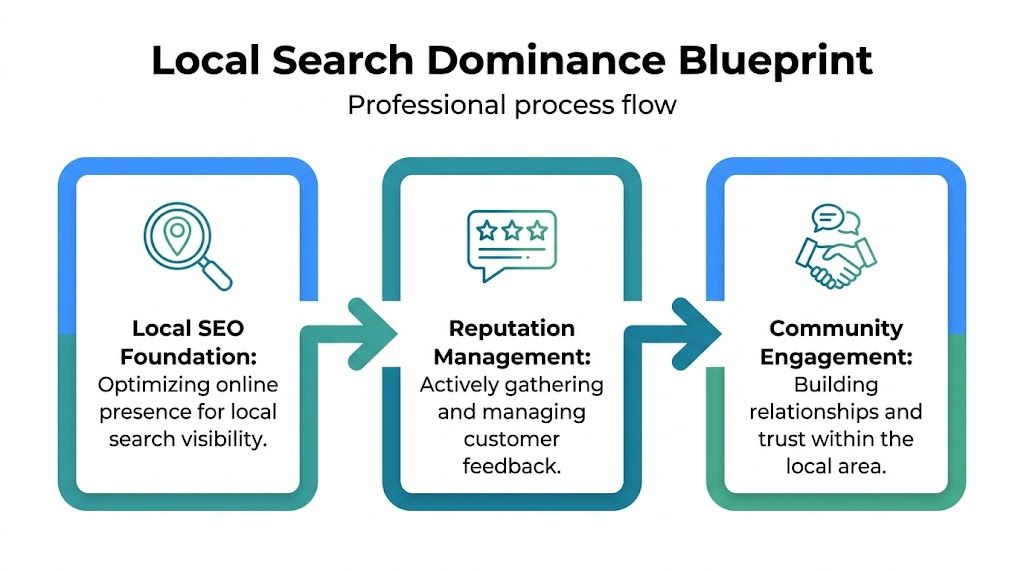
The Blueprint For Total Local Search Dominance
Most local marketing fails because it mixes high-intent and low-intent strategy into one pile. Don’t do that. A company that wants booked jobs needs a system built around transactional search behavior, Google Maps visibility, and AI-readable authority.
That’s the blueprint.
Build around transactional SEO
Transactional SEO isn’t blogging for the sake of blogging. It’s building pages that match the exact phrases people use when they’re ready to hire.
That means your site architecture should revolve around combinations like:
- Service + city
- Service + near me
- Emergency service + city
- Repair versus replacement intent
- Brand-specific or equipment-specific service needs when relevant
A plumbing company shouldn’t bury “emergency plumber [city]” under a generic services page. An HVAC company shouldn’t expect one broad “HVAC services” page to rank for every money term in every town. Search engines need clarity, and buyers do too.
Separate pages by intent, not by convenience
Here’s the mistake most boring marketing companies make. They build one page for “roofing” and call it done. That’s lazy. The buyer searching for roof repair is not always the buyer searching for roof replacement. The buyer searching in your main city is not always the buyer searching in the next suburb.
Your page structure should reflect that reality.
A stronger setup looks like this:
- Core service pages for each main revenue category
- Location pages for each real service area
- Subservice pages for high-intent variants
- Emergency pages where urgency matters
- Supporting content that helps search engines and AI systems understand topical depth
If you want a practical breakdown of this kind of structure, review local SEO for home services and compare it to the way your current website is organized.
Working standard: One page should answer one clear local buying intent.
That doesn’t mean spinning thin pages. It means building useful, specific pages with the right local and service signals.
A short video can help illustrate how local visibility turns into booked jobs in practice:
Win the Google Maps decision moment
If you’re serious about home services lead generation, you have to treat Google Maps as a frontline sales channel. Buyers don’t browse map listings casually when they’ve got an active leak or a dead AC unit. They shortlist quickly and call.
That’s why this stat matters. Inbound phone calls from home services lead generation convert to 10-15x more revenue than web leads, callers convert 30% faster, and they have a 28% higher retention rate, according to Invoca’s home services marketing statistics. That’s the business case for dominating the local map pack for transactional searches.
What actually improves map visibility
Google Maps optimization isn’t magic. It’s operational discipline.
Focus on these areas:
- Category precision: Your primary and supporting categories must align with the work you want.
- Service area clarity: Your profile and site should reinforce where you operate.
- Review signals: Reviews that mention actual services and locations help reinforce relevance.
- Photo freshness: Ongoing image updates show activity and legitimacy.
- Website alignment: Your GBP and landing pages should point to the same service and city themes.
- Response readiness: If Maps drives calls but no one answers fast, rankings won’t save you.
The map pack is where transactional trust gets tested in seconds. Buyers look at rating quality, review language, service fit, and whether your business feels current. If your profile looks stale or generic, you lose before they click.
Prepare for AI optimization now
AI optimization is not a trend to watch later. It’s already changing how businesses get surfaced, summarized, and recommended.
Large language models and AI-powered search systems don’t “rank” your business the same way a traditional search result does. They parse meaning, consistency, specificity, and entity signals across your site and broader web presence. If your website is vague, thin, or sloppy, AI systems have less confidence in recommending you for local service queries.
That means your content has to do three jobs at once:
- Match transactional human searches
- Give search engines clean local relevance signals
- Give AI systems structured clarity about services, locations, expertise, and trust
How to make your site more AI-readable
You don’t need gimmicks. You need clean execution.
Use this checklist:
- State exact services clearly: Don’t hide your revenue-driving services behind clever branding.
- Name real service areas: AI systems need location specificity, not vague regional language.
- Answer buying-stage questions: Include details about service types, urgency, process, and what customers can expect.
- Keep language direct: Clear writing is easier for both buyers and machines to interpret.
- Maintain consistency: Your site, Google Business Profile, and directory mentions should reinforce the same business identity.
- Publish by topic cluster: Build depth around each service vertical instead of scattering unrelated posts.
AI visibility goes to the business that is easiest to understand and easiest to trust.
That’s why industry-specific content matters. Roofing content should support roofing searches. Plumbing content should support plumbing searches. Dental content belongs in a different silo entirely. When your content strategy is disciplined, search engines and AI systems can connect your business to specific local buying intents with far more confidence.
The real goal is local authority tied to action
A lot of agencies chase traffic. Smart operators chase qualified local action.
If you dominate transactional SEO, earn strong map visibility, and publish AI-readable local content, you stop competing as just another contractor with a website. You become the business search platforms keep matching to urgent local demand.
That’s how home services lead generation becomes durable. Not rented. Owned.
Amplify Your Reach With Smart Ads and Partnerships
Paid traffic has a place. It just shouldn’t be the foundation. If your organic search presence is weak, ads become a tax on a broken system. If your organic base is strong, ads become an accelerator.
That’s the right order.

Use ads to fill strategic gaps
Smart home services lead generation uses paid channels with a specific job in mind. You might use Local Services Ads to capture overflow demand during peak season. You might run tightly targeted PPC for one high-margin service in one city. You might support a new service area while your local SEO catches up.
What you should not do is dump budget into broad campaigns with loose geography and generic keywords.
The fastest way to waste ad spend is to buy clicks from people you won’t serve. Businesses report 20-30% higher conversion rates by implementing strict geo-filters, and one of the easiest ways to waste marketing budget is generating leads without geographic controls, according to Inquir’s guide to high-intent home services leads.
Hyper-local territory planning wins
Most contractors think in terms of “we serve the whole metro.” That sounds good until your crew is driving too far, your ad budget is paying for low-fit inquiries, and your close rate drops because response times get worse.
A better model is territory planning with rules:
- Core zone: Your highest-priority area where you want maximum visibility
- Expansion zone: Areas you can serve profitably under normal conditions
- Selective zone: Jobs you’ll take only for the right service type or ticket size
- Exclusion zone: Places that burn time, margin, or scheduling efficiency
That approach makes your campaigns cleaner and your operations better.
If you’re exploring tools and frameworks around leveraging specialized solutions for local services, keep that same principle in mind. Better targeting beats broader targeting.
Partnerships are an underrated lead source
Most local businesses underuse partnerships because they think too narrowly about marketing. Some of the best leads come from adjacent businesses that already have the trust of your next customer.
Examples:
| Partner type | Good fit for | Why it works |
|---|---|---|
| Real estate agents | HVAC, plumbing, electrical, roofing | New buyers need inspections, repairs, and upgrades |
| Property managers | Plumbing, electrical, HVAC, pest control | Recurring service needs and fast dispatch requirements |
| Solar installers | Roofers, electricians | Shared homeowner profile and related project timing |
| Remodelers | Electricians, plumbers, HVAC contractors | Service overlap during renovation work |
A referral partner sends better opportunities than a random click because the trust transfer already happened.
For paid messaging and offer structure, sharpen your campaigns around clear buyer action and service-area fit. This guide on elements of advertisements is useful for tightening ad intent before you spend.
Good ads expand a strong system. Bad ads hide a weak one for a month or two.
Convert More Leads With A Rapid Response System
A lead isn’t valuable because it exists. It’s valuable when your team turns it into a booked job. In home services lead generation, speed decides that outcome more often than clever branding ever will.
The companies that win don’t “follow up later.” They respond immediately, qualify fast, and route the opportunity to the right person without friction.
The speed standard
Contractors who respond within 5 minutes convert at a 400% higher rate than those who wait an hour, and an automated initial contact by call and SMS within 30 seconds can achieve 50%+ higher conversion rates, according to ActiveProspect’s lead response methodology for home services.
That’s not a small optimization. That’s a major operational advantage.
Use a five-step response flow
Most shops need a process, not another motivational speech about answering the phone.
Acknowledge instantly
As soon as a form comes in or a call is missed, trigger a response. If it’s a web lead, send an immediate text confirmation and start the call sequence.Call first
Don’t hide behind email. Phone contact is the fastest way to qualify urgency, location, and fit.Text with purpose
Your text should confirm receipt, state availability, and make the next action obvious. Keep it short.Route correctly
Emergency plumbing should not sit in a general inbox. New install estimates should not interrupt urgent dispatch flow. Route by service type, territory, and urgency.Nurture what doesn’t book today
Some leads go quiet, not cold. Keep a simple follow-up sequence for unbooked opportunities.
What this looks like in practice
Here’s a clean operating model:
- First touch: automated acknowledgment
- Immediate action: outbound call attempt
- Backup channel: short SMS if there’s no answer
- Internal handoff: assign based on territory and service category
- Short follow-up sequence: continue contact attempts over the next window if the lead is still qualified
If your office manager is doing all of this manually, the system will break the moment things get busy.
The first company to respond with clarity usually earns the right to quote.
Fix the leaks after the click
Many contractors think they have a traffic problem when they have a conversion problem. Their ads work. Their rankings are decent. Their office just responds too slowly, too vaguely, or with no process.
Look at these common failures:
- Forms with no immediate acknowledgment
- Missed calls sent to voicemail with no text backup
- No lead qualification before dispatch
- Leads assigned by guesswork instead of territory
- No follow-up after the first missed connection
Your website also plays a direct role here. Better page structure, cleaner calls to action, and stronger booking flow can lift outcomes before your staff even gets involved. This guide on how to improve website conversion rate is a good place to tighten that part of the system.
Keep the human part strong
Automation should speed up the first touch, not replace real service. Once contact happens, your team still needs to sound competent, local, and ready to solve the problem.
That means:
- confirming the service need fast
- verifying the service area
- setting expectations clearly
- moving toward a booked appointment without dragging the conversation out
Homeowners don’t want a long sales script. They want to know you can help, when you can help, and what happens next.
Measuring What Matters And Planning Your Budget
Most marketing reports are stuffed with numbers that don't help you make decisions. Impressions, reach, and vague engagement charts won’t tell you whether your home services lead generation system is producing booked work.
Track what connects directly to revenue.
Focus on the right KPIs
A useful scorecard for a local service business should include:
- Transactional keyword visibility: Are you showing up for the searches tied to booked jobs?
- Google Maps coverage: Where do you appear strongly, and where do you disappear?
- Lead source quality: Which channels produce real conversations, not just form fills?
- Lead-to-booking rate: How many qualified inquiries become scheduled jobs?
- Response time: How fast does your team act when a lead comes in?
- Service-area fit: Are inquiries coming from profitable territory?
If you don’t measure those, you can’t tell whether growth came from better visibility, better conversion, or wasted spend.
Sample lead generation timelines and budget allocation
Below is a practical planning table. It avoids fake precision and keeps attention on what each strategy is supposed to do.
| Strategy | Initial Results Timeline | Primary Focus | Key Metric |
|---|---|---|---|
| Transactional SEO | Early movement often appears within a short ramp-up period, with stronger gains building over time | Service-plus-city rankings and organic lead ownership | Visibility for core transactional terms |
| Google Maps optimization | Can improve quickly when profile, reviews, and local relevance are tightened | Map pack visibility and call generation | Map visibility across service areas |
| AI-focused content | Compounds as content depth and entity clarity improve | LLM readability and topical authority | Coverage across service and location topics |
| Local Services Ads or PPC | Fastest for immediate testing and demand capture | Controlled paid amplification | Qualified lead volume by territory |
| Referral partnerships | Often grows steadily once relationships are active | Exclusive local introductions | Referred lead quality and close rate |
Build reporting around decisions
A dashboard should help you answer simple questions fast:
- Which service pages are bringing in action?
- Which cities are improving?
- Where are you paying for visibility but not converting?
- Which search terms are turning into calls?
For a clearer framework, use a measurement model like the one outlined in how to measure marketing effectiveness. The point isn’t to admire charts. The point is to know where to push harder, where to fix leakage, and where to cut waste.
Don’t budget by channel popularity. Budget by how well each channel supports transactional intent, local fit, and booked revenue.
Your Path To Becoming The Authority In Your Town
The shift is simple. Stop acting like a buyer of leads and start acting like the owner of local demand.
That means building around transactional search terms, tightening your Google Maps presence, publishing content that supports both SEO and AI visibility, and backing it all with a response system that converts inquiries fast. When those pieces work together, home services lead generation stops feeling random.
You stop renting opportunities from lead platforms. You start earning the call when someone in your market is ready to spend.
That’s how a local service company becomes the authority in its town. Not by being everywhere. By being visible exactly where buyer intent is highest, and by making it easy for that buyer to choose you.
If you want help building a no-fluff local growth system around transactional search terms, Google Maps visibility, and AI-driven content, talk to Transactional LLC. They help service businesses own their pipeline instead of renting leads, with contract-free local SEO, map optimization, transparent reporting, and a strategy built to turn searches into booked jobs.