

You’ve probably already gotten wildly different answers to the same question.
One company says you can “start advertising” with a tiny monthly budget. Another tells you anything below a much larger number is pointless. A freelancer pushes Facebook. An agency pushes Google Ads. Somebody else says you should forget ads and just “do SEO.” None of that helps when you own an HVAC company, plumbing business, dental office, pest control company, or med spa and you need booked jobs, not marketing theory.
The reason this feels messy is simple. Many advertisers answer how much does it cost to advertise by talking about channels, not outcomes. They quote a click price, a monthly retainer, or a broad budget range without asking the only question that matters. Are you paying to get in front of someone who is ready to buy right now?
That’s the line between wasted spend and profitable spend.
If someone searches “how to unclog a drain,” that person might never hire a plumber. If they search “emergency plumber near me,” that’s a buyer. If someone types “air conditioning repair near me,” “dentist near me,” or “Botox near me,” they’re not browsing. They’re close to making a decision. That’s transactional search intent, and it’s where local service businesses should put most of their budget.
Advertising costs stop looking random when you frame them that way. You’re not buying ads. You’re buying access to high-intent searches, map visibility, phone calls, booked appointments, and service requests in your city.
Introduction Why Advertising Costs Are So Confusing
Business owners get confused about ad pricing because most quotes mix together things that shouldn’t be mixed together.
A boosted social post, a Google Local Services Ads campaign, a search campaign for “roofer near me,” Google Maps optimization, and a generic awareness campaign are not the same product. They have different buyer intent, different tracking, and different ROI. Yet agencies often throw them into one proposal and call it “advertising.”
That’s the first problem.
The second problem is that most ad conversations focus on surface-level metrics. Clicks sound good. Impressions sound good. Reach sounds good. But for a local service business, those numbers can hide a bad campaign. If the campaign doesn’t turn into calls, forms, appointments, and closed jobs, the price doesn’t matter because the spend was wrong from the start.
Why most ad quotes feel unreliable
Here’s what usually happens:
- One vendor sells cheap attention by offering broad social traffic that doesn’t convert well for urgent local services.
- Another vendor sells expensive intent through Google search, but doesn’t explain why those clicks cost more.
- A third vendor ignores Maps entirely, even though local buyers often choose from the map pack first.
- Almost nobody talks about tracking quality, call handling, response speed, and whether leads turned into revenue.
Practical rule: Don’t ask “What does advertising cost?” Ask “What does it cost to generate a real transaction from someone searching for my service in my city?”
That question changes everything.
Advertising isn’t expensive when it produces profitable jobs. It’s expensive when you buy the wrong traffic, target the wrong area, send clicks to weak landing pages, and fail to track what happened after the lead came in.
The Transactional Marketing Approach to Ad Costs
Most owners look at cost per click first. That’s a mistake.
A cheap click is irrelevant if it comes from someone who isn’t ready to hire. A more expensive click can be a bargain if it comes from a person searching for a service right now. That’s why the right frame is cost per transaction, not just cost per traffic.
In other words, stop asking whether a click is cheap. Ask whether that click came from a buyer.

The numbers that matter
You should know these metrics, but you should view each one through transactional intent.
- CPC means cost per click. Useful, but only if the keyword is commercial.
- CPL means cost per lead. Better than CPC, but still incomplete if leads are junk.
- ROAS means return on ad spend. Good for understanding revenue efficiency, especially for repeatable offers.
- Cost per booked job or appointment is usually the clearest operational number for local service businesses.
If you’re a roofer, a click from “roof color ideas” isn’t worth much. A click from “roof repair near me” is far more valuable. If you run a dental practice, “what causes tooth pain” is educational. “Emergency dentist near me” is transactional. Those searches deserve the budget.
Why digital matters more now
This isn’t opinion. The industry has already moved. In 2025, global advertising spending is projected to exceed $1 trillion for the first time, with digital channels capturing over 75% of the total, according to Insider Intelligence’s advertising spending projection. For local service businesses, that means the money and attention are concentrated in the channels where buyers already search.
That’s why Google search, Local Services Ads, Maps visibility, and AI-shaped search presence matter so much. Buyers don’t wait around to “discover” a plumber the way they discover a sneaker brand. They search, compare, call, and book.
AI optimization changes targeting
AI optimization matters because search behavior is changing. People still type “AC repair near me,” but they also ask longer questions, compare providers through AI-generated results, and rely on summaries before they click. That means your ads, Google Business Profile, local landing pages, and service pages need to align around the same commercial intent.
The businesses that win don’t chase every keyword. They build around phrases with money attached.
If the search term signals urgency, location, and service need, pay attention. If it signals curiosity, filter it out.
That’s the mindset that keeps ad budgets from drifting into vanity traffic.
Digital Ad Costs for Local and Home Service Businesses
A homeowner wakes up to a flooded basement, grabs a phone, and searches “emergency plumber near me.” That click is expensive. It is also the click that can turn into a booked job before lunch.
That is how you should judge digital ad costs.
For local service businesses, the actual question is not “What does digital advertising cost?” The useful question is “What does it cost to get in front of someone ready to call right now?” If you stay focused on transactional searches, the budget gets easier to control and the return gets easier to measure.
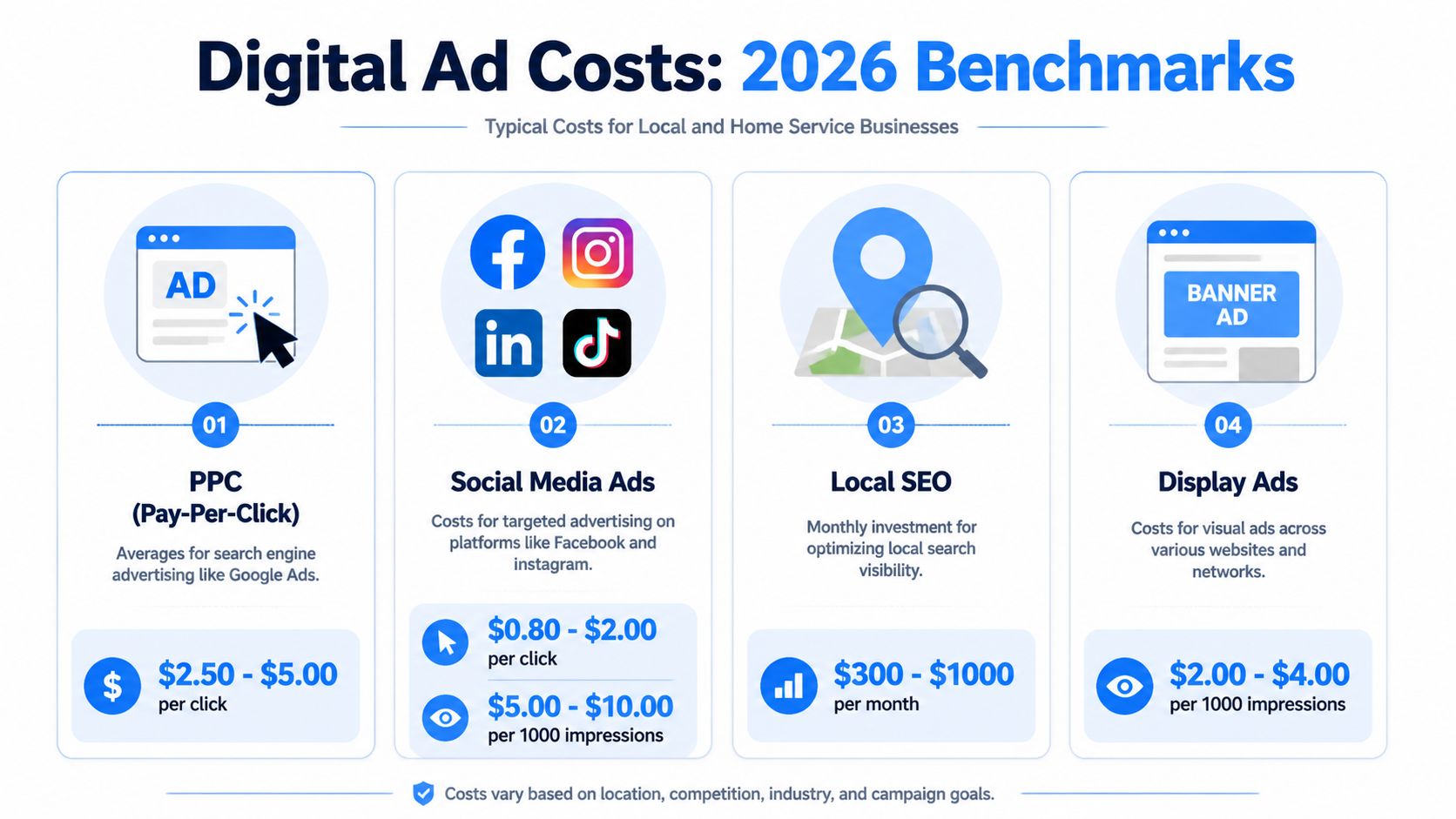
Google Ads search campaigns
Google Search Ads deserve the biggest share of budget for many home service companies because they capture buyers with clear intent. Searches like “roof repair near me,” “AC repair [city],” and “water heater replacement” come from people looking for help now, not people killing time.
Google explains in its Search Ads guide that advertisers bid to show ads on search results for relevant queries. For a local business owner, that means cost is driven by competition, geography, and keyword intent. Urgent, high-value service terms cost more because they produce real leads.
Pay the premium for buyer intent. Cut the rest.
Broad informational terms waste money. “How to fix a leaking pipe” attracts DIY traffic. “Plumber near me open now” attracts someone who needs a truck dispatched. If you want the math behind that channel, this breakdown of Google paid search cost benchmarks gives useful context.
Google Local Services Ads
Local Services Ads work well for contractors, plumbers, electricians, HVAC companies, cleaners, locksmiths, and other service categories where trust matters and speed matters. You pay for leads instead of clicks, which keeps the buying model closer to the outcome you care about.
Google’s Local Services Ads overview explains that these ads appear above standard search ads in eligible categories and are built around direct customer inquiries. That placement matters. A prospect searching for immediate help often calls from the first credible option they see.
LSAs are not passive. Reviews, response time, service area settings, business hours, and lead handling all affect performance. If your office misses calls, your cost per booked job rises fast. If your team answers live and follows up hard, LSAs can become one of the most efficient lead sources in the account.
Google Maps and local visibility
Maps visibility changes the economics of every other digital channel.
A buyer clicks your ad, then checks your reviews, service area, photos, and legitimacy on your Google Business Profile. If that profile looks weak, the paid click gets wasted. If the profile looks strong, conversion rates improve because the buyer gets immediate proof that you are established and local.
Google’s guidance for improving local ranking on Google points to relevance, distance, and prominence as key factors. For service businesses, that means your categories, reviews, business details, and local page alignment directly affect how often you show up when people search nearby.
If you are paying for “electrician near me” traffic and your map presence is thin, you are forcing ads to carry too much of the load.
Social media ads
Social ads usually belong in a supporting role.
Use them for remarketing, seasonal promotions, financing offers, membership plans, before-and-after creative, and staying visible after someone has already visited your site. That is a smart use of budget. Cold social targeting for urgent home service demand is usually weak because the customer was not actively looking when the ad appeared.
Meta explains in its Facebook Ads basics that advertisers can optimize for impressions, clicks, leads, and other actions. That flexibility is useful, but local service owners should stay disciplined. Social can assist branded recall and follow-up. It rarely beats high-intent search for immediate job flow.
A practical channel comparison
| Channel | Best use | Cost structure | Best fit |
|---|---|---|---|
| Google Search Ads | Capture active buyers | Click-based | High-intent local services |
| Local Services Ads | Generate direct service leads | Lead-based | Home services and trust-heavy categories |
| Google Maps optimization | Increase local visibility and trust | Ongoing optimization effort | Nearly every local business |
| Social ads | Retargeting and brand reinforcement | Click or impression-based | Support channel |
| Display ads | Remarketing and light awareness | Impression-based | Secondary channel |
Recommendation: If you need booked jobs, put budget into search terms with service, location, and urgency baked in. Fund Google Search, LSAs, and Maps first. Add social after those channels are producing.
Evaluating Traditional and Local Advertising Channels
A homeowner sees your truck wrap on Tuesday, hears your radio ad on Thursday, and searches “emergency plumber near me” on Saturday. If you are not visible at that last moment, the offline spend helped somebody else close the job.
That is the right way to judge traditional advertising. Don’t ask what a billboard costs. Ask whether it helps you win a high-intent search when a buyer is ready to call.
Traditional media can support demand, but it rarely captures it
Billboards, radio, direct mail, Valpak, local sponsorships, and neighborhood print can all increase familiarity. Familiarity has value. It can improve response rates on branded searches, direct mail callbacks, and referral conversion.
But local service businesses do not grow by collecting vague awareness. They grow by showing up when someone needs a roofer, plumber, electrician, or HVAC company now. Traditional channels usually sit higher in the funnel and make tracking harder. That makes them a support channel, not the foundation.
The real problem is attribution
Offline advertising muddies the path to the sale.
A prospect may see your postcard, ask a neighbor for a recommendation, then search your company name later. Another may hear your radio spot, forget the name, and end up clicking the first contractor running paid search. You still paid for the attention, but you cannot clearly prove you got the job.
Digital channels give you tighter control. You can track calls, forms, booked jobs, landing pages, service-area performance, and keyword intent. That matters because the goal is not exposure. The goal is cost per qualified lead and cost per booked job.
Compare channels by buyer intent, not by surface price
A billboard might generate recognition across town. A direct mail piece might produce a short burst of calls in one ZIP code. Those can work if your search presence is already strong and your brand is known locally.
For most home service companies, though, broad awareness should come after you own the transactional searches in your market. If someone searches “water heater repair near me” or “roof leak repair [city],” that click has more commercial value than thousands of passive impressions.
That is also why many owners should examine models tied more closely to outcomes, such as pay per lead marketing for local service businesses, instead of putting large chunks of budget into media that is difficult to measure.
When traditional channels make sense
Traditional and local advertising earns a place when it supports a system that already converts demand into revenue.
Use it if:
- You already rank and advertise well on high-intent local searches and want more branded lift.
- You serve a tight geographic area where repeated exposure can strengthen recall.
- You have strong call handling and branded search coverage so offline interest turns into tracked leads.
- You can test without cutting budget from search, LSAs, or Maps visibility.
My recommendation is simple. Build around transactional intent first. Use traditional media only after your business is consistently capturing the people already trying to hire someone.
Sample Ad Budgets for Service Businesses in 2026
A budget only makes sense when it matches the kind of business you run, your market competition, and how aggressively you want to grow. A new roofing company, a long-established pest control brand, and a multi-location med spa should not spend the same way.
The easiest way to think about it is by growth posture. Starter. Growth. Domination.
Starter budget
A starter budget is for the owner who wants traction without spraying money everywhere.
For a home service business, this usually means focusing almost entirely on one or two service categories with clear buying intent. Instead of bidding on every plumbing term, narrow the spend to the categories that produce the highest-value calls in your service area. Pair that with a clean Google Business Profile, location-focused landing pages, call tracking, and strict negative keywords.
For a new dental office, the same logic applies. Don’t chase every procedure at once. Start with the most immediate appointment-driving terms and make sure the website and maps presence support those searches.
This level of budget is not for “brand awareness.” It’s for proving that you can turn high-intent local search into booked work.
Growth budget
A growth budget gives you enough room to separate campaigns by service, city, and buyer intent. That’s where performance usually gets cleaner.
You can run one cluster for urgent transactional terms, another for core recurring services, and another for branded protection. You can also support paid traffic with local SEO content and stronger map optimization so you’re not fully dependent on paid media every month.
For med spas, there’s actual benchmark guidance here. According to Kovly Studio’s med spa advertising data, high-intent keywords like “Botox near me” can have a cost-per-click of $2.50 to $10+, which can lead to a cost-per-lead of $30 to $80. That same source says a typical monthly budget ranges from $3,000 to $6,000 in moderate markets and over $10,000 in highly competitive urban areas.
That should tell you two things. First, intent is expensive because it has value. Second, budget without tracking is dangerous.
If you’re also trying to model software and support costs around the campaign, tools pages like Our pricing and plans can help you think through the broader operating stack that supports lead conversion.
Domination budget
A domination budget is for businesses that want broad local coverage, faster testing, stronger branded defense, and lower dependence on any single campaign.
That budget usually supports:
- More service coverage across high-value categories
- More geographic segmentation by city or service area
- LSA plus search layering so paid lead flow doesn’t rely on one system
- Retargeting and branded support to recover unbooked prospects
- Content and maps investment that reduces future paid pressure
The best larger budgets don’t just buy more clicks. They buy more control.
That’s the main advantage. You can cut poor performers faster, isolate profitable terms sooner, and build an engine around transactional searches instead of guessing.
Stop Wasting Money How to Optimize Your Ad Spend
A lot of businesses don’t have an ad budget problem. They have a management problem.
They run broad-match keywords they shouldn’t run. They send paid traffic to weak pages. They track leads badly. They celebrate form fills that never turned into appointments. Then they decide advertising “doesn’t work.”
The spend didn’t fail. The system did.
Where waste usually shows up
According to PatientGain’s discussion of hidden ad waste in local campaigns, budget waste can be 30-50% in local campaigns. That source also notes that for an HVAC firm spending $3,000 to $6,000 per month, that can mean over $1,000 lost monthly without proper GMB integration and heat map tracking.
That’s not a rounding error. That’s avoidable leakage.
Here’s where the leaks usually happen:
- Irrelevant search queries because negative keywords weren’t built properly
- Weak landing pages that don’t match the ad promise
- Poor map presence that creates doubt before the call
- Bad follow-up speed after leads come in
- Reporting built around leads instead of booked jobs
The fixes that actually matter
Start with negative keywords. If you don’t block low-intent searches, Google will happily spend your money on them.
Then fix the landing page. If you’re sending paid traffic from Facebook, this guide on how to improve Facebook landing page conversions is a helpful reminder that message match and friction control matter more than fancy design.
After that, tighten measurement. You need call tracking, form attribution, service-area reporting, and visibility into which keywords and maps areas are generating actual customers. If you don’t know your acquisition math, use a framework like this explainer on how to calculate cost per acquisition.
Why AI optimization matters now
AI helps when it’s used for filtering, pattern recognition, content alignment, and faster optimization cycles. It does not rescue a broken offer or a bad service area strategy.
Used correctly, AI can help identify transactional keyword clusters, improve ad-to-page relevance, surface search trends, and align your service pages with the way buyers now search through both Google and LLM-driven experiences.
Hard truth: The businesses that win local advertising don’t “set and forget” campaigns. They review search terms, landing pages, maps visibility, and lead quality constantly.
That’s why passive ad management usually underperforms. Local advertising needs active pressure on the parts that create transactions.
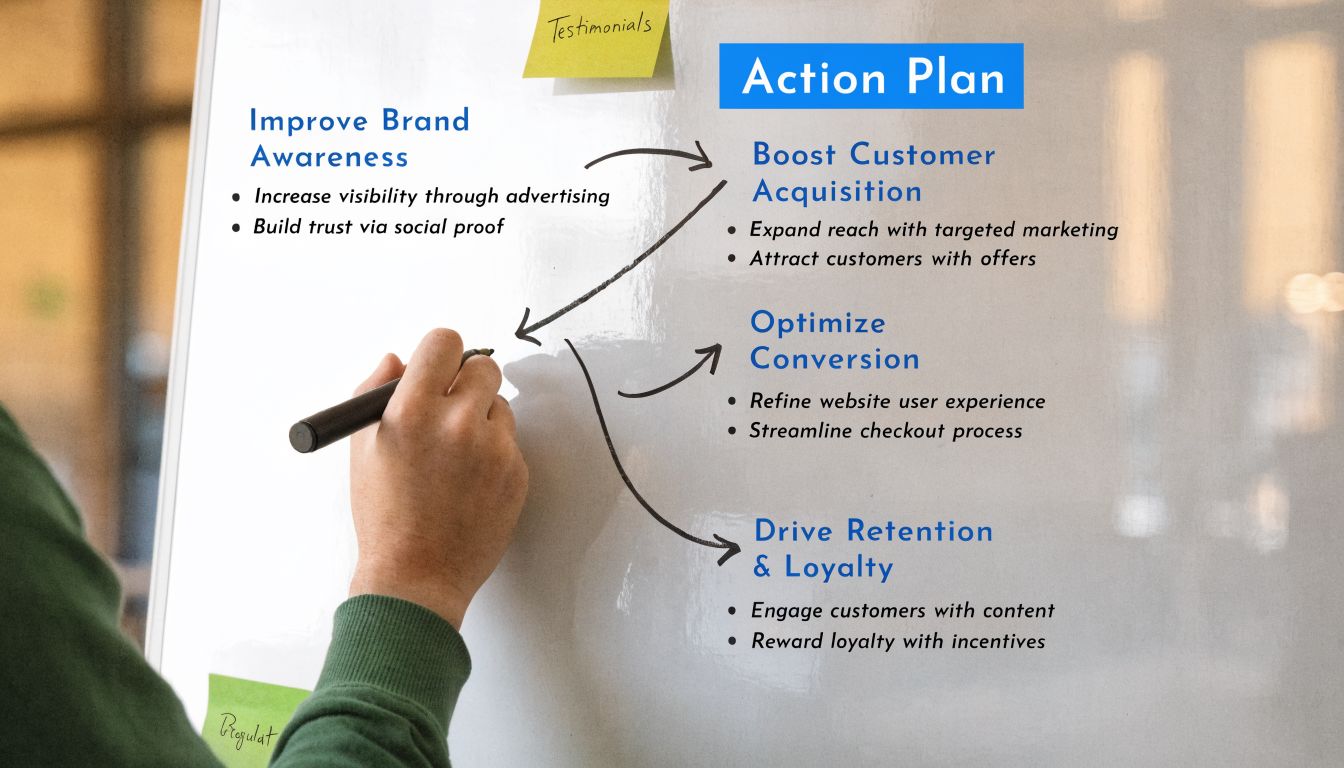
Your Action Plan for Estimating and Testing Ad Spend
If you want a clean answer to how much does it cost to advertise, stop asking for a generic monthly number and build a test plan around buyer intent.
Step one and step two
First, define what a new customer is worth to your business. Not emotionally. Operationally. If you know the revenue from a typical service call, recurring customer, treatment plan, or patient relationship, you can decide what acquisition cost is acceptable.
Second, pick your most transactional searches. Start with service-plus-location phrases, urgent problem phrases, and branded defense. Don’t build your first campaign around broad curiosity searches.
Step three and step four
Third, set up tracking before launch. Calls, forms, Google Business Profile actions, landing page performance, and booked outcomes all need attribution. If your reporting is weak, your decision-making will be weak too. This primer on how to measure marketing effectiveness is worth reviewing before you spend a dollar.
Fourth, use AI to improve speed and testing discipline, not to replace strategy. If you’re looking at ways to boost ad campaigns with AI, focus on tools and workflows that help with creative testing, offer variation, and relevance, while keeping your service and location intent front and center.
A short walkthrough can help tie the process together:
Keep the first test disciplined. One market. A narrow keyword set. Clear service pages. Tight geo targeting. Then scale what produces booked work.
Frequently Asked Questions About Advertising Costs
Should I put my money into SEO or paid ads
Both, but not in isolation.
An integrated strategy performs better because paid ads capture demand now while SEO and Maps reduce your reliance on paid acquisition over time. According to Growth99’s local marketing budget guidance, most guides silo SEO costs of $500 to $2,500 per month from paid ads, but an integrated strategy can cut total acquisition costs by 20-40%. The same source says case studies show that combining GMB optimization with AI content can grow leads by 2x without increasing ad spend.
That’s the right model for local service businesses. Paid search captures ready buyers. Local SEO and AI-optimized content build long-term visibility around the same transactional terms.
Are cheap clicks good enough if volume is high
Usually no.
Cheap clicks often come from weak intent. If the searcher isn’t close to booking, your campaign may look busy while producing poor sales results. Local businesses make more money when they prioritize transactional searches over top-of-funnel traffic.
How do I know if my ad budget is too low
Your budget is too low if you can’t gather enough clean data to judge lead quality or if you’re spread across too many services and locations at once.
It’s also too low if you’re funding clicks but not the infrastructure around them, meaning landing pages, maps credibility, call handling, and conversion tracking. A small focused campaign can work. A scattered small campaign usually won’t.
Should I run social ads if I’m a home service business
Yes, but mostly in a supporting role.
Social is useful for retargeting, offer reinforcement, audience warming, and staying visible after someone has visited your site or searched your brand. It usually isn’t the best first place to spend if your main goal is to capture immediate service demand from local buyers.
What should I demand from a marketing partner
Demand transparency.
You should be able to see your keyword targets, service-area focus, lead sources, map performance, landing pages, and the difference between raw leads and booked business. If the reporting stops at impressions or clicks, you’re not getting enough truth to manage the budget properly.
How long should I test before making a decision
Long enough to collect real buying behavior, but not so long that obvious waste continues unchecked.
Review search terms, calls, booked outcomes, and service-area patterns early. Good campaigns improve through iteration. Bad campaigns get exposed when the operator looks at the data instead of hiding behind vanity metrics.
If you want help building a local strategy around transactional search terms like “roofer near me,” “dentist near me,” or “air conditioning repair near me,” Transactional LLC focuses on Google Maps visibility, local SEO, AI-driven content, and paid campaigns built to turn searches into booked jobs.