


Your phone buzzes. It's a new Google review. One star. The customer says your tech showed up late, left a mess, and charged too much. If you run an HVAC company, dental office, roofing crew, or any appointment-based local service, you already know the feeling. You want to defend yourself. You want to explain the whole story. You also know every future prospect searching “dentist near me,” “roofer near me,” or “air conditioning repair near me” might read that review before they call.
That's why learning how to respond to negative Google reviews isn't a soft skill. It's an operating procedure tied to local visibility, trust, and booked jobs. Google says local ranking is built primarily on relevance, distance, and prominence, and prominence can reflect signals like review quantity and review quality in your Business Profile's overall presence in local search according to Google Business Profile ranking guidance. For businesses that live and die by transactional search terms, the terms where the searcher is ready to buy, review handling sits right in the middle of reputation and search performance.
I've seen the same mistake over and over. Owners treat every bad review like a public argument they need to win. That usually makes the page look worse, not better. What works is a triage system. First decide what kind of review you're dealing with. Then choose the response path that fits the risk.
If you want a broader process for monitoring, routing, and improving review operations, Sift AI's online reviews management guide is a useful companion to the review-specific workflow here. For more local-business review context, Transactional's own reviews and local business resources are also worth keeping bookmarked.
A bad review isn't a final verdict. It's a public service moment, and if you handle it well, future customers can see that.
When a Negative Review Hits Your Business
The first few minutes matter because that's when most owners do the dumbest thing. They read the review once, get angry, and start typing. A roofing owner wants to say the homeowner changed the scope. A dentist wants to explain that treatment options were discussed in advance. An HVAC company wants to point out the customer approved the price before work started. All of that may be true. It still doesn't belong in a public reply.
What the review is really doing
A negative review hits three audiences at once.
The reviewer sees whether you're dismissive or accountable. Future buyers see whether you sound organized, calm, and credible. And your team gets a signal about whether this issue is a one-off complaint or a repeated operational problem that needs fixing.
Harvard Business School summarized research based on more than 20 million online reviews across major travel platforms and found that after businesses began responding to reviews, they received about 12% more reviews and their average rating rose by 0.12 stars on a five-star scale in the Harvard Business School review response summary. That matters for service businesses because it shows a reply isn't only defensive cleanup. A consistent response process can improve engagement and the visible reputation customers use to judge you.
Why local service owners feel stuck
The trap is simple. If you say too little, you look absent. If you say too much, you can expose private details, sound combative, or turn one bad review into a bigger reputation problem.
That's especially true in healthcare and home services. A dental office can't casually discuss treatment details. A roofing company shouldn't post property specifics. A pest control firm shouldn't confirm service dates and addresses in public. The public reply has to do enough to show accountability, without saying so much that it creates a second problem.
Here's the clean way to approach it:
- Some reviews need service recovery
- Some need reporting
- Some need documentation before any reply
- Some are better handled with a short factual response, or no public response at all
That last point gets missed in most template-driven advice. Not every negative review deserves the same treatment. The smart move starts with classification, not wording.
Sorting Reviews Into Four Real Categories
Before anybody writes a reply, the review needs a label. This takes less than a minute when your front desk, office manager, or marketing lead knows what to look for.
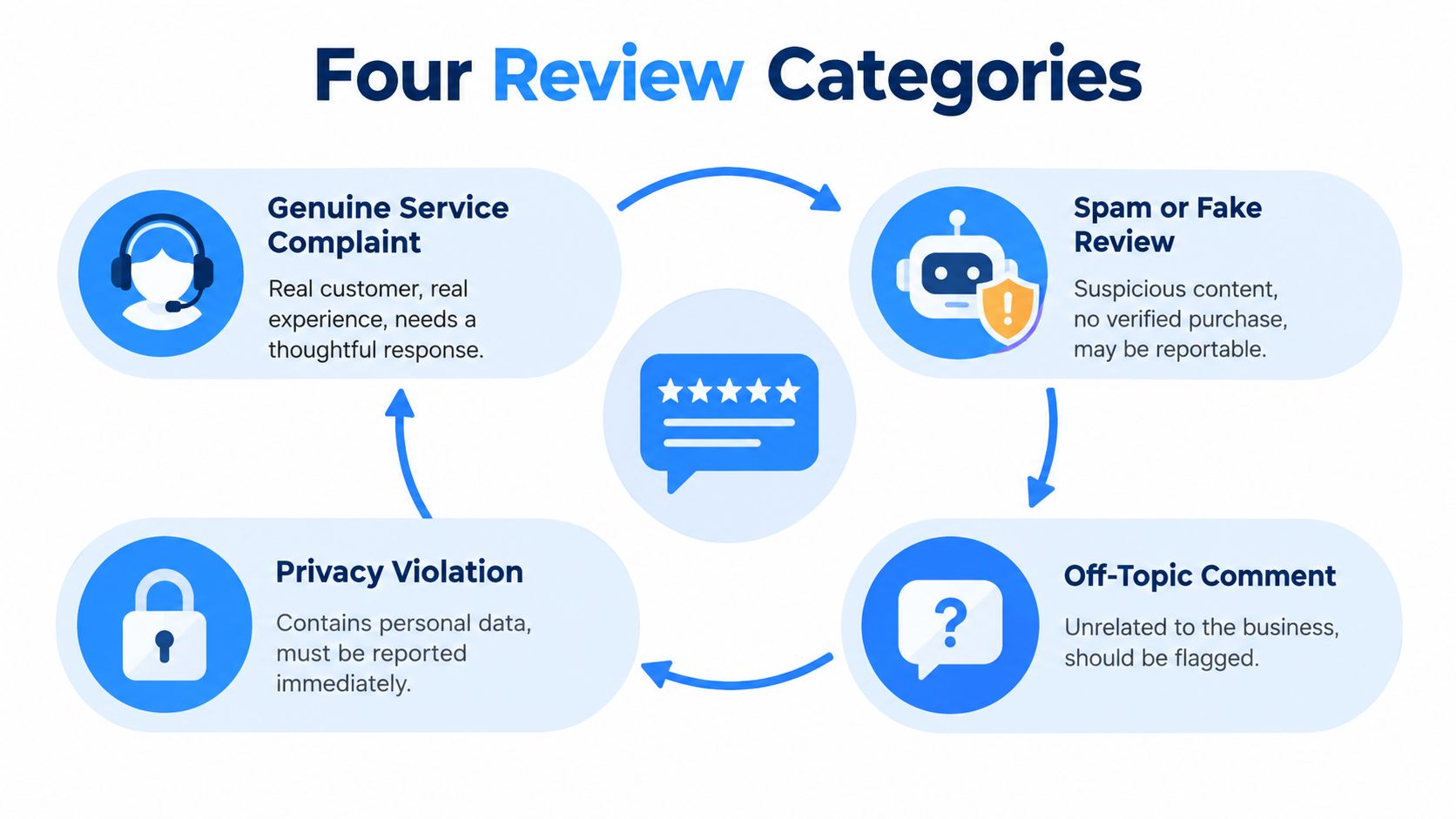
Genuine service complaint
This is the most common category. The reviewer sounds like a real customer, mentions an actual appointment or service type, and complains about price, quality, timing, communication, or results.
Classification cues are usually obvious:
- Specific service detail: They mention a cleaning, a leak repair, a roof inspection, or another recognizable interaction.
- Plausible complaint: The issue sounds like something that can happen in normal operations, even if their version feels incomplete.
A real complaint gets a real response. It doesn't get flagged just because it hurts.
Spam or fake review
Some negative reviews don't match any customer record, contain vague accusations, or appear to be part of a coordinated hit. Google says businesses can report reviews when they violate policy, not because they're negative, and its policy framework is built around identifying non-genuine or prohibited content through Business Profile reporting tools in Google's review policy and reporting guidance.
Quick cues include:
- No matching customer or job record
- Off-topic language or competitor-style wording
- A profile pattern that looks suspicious when you inspect it
Don't accuse the reviewer publicly. Preserve evidence first.
Harassment
This category is less about dissatisfaction and more about abuse. The review contains threats, discriminatory language, slurs, or personal attacks against your staff.
This isn't a customer service problem. It's a documentation and reporting problem. Screenshot it, log the time, and keep your team from engaging emotionally.
Practical rule: If the review attacks a person more than it describes a service problem, stop thinking like customer support and start thinking like risk management.
Privacy or policy violation
This is common in medical, dental, and home-service businesses. The review may contain private health information, billing details, address information, or other sensitive facts that shouldn't sit on a public profile.
Look for these signs fast:
- Personal or confidential details
- Anything that exposes a patient, household, or payment situation
- Content that creates a compliance risk if you answer carelessly
The category changes the next move. A genuine complaint gets empathy and a repair path. Spam gets evidence preservation and a flag. Harassment gets documented and reported. A privacy problem gets escalated immediately.
The Response Workflow That Protects Privacy and Brand
A good review process is boring on purpose. It should feel routine, not emotional. The businesses that clean up their profiles fastest usually aren't more charming. They're more disciplined.
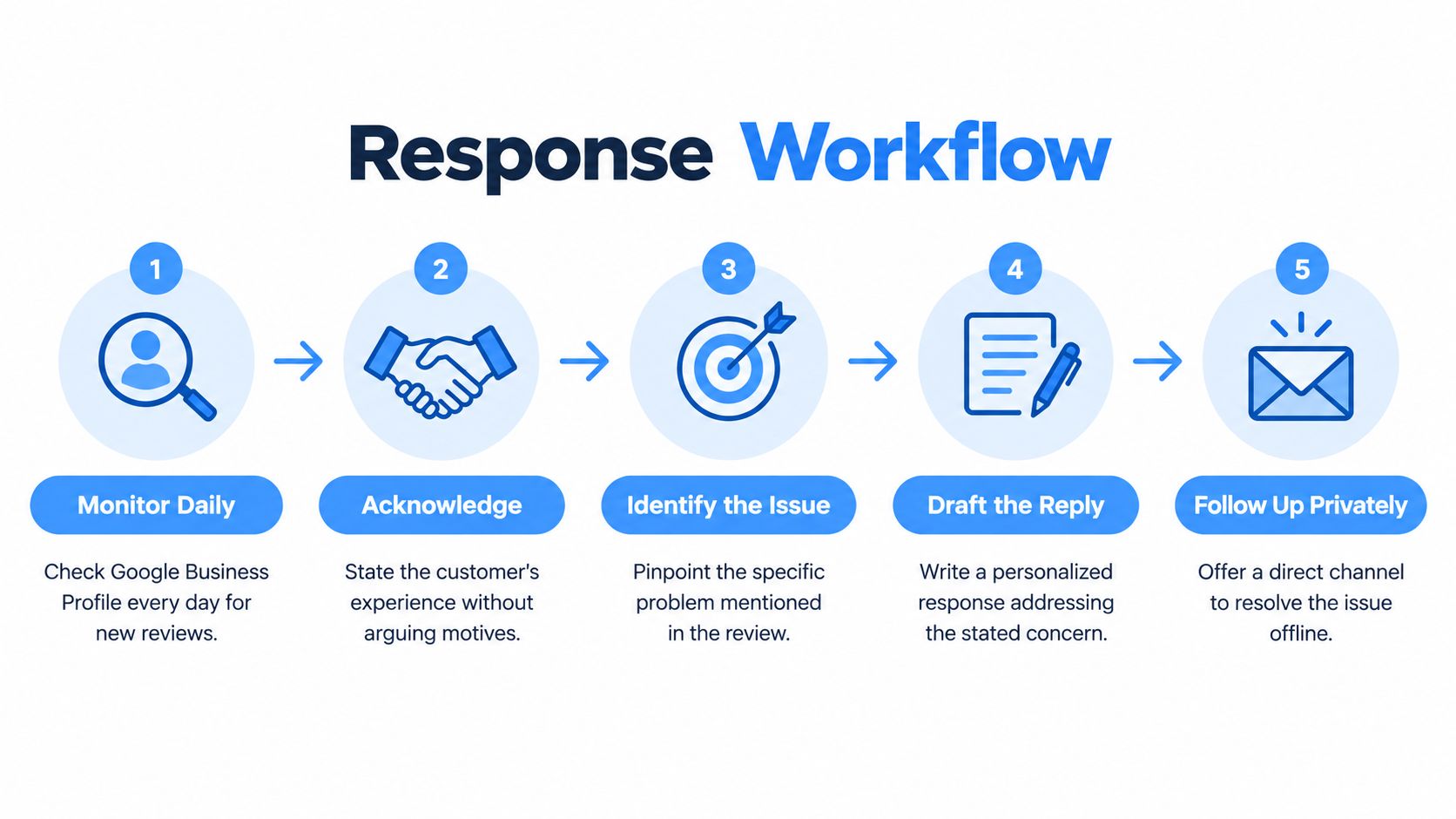
Start with monitoring, not reacting
Somebody should check your Google Business Profile every day. That can be an office manager, a location manager, or a centralized marketing coordinator. The point is that reviews shouldn't sit untouched while the team debates who owns them.
Once a negative review appears, read it against your records before you reply. Google advises businesses to investigate the customer's experience, acknowledge mistakes when they occurred, explain what can and can't be done, and move complex matters to a private channel in its official guidance for replying to reviews on Google's review response help page. That sequence works because it forces you to verify first and perform second.
Keep the public reply narrow
The best public replies are brief. They acknowledge the experience described, avoid arguing about motives, and identify one practical next step.
That usually sounds like this in structure, not as a canned script:
- Acknowledge the concern
- Apologize when the complaint is legitimate
- State one corrective action or next step
- Move the case to phone or email
What it should never include is the transaction history, internal blame, or your full defense. Public replies are for the market watching you, not for litigating the file.
Protect privacy at every line
Google's guidance is blunt on this point. Businesses should keep responses useful, readable, courteous, and they should not post or solicit confidential information in replies in Google's review response best practices. For a dental office, that means no treatment details. For a roofer, no property specifics. For a service tech complaint, no invoice screenshots, payment references, or appointment records.
Keep these items out of public responses:
- Names tied to sensitive cases
- Appointment dates and times
- Health information
- Payment data
- Home addresses or job-site details
If the customer needs to continue the conversation, give your business phone number or email and move it offline.
Don't turn service recovery into a policy violation
A lot of owners make this worse by trying to “fix” the rating with an offer. Google prohibits offering free or discounted goods or services in exchange for posting, changing, or removing a review because that counts as fake and misleading engagement under its policies in Google's review policy documentation.
That means no “We'll refund you if you take this down,” no “We'll give you a free cleaning if you update the review,” and no back-channel bribes dressed up as customer care.
If you use a CRM or dashboard to track outcomes, operational tools help. For example, Transactional LLC offers Google Business Profile management alongside local SEO tracking, which can help teams log review actions, monitor map visibility, and keep response ownership from slipping between locations.
The strongest reply sounds like a person who's in control, not a company trying to win an argument.
Personalization helps. Google recommends responses that are professional, conversational rather than promotional, and specific to the reviewer, including using the reviewer's name when appropriate and signing with a responder's name or initials in a prompt reply in Google's review response recommendations. In practice, “Sarah, Office Manager” or “DK” lands better than “Customer Support Team.”
Reply Scripts for the Three Most Common Scenarios
Templates aren't the enemy. Bad templates are. The useful kind gives your team a structure, then forces them to customize the facts, tone, and next step.
If you want more examples to adapt by service type, Transactional's review response templates can give your team a starting library. The key is to treat every script as a draft, not a final answer.
Pricing dispute reply
Pricing reviews usually come from customers who feel surprised, not always cheated. That distinction matters. If you answer like they're lying, the reply gets ugly fast.
Script:
Thank you for sharing your feedback, [Name]. I'm sorry to hear the final cost didn't match what you expected. We take pricing concerns seriously and would like to review the estimate, scope, and final invoice with you directly so we can clarify what happened and address any missed communication. Please contact us at [phone/email]., [Initials]
Why this works:
- “Thank you for sharing your feedback” lowers the temperature.
- “didn't match what you expected” acknowledges the experience without admitting facts you haven't verified.
- “review the estimate, scope, and final invoice” shows a concrete next step.
- Private contact route moves the billing conversation out of public view.
Service quality complaint reply
This is the review about poor workmanship, a bad clinical experience, a messy cleanup, or a result the customer believes fell below standard. These replies need accountability, not spin.
Script:
Thank you for bringing this to our attention, [Name]. I'm sorry to hear you were disappointed with the quality of the service you received. That's not the experience we want for our customers, and we're reviewing the issue with the team involved so we can address it properly. Please reach out to [phone/email] so we can discuss the matter directly and determine the right next step., [Initials]
What each line is doing:
- Acknowledgment first: You're not dodging the complaint.
- Direct apology: Appropriate when service quality is the issue described.
- One action: “reviewing the issue with the team involved” is specific enough to sound real.
- Private channel: Essential if photos, job details, or clinical facts may come up.
Scheduling complaint reply
Late arrival, missed appointment, no-show, poor communication. This category hits hard because it signals disorganization, which scares buyers in every local service vertical.
Script:
Thank you for the feedback, [Name]. I'm sorry for the frustration caused by the scheduling problem you described. We know timing and communication matter, especially when customers set aside time for an appointment, and we're reviewing what happened with our scheduling process. Please contact us at [phone/email] so we can follow up directly., [Initials]
Why this one lands:
- It names the pain plainly
- It recognizes the customer's lost time
- It points to process review, not excuses
- It avoids debating traffic, staffing, or dispatch issues in public
When the review is wrong, but not abusive
Sometimes the customer gets facts wrong. Sometimes it's a misunderstanding. Sometimes they describe a version of events your records don't support, but the review doesn't violate policy.
That's where businesses often over-answer. Don't.
Use something short like this:
Script:
Thank you for sharing your concerns. We take feedback seriously, but we can't confirm some of the details in your review based on our records. Because we don't want to discuss account-specific information publicly, please contact us at [phone/email] if you'd like us to review the matter directly., [Initials]
That gives a correction without turning the Google profile into a deposition.
A large share of bad replies fail for one reason. The business writes to the reviewer they're angry with, instead of the next customer reading the thread.
Why Copy-Paste Replies Quietly Cost You Customers
The fastest way to make your business sound fake is to answer a real complaint with a polished, interchangeable paragraph. Customers can spot it immediately. So can prospects.

Promotional language backfires
A study with almost 1,000 participants found that review responses containing promotional information were perceived as more self-interested and were associated with lower relationship quality and lower repurchase intention, while more sincere responses centered on gratitude and apology performed better in the Journal of Marketing Analytics study on management responses.
That lines up with what happens on local profiles every day. The reply starts as damage control, then somebody stuffs in a booking link, a sales line, or city keywords. Now it reads like an ad.
Cut phrases like these from your templates:
- “We'd love to earn your business”
- “Check out our seasonal special”
- “As the leading roofer in [city]”
- “Visit our website for more offers”
None of those repair trust. They tell the reader you're using a complaint to market.
Sometimes less is stronger
This is the part most guides skip. A public business reply isn't always the winning move. Research discussed in work from Marquette University shows response effects can vary based on the reviewer, the seriousness of the complaint, and who responds. In some scenarios, a positive reply from another customer performed better than a business response, and in other cases no response did better than a company reply in the Marquette review response research discussion.
That doesn't mean ignore complaints blindly. It means stop acting like every one-star review needs the same cheerful public script. If the post is volatile, factually murky, or likely to pull you into a privacy problem, a short factual response plus private resolution may be the better move.
Sincerity beats optimization theater. The reply should solve a trust problem, not chase a click.
Lead generation belongs elsewhere. Put the sales follow-up in your CRM, your remarketing workflow, and your broader local SEO strategy. Keep the review reply focused on accountability.
Escalation, Reporting, and Legal Guardrails
Some reviews shouldn't be handled like ordinary customer service. They need documentation, escalation, and a cooler head than most owners have in the first hour.
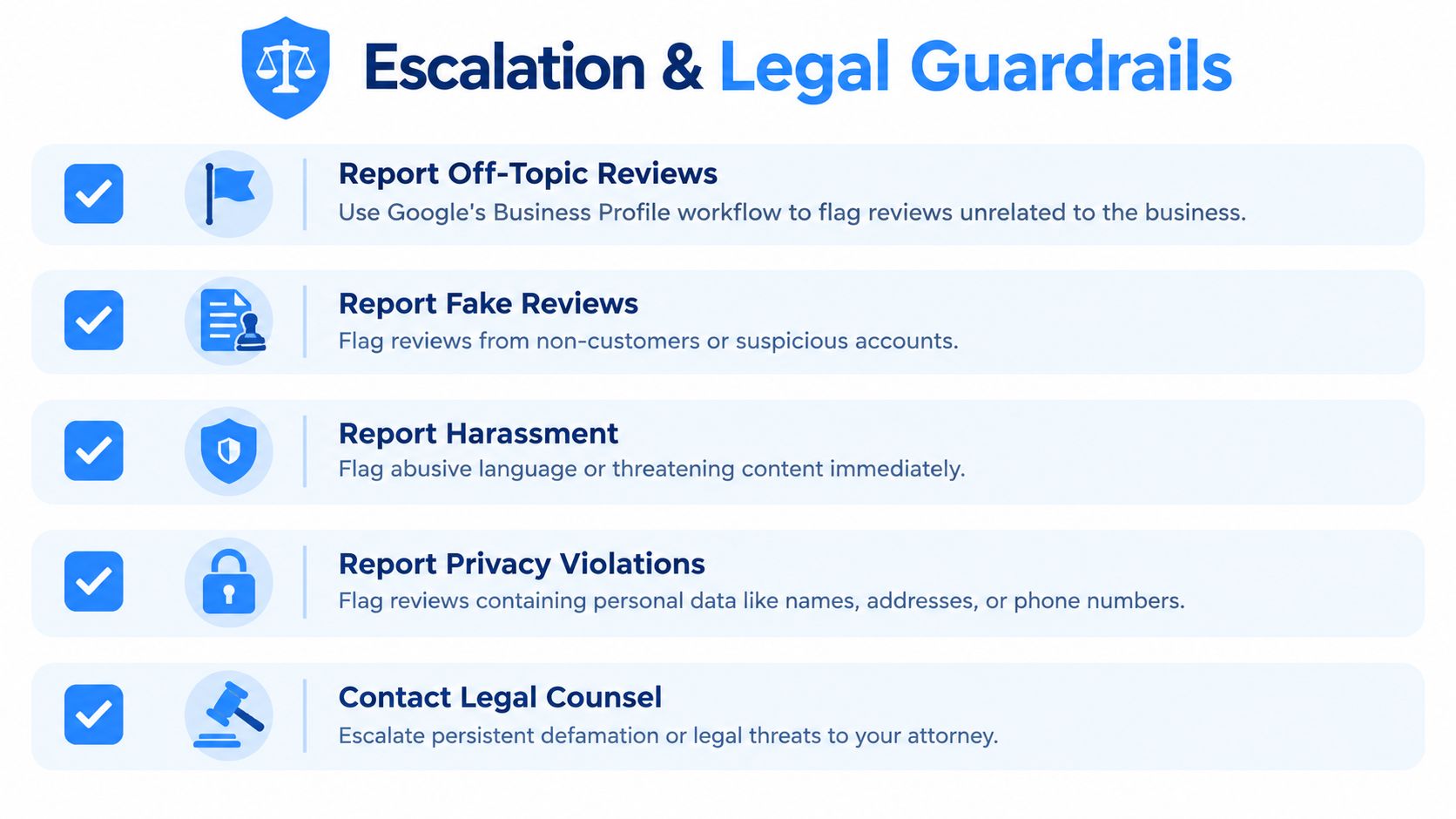
Know when to report instead of reply
If the review is fake, off-topic, abusive, or contains confidential details, preserve screenshots and timestamps before you do anything else. Then report it through Google's Business Profile workflow rather than trying to debate it in public. If you need a step-by-step path for that process, Transactional's guide on how to dispute a Google review is a practical reference.
The main mistake here is public accusation. Businesses post, “This reviewer is lying,” or “This is a fake competitor review,” and suddenly the thread gets more attention than it had before. A neutral response, or no public response while reporting is in progress, is often the safer play.
Hard guardrails you don't cross
These aren't style tips. They're rules.
- No incentives for removal or edits
- No retaliation or threats
- No legal chest-thumping in the reply
- No disclosure of private transaction details
- No publishing names, health facts, or address-level details
When the allegation involves safety, discrimination, repeat service failures, or billing misconduct, assign an internal owner and set a documented response timeline. That review may need an operations review, a manager callback, and sometimes legal review before any public language goes live.
Separate service recovery from moderation
Google has made this distinction clear in its policies. Negative feedback by itself is not grounds for takedown. Policy-violating content is. Businesses get into trouble when they treat every low rating as a moderation problem instead of asking whether the review reflects a service issue, a false post, or a compliance risk.
That separation protects you in two ways. It keeps normal dissatisfaction inside your customer recovery process, and it keeps actual policy violations inside your reporting process. Those are different lanes, and mixing them usually creates more damage than the original review.
Tracking Replies and Connecting Them to Local Rankings
Review handling only pays off when it becomes measurable. If your team replies but never logs the result, you're leaving reputation work disconnected from local search performance.
Google says local ranking is driven primarily by relevance, distance, and prominence, and prominence can reflect signals such as review quantity and review quality in Google's local ranking documentation. That matters because Transactional Marketing is built around transactional search terms, the searches where someone is ready to spend money now, terms like “HVAC repair near me,” “dentist near me,” and “roofer near me.” Review operations support that visibility. They don't guarantee placement, and nobody can pay Google for a better local rank, but they do feed the broader local search system.
Use a dashboard or CRM to track outcomes after every negative review reply, especially if you're coordinating SEO, maps, and AI optimization content around service-area terms.
| Metric | How to Capture | What It Feeds |
|---|---|---|
| Response time | Log timestamp from review post to public reply | Operational accountability |
| Review category | Label as service complaint, spam, harassment, or policy issue | Triage quality |
| Resolution outcome | Mark as private recovery, updated review, removed review, unresolved | Process effectiveness |
| Sentiment trend | Review rolling 30-day and 90-day direction in comments and ratings | Reputation trend |
| Spam share | Compare flagged non-genuine reviews against valid complaints | Reporting discipline |
A negative review reply isn't a one-off emotional task. It's one input in a local visibility system that also includes profile completeness, service-page relevance, map coverage, and ongoing content built for high-intent searches.
If your team needs help building a repeatable review-response process that supports Google Maps visibility, local SEO, and AI-driven discovery for high-intent searches, Transactional LLC offers industry-specific support for service businesses that want stronger review handling and better performance on transactional terms. If you are tired of guessing how to answer bad reviews while trying to rank for the searches that produce calls, start there.