


If you're running an HVAC company, you already know the pattern. The phone rings hard when the weather breaks, then goes quiet, then you spend money on marketing that looks busy but doesn't reliably turn into booked jobs. You get traffic reports, boosted posts, maybe a few vague leads, but not enough calls from people who need service now.
That's the wrong game.
HVAC business marketing only works when it targets transactional search terms. Not broad awareness. Not vanity traffic. Not blog content written for people who are casually browsing. You need to show up when a homeowner searches ac repair near me, emergency furnace repair, or air conditioning installation in [city]. Those searches come from people with a problem, urgency, and buying intent.
That matters even more as the category gets more crowded. The global HVAC system market is projected to grow from USD 299.28 billion in 2025 to USD 407.77 billion by 2030 according to MarketsandMarkets HVAC market projections. More demand brings more competition. If your company isn't visible in search, maps, and AI-assisted results when that demand appears, someone else takes the call.
Why Your HVAC Marketing Must Target Transactional Searches
Most HVAC owners don't have a lead problem. They have an intent problem.
They pay for marketing that reaches the wrong people at the wrong time. A homeowner reading "how does central air work" is not the same as a homeowner searching 24 hour AC repair near me at night. One is researching. The other is ready to hire.
High-intent searches are where revenue lives
A transactional search is simple. It's a query typed by someone who wants action now. In HVAC, that usually means:
- Emergency need: furnace stopped working, AC froze up, thermostat failed
- Replacement intent: new unit quote, AC installation, furnace replacement
- Local service intent: HVAC company near me, AC repair in [city], same day service
Those are the searches that deserve your budget, your page structure, and your Google Maps strategy.
If you want a clearer breakdown of how intent works, read this explanation of search queries and what they signal. It helps separate curious visitors from buyers.
Practical rule: If a keyword doesn't point toward a phone call, form fill, or booked estimate, it shouldn't sit at the center of your HVAC marketing strategy.
Informational traffic doesn't pay your technicians
A lot of agencies still sell HVAC companies on generic "content marketing." They publish broad articles, chase impressions, and call it momentum. That approach misses the point.
You don't need to dominate every HVAC topic on the internet. You need to dominate the searches tied to real service demand in the cities you serve.
Use this filter before you invest in any campaign:
| Search type | Example query | Business value |
|---|---|---|
| Informational | how often to replace air filter | Low immediate value |
| Commercial | best HVAC company in [city] | Strong value |
| Transactional | AC repair near me | Highest value |
The best HVAC business marketing systems are narrow on purpose. They focus on service + city + urgency. That's what gets calls.
The right metric is booked jobs
Clicks are not the goal. Rankings alone are not the goal. Even leads aren't enough if they don't fit your schedule, margin, and service mix.
You need marketing that brings in the right calls. Emergency repair. Replacement estimates. Maintenance plan opportunities during the right season. Commercial inquiries if that's part of your model. Everything else is noise.
Buyers in HVAC often contact the first provider who looks available, credible, and local.
That's why transactional visibility wins. If your website and Google profile act like a brochure, you'll lose to the company that acts like a dispatch-ready sales machine.
Your Foundation for Dominating Local HVAC Searches
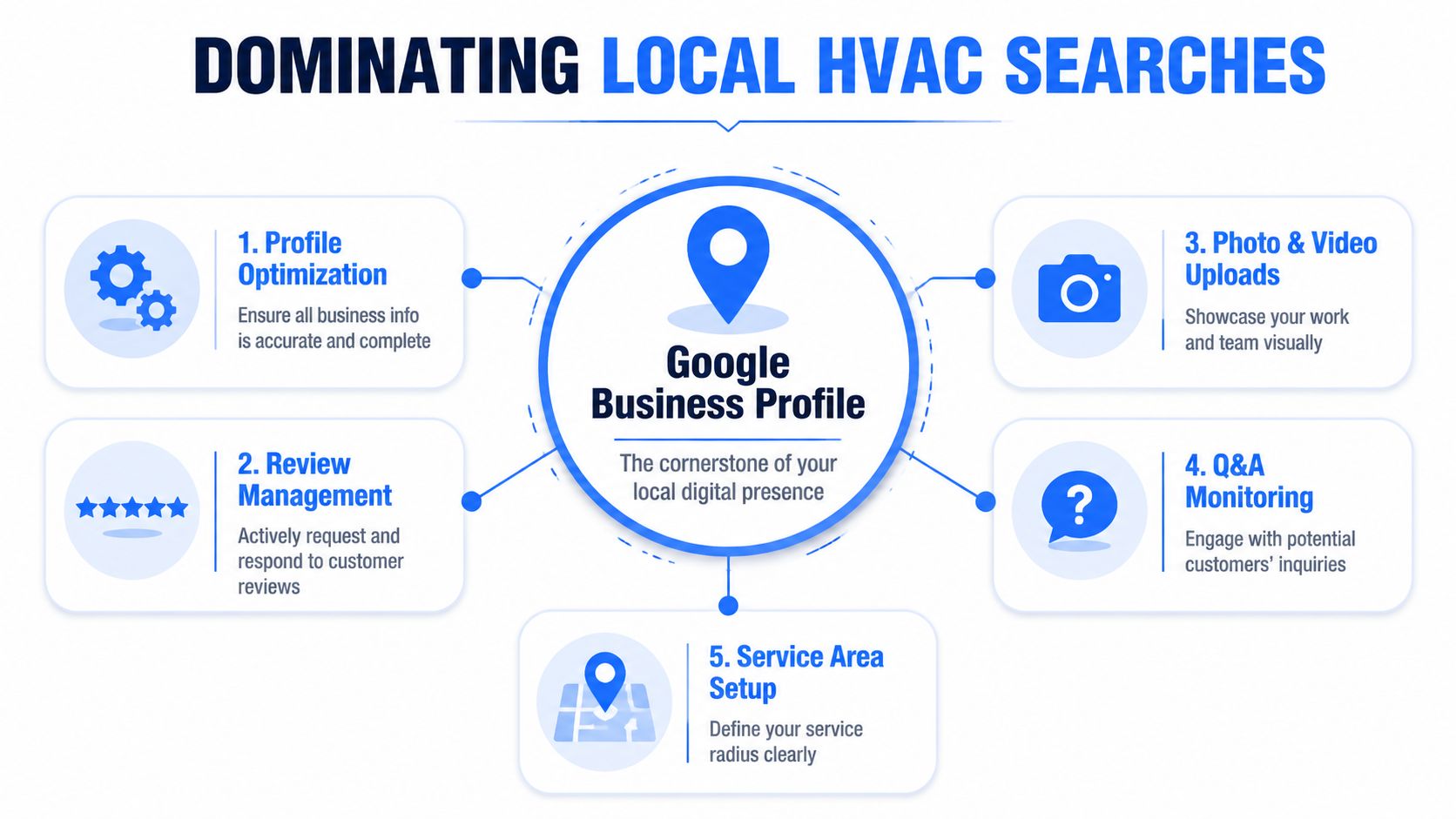
Your Google Business Profile is the first battlefield. For many HVAC companies, it drives more calls than the homepage. When someone searches a local service term, Google often shows the map results before anything else. If your profile is weak, incomplete, or generic, you won't show up when it counts.
Recent guidance is clear. Local SEO for HVAC depends on accurate Google Business Profile details, service-area specificity, and positive reviews. SEO by itself isn't enough because HVAC customers search with urgent, local intent.
Set up the profile like it matters
Too many companies treat GBP like a directory listing. It isn't. It's a sales asset.
Start with the basics, but do them with precision:
Pick the right primary category
If your main revenue comes from repair, don't hide behind a broad label if a more service-specific option better matches what people search. Your category choice affects relevance.Define service areas tightly
Don't spray across an oversized region just because you can technically drive there. Focus on cities and service zones you can support fast.Write a useful business description
Mention core services, emergency availability if you offer it, and the service area. Skip fluff.List real services individually
Add repair, installation, replacement, maintenance, ductless systems, indoor air quality, and anything else you sell.
Use every GBP feature that supports local relevance
Most profiles are underbuilt. Google notices activity and completeness.
A strong profile should include:
- Fresh jobsite photos that show trucks, technicians, installs, and repairs
- Review responses that prove the business is active
- Q&A entries covering common buyer concerns
- Google Posts tied to seasonal service demand
- Correct hours and contact details so no lead dies from bad data
For a deeper local strategy, this guide on local SEO for HVAC companies lays out how service-area targeting and map visibility work together.
If your profile doesn't clearly say who you serve, what you do, and why someone should call today, Google has no reason to rank it and customers have no reason to trust it.
Reviews aren't a side task
In HVAC, reviews are part of ranking and part of conversion. A profile with weak review velocity looks stale. A profile with thoughtful responses and recent job feedback looks active and trustworthy.
Don't ask for reviews randomly. Build the request into the post-job workflow. Send the ask when the customer is satisfied and the experience is fresh. Then respond like a real operator, not with canned one-line replies.
What a winning GBP actually communicates
A strong profile does three things fast:
| Element | What the customer sees | What Google sees |
|---|---|---|
| Clear categories | "They handle my problem" | Relevance |
| Specific service areas | "They work in my city" | Local targeting |
| Fresh reviews and media | "They look legit and active" | Trust and engagement |
That combination is the fastest route into map visibility for local HVAC searches.
Building a Website That Converts Searchers into Customers
Your website shouldn't try to impress people. It should route urgency into action.
Most HVAC sites fail because they lump everything into one generic services page, one generic locations page, and a contact form buried in the footer. That setup doesn't match how people search. It also doesn't match how Google or AI systems interpret local service intent.

Build pages around service and city combinations
If you want to rank for transactional terms, create dedicated pages that mirror them.
That means pages like:
- AC repair
- Furnace repair
- Heat pump installation
- Ductless mini split service
- Emergency HVAC repair
- AC repair in [city]
- Furnace replacement in [city]
Each page needs a real purpose. Don't clone the same copy across city pages. Adjust the messaging to the city, service expectations, scheduling reality, and customer concerns in that area.
This approach also supports AI optimization. Large language models and AI-driven search tools pull answers from pages that are specific, well-structured, and easy to interpret. Generic pages get ignored.
Match the page to the buying moment
Effective HVAC marketing should align demand with operations. PowerChord's HVAC marketing guidance makes that point well. Campaigns should focus on high-margin work like emergency service and seasonally timed tune-ups because urgency-driven buyers often contact the first clearly available provider.
Your page structure should reflect that urgency.
A strong service page usually includes:
- A direct headline using the service term
- A short opening that confirms availability and problem fit
- Common issues the service solves
- A visible phone CTA high on the page
- Trust signals like reviews, certifications, and service guarantees
- A city/service area section so the local relevance is obvious
- FAQ content written in plain language
If you want to sharpen the mechanics, Breaker's conversion rate strategies are useful because they focus on reducing friction and making next steps obvious.
Your homepage is not enough. Buyers don't search for "great HVAC company." They search for the exact problem they need fixed.
Design for mobile callers first
Most transactional HVAC searches happen on phones. Your site has to support that reality.
Here is the minimum standard:
| Website element | What to do |
|---|---|
| Header | Put the phone number and service area at the top |
| Buttons | Use clear actions like Call Now or Schedule Service |
| Page speed | Keep pages lean and easy to load |
| Content layout | Use short sections, not giant text blocks |
| Forms | Ask only for what dispatch actually needs |
A lot of owners obsess over design trends and ignore conversion basics. That's backward. Mobile usability and clear service intent win more jobs than a fancy layout.
For a more focused framework, this guide on how to improve website conversion rate is worth studying.
Write for both search engines and AI systems
HVAC business marketing is changing fast. Search isn't just ten blue links anymore. Buyers now see map results, AI summaries, local packs, service ads, and featured answers.
Your website needs content blocks that machines can parse easily:
- direct service descriptions
- plain-language FAQs
- city references
- financing or estimate details if relevant
- emergency availability language when applicable
That structure helps your site rank. It also helps AI systems understand that your business is a credible answer for transactional HVAC searches.
Using Paid Ads and AI to Accelerate Growth
Once your local foundation is solid, paid ads let you move faster. Not broader. Faster.
Most HVAC companies waste ad spend because they run generic campaigns with loose match terms, broad geography, and weak landing pages. The fix is simple. Buy visibility only where urgency and service intent are strongest, then let AI help you tighten targeting, query coverage, and response speed.

Put your budget where buying intent is highest
A foundational benchmark for HVAC marketing is that companies typically invest 7% to 10% of revenue into marketing, and 60% to 70% of that spend usually goes to digital channels according to this HVAC marketing statistics roundup. That's logical in a local service category where the call often goes to whoever is most visible at the moment of need.
The same benchmark reports that Google Local Services Ads achieve close rates of 18% to 32%, while call-only campaigns can convert at 30% to 50% during emergency-intent searches. It also notes a typical HVAC campaign conversion rate of about 3.10%. The message is obvious. High-intent ad formats outperform generic campaigns because they remove friction.
If you run paid search for HVAC, prioritize:
- Local Services Ads for trust and top-of-page visibility
- Call-only campaigns for emergency terms
- Tightly segmented search campaigns by service line
- Separate campaigns for repair, replacement, and maintenance
AI optimization changes how you win local search
AI optimization isn't hype when it's used correctly. It helps you identify the exact phrases customers use, the service-city combinations Google keeps surfacing, and the gaps in your own site and ad coverage.
In practice, that means using AI to:
- expand real transactional keyword variants
- cluster questions around repair, replacement, and installation intent
- improve ad copy based on service urgency
- structure FAQs and landing pages for AI-generated answers
- monitor search query patterns that signal changing seasonal demand
AI can also help draft content quickly, but raw output usually sounds generic. If you're using it for web copy, ad variants, or FAQ content, a cleanup layer matters. Tools that humanize chatgpt text can help remove the robotic tone before anything goes live.
Speed to lead matters more than clever ads
Paid traffic only works if the back end is disciplined. If the phone isn't answered, if the dispatcher is slow, or if the landing page doesn't make action easy, you're paying to lose.
Keep the customer path short:
- Search
- Call
- Book
- Dispatch
Anything extra lowers conversion quality.
This video does a good job of showing how operators think about lead flow and performance visibility:
If your paid strategy is creating leads but not profitable jobs, fix attribution before you scale. This resource on how to reduce customer acquisition cost is useful because it ties spend back to actual booked work, not surface-level campaign metrics.
Paid ads should not "support brand awareness." They should put your company in front of buyers who need service now and make it easy for them to call.
Creating a Moat with Reviews and Referrals
Paid search gets attention. Reviews and referrals decide whether your market position lasts.
A lot of HVAC companies treat trust as an afterthought. They ask for reviews inconsistently, respond late, and never build a referral process with past customers or local partners. That leaves them dependent on ad spend and weak in maps.
Reviews shape both ranking and close rate
When a homeowner compares two HVAC companies, they don't read every page. They scan for signals. Star ratings. review recency. response quality. proof that real customers had a good experience.
That means you need a system, not a wish.
Use a post-job workflow that includes:
- A same-day or next-day review request by text or email
- A direct review link so the customer doesn't have to search for you
- A trigger from completed jobs inside your CRM or field service platform
- A response policy so every review gets an answer
The script doesn't need to be clever. It needs to be easy:
"Thanks again for choosing us. If the job went well, would you mind leaving a quick Google review? It helps other homeowners know they can trust us."
Short. Direct. No begging.
Referral networks beat isolated marketing
Referrals don't just come from happy customers. They also come from adjacent trades that see the same homeowners.
The strongest local HVAC operators build referral relationships with:
| Partner type | Why it works |
|---|---|
| Plumbers | They often hear about heating and water heater comfort issues |
| Electricians | They encounter panel, thermostat, and equipment upgrade conversations |
| Roofers | They work on homes where attic ventilation and comfort concerns surface |
| Property managers | They control recurring service and replacement demand |
Don't overcomplicate this. Reach out, set clear expectations, and make reciprocation real. If a plumber sends you good repair or replacement work, send useful work back when you can.
Build proof into every customer touchpoint
The moat gets stronger when trust signals appear everywhere, not just on your Google profile.
Make sure your operation includes:
- Review snippets on service pages
- Technician photos and truck branding
- Consistent naming, phone, and service details across listings
- A referral mention in invoices, follow-up emails, and maintenance reminders
That last point matters. Customers rarely refer on their own schedule. They refer when you remind them at the right moment.
Why this lowers dependence on paid acquisition
A company with steady reviews, visible social proof, and local referral partners doesn't need to chase every lead at full price. It earns more branded searches, more direct calls, and more map trust.
That's the moat. Not vague "branding." Actual local credibility that competitors can't duplicate overnight.
The HVAC companies that hold market share for years don't just buy leads. They build trust systems that keep producing calls even when ad costs rise.
Your 90-Day Action Plan for HVAC Market Domination
Most HVAC companies don't need more ideas. They need execution in the right order.
If growth is the goal, budget accordingly. One industry guide notes that 10% to 20% of sales is appropriate for aggressive growth, while 5% is more of a maintenance level, and it stresses tracking lead source, booked jobs, and customer acquisition cost so spend stays tied to margin-positive work, as explained in this HVAC growth budgeting guide.
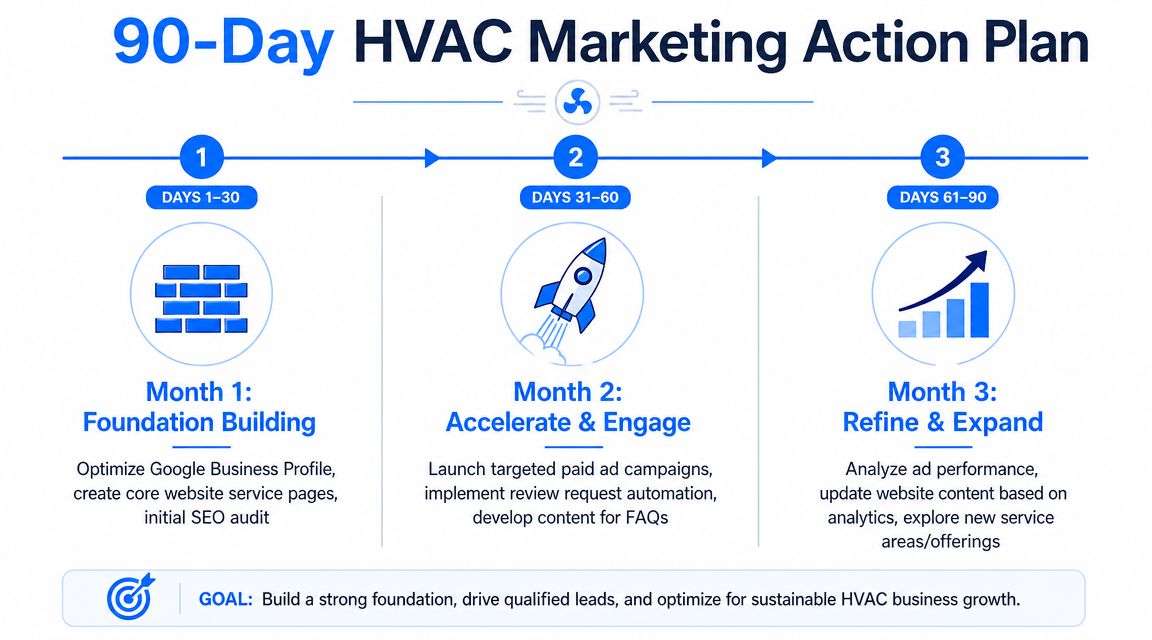
Days 1 through 30
Fix the foundation first.
- Rebuild your Google Business Profile: categories, services, photos, hours, service areas
- Create core transactional pages: AC repair, furnace repair, installation, replacement, emergency service
- Set up tracking: calls, forms, booked jobs, lead source
- Tighten your homepage: service area, phone CTA, service menu, trust signals
Don't add five channels at once. Get the core assets right.
Days 31 through 60
Start pushing demand into the system.
Launch or refine:
- Local Services Ads
- Service-specific Google Ads
- Review request automation
- FAQ content built for search and AI visibility
If you want another perspective on channel selection and local positioning, this guide on how to market your HVAC company is a useful companion read.
Days 61 through 90
Cut waste and scale what books jobs.
Review performance by service line and city. Emergency repair may justify more budget than maintenance. One city page may outperform another. A certain campaign may generate calls that don't convert. Fix that now, not six months later.
Track these KPIs every week:
| KPI | Why it matters |
|---|---|
| Phone calls from organic and maps | Shows transactional visibility |
| Form submissions by service page | Shows page-level conversion strength |
| Booked jobs by lead source | Shows actual revenue contribution |
| Customer acquisition cost | Shows efficiency |
| Ranking for service + city terms | Shows local search progress |
The owners who win at hvac business marketing are the ones who track booked work, not just traffic. That's the entire game.
Transactional LLC helps service businesses show up for the searches that produce revenue. If you want stronger visibility for terms like AC repair near me, better Google Maps placement, and a local SEO system built around booked jobs instead of vanity metrics, talk to Transactional LLC.