


A homeowner loses power on a Friday night. They do not ask a neighbor for a referral, dig through old mailers, or spend half an hour comparing brands. They grab a phone, search for an electrician, and call one of the businesses that shows up first.
That is the market now. Local seo for electricians is not about abstract visibility. It is about owning the searches that happen when someone needs panel repair, troubleshooting, rewiring, or emergency service right now.
The biggest mistake I see is electricians treating SEO like branding. It is not. The true opportunity sits inside transactional search terms. Those are searches with buying intent built in, such as “electrician near me,” “emergency electrician [city],” or “EV charger installation [city].” If you rank for those terms, you get calls from people ready to hire.
Why Your Competitor's Phone Is Ringing and Yours Isn't
A customer with a dead outlet or smoking breaker is not browsing for entertainment. They are trying to solve a problem fast. If your business does not appear when they search, your competitor gets the first call and usually the job.

The size of that opportunity is not small. Approximately 230,000 people search “electrician near me” every month, and 98% of consumers used the internet to find local businesses in 2024 according to Four Arrows Marketing’s electrician SEO analysis. That tells you exactly where demand lives. It lives in local search.
Old marketing loses urgency searches
Door hangers, wrapped vans, referral requests, and yard signs still have value. They help with recall. They do not win the urgent moment when someone searches on a phone and needs help now.
What wins that moment is simple:
- Map visibility: Your business appears in the top map results.
- Clear offer: The profile and website show the service the customer needs.
- Fast trust signals: Reviews, photos, service areas, and accurate business info remove hesitation.
- Strong call path: Tap the phone number. Book the service. Done.
That is the philosophy behind Transactional Marketing. Go after the searches where the buyer already has intent and is close to calling.
Practical rule: If a keyword sounds like something a homeowner would search while standing in front of an electrical problem, it belongs in your strategy.
Operations matter too
Local SEO does not replace strong field operations. It amplifies them. The electricians who usually gain the most are the ones who already estimate cleanly, answer calls quickly, and move leads through the pipeline without friction.
That is also why tools outside SEO matter. If you are tightening up bidding and job scoping, Exayard electrical estimating software is a useful operational resource to evaluate alongside your marketing stack.
The core issue is not whether people are looking for electricians online. They are. The issue is whether Google, Maps, and now AI-driven search surfaces see your business as the best local answer.
Your Google Business Profile Transactional Engine
Your Google Business Profile is the closest thing an electrician has to a digital storefront for urgent demand. When someone searches for an electrician in a service area, Google often shows the map pack before it shows standard website results. High-intent calls happen there.
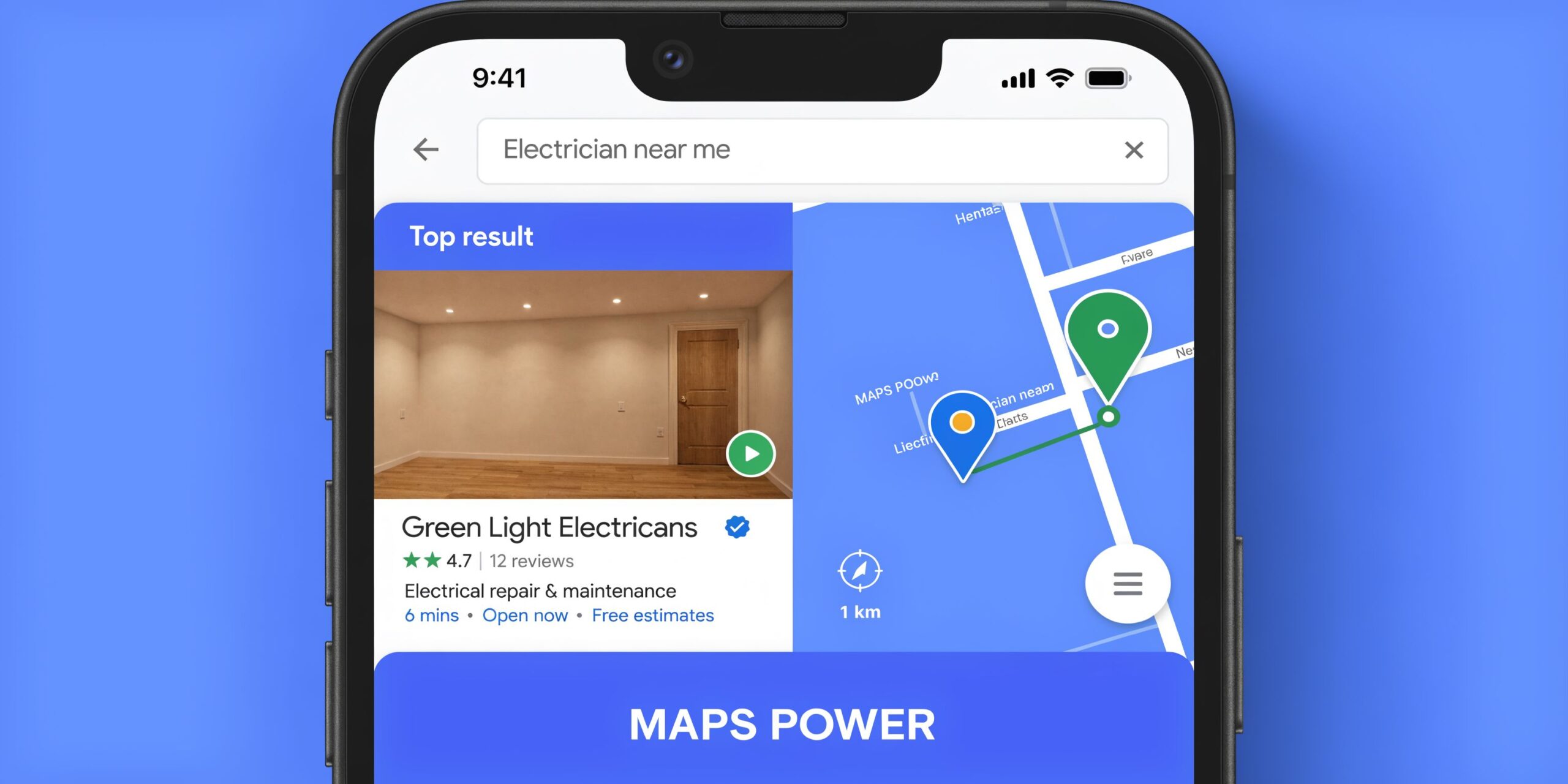
Electricians who fully optimize their Google Business Profiles can expect to appear in the Google Maps Local Pack within 30 to 90 days, according to JPG Designs’ local SEO guide for electricians. That timeline depends on completeness. Half-finished profiles lag because Google gets weak signals about who you are, what you do, and where you work.
Fill out every field that affects buying decisions
Most profiles are incomplete in ways that directly cost jobs. The business owner adds a name, phone number, and category, then stops. That is not optimization. That is basic existence.
A strong profile includes:
- Primary category: Use the most accurate core business category.
- Service list: Add every service you offer, not just a broad label.
- Service areas: Define where you work so the profile matches the territory you want to rank in.
- Hours: Keep regular and emergency availability accurate.
- Business description: Write around real services and local buying intent.
- Photos: Use real jobsite images, team photos, vans, panel work, lighting installs, and finished results.
- Q&A: Seed common pre-sale questions and answer them clearly.
- Review responses: Reply consistently so the profile shows activity and trust.
If you want a deeper tactical walkthrough, this guide on how to optimize a Google Business Profile covers the mechanics in more detail.
Match your profile to transactional searches
A profile should not read like a generic brochure. It should align with how customers search.
Weak wording:
“Quality electrical solutions for residential and commercial clients.”
Better positioning:
“Licensed electrician offering panel upgrades, electrical repairs, lighting installation, outlet troubleshooting, and emergency service in specific service areas.”
The second version gives Google and customers more usable information. It also supports the exact kinds of searches that trigger calls.
Photos are not decoration
Customers use photos as proof. Google uses them as freshness and relevance signals. Stock images are weak. Real job documentation is better.
Upload photos that show:
- Panel upgrades completed
- Lighting installations in finished spaces
- Service vans with branding
- Technicians on-site
- Before and after electrical work
- Exterior shots that help customers recognize your business
Many electricians miss easy wins here. They do quality work every week but never turn that work into visual proof inside the profile.
Tip: Treat every completed job as content. One job can produce website photos, GBP images, review prompts, and location-specific proof.
Build a profile that answers objections before the call
Customers hesitate for predictable reasons. They wonder whether you serve their area, whether you do the exact service, whether you are active, and whether other customers trusted you.
Use the profile to reduce that hesitation.
A practical checklist:
| GBP element | What it should do |
|---|---|
| Services | Confirm exact job types |
| Hours | Reduce uncertainty about availability |
| Reviews | Show trust and recent activity |
| Photos | Prove legitimacy and workmanship |
| Q&A | Handle common objections early |
| Description | Reinforce local relevance and service focus |
That is why profile completeness matters so much. A customer comparing three map results often makes a decision based on clarity, not just rank.
Post updates that support conversion
Google Posts are useful when they reflect real services and seasonal needs. They are less useful when they are generic slogans.
Good post topics for electricians include:
- Emergency readiness: Storm-related outage help, surge issues, breaker problems.
- High-demand installs: EV charger installation, panel upgrades, lighting upgrades.
- Safety topics: Flickering lights, hot outlets, repeated breaker trips.
- Service area reminders: City-specific posts tied to where you want more calls.
Later in your profile workflow, video can help explain what customers should expect from a high-performing map presence:
What does not work
Some patterns fail over and over:
- Keyword stuffing the business name
- Using fake locations
- Ignoring reviews
- Leaving service areas broad and vague
- Uploading a burst of photos once, then going silent
- Writing a profile that sounds the same as every competitor
A Google Business Profile works best when it mirrors real-world operations. Accurate details, complete services, active review management, and steady updates beat shortcuts.
Website Architecture for Local Service Domination
A generic website with one Services page and one Contact page will not carry a serious local SEO campaign. If you want calls from transactional searches, your website has to separate services, locations, and conversion paths clearly.
That structure is what lets Google understand the difference between “panel upgrade in one city” and “EV charger installation in another city.” It also lets customers land on the exact page that matches what they need.
Build a service and city silo
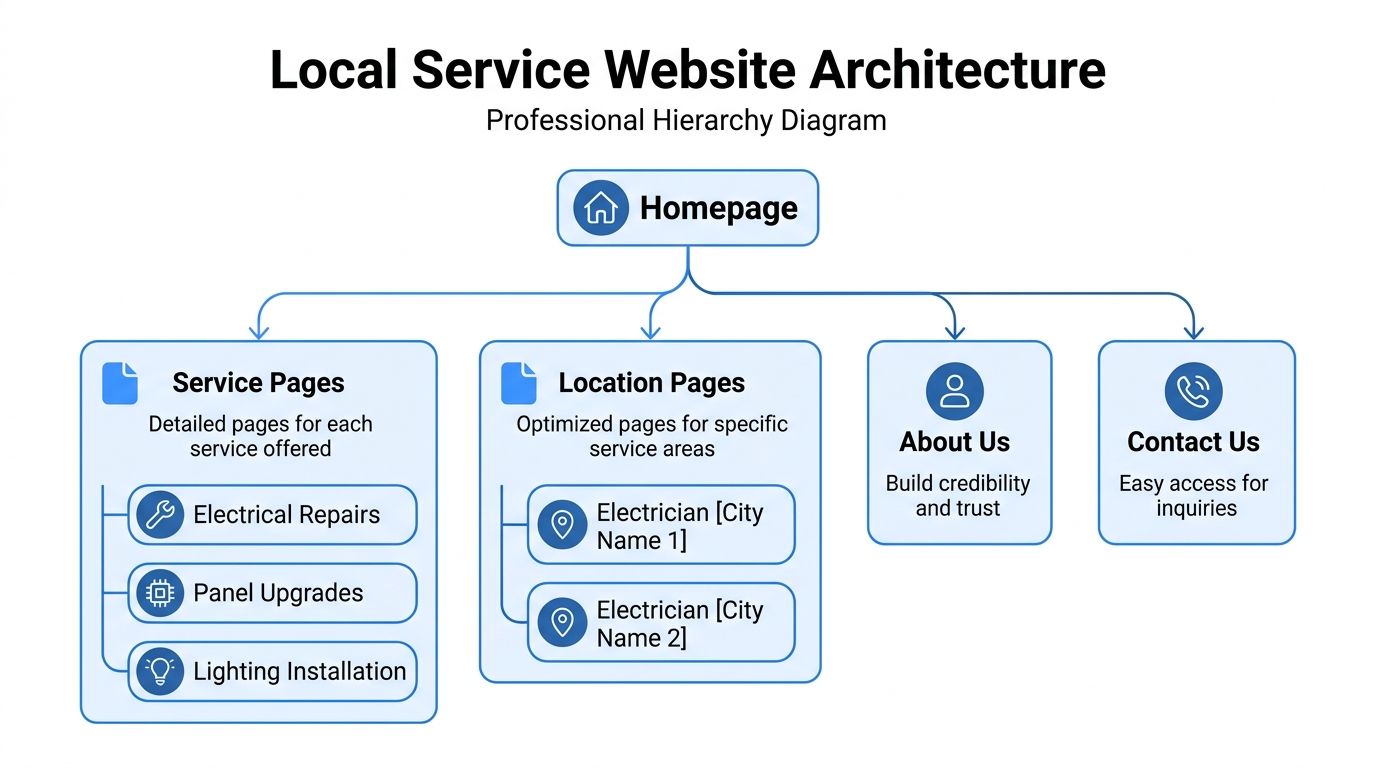
According to Energized Electric’s guide to local SEO architecture for electricians, expert-level local SEO requires individual service pages for each geographic area, with each page targeting location-specific keywords. Service schema and LocalBusiness schema can significantly outperform generic pages.
That means your site should not lump everything into one page. It should break out:
- Core service pages: electrical repair, panel upgrades, EV charger installation, lighting installation, rewiring, generator-related work if applicable
- Location pages: city pages, suburb pages, or service-area pages
- Combined local intent paths: pages that tightly align service and geography
If you are rebuilding or refining that structure, strong web design for electrician sites starts with navigation and page hierarchy before design polish.
What a strong page setup looks like
Here is a simple model:
- Homepage
- Main service pages
- Main location pages
- Supporting city-service pages where demand justifies it
- About page
- Contact page
- Review or testimonials page
The homepage should establish the brand and core territory. The service pages should go deep on job type. The location pages should prove you serve that area. The combined pages are where many electricians create their best ranking assets.
The page template that pulls in calls
A strong service-city page is not a spun duplicate. It needs local detail and clear conversion intent.
Use this page structure:
Title tag
Include the service and city naturally.H1
Match the page topic directly.Opening section
State the service, who it is for, and the service area.Common problems
Explain the issue in plain language.Service details
Cover what is included, what customers should expect, and when they should call.Local relevance
Reference neighborhoods, nearby areas, or common local property types naturally.Proof
Add testimonials, photos, and examples tied to the area when possible.Map embed
Reinforce local relevance visually.Schema
Use Service schema and LocalBusiness schema.Clear CTA
Click-to-call, short form, or appointment request.
What to write on these pages
The source above notes 1,000+ words per core service page as a content depth requirement. That does not mean padding the page with fluff. It means giving the page enough substance to answer the customer’s question and give search engines clear context.
Focus on:
- Specific symptoms: breakers tripping, partial power loss, outlet failure, panel overheating signs
- Specific service language: panel replacement, dedicated circuit installation, EV charger wiring
- Specific area references: city names, neighborhoods, service boundaries
- Specific conversion language: call now, request service, book an inspection
Key takeaway: The page should feel like it was written for a homeowner in that city with that problem, not copied from a template and city-swapped.
Technical basics that support local rankings
This part gets ignored because it is less visible to customers, but it matters.
Make sure the site has:
- SSL/HTTPS enabled
- Fast mobile load times
- Clean internal linking between service and area pages
- Simple navigation
- Clickable phone number on mobile
- Embedded map where relevant
- Schema markup for business and services
A page can rank and still fail if the conversion path is weak. If a customer lands on your panel upgrade page from a phone and cannot quickly tap to call, the architecture is not doing its job.
What usually underperforms
The weak patterns are predictable:
| Underperforming setup | Better setup |
|---|---|
| One broad Services page | Separate pages by service |
| One city list page | Individual city pages with local detail |
| Thin copy with keyword repeats | Useful copy with problem and service detail |
| No schema | Service and LocalBusiness schema |
| No internal linking | Strategic links between related pages |
The electricians who dominate local search usually do not have the fanciest websites. They have the clearest site structure, the strongest local page depth, and the shortest path from search to call.
Building Unshakable Trust with Reviews and Citations
Ranking gets you seen. Trust gets you chosen.
For electricians, trust is unusually important because customers are letting someone into a home or business to solve a safety-related issue. If your reviews are sparse, old, unanswered, or disconnected from your service areas, people hesitate. Search platforms do too.
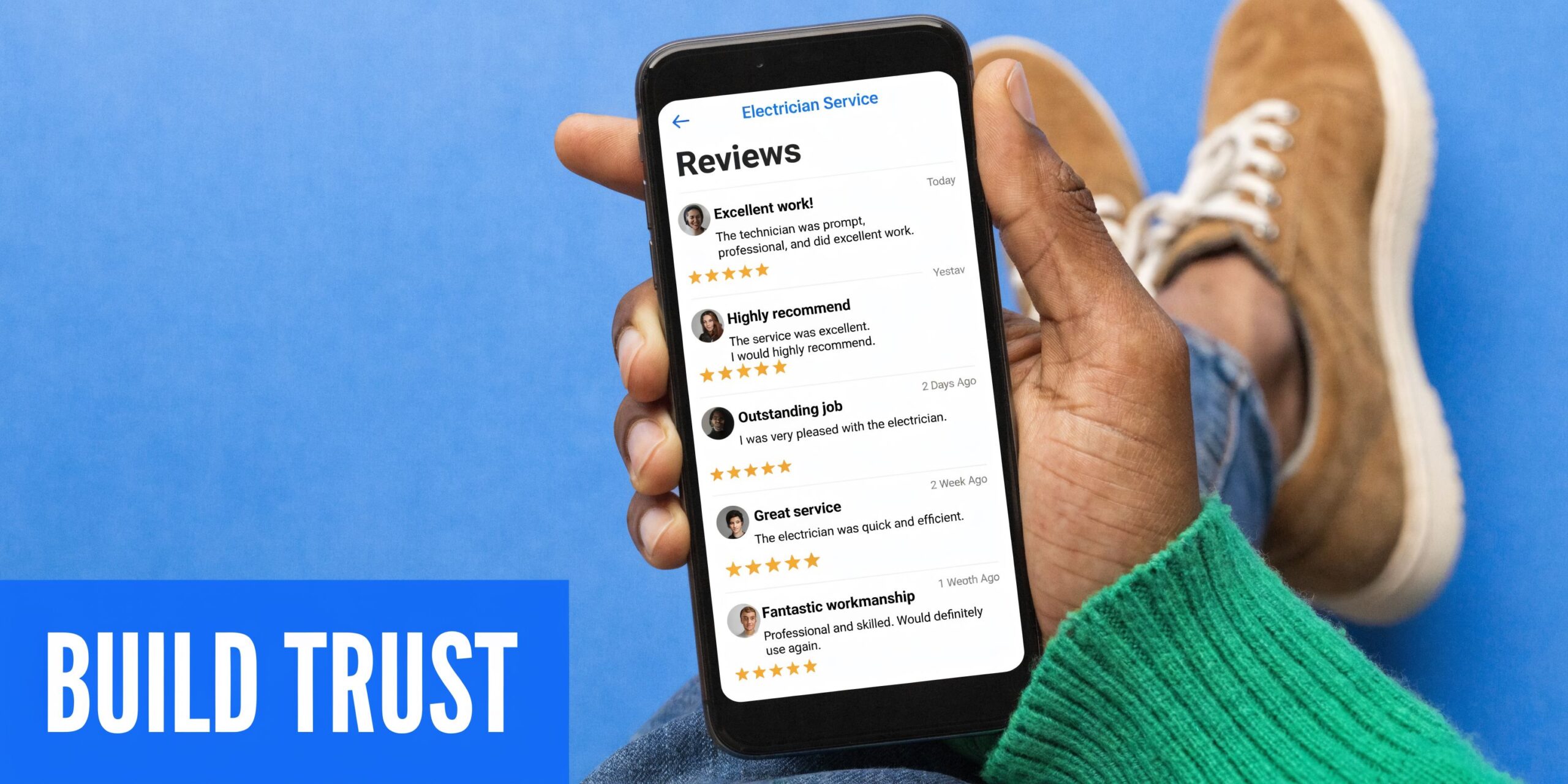
Reviews need a system, not occasional effort
Most electricians ask for reviews when they remember. That creates gaps. A better approach is to make review generation part of the service process.
A simple system looks like this:
- Ask at completion: The technician asks when the customer is satisfied and the fix is fresh.
- Send a direct link: Text or email the review link immediately after the job.
- Mention the service naturally: Customers often include the actual work performed when prompted well.
- Respond to every review: Thank positive reviewers and handle criticism without defensiveness.
Good responses do two things. They reassure future customers and add service relevance back into your brand footprint.
Citations are still foundational
A citation is any mention of your business name, address, and phone number across the web. Think directories, local listings, association sites, and platforms where people validate businesses before calling.
Inconsistent citations cause problems. If one listing has an old phone number, another has an outdated suite number, and another uses a different business name format, trust gets diluted.
That is why citation building for local SEO matters. It is not glamorous work, but it supports map visibility, reinforces location signals, and reduces confusion.
Use citations to find market gaps
Most electricians stop too early here. They claim the obvious directories and call it done.
A stronger approach uses competitor gap analysis. According to Try WebTec’s local SEO guide for electricians, competitor gap analysis can reveal underserved electrical specializations and geographic micro-areas, and intent-specific pages targeting problem-based keywords can convert up to 3x better than generic content.
That matters because citations are not only about consistency. They also reveal where competitors are visible and where they are absent.
Look for gaps like:
- Micro-areas they do not mention
- Specialties they barely cover
- Problem-based terms they ignore
- Directories tied to property management, local trades, or niche service categories
If several competitors mention “electrician” broadly but none has strong coverage for smart home wiring, solar-related electrical work, or EV charger service in a specific suburb, that is an opening.
Tip: Review pages and citation profiles often tell you more about local positioning than a competitor’s homepage does.
What to avoid with reputation work
Do not treat review management like cleanup after a bad month. It should be ongoing.
Avoid these mistakes:
- Asking every customer the same stale way
- Leaving negative reviews unanswered
- Using inconsistent business details across listings
- Building citations without checking NAP accuracy
- Collecting reviews without using them on site pages
Strong local SEO for electricians depends on trust signals stacking together. Reviews, citations, service pages, and your map profile should all tell the same story. Same business. Same areas. Same services. Same quality.
Future-Proofing Your SEO for AI Search
A lot of electricians still optimize as if Google’s blue links are the only place discovery happens. That assumption is getting weaker.
Customers now ask AI-driven platforms the same questions they used to type into standard search. They ask about service quality, safety, local options, and who to hire. If your content is not structured for that environment, you may be invisible in a growing part of the buying journey.
AI search rewards clarity, not vague marketing copy
The pages that perform best in AI-assisted discovery tend to be the pages that answer real questions directly.
According to 33 Mile Radius on SEO for electricians and AI-driven search, optimizing for AI-driven search is a major underserved angle, and structuring content with natural city references and strong review sentiment is key for visibility in AI Overviews and similar platforms.
That changes how local seo for electricians should be written.
Weak copy:
“We pride ourselves on excellence and customer satisfaction.”
Stronger AI-friendly copy:
“We install EV chargers, upgrade electrical panels, repair outlets, and troubleshoot breaker issues for homeowners in specific service areas.”
The second version is easier for systems to parse. It defines services, intent, and geography clearly.
What AI platforms pull from
AI-driven results do not depend on one page alone. They pull from a mix of signals, including:
- Structured service pages
- Google Business Profile details
- Reviews and review sentiment
- Consistent local mentions
- Clear FAQ content
- Business identity signals across the web
That is why AI optimization is not separate from local SEO. It is built on the same foundation, but it favors content that is easier to interpret and quote.
If you want a deeper look at that shift, this resource on AI search engine optimization is a solid next read.
How to format electrician content for AI visibility
Here is the practical part. Write your pages so both humans and machines can understand them quickly.
Use this checklist:
Lead with the answer
Put the direct answer near the top of the section.Use natural city references
Mention service areas where they fit naturally.Break out FAQs
Answer common questions in plain language.Avoid empty adjectives
“Trusted,” “reliable,” and “quality” mean little without specifics.Add schema
Use business and service markup to define what the page is about.Align review themes with service themes
Reviews mentioning actual work types reinforce relevance.
Good topics for AI-era electrician pages
Some content topics work well because customers already phrase them as questions.
Examples:
- Is EV charger installation safe in an older home?
- Why does my breaker keep tripping?
- Do I need a panel upgrade for new appliances?
- Who installs dedicated circuits in my city?
- What should I do if an outlet smells like burning?
These topics are useful because they sit close to purchase intent. They are educational, but they also lead into service decisions.
Key takeaway: Do not write content only for ranking. Write content that can be lifted into an AI answer and still lead a customer to contact you.
The trade-off most electricians miss
If you chase only classic rankings, you stay dependent on one search surface. If you build pages that work in maps, organic search, and AI-driven answers, your visibility becomes more durable.
That is the bigger play. Not more content. Better structured, better localized, more answerable content.
Tracking What Matters Transactional Growth KPIs
Most SEO reporting for service businesses is overloaded with numbers that look impressive and do not help an owner make decisions. For electricians, only a handful of KPIs matter if the goal is booked work from transactional searches.
Start with calls, not vanity metrics
The first question is simple. Did the campaign increase qualified phone calls from people in the right areas asking for the right jobs?
That means tracking:
- Calls from Google Business Profile
- Calls from local service pages
- Form submissions by page
- Rankings for transactional terms
- Service-area performance by city or suburb
- Search queries that show buying intent
Traffic matters only if it leads to calls and jobs. A page can attract visits and still be weak if those visits come from low-intent searches.
Match lead flow to revenue intent
A useful dashboard should help you answer practical questions:
| KPI | Why it matters |
|---|---|
| GBP calls | Shows map visibility is producing contact |
| Form submissions | Confirms page-level conversion |
| Transactional keyword rankings | Measures presence for buyer-intent searches |
| Call quality notes | Separates real leads from junk |
| City-level visibility | Shows where to expand or fix coverage |
Effective call tracking is important for this purpose. You need to know which pages, locations, and search surfaces are producing inquiries.
Watch the handoff after the lead arrives
Marketing can create demand and still underperform if the estimate process is slow or unclear. The businesses that win more often usually tighten both ends of the pipeline. They improve search visibility and they improve how quotes get accepted.
If your team is working on that second part, increase your quote acceptance rate is a practical resource to review alongside lead tracking.
Tip: A ranking report without call data is incomplete. A call report without keyword and page attribution is incomplete too.
The clearest success signal
The best KPI stack is not complicated. Rank for the right terms. Generate calls from the right areas. Track whether those calls turn into real opportunities. Then invest more in the pages, services, and cities that keep producing.
That is how local seo for electricians becomes a growth system instead of a marketing expense.
Frequently Asked Questions About Local SEO for Electricians
Electricians usually ask the same handful of questions before they commit to a local SEO strategy. The answers should be direct.
FAQ on Electrician SEO
| Question | Answer |
|---|---|
| How long does local SEO take for an electrician? | Google Business Profile improvements can begin showing results within a defined window when the profile is fully optimized. As noted earlier, map pack visibility can happen within 30 to 90 days when the profile is complete and aligned with local intent. Website SEO often builds more gradually because service and location pages need time to earn trust and visibility. |
| Should I focus more on my website or my Google Business Profile? | Both matter, but they do different jobs. Your GBP captures urgent map-based demand. Your website supports deeper service coverage, city targeting, and conversion paths. If one is weak, the other carries less weight. |
| Can I do local SEO myself? | You can handle basics such as updating your profile, asking for reviews, and improving business information. The harder part is building the right site architecture, managing citations, adding schema, tracking calls by service area, and creating pages that target transactional searches without duplication. |
| What keywords matter most? | The most valuable terms are transactional ones. Think “electrician near me,” “emergency electrician [city],” “panel upgrade [city],” and other searches that signal the customer is ready to hire. Informational questions matter too when they lead naturally into service pages and FAQs. |
The short version is this. If your phone should be ringing more than it is, the answer is rarely “post more on social media.” It is usually tighter local targeting, better map visibility, stronger service pages, cleaner citations, and content built for both search engines and AI-driven discovery.
If you want help building that system, Transactional LLC specializes in getting local service businesses in front of high-intent, transactional searches that drive real phone calls. Their work combines Google Maps optimization, local SEO, website structure, and AI-focused content so electricians can dominate the service areas that matter most.