

Your phone rings. The lead wants “just a ballpark quote.” They disappear. Another form fill asks if you service a town two counties away. Then a real homeowner in your city searches “roofer near me,” clicks one of the first map listings, and hires someone else.
That's why most roofing marketing feels broken. It chases attention instead of transactional search terms. A transactional search is simple. Someone needs work done now, they're searching locally, and they're close to making a hiring decision. Think “roof repair near me,” “emergency roofer in Dallas,” or “roof replacement in Plano.”
If you want more booked jobs, local SEO for roofing companies has to focus on those searches first. Not vanity traffic. Not random blog clicks. Not “brand awareness” that never turns into inspections, estimates, and signed jobs. And because search is shifting, that same strategy now needs to work for Google, Google Maps, and AI-driven answer engines that summarize local businesses for users before they ever click.
Why Most Roofing SEO Fails to Generate Real Jobs
Most roofing SEO fails because it targets the wrong visitor.
A lot of agencies build traffic reports around broad keywords, fluffy blog content, and generic rankings. That can make a dashboard look busy, but it doesn't reliably put your company in front of homeowners who need a roofer right now. Roofing is a high-urgency service. When someone finds a leak, storm damage, or missing shingles, they don't want a marketing funnel. They want a local company that answers the phone and books the inspection.
That means your entire strategy should revolve around transactional search terms. Terms like “roofer near me,” “roof repair [city],” and “emergency roof repair [city]” signal buying intent. Those searches produce better calls because the homeowner already knows the service they need and is looking for someone nearby.
Traffic isn't the goal
If your SEO campaign sends people to articles they'll never act on, you're paying for noise.
The better play is to align your Google Business Profile, service pages, city pages, and call tracking around the searches that lead to revenue. That's the model we use when we talk about local SEO for roofing companies. Search visibility should create one outcome. More booked jobs.
Practical rule: If a keyword doesn't sound like something a homeowner types when they're ready to hire, it probably belongs behind your money pages, not at the center of your strategy.
A second problem is operational. Roofers often miss calls, route leads badly, or rely on outdated phone setups that create friction when urgency matters. If your office team is upgrading communications, these Modern hosted PBX phone solutions are worth reviewing because fast response matters as much as rankings.
What to fix first
Start with these priorities:
- Own local intent: Build around “service + city” and “near me” searches.
- Tighten lead routing: Make sure calls get answered, tracked, and assigned fast.
- Stop buying fluff: Don't pay for content that never supports estimates or jobs.
- Use a local-first SEO partner: If you need outside help, work with a team focused on search visibility that turns into calls, not vanity metrics. A good starting point is this overview of a local SEO company for service businesses.
AI search is only raising the stakes. If answer engines summarize local options before a click happens, the companies that win will be the ones already structured around clear service intent, local authority, and consistent business data.
Mastering Your Google Business Profile for Map Pack Dominance
For roofing, your Google Business Profile is not a side asset. It's the front line.
One roofing SEO guide notes that appearing in the top three local results can capture 75% of all clicks for high-intent searches, which is why local pack visibility matters so much for roofers dealing with urgent local demand, according to Roofing Webmasters on local SEO for roofers. If you're not competing for the Map Pack, you're giving away the calls that matter most.
Set the profile up like a lead asset
Don't treat your profile like a directory listing. Build it like a sales page inside Google Maps.
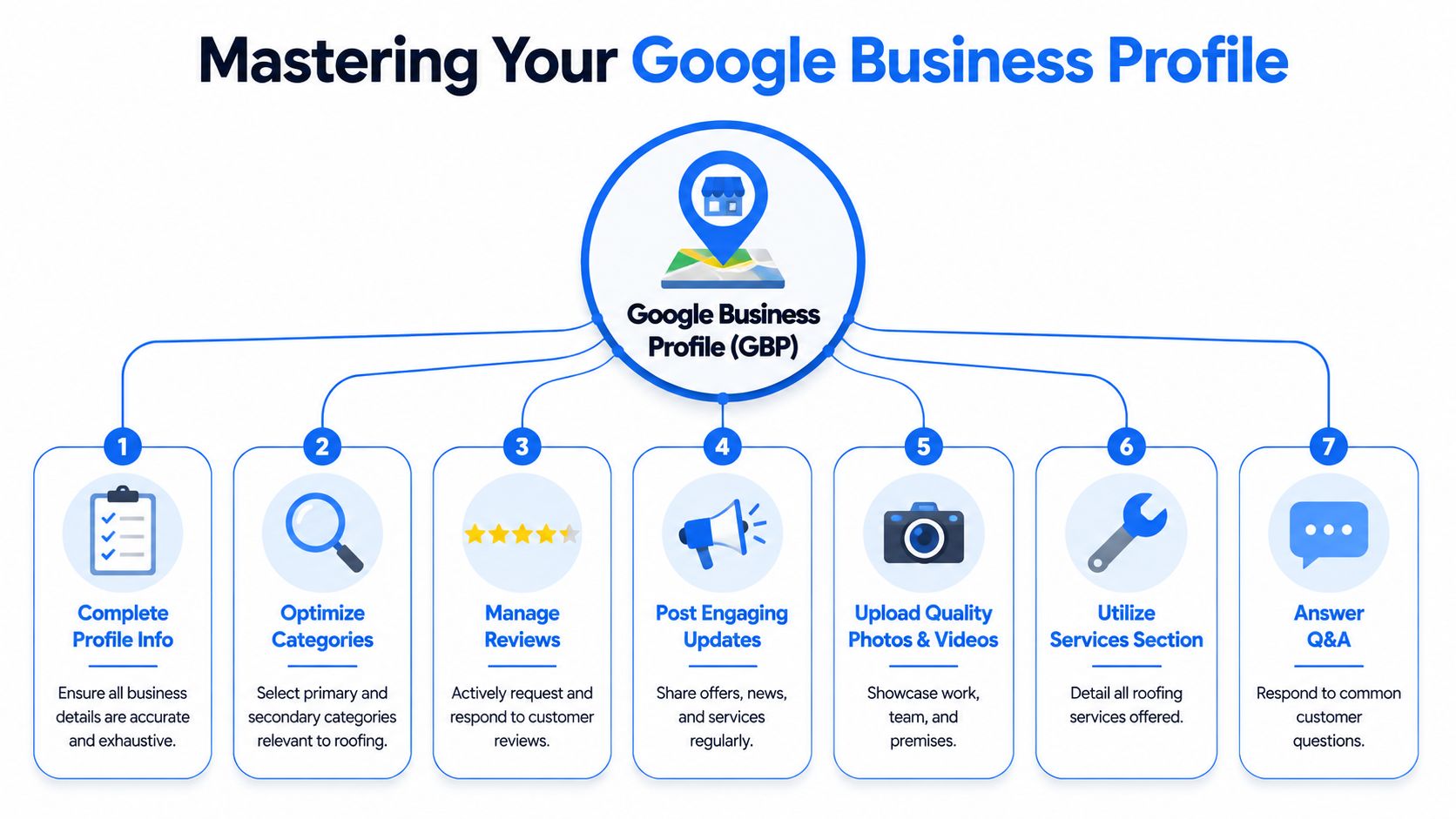
According to roofing-focused local SEO guidance, Map Pack visibility is shaped by relevance, distance, and prominence. That same guidance recommends using “Roofing Contractor” as the primary category, setting a realistic service radius of roughly 20 to 30 miles, defining up to 20 service areas where appropriate, keeping NAP details identical across directories, and maintaining photos, posts, and review activity through your profile, as explained by UpRankd's roofing Google Maps optimization guide.
Use that as your operating standard:
- Claim and verify the profile.
- Set the primary category to Roofing Contractor.
- Add every core service you sell.
- Write service descriptions in plain language.
- Define a realistic service area instead of pretending you cover half the state.
- Upload jobsite photos consistently.
- Ask for reviews after completed work, then reply to them.
What most roofers leave half-done
A stale profile loses ground. Google wants recent signals that show the business is active, trusted, and relevant in the market.
Here's what gets neglected most:
- Photos: Add completed roofs, repair work, crews, trucks, before-and-after shots.
- Posts: Use updates to reinforce service focus and seasonal demand.
- Q&A: Seed common questions and answer them clearly.
- Review responses: Reply like a real company, not a script.
- Service areas: Keep them tight and honest.
Your website can be strong and still lose calls if your profile looks inactive, incomplete, or weak compared to the contractors around you.
If you want a deeper breakdown of field-by-field setup, use this guide on how to optimize a Google Business Profile.
Sample GMB Weekly Post Calendar for Roofers
| Day | Post Type | Content Idea | Call to Action |
|---|---|---|---|
| Monday | Recent Project | Show a completed roof replacement in a target city | Call for an estimate |
| Tuesday | Service Spotlight | Explain emergency roof repair service | Request same-day inspection |
| Wednesday | Review Highlight | Share a recent customer review with job context | Call now |
| Thursday | Seasonal Update | Discuss local storm or weather-related roofing issues | Book an inspection |
| Friday | Team Post | Introduce crew members or project manager | Contact our team |
| Saturday | FAQ Post | Answer a common homeowner roofing question | Send a message |
| Sunday | Photo Update | Upload fresh project images with city relevance | View services |
A simple posting standard that works
You don't need clever campaigns. You need repetition.
Post around real jobs, real service areas, real homeowner questions, and real proof that your company is active in the market. That's how local SEO for roofing companies turns a profile into a call generator instead of a forgotten listing.
Designing a Website That Converts Local Searches
Your Google Business Profile can win the click. Your website has to win the call.
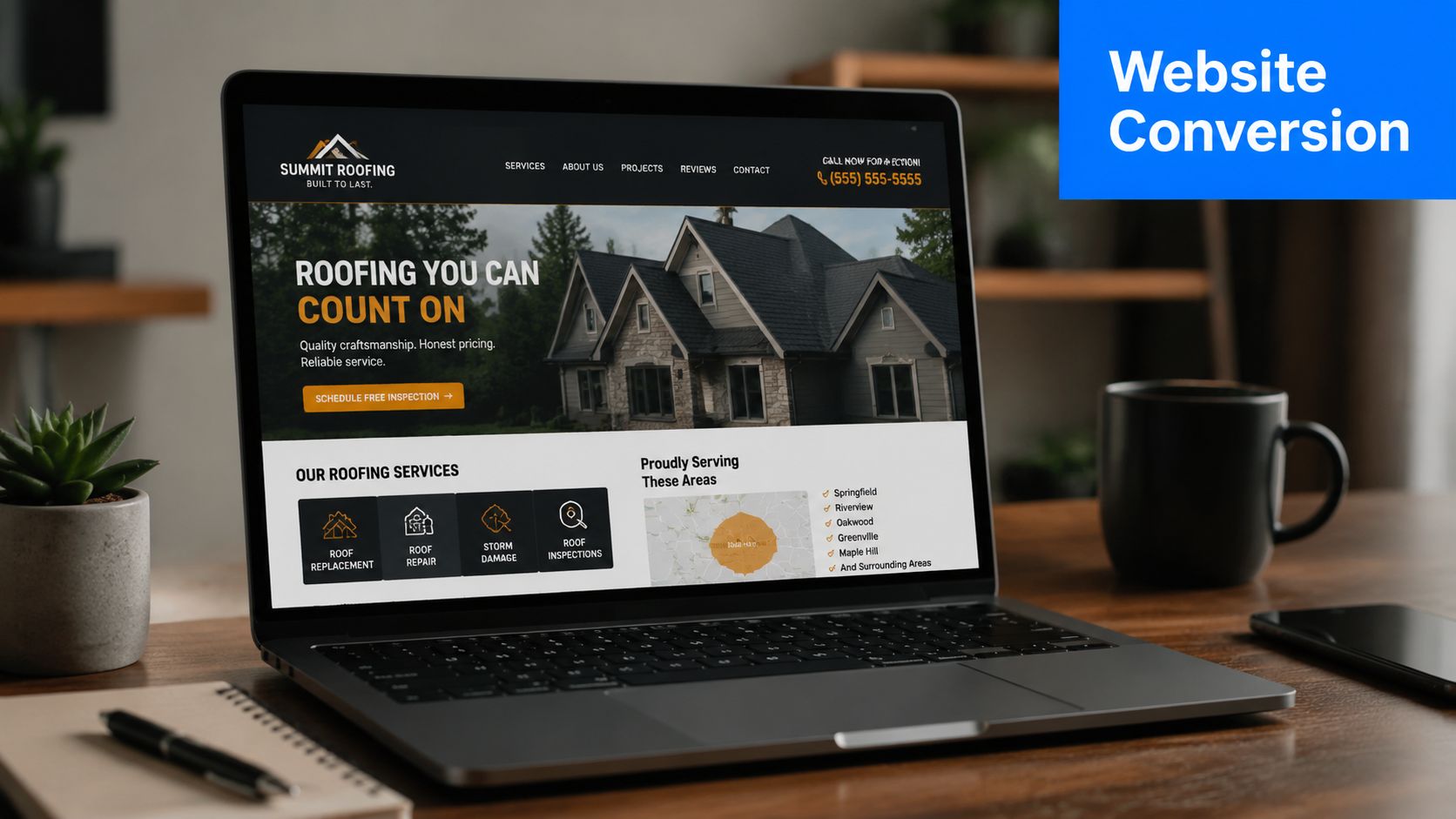
A lot of roofing sites fail because they're built like brochures. Nice photos. Vague copy. One generic services page. A few stock claims. That setup doesn't match the way homeowners search, and it doesn't give Google clear landing pages for transactional queries.
Build the site like a service area machine
A practical workflow for local SEO for roofing companies is to create a hierarchical structure with a core /services/ hub, then separate pages for each roofing service and each major city or service area. That structure helps you map queries like “roof repair in [City]” to dedicated pages and avoid diluting intent across a single generic page, as outlined by Portland SEO Growth's roofing SEO architecture guide.
That means your site should look more like this:
- Homepage for your core market and brand
- Services hub that links to each major roofing service
- Individual service pages for repair, replacement, storm damage, inspections, and specialty systems
- City pages for each market you actively serve
- Service plus city combinations where demand justifies a dedicated page
Thin location pages are a waste
Google doesn't need twenty copies of the same page with city names swapped out. Homeowners don't either.
A strong city page includes local proof:
- Local project photos: Show roofs you completed in that market
- Area-specific details: Mention neighborhood types, local storm patterns, or roof issues common there
- Testimonials from that city: Use real customer language tied to that area
- Service relevance: Explain what you do there, not just where you go
- Internal links: Connect the city page back to the matching service pages
If you need a model for building pages that sell jobs instead of taking up server space, review this approach to website design for roofers.
What a high-converting roofing page needs
A money page should answer the homeowner's first questions fast. What service do you offer? Where do you offer it? Why should they trust you? How do they contact you right now?
Use this framework:
- Clear headline with the service and city.
- Short intro that speaks to the local problem.
- Proof section with photos, reviews, or job examples.
- Process section so the homeowner knows what happens next.
- Strong call button and phone CTA above the fold and again lower on the page.
A walkthrough helps if you're redesigning from scratch:
Field note: Your best pages usually aren't the prettiest ones. They're the ones that match a specific search, prove local credibility, and make it easy to call.
That's the blueprint. One page per real service. One page per real market. No filler.
Creating Content That Captures Transactional Roofing Leads
Most roofing content is built backward. It starts with topics someone thinks are “good for SEO” and ends with a weak internal link to the pages that make money.
Do the opposite. Start with transactional intent, then create content that supports it.
A roofing SEO guide from a home-services platform points out that local search behavior has shifted toward tightly mapped terms like “roof repair + city,” “roof replacement + city,” and “roofing inspection + neighborhood,” backed by citations and reviews instead of broad targeting around generic terms, as described in ServiceTitan's roofing SEO guide. That's exactly how you should build your content map.
Start with pages that can close business
Your first content priority is not blogging. It's publishing pages tied to services people buy.
That includes:
- Core service pages: Roof repair, roof replacement, emergency service, storm damage, inspections
- City pages: Major towns and neighborhoods you actively cover
- Problem pages: Leaking roof repair, missing shingles, storm response, insurance-related inspections
- Commercial or specialty pages: If you sell them, they deserve their own pages
After those are live, create supporting content that helps those pages rank and convert.
Write for Google and AI systems at the same time
AI optimization isn't some separate marketing channel. It's good SEO with clearer structure.
If an AI assistant is trying to answer “Who handles storm damage roof repair near me?” it needs content that is easy to parse. That means:
- Direct headings: “Storm Damage Roof Repair in [City]”
- Short answers under each question
- FAQ blocks written in plain English
- Clear service descriptions without fluff
- Location signals throughout the page
- Consistent business details across your site and profiles
AI systems favor content that gives clean answers and obvious entity signals. Google likes that too. So do human buyers.
If a page rambles, hides the answer, or tries to sound clever, it's harder for search engines, AI tools, and homeowners to trust it.
A useful reference for that writing style is this guide on how to write SEO content.
A content formula that actually helps sales
Use this order on your service and city pages:
- State the service and area immediately.
- Explain the local problem in one short paragraph.
- Describe your process.
- Add proof from real jobs.
- Answer common objections.
- Tell the visitor what to do next.
For blog and support content, keep it practical. “What to do after hail damage in [City].” “How fast should you fix a roof leak.” “What a roofing inspection includes before insurance review.” Those aren't vanity topics. They sit close to intent and help your money pages gain relevance.
What to stop publishing
Don't waste time on generic content that has no path to a sale.
Skip content like:
- Broad roofing history articles
- National trend pieces with no local angle
- General homeowner advice disconnected from your services
- AI-generated filler stuffed with keywords
The best local SEO for roofing companies doesn't publish more. It publishes tighter. Every piece should strengthen your presence for the searches that turn into calls, inspections, and jobs.
Building the Local Trust Signals Google Demands
You can have strong pages and a polished profile and still lose if Google doesn't trust your business enough to surface it aggressively.
That trust shows up in off-page signals. Reviews. Citation consistency. Local backlinks. Community proof. These aren't optional cleanup tasks. They're ranking factors tied directly to prominence.
Reviews need a system, not good intentions
Most roofers ask for reviews when someone remembers. That's too random.
Build the request into your closeout process. The production manager marks the job complete. The office sends the review request the same day. If the customer replies positively, send the direct review link. If they don't respond, follow up once.
Use simple language.
“Thanks for choosing us for your roofing project. If you can spare a minute, we'd appreciate a Google review about your experience with our crew and communication.”
Then answer every review. Mention the service and city naturally when it fits. Don't keyword stuff. Just sound like a company that did the work and cares about the customer.
Citation consistency is basic, but it matters
Google gets suspicious when your business details vary from site to site.
Audit your business name, address, phone number, website URL, and service-area setup across your key listings. Keep them identical. Fix old numbers. Remove bad duplicates. Make sure your categories and descriptions line up with the work you perform.
Prioritize:
- Google Business Profile
- Major business directories
- Relevant local directories
- Industry and contractor listings
- Supplier or association profiles
Local links separate real companies from thin web listings
A local backlink tells Google your business exists in the community beyond its own website.
The easiest wins are often offline relationships turned into online mentions:
- Suppliers and manufacturers: Ask for contractor profile links where available.
- Community sponsorships: Youth sports, school events, or neighborhood projects often list sponsors.
- Trade groups and chambers: Membership pages can strengthen local trust.
- Referral partners: Realtors, restoration companies, and related trades can create local relevance when the relationship is legitimate.
If you're tightening your business credibility overall, make sure your risk management is in order too. Homeowners and commercial clients often check for proper coverage, and this guide to roofer general liability coverage is a practical reference.
A clean local trust stack matters for AI visibility too. Answer engines pull from the same web signals that help Google decide whether your business is established, consistent, and worth recommending.
The Future of Roofing Leads AI Optimization and Tracking
Search is changing, but the winners won't be random.
The roofing companies that show up in AI-generated answers will usually be the same companies that already did the boring work right. Clean site structure. Clear service pages. complete business data. Active reviews. Strong local relevance. AI optimization is mostly the result of disciplined local SEO for roofing companies, not a magic trick layered on top.
What AI systems need from your business
Large language models and AI search features don't browse your site like a human buyer. They extract, compare, summarize, and recommend.
That means your business has to be easy to understand:
- Service clarity: Separate roof repair, replacement, inspections, and storm work
- Location clarity: Make service areas obvious and consistent
- Entity consistency: Keep your business information aligned across the web
- Answer-ready content: Use short, direct explanations and FAQ formatting
- Proof signals: Reviews, local mentions, project photos, and page-level trust elements
If your site is vague, duplicated, or thin, AI systems have less confidence in it. If your site is structured and specific, it becomes easier for those systems to cite or summarize.
Track the signals that matter
Most roofers don't need more reports. They need the right scoreboard.
Track these items every month:
| KPI | Why it matters |
|---|---|
| Map Pack rankings by city | Shows whether you're visible where buyers search |
| Google Business Profile calls and direction requests | Measures action from local map visibility |
| Rankings for transactional terms | Keeps focus on buying-intent keywords |
| Organic landing pages by service and city | Reveals which pages attract local demand |
| Form submissions and phone calls | Ties search visibility to lead flow |
| Lead-to-job conversion rate | Tells you whether the right leads are coming in |
The point isn't to admire charts. The point is to identify which markets, services, and pages are producing booked work.
Use a dashboard, not guesswork
A proper local SEO operation should let you see movement by service area, keyword group, and lead source. Transactional LLC is one example of a provider that offers local SEO, Google Maps optimization, AI-driven content planning, and dashboard reporting for service businesses. That kind of visibility matters because you need to know whether “roof repair in [city]” is climbing, whether map rankings are improving, and whether those gains are turning into calls.
SEO without tracking turns into storytelling. Tracking forces decisions.
When AI search grows, the companies with the cleanest data and clearest proof will have an advantage. Not because AI is mysterious. Because machines reward structure.
Your Top Local SEO Roofing Questions Answered
Roofers usually ask the same hard questions once they stop chasing gimmicks and start taking local SEO seriously. Here are the straight answers.
How can a newer roofing company compete without many reviews
A common gap in roofing SEO advice is how a smaller roofer can compete when established companies already have stronger review volume and brand signals. The more useful strategy is to lean harder into tightly matched service plus city pages and specific local intent, rather than trying to out-publish everyone with generic blog content, as discussed in Cider House Media's roofing SEO guide.
That means you narrow the fight.
Instead of trying to rank everywhere for “roofing company,” build pages around the services you can sell and the markets you can serve well. Go after emergency repair in a smaller cluster of cities. Go after storm damage inspections in neighborhoods where your crews already work. Go narrow, build proof, collect reviews, then expand.
Should I use a P.O. Box or home address for my Google Business Profile
Use your real business setup. Don't invent an office you don't have.
If you run a service-area business, configure it that way and keep your information consistent across the web. Fake locations create long-term problems. Google gets better at spotting them, and customers don't like surprises when they realize the listing isn't real.
Is it better to create more blog posts or more location pages
For most roofing companies, more location and service pages win first.
If you don't already have dedicated pages for your key services and core markets, that is the priority. Blog content helps when it supports those pages, answers buyer questions, and reinforces local expertise. But generic blogging won't replace missing service-intent landing pages.
A simple rule works:
- Missing money pages: Build those first
- Weak local coverage: Expand city pages next
- Need support topics: Add FAQs and blog content after the core structure is in place
How long does local SEO for roofing companies take
It takes as long as it takes to build relevance, trust, and visibility in your market.
Some improvements happen fast. A cleaned-up profile, stronger service pages, and better review collection can move the needle early. Competitive cities take longer. New domains take longer. Weak websites take longer. The mistake is expecting rankings without doing the foundational work thoroughly.
What should I focus on first if my budget is tight
Start with the assets closest to revenue:
- Google Business Profile cleanup
- Core service pages
- Top city pages
- Review request system
- Citation cleanup
- Call tracking and lead attribution
That order gives you the best shot at capturing transactional searches without spreading your effort too thin.
Does AI optimization change the fundamentals
No. It rewards the fundamentals.
AI search still needs clear business information, location relevance, strong service pages, and trusted signals from around the web. If your local SEO for roofing companies is sloppy, AI won't save it. If your local SEO is structured and specific, AI can amplify it.
What's the biggest mistake roofing companies make
They go too broad.
They target giant generic terms, build weak pages, ignore their profile, and hope volume solves quality. It doesn't. Roofing SEO works when it's built around transactional search terms, local service intent, and fast conversion paths.
If you want help building a roofing SEO system that targets transactional searches, strengthens Google Maps visibility, and supports AI-driven discovery, talk to Transactional LLC. They work with service businesses on local SEO, Google Business Profile optimization, website structure, content systems, and reporting built around one outcome: turning searches into booked jobs.