


You're probably already in the loop that feels familiar, the phone rings less than it should, a competitor keeps showing up for “roofer near me” or “dentist near me,” and every month you're asked to spend more on marketing without a clear path to booked jobs. That's usually the moment owners realize SEO isn't a vanity project, it's a compounding revenue channel that has to be built around buyers who are ready to act, not just people browsing for information.
For local service businesses, a long-term SEO strategy has to start with transactional intent. Organic search is still the largest website-traffic channel, and BrightEdge data is widely cited as showing it drives 53.3% of all website traffic, while Google still holds about 89.85% of global search traffic in 2025 to 2026, so most discovery still happens inside one dominant system (Apollo Technical SEO statistics). That's why ranking gains matter so much, and why chasing a few broad keywords is usually a bad trade when 94.74% of keywords have monthly search volumes of 10 or less and only 0.0008% exceed 100,000 monthly searches (Apollo Technical SEO statistics). The money is in the long tail, in local landing pages, content silos, and map visibility that capture people already holding the budget.
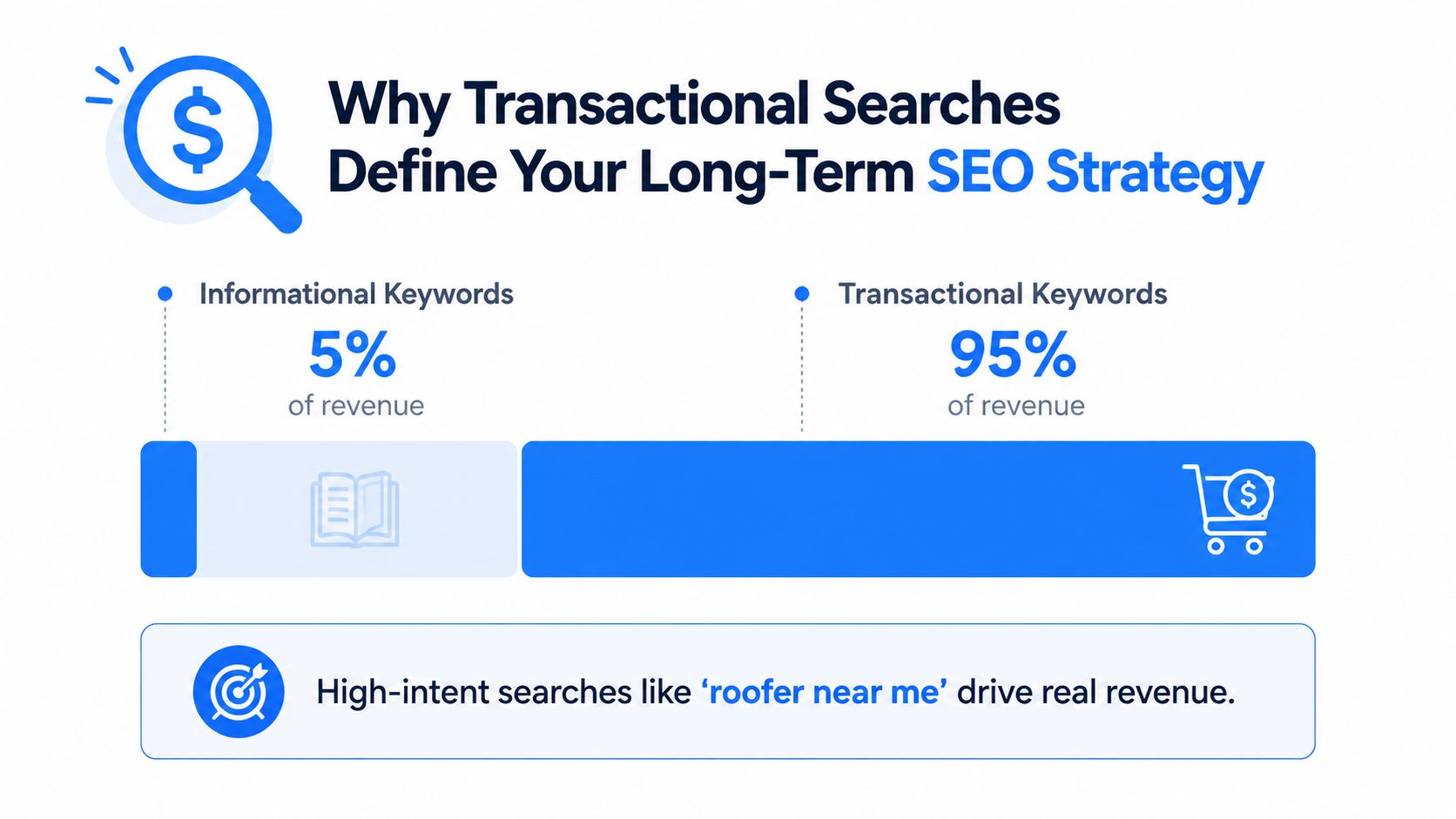
Why Transactional Searches Define Your Long-Term SEO Strategy
The owner who is frustrated today usually has the same problem I have seen across roofing, HVAC, pest control, and dental accounts. They spent money on blog posts that answered general questions, but the calls kept going to the competitor that owned the near me searches. That is not a content problem in the abstract, it is a search-intent problem.
Buyers search differently than browsers
A search like “roof leak repair Austin” or “orthodontist near me” is not casual research. It comes from someone who already knows the service they want and is comparing who can take the job or appointment. That is why Transactional Marketing is built around transactional search terms, the queries where money is already in motion, and why a guide to transactional search terms belongs in the planning phase, not buried after the fact.
Practical rule: if a keyword can lead directly to a call, form fill, or booking, it belongs near the center of your SEO plan, not as an afterthought.
Long-term SEO works when you stop thinking in terms of isolated posts and start thinking in terms of demand capture. Broad evergreen pages can support the funnel, but they do not usually close the gap on “roofer near me” or “air conditioning repair near me.” The pages that move revenue are the ones tied to service intent, city intent, and local map behavior.
Why specificity wins in keyword targeting
The long tail is the actual playing field. As noted in Apollo Technical SEO statistics, when 94.74% of keywords have monthly search volumes of 10 or less and only 0.0008% exceed 100,000 monthly searches, the winning strategy is coverage, not obsession with head terms. That is why one strong content silo around a service and city combination can outperform a generic article that never matches commercial intent (Apollo Technical SEO statistics).
For service businesses, this changes budget priorities. A few polished informational articles will not beat a structure built around local landing pages, Google Maps visibility, and high-intent search terms that mirror how real customers type. Search engine optimization becomes a compounding asset when every page supports a clear business goal, not just pageviews.
Auditing Your Current Local Search Presence
Before building anything new, start with a clean read on what is already holding performance back. I've seen HVAC and dental sites with decent content still miss page one because crawling was broken, location pages were duplicated, or the Google Business Profile was only half set up. An audit finds those leaks before more budget goes into traffic acquisition.
Start with technical and indexation basics
The first pass is technical. Check whether important pages are crawlable, indexable, and internally linked from places Google can reach. If a city page or service page is not in the index, new blog content will not fix the problem.
Use a full site review, then revisit pages that have lost traffic on a quarterly cadence, roughly every 90 days. If you are moving platforms or redesigning, keep the 10-step migration checklist open during the audit so rankings do not slip during the transition.
Search problems usually hide in plain sight, especially on service sites with old templates, duplicate pages, or thin location copy.
Review the local signals that matter
Google Business Profile deserves its own review. Check completeness, categories, service descriptions, attributes, photos, hours, and the way reviews are being earned and answered. Compare your map visibility to the businesses that already dominate the service area, because local search follows a different ranking model than standard organic results. A useful internal benchmark is the Google Business Profile audit, especially if multiple locations share one brand.
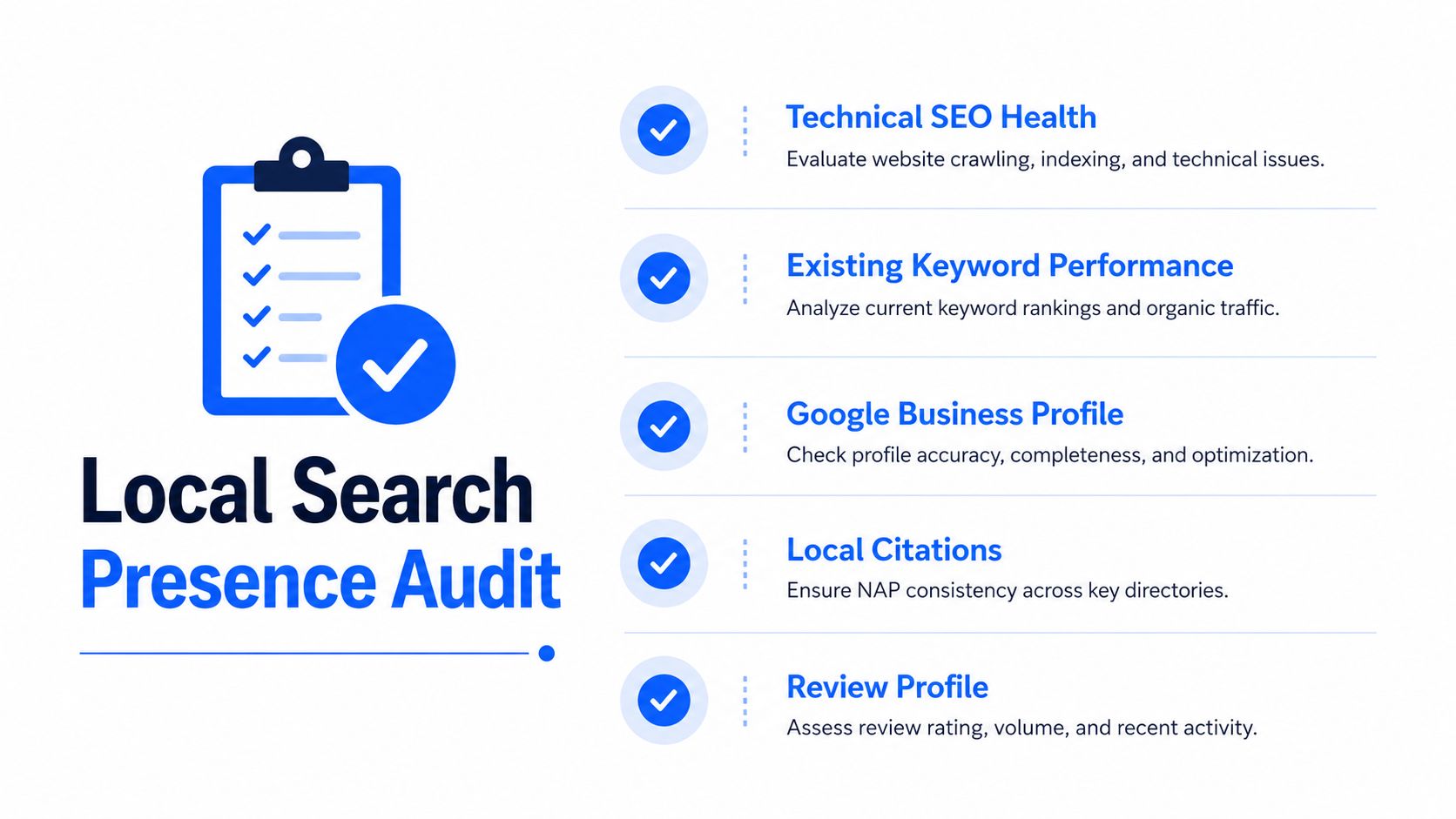
For service-area brands, I look at five things first:
- Technical SEO health. Are crawling and indexing blocked anywhere important?
- Existing keyword performance. Which transactional terms are already close to page one?
- Google Business Profile completeness. Does the profile support the service and city mix?
- Citation consistency. Do the business name, address, and phone stay aligned across listings?
- Review profile quality. Does the profile have enough relevance signals to compete locally?
A backlink profile review belongs here too. You do not need a large pile of links, but you do need links that support local relevance and authority instead of random junk. If a site is preparing a platform change, location-page rebuild, or redesign, the 10-step migration checklist helps protect the equity already in place.
Video walkthrough for a hands-on perspective.
A strong audit is about protecting what already works before adding more pages, more links, or more spend.
Building Content Silos for City and Service Targeting
Random blog posts don't create durable local visibility. A site built around content silos does, because it teaches search engines which services, cities, and intent patterns belong together. That structure matters even more for service businesses that need to rank for specific jobs, not generic education.
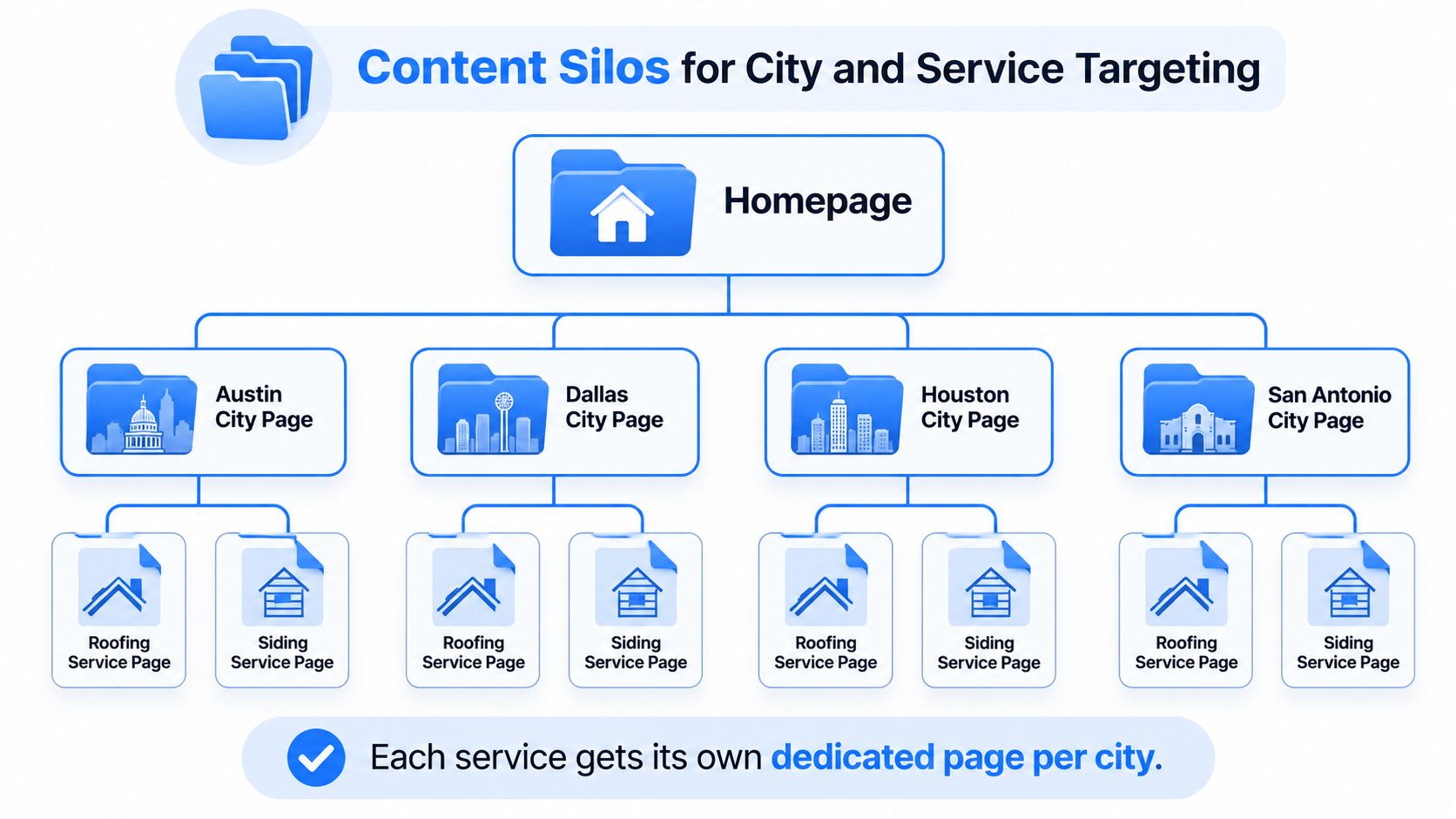
Separate by service, then by city
A roofing company shouldn't cram every topic into one blog. It needs distinct pages for roof repair, roof replacement, emergency leak repair, and then city-specific versions where demand and competition justify them. A dental practice needs the same discipline, because SEO services and marketing for a dental business should stand alone from the roofing version of the topic.
An HVAC example makes the structure obvious. Air conditioning repair in Austin deserves its own page cluster, and furnace installation in Round Rock deserves another. Those pages should link back to a service hub, then out to related supporting content, so the site reads like a map of the business instead of a pile of disconnected articles.
Avoid duplication and cannibalization
Thin city pages are one of the fastest ways to waste crawl budget and confuse relevance. If every location page says the same thing with the city name swapped out, Google has no reason to treat them as distinct. Recent guidance around entity-based optimization and topical authority mapping points in the right direction, because the goal is topical completeness, not page count (Dot It SEO strategy guidance).
Practical rule: every city page should answer a different local question, mention a different proof point, or support a different service scenario.
That's also where internal linking becomes a ranking signal, not just a navigation feature. Pages for roofing, siding, and gutters should point to the right city hubs and service pages, while the supporting articles reinforce the same local theme. If the architecture is tight, the site can rank for many low-volume transactional searches without stuffing keywords or creating cannibalization.
For operators using AI-assisted workflows, the discipline matters even more. Google's quality guidance has become less forgiving toward scaled content that exists mainly to manipulate rankings, so the page needs real value, local specificity, and originality. A silo built around one service in one city is far safer and far more useful than a template farm.
Mastering Google Maps and Business Profile Rankings
For local service businesses, the map pack is where the calls usually happen first. A homeowner searching “roofer near me” or “dentist near me” rarely wants ten tabs and a research project, they want the closest credible option that looks available now. That's why Google Business Profile work deserves the same strategic attention as on-site SEO.
Relevance, distance, and prominence drive the map pack
Google's local ranking model comes down to relevance, distance, and prominence. Relevance is how well the listing matches the search, distance is how far the business is from the searcher or the place named in the query, and prominence reflects how well known the business is online and offline (Google local ranking factors overview). You can't pay to improve local ranking, so the work is about alignment, completeness, and authority, not ad spend alone.
That means categories, services, attributes, and descriptions need to match the transactional searches you want. A profile for an air conditioning company should clearly support repair, replacement, and emergency work, not just a generic “contractor” label. Photos, service updates, and review responses all add confidence, especially when they reinforce the service area and the exact jobs the company wants.
Build prominence with proof, not noise
Prominence is where many businesses get lazy. They ask for a few reviews, collect some citations, and stop. The profiles that hold top visibility usually have a steadier pattern, better relevance signals, and stronger engagement from real customers.
I've also seen local businesses underinvest in the listing itself while spending too much on broad content. That's backwards. The map pack can outperform a blog archive for revenue because it connects the searcher to a call or directions instantly. For service-area businesses, the better move is to match Google Business Profile optimization with city-level content, then keep both updated so the local signal stays coherent.
If you want a practical reference on the ranking mechanics, the Google Maps ranking factors page is a useful companion. The point isn't just to appear on the map, it's to stay there in a way that turns searches into booked work.
Adapting to AI Overviews and Zero-Click Search Shifts
The old assumption was simple, rank high, earn the click, get the lead. That assumption is getting weaker for informational queries because AI Overviews and other zero-click experiences can satisfy the searcher before they ever visit a site. A 2025 Ahrefs study found that AI Overviews can significantly reduce clicks to traditional organic results, especially on informational searches, which changes the playbook for long-term visibility (Underrated long-term SEO elements in the AI era).
AI optimization now sits beside classic SEO
AI optimization is no longer a side topic. Businesses need to think about how they're represented inside LLM-driven answers, citations, and answer summaries, not just where they sit on the blue links. That doesn't replace SEO, it extends it into brand visibility, entity clarity, and citation-worthy content.
Transactional searches still hold up better because they usually need live local data. Someone looking for a plumber, dentist, or roofer near them still needs a nearby option, a phone number, and a real business profile. That's why local authority, entity consistency, and strong map signals matter so much, they anchor the search journey in a way that AI summaries can't fully flatten.
AI content still has to be useful
Google's spam policies now explicitly address scaled content abuse, site reputation abuse, and expired domain abuse, and it treats AI-generated or scaled content as low-value when it's mainly built to manipulate rankings (Google spam policy update coverage). That means AI-assisted publishing can help, but only when the content adds genuine value and stays tightly focused on the service and the search intent.
Practical rule: if an AI draft wouldn't help a customer choose, compare, or book, it doesn't belong on the site yet.
For local businesses, the safest path is clear. Use AI to speed up research, outline service-city content, and maintain freshness, then keep a human operator on the page for local accuracy, proof, and conversion focus. That approach protects compounding traffic while giving the business a better chance of being cited, summarized, and trusted across search surfaces.
Your 12-to-24-Month Roadmap With KPIs and Milestones
A real long-term SEO strategy needs a timeline, or it turns into a wish list. A new site usually needs time to build meaningful organic traction, and competitive local niches often need even longer before rankings feel stable. The businesses that win treat that wait as part of the plan and keep funding the work while the curve builds.
The first phase is technical cleanup, content architecture, and map-profile alignment. Pages need to be indexed properly, location and service pages need clear separation, and the Google Business Profile needs to reflect the actual offer. The content calendar should also be built around service-city combinations, not random topics that look busy but do nothing for transaction intent.
At this stage, I watch three KPI groups, indexed pages, transactional keyword movement, and map visibility in the target service area. The goal is not perfection yet. It is proving that the site can be crawled, understood, and connected to the right local intent.
Content expansion and link acquisition start to compound after the foundation is in place. Sustained investment can produce strong organic gains over time, based on seoplus+ campaign results across 2015 to 2023 (seoplus+ long-term SEO case study). That kind of growth does not come from one page or one campaign. It comes from a system that keeps adding useful service, city, and trust signals.
CTR is a useful reality check. WebFX's benchmark data shows position 1 captures about 27.6% average organic CTR, while position 2 captures about 15 to 18% and position 3 about 10 to 12%, with steep drops after the top three. In practice, that means the target is not page one by itself. The target is the top three, and the discipline to defend them.
By this stage, the site should have enough topical depth and local proof to hold rankings more reliably. The work shifts away from adding pages for volume and toward refreshes, internal-link tightening, and reputation building. A transparent dashboard matters here, because owners should see keyword timelines by city, map rankings, Search Console queries, and actual lead data.
For measurement, a simple internal reference like how to measure marketing effectiveness keeps the focus on business outcomes instead of vanity metrics. If the team cannot tie rankings to calls, forms, and booked appointments, the strategy is not complete yet.
A roofing client can rank on page one and still lose if the calls do not come through. I have seen the same thing in dental and pest control, good visibility without enough conversion intent behind it. The businesses that grow steadily connect the ranking work to the front desk, the dispatch board, or the appointment calendar.
Transactional searches are what make the roadmap pay off. A search for a plumber, dentist, or roofer near me only matters if the site, the map profile, and the service pages are ready to turn that query into a call or booking. If you want a cross-check on how service businesses can grow patient volume, the guide on how to grow your medical practice is a good reminder that visibility only matters when it feeds the pipeline. The same principle applies to home services, a search result is valuable only when it turns into a real customer.
Turning Search Visibility Into Booked Jobs and Patients
One roofing client can rank on page one and still lose if the calls don't come through. I've seen the same thing in dental and pest control, good visibility without enough conversion intent behind it. The businesses that grow steadily are the ones that connect the ranking work to the front desk, the dispatch board, or the appointment calendar.
A simple operating model works best. Audit the site, build the service and city silos, dominate the map profile, keep the pages fresh, and adapt the content for AI-driven search shifts. Then measure the stuff that pays the bills, phone calls, forms, booked jobs, and scheduled patients, not just impressions.
If you want a cross-check on how service businesses can grow patient volume, the guide on how to grow your medical practice is a good reminder that visibility only matters when it feeds the pipeline. The same principle applies to home services, a search result is valuable only when it turns into a real customer.
Transactional LLC builds contract-free local SEO systems for service businesses that need more than traffic. If you're trying to win transactional search terms, rank in Google Maps, and turn local searches into calls and appointments, visit Transactional LLC and see how the process fits your market.