


If you're running a landscaping company right now, you're probably dealing with the same problem most owners face. You do good work, you have trucks on the road, you have some referrals, and yet the phone still isn't ringing enough from the exact neighborhoods and services you want.
That usually happens because your marketing is too broad.
Significant revenue in marketing for outdoor services doesn't come from vague brand awareness. It comes from showing up when a homeowner is actively searching for a service they want to buy right now. Terms like lawn care near me, outdoor designer in [city], retaining wall contractor near me, and spring cleanup service near me are transactional searches. Those are the searches that matter because the buyer already has intent.
Generic marketing misses that intent. A focused SEO and AI optimization system captures it.
The Foundation for Local Market Dominance
Landscaping is not a small, sleepy category anymore. IBISWorld projects the U.S. landscaping services industry at $188.8 billion in 2026 with about 693,000 businesses (IBISWorld landscaping industry data). That's why weak positioning gets buried. You're not just competing with the company across town. You're competing with a crowded field of businesses offering the same core services.
Transactional searches are the only searches worth obsessing over
A landscaping business should build its marketing around searches that signal buying intent. Not curiosity. Not casual browsing. Buying intent.
Examples include:
- Maintenance intent: lawn mowing near me, weekly lawn service in [city], yard cleanup near me
- Project intent: patio installer in [city], retaining wall contractor near me, sod installation [city]
- Urgency intent: sprinkler repair near me, drainage fix for yard [city], fall cleanup service near me
These searches convert because the person searching already knows what they need. They aren't asking for landscaping inspiration. They're trying to hire someone.
That's the core shift. Stop trying to be visible for everything. Start trying to own the searches tied to booked jobs.
Why old-school landscaping marketing breaks down
A lot of outdoor service professionals still market like it's a referral-only business. They rely on yard signs, a basic website, and maybe a few Facebook posts. That approach can keep a small company alive, but it won't help you dominate your service area.
You need an acquisition system that matches how people buy now. A helpful outside example is this actionable digital marketing playbook, which lays out how local businesses move from scattered tactics to a structured visibility system. That applies directly to landscaping because buyers now compare map results, reviews, service pages, and project proof before they call.
Practical rule: If your marketing doesn't target a service plus a location plus a buyer-ready phrase, it's probably too soft.
What AI optimization actually means for landscapers
AI optimization isn't some futuristic gimmick. It means structuring your business information, service pages, images, reviews, and location signals so search systems can easily understand what you do, where you do it, and why you're a credible answer.
For a landscaper, that means:
- Clear service definitions on the site and business profiles
- Dedicated pages for each core service and service area
- Real project proof with labeled photos, captions, and context
- Consistent business data across your website and listings
- Review language that reinforces your actual services and locations
AI-powered search tools and LLM-driven search experiences don't reward vague websites. They favor businesses that are easy to classify and easy to trust.
Here's the simplest way to think about it.
| Weak presence | Strong presence |
|---|---|
| One generic services page | One page per service |
| City-wide messaging only | Neighborhood and service-area relevance |
| Random project photos | Labeled galleries tied to specific services |
| Generic homepage copy | Transactional language tied to buyer intent |
| Passive online footprint | Structured content built for search interpretation |
If you want a deeper tactical breakdown of service-page and local SEO structure, this guide on SEO for landscapers is a useful reference point.
The companies that win local search don't just look professional. They look like the most relevant answer for a specific job in a specific place.
Winning the 'Near Me' Battle on Google Maps
For most grounds care companies, Google Maps matters more than the homepage. When someone searches grounds care specialist near me or lawn care near me, the map pack is often where the call happens.
That means your Google Business Profile can't be treated like a listing you set up once and forget.
A good companion resource on this broader topic is effective local SEO for small business owners, especially if you want a practical reminder that local visibility is built from relevance, trust, and consistency, not guesswork.
Start with a visual checklist.
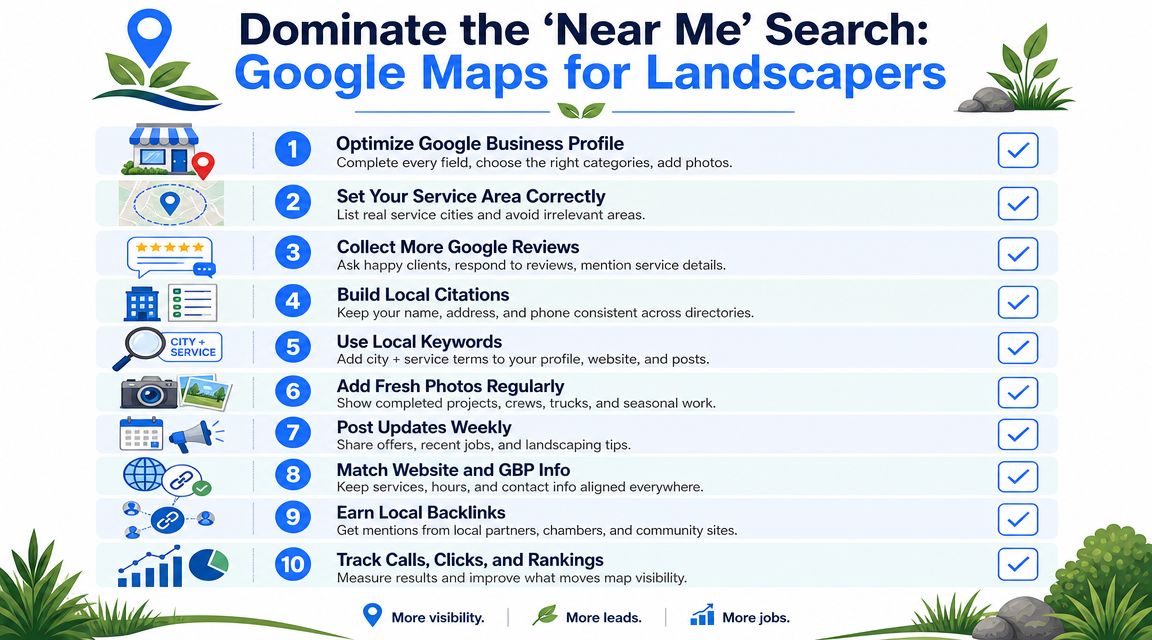
Build a Google Business Profile that can rank
Your profile needs to tell Google exactly what you do and exactly where you do it.
Use this checklist:
- Primary category first: Choose the category that best matches your main revenue driver.
- Service list depth: Add specific services, not just broad categories. Lawn maintenance, sod installation, retaining walls, drainage solutions, mulch installation, irrigation repair.
- Service areas that reflect reality: Don't spread yourself across every nearby city if you don't consistently work there.
- Photo coverage by service type: Organize visual proof around specific jobs and specific services.
- Business description with intent: Describe what you do in plain language tied to high-intent services and locations.
Most profiles are incomplete. That creates an opening for operators who treat Google Maps like a revenue channel.
Stop targeting whole cities and start targeting routes
A big mistake in marketing for landscaping is broad city-level targeting. It sounds smart, but it often creates junk leads, long drive times, and thin margins.
Grow Group notes that a common gap in landscaping marketing is focusing on broad city-level SEO instead of route-based marketing, and that a better strategy is targeting clusters of high-value properties by neighborhood to improve job density and route efficiency (route-based landscaping marketing guidance).
That should shape how you optimize your map presence.
Instead of thinking, "How do I rank in the whole metro area?" ask:
- Which neighborhoods have the right property values?
- Where do HOAs or dense residential clusters create recurring work?
- Where can one job turn into three nearby estimates?
- Which areas match my best services, not just my widest reach?
Rank where you can serve profitably. A lead that burns an hour of windshield time is not a good lead.
If you're trying to tighten your local pack strategy, this walkthrough on how to rank higher on Google Maps gives a useful operational lens.
Here's how that route-based mindset changes execution:
| Broad targeting | Route-based targeting |
|---|---|
| "We serve the whole city" | "We focus on the neighborhoods we can service well" |
| Generic city page | Service-area content around profitable clusters |
| Random review collection | Reviews that reinforce priority locations |
| Wide ad radius | Tighter local visibility around strong routes |
Reviews and media push your listing over the line
Your profile needs activity. Fresh reviews, real project photos, and useful updates all strengthen trust.
This video gives a practical look at local visibility mechanics.
A few rules matter here:
- Ask for reviews after completed work: Not weeks later when the job is forgotten.
- Guide reviews naturally: Encourage customers to mention the service and neighborhood in their own words.
- Reply like a real business owner: Confirm the work, the area, and the result without sounding scripted.
- Upload proof consistently: Before-and-after photos, seasonal cleanup work, hardscape installs, drainage corrections.
The map pack rewards businesses that look active, specific, and locally trusted. That's exactly how an outdoor service professional should look.
Building a Website That Converts Searchers into Jobs
Most landscaping websites fail for one reason. They force buyers to do too much work.
A homeowner lands on the site and sees a generic headline, a few stock photos, and a long list of everything the company has ever done. That doesn't help someone who searched for patio installer in [city] or sprinkler repair near me. A transactional visitor wants fast confirmation that you offer the exact service in the exact place they need.
Site structure matters more than design flair.

Build pages for services buyers actually search for
Your homepage should not carry the whole SEO load.
Create dedicated pages for each major service line. If you offer design-build and recurring maintenance, those should be separated. If you do hardscaping, drainage, sod, mulch, and seasonal cleanups, each should have its own page.
A strong service page should include:
- A precise headline: Match the service the buyer searched for
- A short opening paragraph: Confirm the problem you solve
- Service details: Scope, process, property types, and common use cases
- Photos from that service: Not a random gallery dump
- A local angle: Areas served, neighborhood relevance, and project context
- Clear conversion points: Call button, quote form, estimate request
If you want a good outside framework for tightening lead flow and page action paths, MetricsWatch's conversion strategies are worth reviewing.
AI optimization starts with clarity and proof
Search is changing. Clicks aren't guaranteed anymore, and search systems are summarizing businesses before the visitor even reaches your site.
Scorpion notes that in an AI-influenced search environment, visual proof is critical because Google's AI Overviews can reduce clicks to websites, which makes service-specific galleries and project stories more important when search systems decide what to feature and trust (AI-influenced landscaping search guidance).
That means your website needs assets AI systems can interpret cleanly:
- Before-and-after galleries labeled by service type
- Project stories tied to a location and problem solved
- Image filenames and alt text that reflect the job
- Captions that explain what changed
- Pages that group related proof instead of scattering it
If your best work only lives on Instagram, search systems can't use it as well as they can use structured content on your site.
Location pages need to be useful, not duplicated
Many outdoor service providers create city pages that all say the same thing. That's weak SEO and even weaker AI optimization.
A better location page includes:
- The actual services offered in that area
- Property types common to that market
- Local project examples or photo references
- Neighborhood-specific issues, such as drainage, slope, shade, or maintenance needs
- A direct call to book an estimate
Here's a simple structure comparison:
| Weak page | Strong page |
|---|---|
| "We serve City A" | "Retaining wall installation in City A for sloped yards" |
| Generic service list | Focused service intent |
| No visual evidence | Service-specific project proof |
| No local detail | Neighborhood and property context |
| One contact form at bottom | Repeated calls to action |
If your current site gets traffic but not enough booked estimates, this guide on how to improve website conversion rate is a practical next read.
A landscaping website should answer four questions immediately. Do you do this service? Do you serve this area? Can I trust your work? How do I contact you right now? If the page answers those fast, it converts.
A Layered Strategy for Immediate and Long-Term Leads
Too many outdoor service providers pick one channel and hope it carries the business. That's a mistake.
SEO is powerful, but it takes time. Paid search is fast, but it stops the second you stop funding it. The smart move is to run both with different jobs.
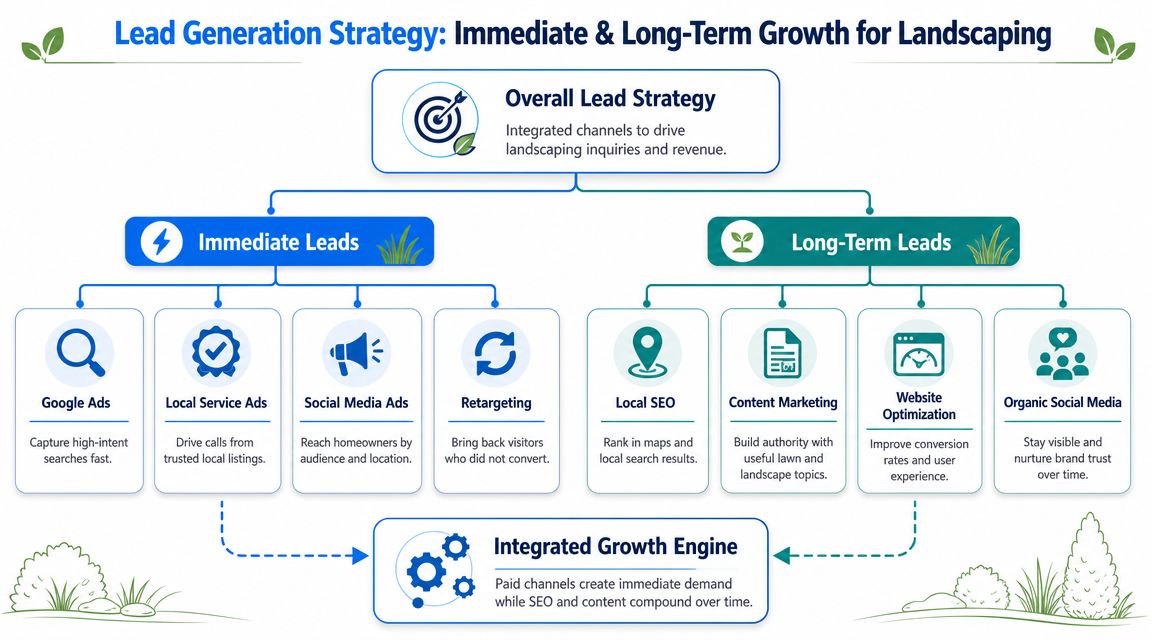
What SEO does and what paid ads do
A proven landscaping marketing methodology is a layered acquisition system: SEO for compounding long-term demand, Google Ads and LSAs for immediate seasonal needs, and social ads for awareness (layered acquisition system for landscapers).
That system works because each channel solves a different problem.
| Channel | Best use |
|---|---|
| SEO | Build long-term visibility for transactional local searches |
| Google Ads | Capture immediate demand for specific services |
| Local Service Ads | Drive direct inquiries from high-intent buyers |
| Social ads | Stay visible, retarget visitors, and support brand recall |
How to use them together without wasting budget
Run SEO like an asset. Build service pages, location pages, galleries, and map signals that strengthen over time.
Run paid search like a scalpel:
- Target service-specific searches: spring cleanup, sod installation, drainage correction, patio build
- Limit the geography: Don't pay for clicks in weak service zones
- Use negative keywords: Cut out DIY traffic, job seekers, and irrelevant searches
- Send traffic to matched landing pages: Never dump every click onto the homepage
Social ads have a different role. They usually won't replace search intent, but they can keep your brand in front of people who visited your site, watched your videos, or looked at a service page and left.
A simple rule helps. Use SEO to build authority. Use paid search to fill schedule gaps and push high-margin services. Use social to stay remembered.
Automating Growth with Technology and Referral Systems
Most landscaping companies don't have a lead problem. They have a follow-up problem.
A missed call, a forgotten estimate, or a delayed response costs work. Then owners say they need more leads when the actual issue is that the business isn't handling the leads it already gets with enough speed and consistency.
That's why referrals and follow-up need to become systems, not habits.
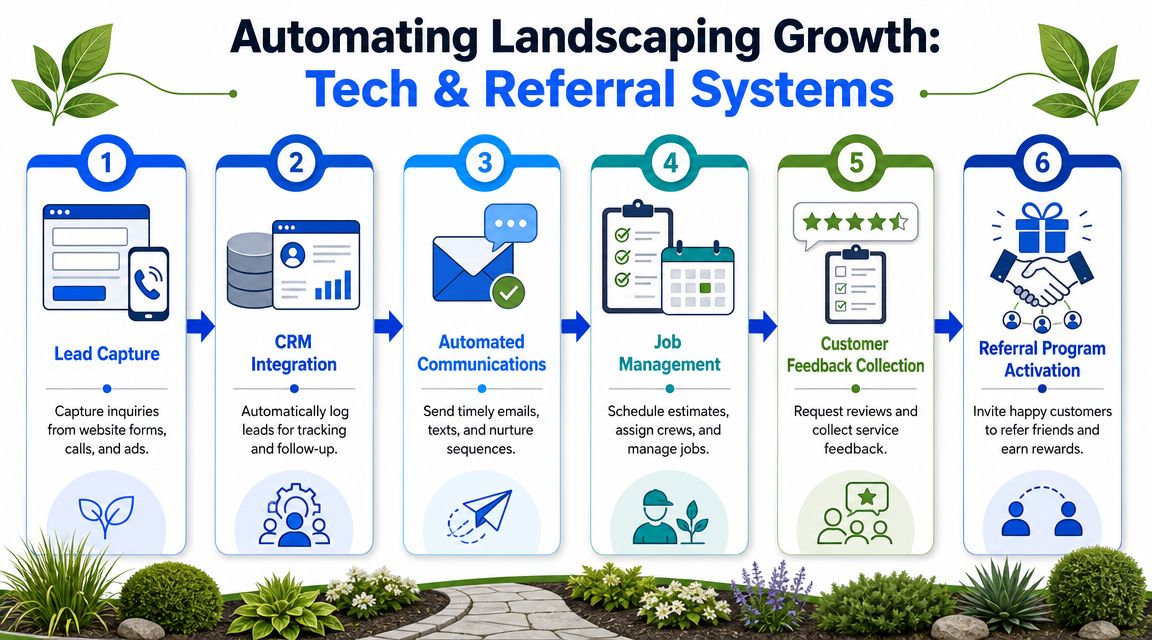
Your tech stack should remove delay
You do not need a bloated enterprise setup. You need a clean process.
At minimum, a landscaping company should use:
- A CRM: Track every call, form fill, estimate, and status
- A quoting system: Send estimates fast and keep them organized
- Automated follow-up: Email or text reminders for open quotes
- Review request automation: Ask at the right moment after service
- Referral tracking: Know which customers send work
This does two things. First, it stops leads from falling through the cracks. Second, it creates accountability. You can see which source produced the lead, whether the estimate was sent, and whether the job booked.
Good operators don't guess which marketing is working. They track the path from inquiry to estimate to job.
Referrals should be engineered, not left to chance
Outdoor contractors love to say, "Most of our business comes from word of mouth." That sounds good, but passive word of mouth is unreliable.
GorillaDesk notes that 92% of consumers trust recommendations from friends and family more than other advertising, which is why landscaping businesses should systematize referrals with structured follow-ups and incentives instead of waiting for word-of-mouth to happen on its own (structured referral marketing for landscapers).
That means your referral process should be built into operations.
A simple referral system looks like this:
- Finish the job well
- Send a thank-you message
- Ask for the review
- Invite the referral
- Track who referred whom
- Acknowledge and reward the referral when it closes
What a practical referral workflow looks like
Here's the difference between weak and strong execution:
| Passive approach | Systemized approach |
|---|---|
| Hope happy customers talk about you | Ask every satisfied customer directly |
| No timing | Request referral right after a positive outcome |
| No tracking | Log referral source in CRM |
| Inconsistent reward | Standard incentive or thank-you process |
| No follow-up | Automated reminder if they don't respond |
Email matters here too, but not as a newsletter vanity play. Use email to send seasonal reminders, maintenance prompts, service reactivation offers, and project follow-ups. The point isn't to "stay in touch." The point is to bring dormant demand back into the pipeline.
The best landscaping companies scale because their systems keep working when the owner is out in the field.
Your 2026 Marketing Action Plan and KPIs
Most business owners measure the wrong stuff. They look at traffic, impressions, or how many people liked a photo. None of that pays the crew.
For marketing for landscaping, the metrics that matter are the ones tied to booked work and profitable routes.
The KPIs worth checking every month
Track these:
- Map visibility for transactional searches: Are you showing up for the service terms that matter in the right service areas?
- Qualified leads by service type: Which services generate serious inquiries, not tire-kickers?
- Estimate-to-job close rate: How many quotes turn into revenue?
- Lead source quality: Which channel sends your best jobs?
- Response and follow-up speed: Are leads getting handled fast?
- Route quality by source: Do the jobs fit the neighborhoods you target?
If you need a more disciplined scorecard, this guide on how to measure marketing effectiveness is worth using as your reporting baseline.
A practical 30 to 60 day rollout
Don't try to do everything at once. Execute in sequence.
First 30 days
- Tighten your Google Business Profile: categories, services, service areas, photos, review workflow
- Identify core transactional keywords: one list by service, one by location
- Build or revise service pages: start with your highest-margin offerings
- Install call tracking and form tracking: every lead source should be visible
- Set up CRM stages: new lead, contacted, estimated, won, lost
Days 30 to 60
- Launch route-focused location pages: priority neighborhoods first
- Start Google Ads or LSAs: only for services you can fulfill well
- Add project galleries: organized by service, not random album dumps
- Automate estimate follow-up: stop losing work to delay
- Launch referral prompts: after satisfied jobs and review requests
The right KPI isn't "Did we get more traffic?" It's "Did we get more booked jobs from the searches that signal buying intent?"
What success should look like
A healthy system gets clearer over time. You should know which services pull the best leads, which neighborhoods produce the best routes, which pages create estimate requests, and which map terms need more work.
That's local dominance in practice. Not vanity visibility. Not broad awareness. Consistent presence where buyers are ready to spend.
Transactional LLC helps landscaping companies turn search intent into booked jobs through local SEO, Google Maps optimization, website improvements, paid ads, and AI-focused content systems built around transactional keywords. If you want a direct plan to rank for the searches that drive revenue, visit Transactional LLC.